
惯性聚合 高效追踪和阅读你感兴趣的博客、新闻、科技资讯
阅读原文 在惯性聚合中打开

推荐订阅源

Cisco Talos Blog
Cisco Talos Blog
V
V2EX
C
Check Point Blog
GbyAI
GbyAI
D
Docker
Cyber Security Advisories - MS-ISAC
B
Blog RSS Feed
H
Hackread – Cybersecurity News, Data Breaches, AI and More
N
Netflix TechBlog - Medium
T
Troy Hunt's Blog
博客园 - Franky
Threat Intelligence Blog | Flashpoint
Microsoft Security Blog
P
Privacy & Cybersecurity Law Blog
WordPress大学
WordPress大学
The Cloudflare Blog
S
SegmentFault 最新的问题
Latest news
Latest news
Microsoft Azure Blog
P
Proofpoint News Feed
I
InfoQ
博客园 - 【当耐特】
NISL@THU
NISL@THU
A
About on SuperTechFans
T
Tailwind CSS Blog
酷 壳 – CoolShell
酷 壳 – CoolShell
The Hacker News
The Hacker News
奇客Solidot–传递最新科技情报
奇客Solidot–传递最新科技情报
Scott Helme
Scott Helme
雷峰网
雷峰网
C
CXSECURITY Database RSS Feed - CXSecurity.com
Security Latest
Security Latest
V
Vulnerabilities – Threatpost
Security Archives - TechRepublic
A
Arctic Wolf
Hacker News: Ask HN
Hacker News: Ask HN
N
News and Events Feed by Topic
IT之家
IT之家
cs.CL updates on arXiv.org
aimingoo的专栏
aimingoo的专栏
T
Threat Research - Cisco Blogs
OSCHINA 社区最新新闻
OSCHINA 社区最新新闻
阮一峰的网络日志
阮一峰的网络日志
SecWiki News
SecWiki News
大猫的无限游戏
大猫的无限游戏
S
Security Affairs
The Register - Security
www.infosecurity-magazine.com
L
LINUX DO - 热门话题
T
Tor Project blog

VMware Blogs

Diagnostics for VMware Cloud Foundation (VCF) 9.1 with Old Versions of VCF Components Mastering Infrastructure Policies in VMware Cloud Foundation Automation 9.1 Modernizing the Private Cloud: Why VCF 9.1 Lifecycle Management is a Game Changer Announcing the VMware Cloud Foundation 9.1 Upgrade Planning Tool VCF Breakroom Chats Episode 86 – Containers Made Easy: The New “Container-as-a-Service” in VCF 9.1 Securing Your VCF 9.1 Infrastructure with the Symantec Identity Security Platform Virtually Speaking: The AI Reality Check with Dave Linthicum Zero Touch Provisioning: Activating Edge Sites with VMware Cloud Foundation Edge 9.1 VCF Breakroom Chats Episode 85 – Cloning Success at Scale: Inside VCF 9.1’s App Stack Formation VMware Cloud on AWS の使用状況を確認できる API Unlocking the Full Potential of Programmable Infrastructure with VMware Cloud Foundation 9.1 – New Features and Capabilities Smarter Patching at Scale: Vulnerability Assessment and Remediation with VMware Tanzu Platform Encrypted vMotion Offload to Intel QAT in VMware Cloud Foundation 9.1 Deepen Your Expertise: Four Key Benefits of Attending Increase Deployment Flexibility with VCF Edge Automation 1.0.3 Avi Advantage: Automating Certificate Management of VCF Workloads More Memory, Less Effort: Configuring Memory Tiering in VCF 9.1 VCF 9.1 Licensing: Programmatic, Centralized, and Built to Scale Why APJ Networking Professionals Need Private Cloud Expertise VCF 9.1 Networking: Exploring Network Services for Virtual Private Clouds VCF Networking 9.1: Seamless DDI Integration with Infoblox The Open Source Advantage: Building from Source for Ultimate Security Expand Shared VMDKs with Clustered Applications in VMware vSAN for VCF 9.1 Monetizing Zero-Trust Security with VCF 9.1 and VMware vDefend VMware vSAN Protection and Recovery Enhancements for VCF 9.1 Deliver Production SQL Server DBaaS with VMware Data Services Manager 9.1 Maximizing Profitability: VCF 9.1 Cost-Focused Approach for VMware Cloud Service Providers Modernizing Your Infrastructure: Introducing VMware Cloud Foundation 9.1 to VCSPs VCF 9.1 is Available: Explore the New Features in Hands-on Labs What’s New with vSphere in VMware Cloud Foundation 9.1? Resizing VMware vCenter in VMware Cloud Foundation 9 Non-Disruptive VMware vCenter Patching in VMware Cloud Foundation 9.1 VMware vCenter Virtual Hardware Gets an Upgrade in vSphere with VCF 9.1 AI Has Changed the Threat Landscape. Is Your Infrastructure Ready? Simplifying Storage with the New Effective Capacity View in VMware vSAN for VCF 9.1 Auto-RAID in VMware vSAN for VCF 9.1 – Comprehensive System-Managed Data Resilience Introducing VMmark 4.1: Enhanced Power Efficiency Benchmarking for Private Cloud Infrastructure Advanced Memory Tiering Enhancements in VMware Cloud Foundation 9.1 VCF 9.1 Is Here. See It in Action. 博通發布 VMware Cloud Foundation 9.1 How Broadcom Is Helping Enterprises Win the AI Security Sprint How to Prepare for the World of AI Driven Exploits Avi Innovations for VCF 9.1: Powering Kubernetes, Agentic AI and VPC Workloads VCF 9.1: The Secure, Cost-Effective Private Cloud Platform for Production AI Announcing VCF 9.1: Modern Private Cloud Built for Efficiency and Resilience Announcing VMware Cloud Foundation Edge 9.1: A Scalable, Autonomous Edge Platform Accelerate, Streamline, and Control Your Self-Service Private Cloud with VMware Cloud Foundation 9.1 Deploy Modern Apps Faster, Scale Smarter, and Lower Your TCO with VMware vSphere Kubernetes Service in VCF 9.1 Scale Smarter, Save More: Redefining Infrastructure Economics with VMware vSphere in VCF 9.1 AI with VCF 9.1 on AMD GPUs: Build with open frameworks and simplify management, at a lower TCO Streamline, Simplify and Protect all your AI workloads with VCF 9.1 Simplify Workload Connectivity and Enhance Network Scale and Performance with VCF 9.1 VMware and CrowdStrike Deliver New Integration for Cyber Recovery Workflows How Many Users Can Your LLM Server Really Handle? From Infrastructure to Agents: A Hands-On Guide to Secure Private AI with Broadcom – Part 2 The New Frontier: Leading the Cloud-Native Evolution Replicating VMware vSphere Configuration Profile Desired State Webinar Recap: Design and Architecture Considerations for VMware vSphere Kubernetes Service on VMware Cloud Foundation Kubernetes 1.36: What Actually Changed for Enterprise Platforms Enhance Lateral Security and Ingress Load Balancing for Kubernetes Workloads Avi Load Balancer Analytics: Root Cause Application Performance Issues in Minutes Analyst Insight Series #3: Policy-Driven Governance and Multi-Tenant Control Post-Quantum Readiness on VMware Cloud Foundation Registration Is Live for Las Vegas | $ave with Early-Bird May 21, 2026: What’s New in VMware Tanzu Data Intelligence 10.4 From Infrastructure to Agents: A Hands-On Guide to Secure Private AI with Broadcom – Part 1 Stop Guessing: Advanced Monitoring and Troubleshooting for Data Services CPU, Disk, Network, and Memory Workload Profiles for DVD Store Database Testing How VMware Salt Automates Compliance Across Private Cloud Analyst Insight Series #2: Operational Scalability and Lifecycle Management MCP vs. APIs: Why You Need Both for AI Applications The Real Constraint on Enterprise AI isn’t GPUs; It’s Power Deploying Harbor Service in Air-Gapped VMware Cloud Foundation 9.0 Why Enhanced DirectPath Wins for High-Performance Apps Bridging the (.Local) Gap: A Split-Domain Design for VMware Cloud Foundation Deployment Observability on VMware vSphere Kubernetes Service VMware Cloud on AWS: Introducing the Usage Report APIs Converging VMware vSphere to VMware Cloud Foundation 9.0: The Top 10 Questions Answered May 6, 2026: What’s New in Tanzu Platform 10.4: Powering Agentic Apps at Scale VMware Tanzu RabbitMQ Powers the Modern Data Lakehouse with New Spark Integration and Enterprise Tooling Tanzu Data Intelligence 10.4 Delivers AI-Driven Analytics, Unified Real-Time Operations, and Sovereign Resilience Enterprise-Ready Agents Made Simple & Safe with VMware Tanzu Platform Agent Foundations Introducing Tanzu Platform 10.4: Extending Platform as a Service to Agentic Applications How AI-Assisted Analytics in Tanzu Data Intelligence Can Help Remove the SQL Bottleneck From Prototype to Production: Securing Database MCP at Enterprise Scale The Compelling Case for a Private Cloud Data Intelligence Platform The Unification Dividend: Consolidating Database Operations on VMware Cloud Foundation The Modern Spring Workflow Is Enterprise-Ready and AI-Boosted [TAM Blog] セキュアブート証明書の有効期限切れに関する注意点と対応について Accelerate Lateral Security and Ingress Load Balancing for Kubernetes Workloads From Platform to Data: Building a Cloud-Native Developer Experience On-Prem with VMware Cloud Foundation How VMware Cloud Foundation (VCF) Training Helps Keep Top Tech Talent in APJ Build Your Case for Attending VMware Explore 2026 Spring 開発元が提供する商用サポート「VMware Tanzu® Spring Essentials」とは VMware Cloud on AWS より i7i.metal-24xl インスタンスの提供開始 VMware Advanced Memory Tiering Tips for Success VMware Cloud Foundation Edge 9.0: Two-Host Edge Site Deployment with Brownfield Import Your Database Is About to Become an AI Tool. Is It Ready? Applying GitOps Principles to Maintain Desired State Configuration using VMware vSphere Configuration Profile – Part 3 Webinar Recap: Converging VMware vSphere to VMware Cloud Foundation 9.0
VCF 9.1 Networking: Simpler VPC Connectivity Control
Dimitri Desmidt · 2026-05-16 · via VMware Blogs

VMware Cloud Foundation (VCF) provides a robust suite of self-service networking capabilities (as covered in our previous post: Network Services.

In this blog, we zoom in on a powerful new feature introduced in VCF 9.1: Connectivity Policy for Virtual Private Clouds (VPCs).

Note: This capability is available exclusively via the Advanced Cyber Compliance (ACC) Advanced Service add-on for VCF 9.1.
To learn more about what this add-on brings to your environment, check out our post Continuous Compliance, Integrated Cyber Recovery and Enhanced Platform Security for VCF 9.1.

Taking Control of Cross-VPC Communication

By default, applications in a VPC can communicate freely with other applications in other VPCs. Restricting this traffic used to mean relying on the vDefend Firewall Add-on.

Starting with VCF 9.1, you can natively manage cross-VPC communication using Connectivity Policy to your VPCs, and dictate their routing boundaries without any firewall.

The Three Connectivity Policies

VCF 9.1 introduces three distinct policy types to govern how your VPCs interact within a project:
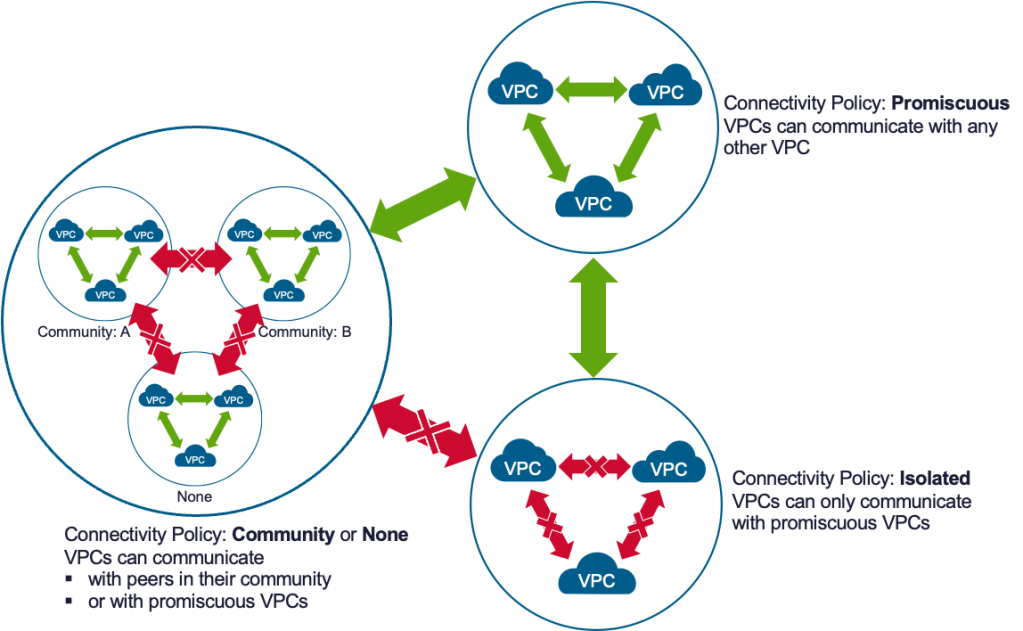
  • Community: Group specific VPCs together under a shared community policy. Applications within these VPCs can communicate seamlessly with others in the exact same community, but are strictly isolated from any VPCs outside of it.
  • Promiscuous: VPCs assigned this policy act as open VPC. A promiscuous VPC is allowed to communicate with any other VPC in the project.
  • Isolated: VPCs in this group are highly restricted. An isolated VPC cannot communicate with other community VPCs; it can only communicate with VPCs designated as Promiscuous.

These connectivity policies provide a remarkably simple way to architect project environments.

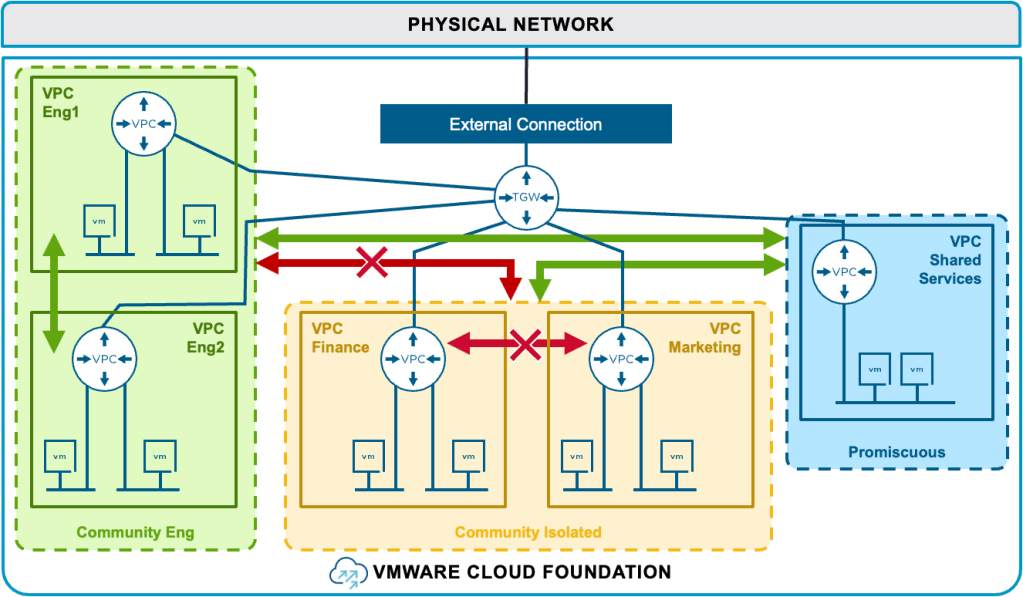
For example, imagine you need a Shared Services VPC (housing DNS, Active Directory, or logging tools) that every application in their VPC needs to access, while keeping those isolated from one another.

You can simply set your Shared Services VPC to Promiscuous and set all the other VPCs to Isolated. You achieve perfect architectural isolation through simple grouping — no firewalling required.
And if you have a few applications in VPCs that need to communicate between each other, place these in a specific Community.
Summary

VCF 9.1 drastically streamlines cloud architecture by managing cross-VPC communication natively at the network level.

By eliminating the need to use firewall-based isolation for basic traffic boundaries, it keeps your VMware vDefend environment lean and your security operations highly efficient.

Seeing is believing!

Check out the quick demo below to watch these connectivity policies in action.
We will walk you through assigning Community policies to real VPCs, demonstrating exactly how simple it is to lock down your project traffic natively without touching a single firewall rule.

Discover more from VMware Cloud Foundation (VCF) Blog

Subscribe to get the latest posts sent to your email.