


As data center fabric speeds surge from 100Gbps toward 400Gbps, a silent bottleneck threatens virtual infrastructure: the hypervisor networking stack. Traditional packet handling introduces a linear serialization tax, consuming excessive CPU cycles just to parse, classify, and apply security rules.
For modern enterprise clouds running on VMware Cloud Foundation (VCF), the Enhanced Data Path (EDP) Standard feature provides an out-of-the-box architecture that decouples packet velocity from CPU overhead. Let’s explore how this technology strips latency out of your data path and reclaims vital compute capacity for your business applications. For a deeper dive into the design and implementation of Enhanced Data Path (EDP) in VMware Cloud Foundation deployments, please refer to the Enhanced Data Path technical paper.
To appreciate the design of EDP Standard, it helps to examine the two primary modes operating within the ESX kernel subsystem.
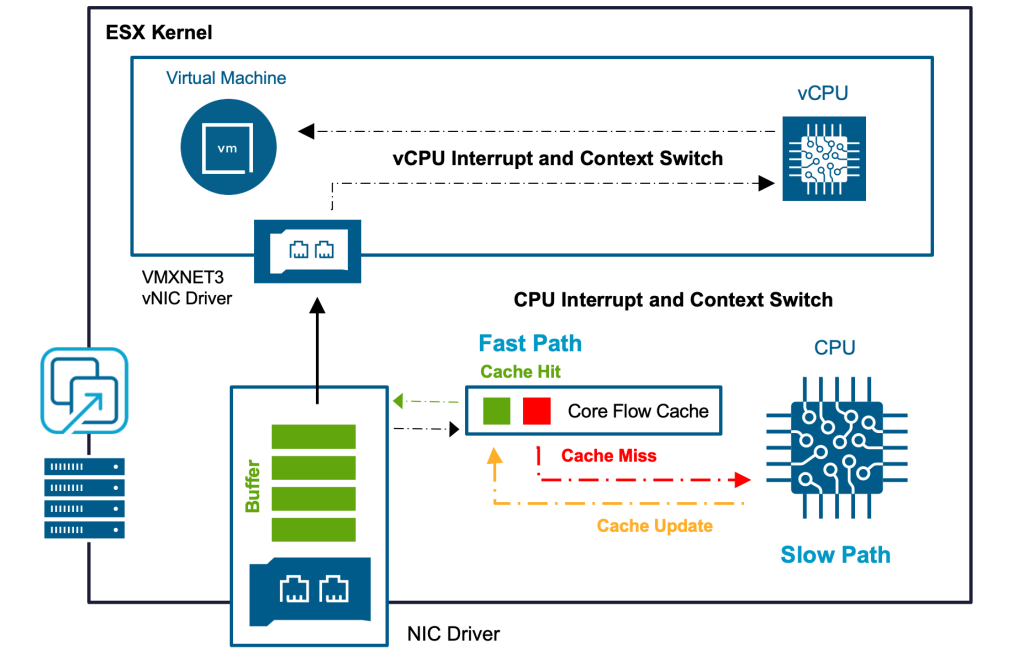
The legacy network stack relies on an interrupt-driven mechanism called the IOChain. Every packet traversing the switch goes through discrete modules for header parsing, policy checks (ACLs/Firewalls), routing lookups, and stateful processing. Under high packet rates, this serial pipeline establishes a performance ceiling and drives up host latency.
The EDP Standard mode introduces a state-of-the-box mechanism called Fast Path. Instead of re-evaluating every single packet in a stream, the system monitors the initial packet of a new flow via the traditional IOChain. Once resolved, the required handling rules are committed to a localized Flow Cache.
Subsequent packets matching that exact flow signature bypass the slow IOChain completely. They are processed using a rapid, single-lookup cache match—delivering complex routing and security policies at true line rate.
VCF has another mode called EDP Dedicated which operates on a poll-mode mechanism that locks down 100% of assigned CPU cores strictly for Telco/5G workloads. Because those cores are entirely unavailable for general enterprise computing when idle, EDP Standard is the recommended choice for dynamic, “bursty” enterprise applications.
EDP Standard doesn’t achieve its 2.5x efficiency boost over the standard stack via a single trick. It relies on three tightly integrated software-defined core technologies:
To keep the Flow Cache accurate and lightweight, entries use an automated eviction algorithm with a staggered expiration timer between 90 and 150 seconds. Staggering prevents mass cache evictions and forces long-lived streams to periodically revalidate behavior safely. Furthermore, rather than a single global table, EDP allocates an independent flow cache table (storing up to 128K entries) per active packet-processing thread.
EDP handles packets using dedicated hypervisor processing threads called EnsNetWorlds. The TLB acts as an intelligent traffic cop, evaluating thread utilization on a continuous 4-second polling cycle. If a thread hits 70% utilization or virtual machine topologies shift, a bin-packing algorithm redistributes queues smoothly across underutilized threads.
In legacy architectures, a data format called pktHandle occupies 256 bytes (four hardware cache lines) per packet. EDP Standard completely swaps this for the Mbuf Framework. Based on the high-performance DPDK library, Mbuf shrinks this structure to a lean 128 bytes. This 50% footprint reduction permits far more packet references to reside entirely within the CPU’s ultra-low-latency L3 hardware cache.
For EDP Standard to function optimally, your virtual software layers must synchronize with physical server silicon:
What does this mean for a live production deployment? Technical studies conducted using a high-stress UDP profile (2 million concurrent flows over dual 100G ports) illustrate the massive delta between a manually tuned heritage stack and out-of-the-box EDP Standard.
For 1518-byte frames, raw data throughput jumped from 34 Gbps using the standard stack to 64 Gbps under EDP Standard. More impressively, while the standard stack required up to 28 host cores to sustain maximum load, EDP Standard maintained a flat, optimized footprint of just 16 cores. This represents a 40% reduction in CPU consumption, giving you more processing headroom to run application VMs on your hypervisors.
Deep observability features like VMware vDefend Distributed Firewall (DFW) or VDS IPFIX logs are critical for compliance, but they traditionally levy a heavy performance tax. When deep monitoring is active on a heritage network path, throughput can crater by more than 50%. EDP Standard limits that drop to as low as 18.4%, helping ensure complete data plane security without choking application performance.
Getting started with EDP Standard varies depending on where you stand in your lifecycle journey:
Ultimately, embracing EDP Standard prepares your network backbone for the next generation of accelerated infrastructure, including advanced VCF 9.1 hardware features like Uniform Passthrough (UPT) and Enhanced DirectPath (EDPIO) for NVIDIA accelerated smartNICs. By standardizing on this optimized pipeline, you eliminate hypervisor data path ceilings entirely—from silicon to application.
Subscribe to get the latest posts sent to your email.
此内容由惯性聚合(RSS阅读器)自动聚合整理,仅供阅读参考。 原文来自 — 版权归原作者所有。