


Let’s be honest: the phrase "AI-powered analytics" has become so saturated it’s starting to lose its meaning. If you look at the marketing brochures, AI is a magic wand that solves every data silo and predictive hurdle with a single prompt. If you look at the day-to-day reality of a data engineer or analyst, AI is often just another source of "hallucinated" code or high-maintenance models.
We are currently navigating a massive utility gap. On one side, we have the proven reliability of traditional data analytics—the SQL queries, the ETL pipelines, and the BI dashboards that run our businesses. On the other side, we have the unprecedented potential of Generative AI and Agentic systems.
The real magic isn't in replacing the former with the latter. It’s in the integration. To move past the bubble, we have to stop treating AI as a replacement for data practitioners and start seeing it as the force multiplier for the entire data lifecycle.
It’s time to move from "What can AI do?" to "How does AI actually work within my data stack?"
Data analytics is the practice of processing raw data to uncover valuable insights that drive better decision making. By applying statistical algorithms and visualization techniques to large volumes of data, analytics enables organizations to:
Analytics comes in many flavors, each suited to different use cases and data characteristics as follows.
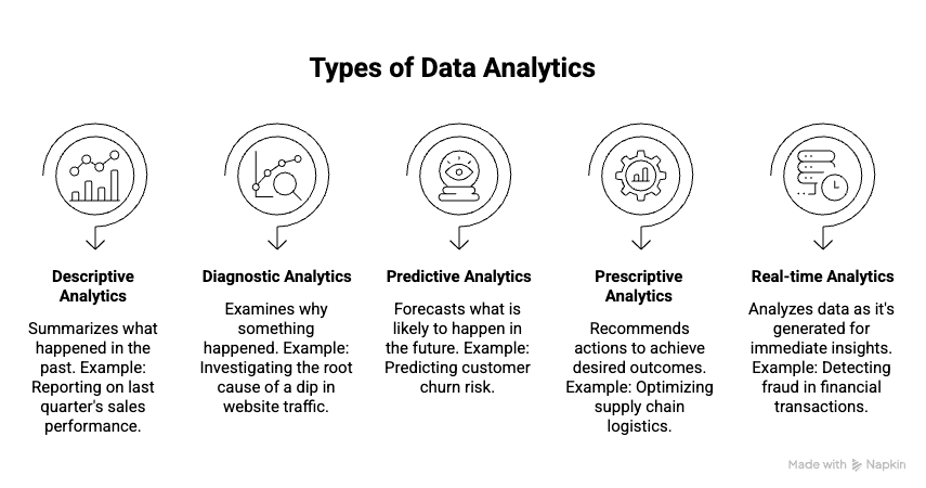
To understand how AI fits into data analytics, we need to categorize technologies by their functional role within an organization. Think of this as the Anatomy of Modern Analytics.
This is the classic AI we’ve known for a decade. It is deterministic and predictive.
Generative AI acts as the interface layer. It translates the complexity of data into the simplicity of language.
For the developer, Agentic AI is the shift from linear scripting to dynamic reasoning. While a traditional script follows an if-then-else path, an agent uses a Reasoning and Acting (ReAct) loop. It leverages tool-calling capabilities to interact with your data stack in real-time.
Agents utilize LLM-based orchestration frameworks (like LangGraph, CrewAI, or Semantic Kernel). They are provided with a toolbox—a set of Python functions or API connectors (e.g., a Snowflake connector, a Slack API, or a Jupyter Sandbox).
The Logic Loop happens when an agent is given a goal:
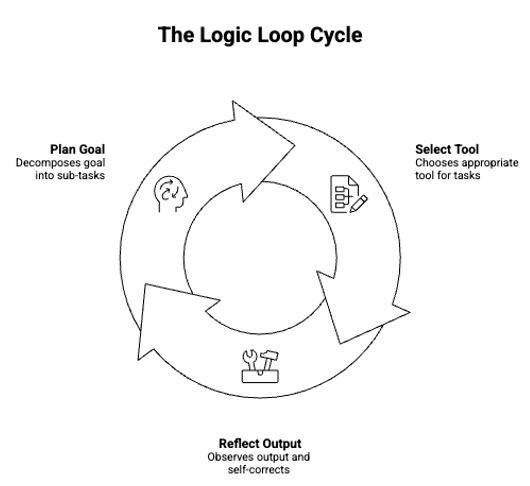
To connect an agent’s goal and its set of tools to a real-world use case, consider this: instead of writing a fixed pipeline to monitor data drift, a developer builds a Drift Agent. When a threshold is met, the agent autonomously triggers a bias-detection suite, summarizes the affected features, and opens a Jira ticket with suggested remediation.
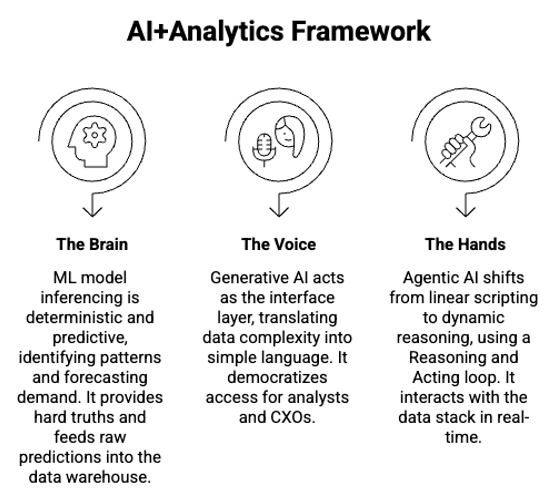
To see the real value of this framework, we have to look at how it transforms the actual workflow of data professionals. The shift isn't just about speed; it's about moving from manual execution to strategic oversight.
For a CXO, the conversation around AI in 2026 has shifted. It’s no longer about whether the technology works, but whether it delivers "Agentic Alpha"—the measurable edge gained by outperforming competitors through autonomous intelligence.
In this landscape, the value of AI in analytics is defined by three core pillars:
Traditional ROI—(Revenue - Cost) / Cost—is becoming too blunt an instrument for AI. Progressive organizations are now measuring the Intelligence Efficiency Ratio (IER). This tracks the volume of high-intent insights produced against the AI tax (compute costs, token consumption, and model licensing).
The suggested formula for the IER is:

The Impact: By using Agentic AI to automate the first pass of data discovery, firms are seeing a 15-45% reduction in the cost per insight. Not only does this save money; it reclaims thousands of human hours that can be redeployed to high-level strategy.
In a volatile market, the value of time is everything. If your competitors take three days to realize a supply chain disruption occurred and your Agentic AI identifies it and suggests a mitigation plan in three minutes, you’ve already won.
The Advantage: AI-integrated analytics collapses the distance between a data event and a business action. This moves the organization from reactive reporting to proactive maneuvering.
CXOs are often wary of black box AI.
Black box AI refers to models—often deep learning systems—whose internal reasoning is hard to interpret, even if they produce accurate outputs. Because it’s difficult to trace why a specific prediction was made, these systems can create trust, compliance, and risk-management challenges. Opening the black box usually means adding interpretability, audit trails, and human review so decisions can be explained and validated.
The modern framework solves the black box AI problem by pairing GenAI with deterministic ML.
The Guardrail: While an AI agent might suggest a financial forecast, the underlying calculation is performed by a rigid ML model with a transparent audit trail. This provides explainable AI—allowing you to meet regulatory compliance while still benefiting from the speed of automation.
While the potential is massive, it’s important to be grounded: AI is not a fix for bad data. The biggest bottleneck to AI ROI isn't the models themselves—it's data debt. If your underlying data foundation is fragmented or full of noise, an AI Agent won't just find insights; it will find (and act upon) hallucinations at a scale you can't manually correct.
The most successful organizations aren't those with the biggest AI budgets, but those who treat their data quality as a first-class citizen. AI is the engine, but your data is the fuel. Make sure it's high-octane before you step on the gas.
To implement this framework, you need a data foundation designed for the agentic era. EDB Postgres AI (EDB PG AI) doesn't just add AI capabilities on top of your database—it unifies your entire data estate into a single, intelligent core built for all three layers of the anatomy: the Brain, the Voice, and the Hands.
The future of data isn't a choice between the stability of Postgres and the frontier of AI. It is the seamless marriage of the two.
By leveraging EDB PG AI, you aren't just building a faster database; you’re building an intelligent data core. You gain the precision of traditional analytics, the intuitive interface of Generative AI, and the autonomous action of agentic systems—all built on the world’s most trusted database.
With EDB, you don't just analyze the past; you orchestrate the future.
此内容由惯性聚合(RSS阅读器)自动聚合整理,仅供阅读参考。 原文来自 — 版权归原作者所有。