
惯性聚合 高效追踪和阅读你感兴趣的博客、新闻、科技资讯
阅读原文 在惯性聚合中打开

推荐订阅源

Engineering at Meta
Engineering at Meta
人人都是产品经理
人人都是产品经理
大猫的无限游戏
大猫的无限游戏
博客园 - 三生石上(FineUI控件)
量子位
腾讯CDC
The Cloudflare Blog
酷 壳 – CoolShell
酷 壳 – CoolShell
云风的 BLOG
云风的 BLOG
Vercel News
Vercel News
钛媒体:引领未来商业与生活新知
钛媒体:引领未来商业与生活新知
L
LangChain Blog
aimingoo的专栏
aimingoo的专栏
The Hacker News
The Hacker News
T
The Exploit Database - CXSecurity.com
B
Blog
S
SegmentFault 最新的问题
P
Privacy & Cybersecurity Law Blog
T
Threatpost
博客园 - 聂微东
T
Tailwind CSS Blog
The Last Watchdog
The Last Watchdog
C
Check Point Blog
N
Netflix TechBlog - Medium
D
DataBreaches.Net
爱范儿
爱范儿
IT之家
IT之家
S
Secure Thoughts
M
MIT News - Artificial intelligence
NISL@THU
NISL@THU
C
Cisco Blogs
TaoSecurity Blog
TaoSecurity Blog
有赞技术团队
有赞技术团队
A
Arctic Wolf
OSCHINA 社区最新新闻
OSCHINA 社区最新新闻
P
Proofpoint News Feed
Spread Privacy
Spread Privacy
Schneier on Security
Simon Willison's Weblog
G
GRAHAM CLULEY
雷峰网
雷峰网
Project Zero
Project Zero
博客园 - Franky
H
Heimdal Security Blog
A
About on SuperTechFans
Security Latest
Security Latest
Webroot Blog
Webroot Blog
Exploit-DB.com RSS Feed
Hugging Face - Blog
Hugging Face - Blog
H
Hackread – Cybersecurity News, Data Breaches, AI and More

EDB

Enterprise Automation Resilience: Red Hat AAP on EDB Postgres AI EDB heads to PGConf.Brasil 2026, this is what we’ll be talking about! Powering Invisible Commerce at World Cup Speed By the Time Your Data Warehouse Answers, the Opportunity Is Gone Building a Sovereign, Intelligent Data Foundation with EDB Postgres® AI on IBM LinuxONE 5 Deep Dive Into EDB Postgres AI's Agentic Database Capabilities Jumping the gun: looking ahead at PostgreSQL 19 Meeting in Montreal: Developer U plan(ner) patches KubeCon + CloudNativeCon NA EDB Summer Academy Your Database Goes Down. What Does That Cost Your Business? The Oracle Renewal Is Coming. This Time, There’s a Way Out. One Dashboard to Rule Them All — and Finally Get Your Fridays Back Your Database Should Be Working While You Sleep Inside the Agentic Database: How EDB Turned Postgres Into a Self-Managing System The Architecture IS the Security: Building Sovereign AI Ops on Postgres with EDB Agent Factory EDB Named a Leader in Multimodel Data Platforms Evaluation PGDay Hyderabad The Role of AI in Data Analytics: Moving From Hype to High-Octane Utility Iga Januszek Mike Olifirowicz Meeting EU Data Sovereignty Requirements While Speeding-Up Innovation Inside EDB’s New Principles for Responsible AI: Sovereign, Governed, Trusted and Beneficial Built From the Data Up: A Trusted Foundation for the Agentic Era | EDB Postgres® AI Q2-2026 Release EDB Launches Agentic Database, Converged Analytics, and Governance, Bringing Sovereign AI Where Enterprise Data Already Lives Stop Spending Hours on What Should Take Minutes: A DBA's Guide to EDB Postgres AI’s Agentic Database Capabilities Making Agentic AI Smarter at the Architecture Level Charly Batista Buildfarm Query API Jaime Arze EDB PGD 6.4 Brings Distributed Consistency to Mission-Critical Postgres Data Layer Precedes Compute, GPU Capacity in Sovereign AI The pipeline tax is breaking enterprise AI at agent scale Sovereignty boosts enterprise AI returns, study finds As the Agentic Era Reshapes the Data Layer, Enterprises Build Their Sovereign Foundation on EDB Postgres® AI The Industrial Bank of Korea Bets Its Core Financial Infrastructure on EDB Postgres® AI Governing Agentic AI at Enterprise Speed Beyond the Latency Gap: Building Sovereign, Real-Time Agentic Applications on a Unified Postgres Estate Just Clear a Day: What We Learned Running an AI Security Hackathon How Shinhan EZ Insurance Built a Cloud-Native Core Banking System on EDB Postgres® AI PGConf.dev 2026: Our team’s sessions, working groups, and key takeaways EDB Releases PGD 6.4 with Quorum Commit, Bringing True Distributed Consistency to Mission-Critical Postgres PostgreSQL Conference Europe (PGConf EU) Cloud Native Denmark Data Stack Conf Community over Code Postgres Summit US PGDay Lowlands PGDay UK PGConf.Brasil Kubernetes Community Days (KCD) Melbourne Swiss PGDay Switchover and Switchback of CloudNativePG Replica Clusters in a Distributed Topology (K8s) - Part 2 Preparing Enterprises for the Agentic Workforce CWO Society Dinner for FSI From VMs to Kubernetes: A DBA's Journey in a Large Global Bank AI Data Pipeline Automation with AIDB Navigating Disruption: Architecting Your Sovereign Data Estate for Resiliency Sovereignty Is the New Operating System for Agentic AI, New MIT Technology Review Insights Report Finds Beyond the DBaaS Trap: Achieving Data Sovereignty with Kubernetes and CloudNativePG Red Hat Ansible Automates: Washington DC OpenShift Showcase: Toronto 소버린 AI 전문가와 함께하는 EDB 웨비나 コンテナ化の運用の壁をどう超えるか 〜デプロイ・保守を自動化し、リソース負担を最小化する次世代DB運用戦略〜 コンテナ化の運用の壁をどう超えるか? 〜デプロイ・保守を自動化し、リソース負担を最小化する次世代DB運用戦略〜 A Day in the Life: Inside a Director of Sales Development Role at EDB Taller: Creación de una plataforma de análisis soberana a gran escala con EDB Postgres AI Workshop: Building a Sovereign Analytics Platform at Scale with EDB Postgres AI Building Real-Time, Data-Aware Intelligence with Postgres and the Model Context Protocol Yogesh Jain POSETTE How Euronext FX Built the Data Foundation for a New Era of Electronic Trading EDB Postgres® AI: The Sovereign Data and AI Platform for the Agentic Enterprise HOW2026 Data, Trust, and the New Rules of AI EDB at Red Hat Summit 2026: Building AI on Ground You Own A Day in the Life at EDB: Inside a Director of Customer Success Role at EDB PostgreSQL vs MySQL: Migration Without the Migraine DIVA (Dive into AI) 2026 Club des Utilisateurs Français d’EDB Postgres (CUFEP) 2026 EDB Delivers “Intelligence per Watt” Paradigm to Slash Token Consumption and Cut Data Center Emissions by up to 87% EDB Postgres AI on OpenShift cluster using CSI driver for Dell PowerFlex takashi eridai EDB Japan EDB Spearheads the Year of the Agentic Workforce with Industry Recognition, Ecosystem Momentum, and Continued Postgres® Leadership A Strategic Roadmap for Oracle to Postgres Migration at Ooredoo Deployment of PostgreSQL Replica Cluster via Barman Cloud Plugin on CloudNativePG - Part 1 Making AI Work for Your Business PGDay Armenia Ava Chawla Why the World’s Most Stable OS Demands a High-Performance Data Foundation MySQL to PostgreSQL Migration Chris Chiappone EDB Postgres® AI Delivers Superior Predictability vs. Cloud Data Warehouses in High-Concurrency Benchmark, Unveils Q1 Platform Updates to Power the Agentic AI Era The Next Generation of EDB Postgres AI Factory: Built for the Agent Era Why Your Analytical Database Needs Multiple Clusters to Do What WarehousePG Does With One Driving the Next Digital Experience
The Agentic Confusion: Why I Keep My Postgres Control Plane Deterministic
Chris Chiappone · 2026-03-31 · via EDB

We are living in the "agent era." It feels like every week, a new framework promises to wrap our infrastructure in a layer of autonomous intelligence. The pitch is seductive: stop writing scripts, start setting goals. Let the AI figure out the "how."

But recently, while designing automation for an EDB Postgres AI environment managed via Hybrid Manager, I hit a wall. I was sketching out an "Agentic DB" architecture one that could autonomously scale clusters based on load and I realized something felt off.

The more I looked at the actual requirements, the more the "agent" pattern felt like a solution looking for a problem. In fact, for core database operations, it felt like a step backward.

This is the story of why I pulled back, and why the most robust architecture for Postgres isn't "agents everywhere", it’s policy-first, agent-assisted.
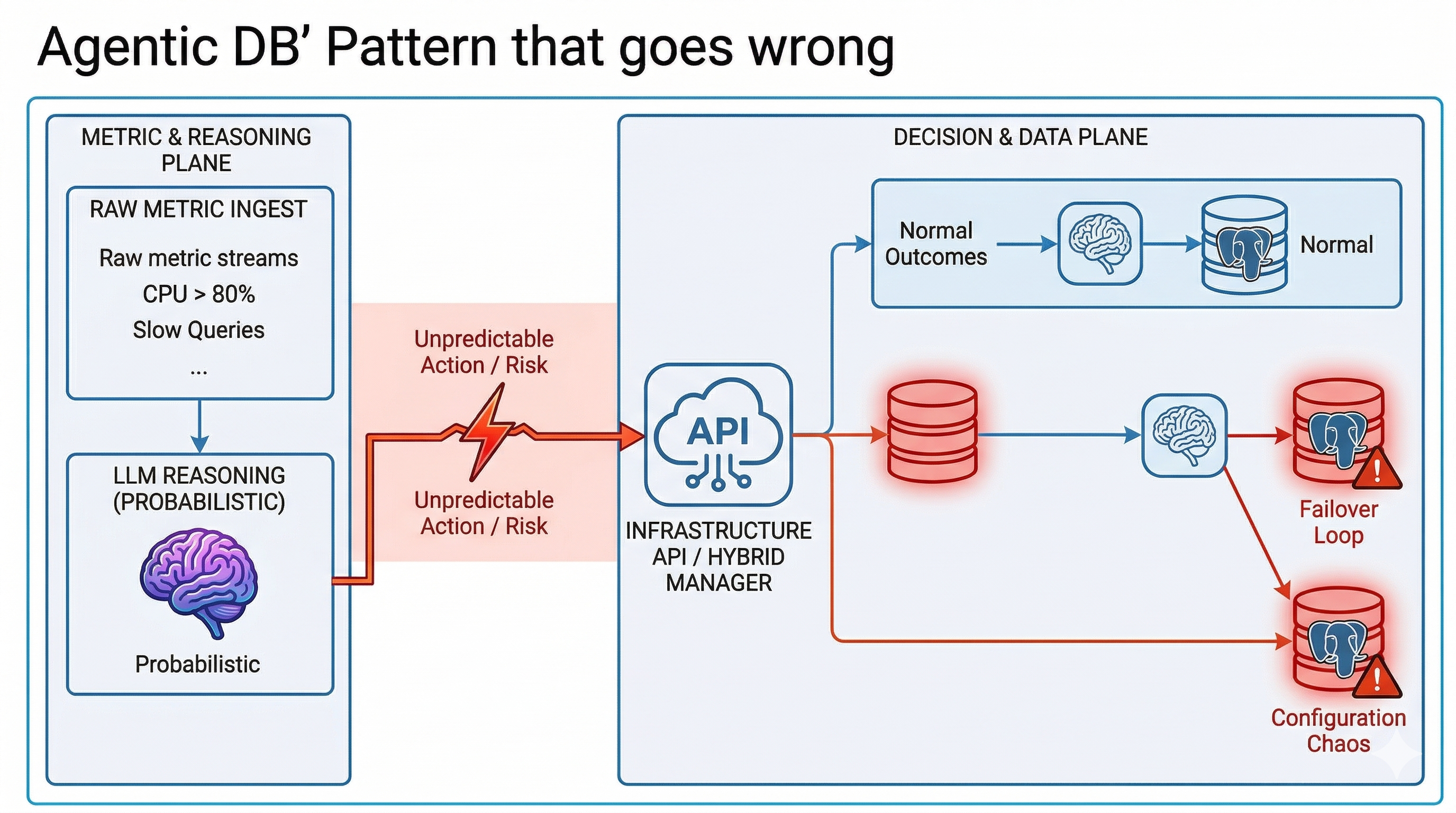
img 1

Image 1: The 'Agentic Delusion.' A naive architecture where a probabilistic LLM agent directly drives infrastructure APIs, leading to unpredictable scaling events and configuration chaos in the Postgres environment.


The Temptation of the Agent

The initial architecture I was playing with looked cutting-edge. I wanted a system that would:

  • Pull CPU and memory metrics.
  • "Evaluate" utilization.
  • Call the Hybrid Manager API.
  • Scale the cluster.

On paper, this is a perfect use case for an LLM. You give the agent access to your metrics and your API, write a prompt telling it to "keep the cluster performant," and let it reason its way to a solution.

But then I looked at the logic the agent was supposed to "reason" out.

IF cpu_avg > 80% for 10 minutes
AND cooldown_expired
AND not currently scaling
THEN increase instance tier by 1

This isn't ambiguous reasoning. It’s a deterministic policy.

There is no nuance here. There is no need for tool selection, multi-step planning, or probabilistic interpretation. By delegating this to an agent, I wasn't making the system smarter; I was making it probabilistic. I was taking a closed-form control problem—a simple if/then statement—and injecting the chaos of an LLM.

The Cost of Non-Determinism in Production

Once I saw the scaling logic for what it was, the risks of the "Agentic" approach became impossible to ignore.

In a production Postgres environment, we crave determinism. If I scale a cluster, I need to know exactly why it happened, when it happened, and what the preconditions were.

An agent introduces variability. Different model versions might interpret the "80%" threshold differently based on the phrasing of a prompt. A slight update to the system prompt might change the agent's tolerance for risk. If an agent decides to scale, and something goes wrong, the post-mortem becomes a nightmare. Instead of debugging code, you're debugging a thought process.

I realized that for infrastructure control paths (scaling, failover, configuration changes) the "intelligence" part of the loop isn't just unnecessary; it's a liability.

Blast Radius and the Audit Trail

Then there’s the question of authority.

If you give an agent access to patch_cluster, failover endpoints, or direct SQL execution, you are effectively handing the keys to your production kingdom over to a system that doesn't truly understand the concept of a "blast radius."

You can try to constrain it. You can write prompts like "Only scale one tier at a time" or "Never retry failed tool calls." But these are suggestions, not guarantees.

Compare that to a deterministic controller loop. In code, I can enforce hard bounds:

  • Explicit cluster scoping.
  • Hard tier limits.
  • Enforced cooldown windows.
  • One-action-per-cycle guarantees.

These guarantees are enforced by the compiler, not a prompt.

And for compliance? Enterprise Postgres environments demand auditability. A deterministic scaler produces a clean, structured log:

cpu_avg=84.3; threshold=80; action=patch_cluster; target=large

An agent-driven system adds layers of complexity: prompt versions, model versions, context memory state, and tool reasoning traces. When the auditors ask "Why did this change?" handing them a 500-line trace of an LLM thinking about scaling is not going to satisfy them.

The Pivot: Where Agents Actually Belong

Does this mean agents are useless for Postgres? Absolutely not. The error wasn't in using agents; it was in applying them to the execution layer.
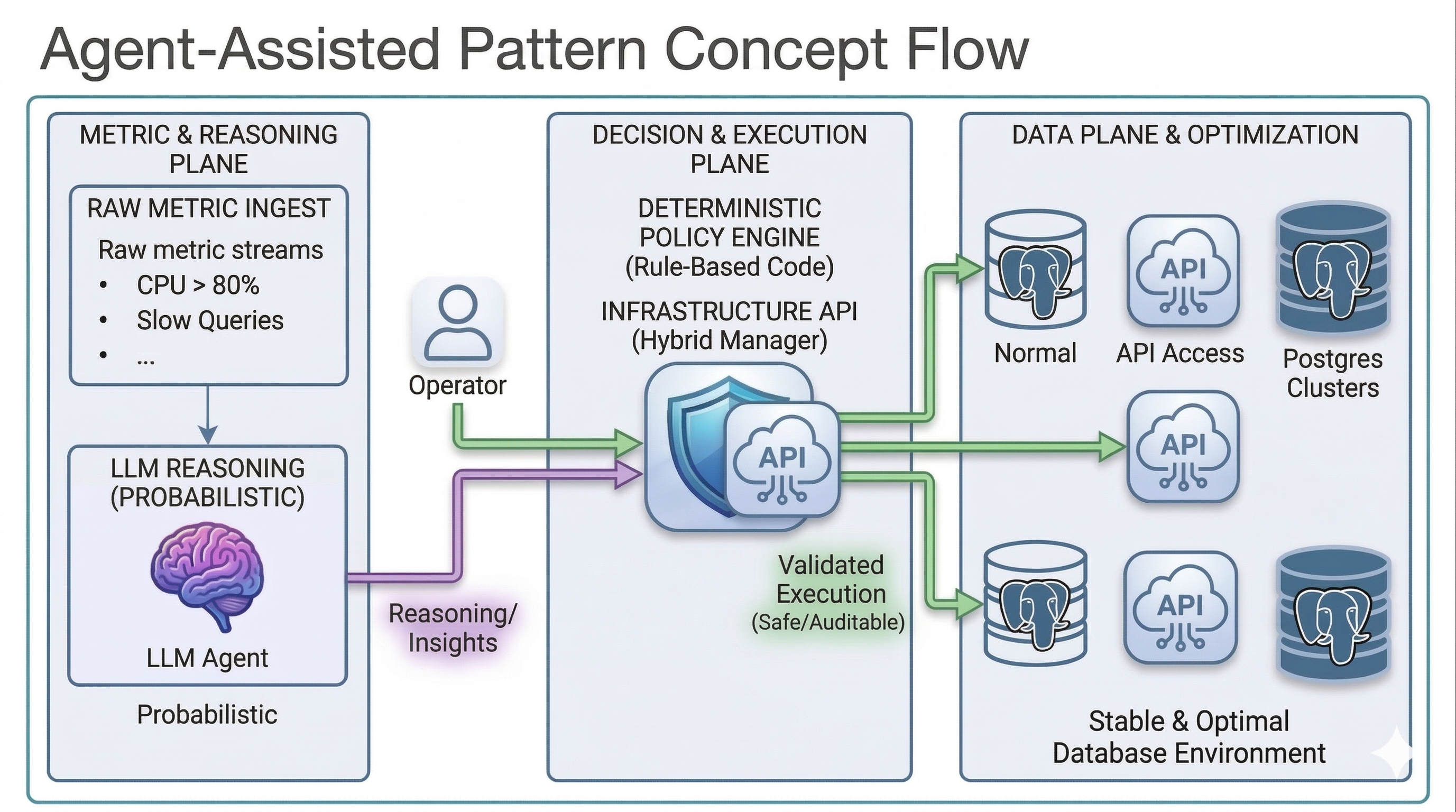
img 2

Image 2: Reasoning Over Control. The correct architecture utilizes the probabilistic LLM Agent (purple) only for analysis and insights, feeding them into a strong, Deterministic Policy Engine (blue shield) that validates all actions against hard rules before executing them via the stable Hybrid Manager API.


I realized I needed to flip the architecture. Agents are terrible at control, but they are phenomenal at reasoning.

I stopped trying to let the agent scale the database, and started letting it watch the database.

1. Incident Triage

When a CPU spike hits, a static script can fire an alert. But an agent? An agent can pull slow query logs, check lock tables, analyze replication lag, and cross-reference recent schema changes. It can produce a ranked list of hypotheses: "The spike correlates with a new index creation on the users table." That is high-value reasoning.

2. Query Optimization

Interpreting EXPLAIN ANALYZE is an art. Agents excel here as copilots, suggesting index strategies or rewriting inefficient SQL. This is advisory, safe, and leverages the model's semantic understanding.

3. Cross-System Orchestration

If a PagerDuty ticket fires, an agent can pull metrics from Hybrid Manager, fetch the relevant runbook from a vector store, draft a remediation plan, and post it to Slack. It connects the dots between disparate systems. It just shouldn't be the one to press the "Execute" button.
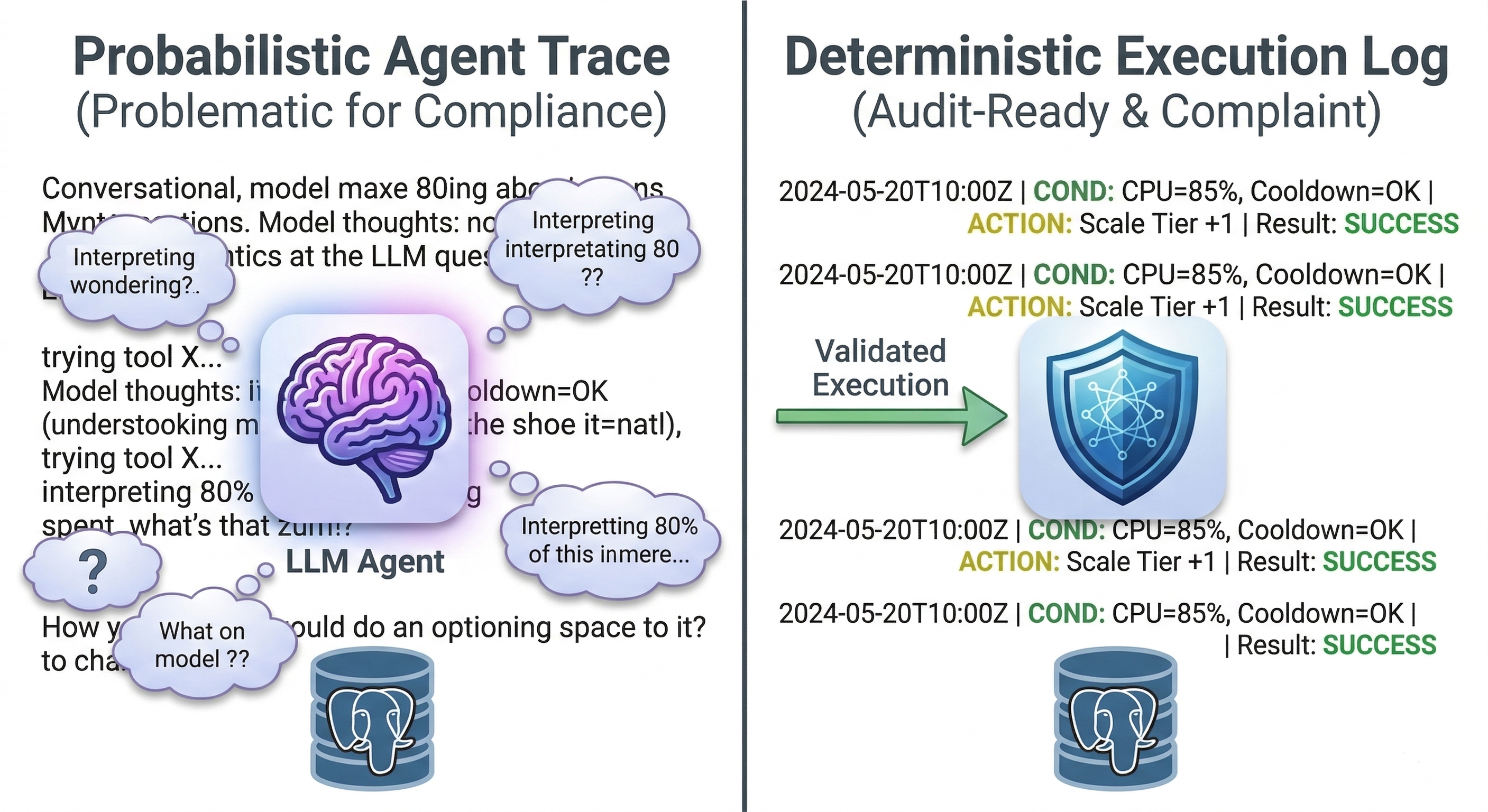
img 3

Image 3: Audit Trail Comparison. The left side (probabilistic) generates chaotic, unstructured reasoning traces that defy auditing. The right side (deterministic, as used in Image 2) produces clean, structured, sequential logs suitable for compliance.


The Mature Architecture: Reasoning Over Control

This brings me to the architecture I eventually settled on. It’s not "Agentic DB." It’s a hybrid model that keeps the reins tight.

[Agent Layer] → [Deterministic Policy Engine] → [Hybrid Manager API]
   analyze            decide + validate             execute

The Agent Layer sits at the top. It looks at the data, summarizes health, explains anomalies, and recommends actions. It says, "Hey, CPU is high, you might want to scale."

The Deterministic Policy Engine sits in the middle. It takes that recommendation (or metric thresholds) and applies the hard logic. It checks the cooldowns, validates the preconditions, and ensures the blast radius is contained. It makes the final decision.

The Execution Layer does the work. It makes the bounded API calls to Hybrid Manager and logs the result.

This model gives me the best of both worlds. I get the intelligence and insight of an LLM without surrendering control to a probabilistic system.

The Pragmatic Takeaway

The industry is rushing to wrap everything in agents, but for those of us operating Postgres in production, we have to be more discerning.

If the task is a control problem, ie.  it modifies infrastructure, use a script. Use a state machine. Use determinism.

If the task is a reasoning problem, ie.  it requires analysis, synthesis, or communication then use an agent.

The goal isn’t to avoid agents. It’s to deploy them where their strengths matter: in the passenger seat, navigating, while the deterministic engine keeps the car on the road.