


惯性聚合 高效追踪和阅读你感兴趣的博客、新闻、科技资讯
阅读原文 在惯性聚合中打开

推荐订阅源

酷 壳 – CoolShell
酷 壳 – CoolShell
H
Hacker News: Front Page
P
Palo Alto Networks Blog
T
ThreatConnect
Apple Machine Learning Research
博客园_首页
T
True Tiger Recordings
P
Privacy & Cybersecurity Law Blog
B
Blog
IT之家
IT之家
Last Week in AI
Last Week in AI
F
Full Disclosure
Hacker News: Ask HN
Hacker News: Ask HN
C
Comments on: Blog
Microsoft Azure Blog
C
Cybersecurity and Infrastructure Security Agency CISA
Microsoft Security Blog
博客园 - 【当耐特】
N
News and Events Feed by Topic
NISL@THU
NISL@THU
腾讯CDC
雷峰网
雷峰网
Security Latest
Security Latest
李成银的技术随笔
M
Microsoft Research Blog - Microsoft Research
L
LangChain Blog
L
Lohrmann on Cybersecurity
cs.CL updates on arXiv.org
C
Check Point Blog
Y
Y Combinator Blog
Recent Announcements
博客园 - Franky
N
News | PayPal Newsroom
V
V2EX
A
About on SuperTechFans
The Register - Security
月光博客
月光博客
奇客Solidot–传递最新科技情报
奇客Solidot–传递最新科技情报
Google Online Security Blog
MyScale Blog
MyScale Blog
Cisco Talos Blog
Cisco Talos Blog
Vercel News
Vercel News
WordPress大学
WordPress大学
C
Cyber Attacks, Cyber Crime and Cyber Security
The Hacker News
The Hacker News
IntelliJ IDEA : IntelliJ IDEA – the Leading IDE for Professional Development in Java and Kotlin | The JetBrains Blog
爱范儿
爱范儿
A
Arctic Wolf
L
LINUX DO - 最新话题
freeCodeCamp Programming Tutorials: Python, JavaScript, Git & More

NETSCOUT

The 1 A.M. Cloud Migration Meltdown Communication Service Provider Supports Banking Application Success Across International Borders Defending Against DDoS Attacks at Scale AI-Driven Workflow Automation Is the New North Star for Communication Service Providers Key Takeaways from the EMA Network Management Megatrends 2026 The Digital Foundation of Public Trust Is More Than Skin Deep Unlocking the Full Value of 5G with Network Slicing NETSCOUT to Have a Strong Presence at Cisco Live Why Airlines and Airports Must Embrace Observability Ahead of the Summer Travel Surge Beyond “Best Effort”: Why Carrier Grade 5G Slicing Matters More Than Ever The Shrinking Lifespan of SSL/TLS Certificates From Packets to Insight: How Curated Network Data Powers AI Data Centers Are Feeling the Heat, and That’s OK If You Can’t See the Slice, You Can’t Sell the SLA Insights from the GigaOm Radar for Network Observability v6 Report How Shadow AI Creates Zombie Infrastructure NETSCOUT Earns Eight Leader Badges in the G2 Spring 2026 Grid Reports Your Modern Manufacturing Network Deserves a Modern Observability Strategy How Botnet-Driven DDoS Attacks Evolved in 2H 2025 The Hidden Cost of Poor Network Observability Insurance Systems Look Simple, but the Infrastructure Isn’t How AI is Transforming the RAN With the Right Data When Cloud SaaS DDoS Mitigation Offerings Aren’t Enough Frictionless Banking Experiences Start with Observability Colocation Growth Demands Scalable End-to-End Observability Bringing Shadow AI Into the Light AIOps Outcomes Depend on Data Quality, Not Algorithms Why AI, Zero Trust, and Modern Security Require Deep Visibility How Service Behavior Changes in Remote Locations The 10-Hour Problem: How Visibility Gaps Are Burning Out the SOC From Insight to Impact: Observability Fuels AI-Driven Innovation How Orphaned Applications Are Quietly Fueling Your Shadow IT Problem Why Today’s Security Tools Can’t See the Network Anymore How NETSCOUT Addresses Modern Network Observability Challenges Helping IT Organizations Prevent Disruptions Before They Impact Business How Hidden Blind Spots Quietly Became Cybersecurity’s Biggest Vulnerability The Blame Game! Is it the Network or Gaps in Observability? Six Winter 2026 G2 Leader Badges Prove This DDoS Protection Stands Out The Value of Combining Modern Observability Solutions for Actionable Insights AI Failure Is the Norm Because Most Initiatives Are Flying Blind NETSCOUT Distinguished by Frost & Sullivan with the 2025 Company of the Year Recognition 5 Emerging AI Data Trends Enterprise IT Teams Cannot Ignore What is Network Slicing NETSCOUT’s Omnis Cyber Intelligence Earns Security Today’s 2025 CyberSecured Award Turning a Flood of 5G Data into Rocket Fuel for AIOps NETSCOUT Recognized by Comparably as a Top Workplace for Q4 2025 How to deliver consistent ultra-low latency, high-throughput, and total reliability across complex networks Smart Data: The Super Fuel Driving Next-Gen Observability NETSCOUT Recognized for Leadership in Network Detection and Response Integrating Deep Packet Inspection in 5G Networks Removing Barriers to Digital Transformation Gain Real-time Visibility to Future Proof Your Network for Autonomous Operations Why Is Cloud Performance Still Foggy? How DPI Is Transforming Observability and Operational Resilience 10 Key Challenges to Optimizing Radio Access Networks in the 5G Era Why Arbor Edge Defense and CDN-Based DDoS Protection Are Better Together NETSCOUT’s Holiday Playlist for IT Teams and Leaders More Data Does Not Always Equate to Better Business Visibility Seeing Clearly with Deep Packet Inspection at Scale How to Ensure High Availability for FWA Services System Integrators and the Future of Enterprise IT The Transformative Power of ‘Thinking’ AI and the Implications for Business How Fast Can Your Organization Identify and Resolve IT Outages? Observability for the “Always On” Power Industry
Smarter DDoS Security at Scale
2025-11-24 · via NETSCOUT

Stopping encrypted attacks with NETSCOUT Arbor Edge Defense

Person in hoodie looking at hex data.

In today’s digital landscape, encrypted traffic is the norm—not the exception. While encryption such as Transport Layer Security (TLS) 1.3 protects user privacy and data integrity, it also presents a growing challenge for security teams: How do you defend against threats hidden inside encrypted traffic without overwhelming your systems?

The Challenge of Encrypted DDoS Attacks

Threat actors are always looking for ways to circumvent modern defenses, and one of the most popular distributed denial-of-service (DDoS) attack methods is to hide the attacks in what looks like ordinary traffic. Enormous amounts of internet traffic now rely on Hypertext Transfer Protocol Secure (HTTPS). Since decrypting TLS 1.3 traffic typically requires proxy-based solutions—which are resource-intensive—many security products struggle to inspect encrypted sessions effectively. This blind spot makes encrypted DDoS attacks harder to detect and mitigate.

Block First, Ask Questions Later

One way to minimize the impact of encrypted attack traffic is to simply drop it before decrypting. There are several methods we employ to filter out the garbage quickly and efficiently:

  • Known source blocking: Many attackers are now using open internet proxies to hide the source of their HTTPS attacks. We constantly track these sources, and our ATLAS Intelligence Feed (AIF)-powered countermeasure can block them automatically.
  • TLS attack prevention: This countermeasure looks at the TLS handshake (pre-encryption) and can block TLS sessions that don’t follow standard user behaviors​.
  • TCP connection limiting: This countermeasure looks at TCP connection behavior from each source. Sources opening too many connections or engaging in abusive behaviors over TCP can be blocked.
  • Rate-based protections: Usually attackers will be sending more traffic than legitimate users, and these protections can distinguish and block those sources automatically​.
  • Selective decryption: This is used to decrypt and deal with more-advanced attacks, when encrypted traffic behavior mimics legitimate users.

Why Full Decryption Isn’t Always the Answer

Decrypting all traffic isn’t practical. It’s computationally expensive and can quickly exhaust system resources. What’s needed is a smarter approach—one that focuses decryption efforts only where it’s truly necessary.

NETSCOUT’s Solution: Selective Decryption

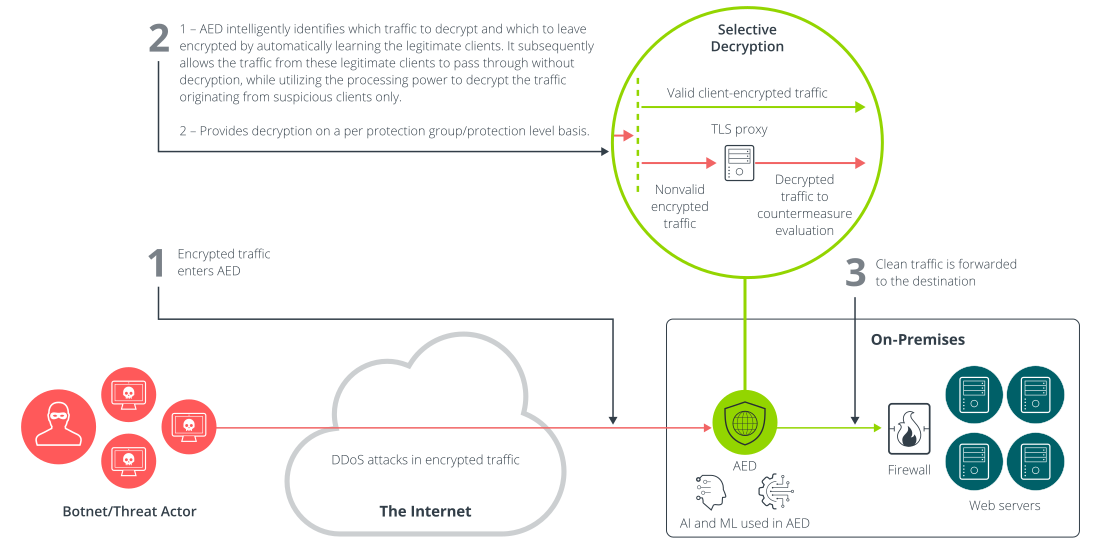
NETSCOUT’s Arbor Edge Defense (AED) offers a powerful solution via selective decryption. Positioned at the network edge, AED intelligently decides which traffic to decrypt based on threat indicators and client validation.

Here’s how it works:

  • Intelligent decryption: As the traffic enters, AED identifies valid client traffic and passes it on without requiring decryption
  • Suspicious traffic decryption: Only nonvalidated encrypted traffic is decrypted and analyzed for DDoS threats
  • Customizable decryption: Users can enable decryption for specific protection groups or levels, allowing targeted inspection without wasting resources
Chart

Benefits of Selective Decryption

Efficient resource use: Focuses decryption on suspicious traffic, preserving system performance
Scalable protection: Enables high-scale defense against encrypted threats without compromising throughput
Flexible configuration: Tailors decryption policies to match the needs of different services and threat levels

Conclusion

As encrypted traffic continues to grow, so does the need for smarter security solutions. NETSCOUT AED’s selective decryption approach empowers organizations to defend against encrypted DDoS attacks efficiently and effectively—without sacrificing performance.

    Learn more about Arbor Edge Defense.