


Distributed denial-of-service (DDoS) attacks continue to grow in scale, frequency, and sophistication, forcing organizations to rethink not just how they defend against attacks, but how much visibility and control they have over those defenses. At the center of this shift is a fundamental architectural choice: black box versus glass box DDoS protection.
While both approaches aim to stop attacks and keep services available, the difference between them comes down to transparency, trust, and operational control. Understanding these differences is critical for organizations that treat availability, customer experience, and resilience as strategic priorities rather than technical checkboxes.
“Black box” DDoS protection is often accepted as “good enough” for maintaining uptime, but in reality it frequently fails in critical ways. These systems tend to over block legitimate traffic, disrupting services, while also under blocking actual attacks, allowing damage to continue. When failures happen, operators lack visibility and control; they can’t see what was blocked, understand why, or fix issues quickly. This makes it difficult to prove problems, validate decisions, or restore service.
As attacks become more sophisticated, these weaknesses worsen. Instead of simplifying operations, black box solutions increase risk, turning protection into a potential source of outages. While they may be appealing for quick deployment or limited resources, they ultimately undermine reliability, customer trust, and long-term stability, making them an inadequate security approach.
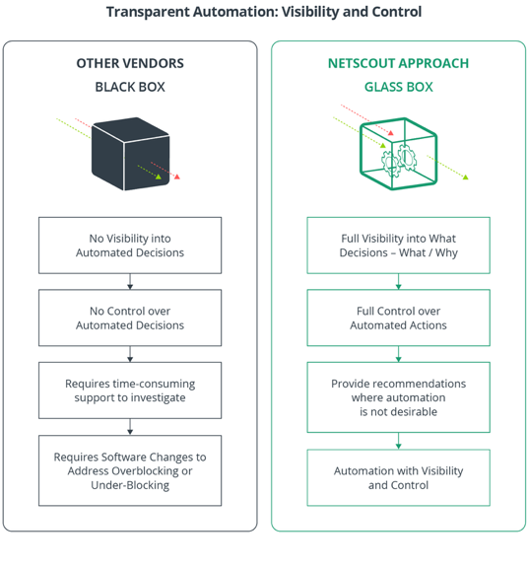
A “glass box” DDoS protection approach focuses on full, real-time visibility into network activity and mitigation decisions. NETSCOUT’s Arbor Adaptive DDoS Protection uses continuous analysis of traffic, threat intelligence, and attacker behavior to adapt defenses dynamically. Instead of static, one-time responses, it runs as a closed-loop process that updates mitigation as attacks evolve. This gives security teams the ability to understand, audit, and refine defenses at every stage, while still maintaining the efficiency of automated protection.
This level of transparency allows security teams to validate decisions, tune policies to their environment, and reduce false positives that can disrupt legitimate users. Importantly, glass box protection doesn’t replace automation, it enhances it by combining machine speed with human insight. The result is more predictable, explainable, and defensible DDoS mitigation.
Modern DDoS attacks are becoming faster, more dynamic, and harder to detect, which makes traditional black box defenses less effective. These older approaches lack visibility and struggle to adapt when attacks change tactics midstream.
Glass box DDoS protection addresses this by offering transparency and control. It helps organizations clearly see how attacks behave, align defenses accordingly, and explain actions to stakeholders.
In short, the shift is from opaque, one-size-fits-all protection to defenses that are visible, adaptable, and provably effective which is essential for organizations that rely on always-on digital services.
DDoS protection is no longer just about blocking bad traffic. It’s about confidence, accountability, and operational insight. As organizations mature their security posture, the shift from black box to glass box thinking reflects a broader industry truth: defenses are strongest when they’re not only effective, but understandable.
The shift from black box to glass box DDoS protection reflects a broader truth in security: Defenses are strongest when teams can see, trust, and refine how they work.
For more about black box versus glass box protection, read this case study.
此内容由惯性聚合(RSS阅读器)自动聚合整理,仅供阅读参考。 原文来自 — 版权归原作者所有。