


Using real but undisclosed domain sales, we tested how closely automated appraisal tools match market reality.
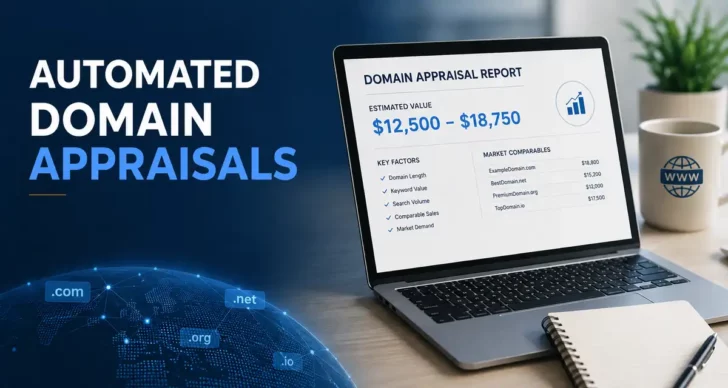
This is the first in a series of stories about automated domain appraisal systems.
Automated domain name appraisal services have been around for a while, and they’ve always been controversial.
People like appraisal tools that tell them what they want to hear. For sellers, that’s hearing that their domains are worth a lot of money.
Feeling good is one thing, but feelings don’t help you sell domains. In fact, overvaluing your domains can hurt your sell-through rate by pushing prices beyond what buyers are actually willing to pay.
With the help of Mike Cyger, we evaluated fifteen automated appraisal tools. (New AI platforms have made it easier to create appraisal tools, and the number of appraisal tools has ballooned in the past few years.)
Our takeaway is that no automated appraisal service is perfect. Some seem to nail certain types of domains but not others.
To be fair, it’s challenging to evaluate how good appraisals are. We used a collection of domain names that have recently sold but haven’t been disclosed, so appraisal tools don’t know the sales price. These domains aren’t outliers and were sold for prices we believe are in line with the market. We also tested some domains that are currently for sale with buy now prices.
We did not expect pinpoint accuracy. What matters is getting the order of magnitude right. A domain worth around $5,000 shouldn’t be appraised at $0 or $50,000+, even if the exact number is hard to dial in.
To understand the complexity of back-testing appraisal systems, consider a scenario with two word brands. One domain we tested was MakeMatter.com, which Andrew sold for $15,000. Another was PressBridge.com, which Mark Levine sold for $5,000.
Which one of these domains is better? It’s debatable. The wholesale market gives a clue: Andrew paid $847 for MakeMatter.com in a GoDaddy auction in 2022. Mark bought PressBridge.com for $59 in an uncontested backorder. To be fair, Mark’s purchase was in 2016. Also, press is a good keyword.
But had I priced MakeMatter.com at $5,000, the sale would have only been for $5,000. Had Mark priced PressBridge.com for more than $5,000, it’s possible it would have sold for more.
All of this is to say that you can’t expect appraisal tools to accurately guess what domains sold for. A lot of it has to do with the seller. To truly test, you’d need to run through thousands of unreported sales, and only a few companies have the data to do that.
Some appraisals should be considered inaccurate, though. An appraisal suggesting the retail value of a domain is less than what it sold for in a competitive GoDaddy auction is probably wrong. Two appraisal services estimated MakeMatter.com’s value below $847.
On the flip side, an appraisal system that values an unregistered domain at five figures is probably wrong, too.
Perhaps the worst scenario is when an appraisal tool isn’t consistent with the same domain. This can happen with AI systems, especially when parameters aren’t dialed in.
Here are a few overall takeaways:
- Specificity is a problem. One thing Andrew learned in his early career in finance was to round numbers used in forecasts. Appraising a domain at $158,328 suggests a high degree of accuracy — accuracy that simply isn’t possible with domain appraisals. Many appraisal services round, and some even give a range. This is smart.
- Appraisal systems need to know their limits. We appreciate that some systems limit themselves to .com domain names. Appraising non-coms is difficult because there’s less data.
- Appraisals can be useful even if you don’t agree with the specific values. If you rank expired domains on ExpiredDomains.net using GoDaddy’s Go Values, you’ll find that the best domains are generally at the top of the list and the worst domains are at the bottom. You might not agree with the numbers for each domain, but it’s a good way to make a first cut at evaluating domains.
- Appraisal systems need to show their work. Some are better than others at explaining why the domain is valuable (or not valuable). Very few actually show comps, which is the best datapoint to help sell domains. It’s also the way nearly all real property is valued. Without comps, appraisals are hard to defend.
Over the coming days, Domain Name Wire will post analyses of 11 domain appraisal tools. After that, we’ll summarize which tools we think are best, along with a list of four tools we used that weren’t worth reviewing due to critical flaws.
Note: We considered providing our results to each appraisal platform in advance so they could explain some of the results. In the end, we decided to publish the results first and let them comment later. We welcome comments and feedback from appraisal tool creators and users.
