

惯性聚合 高效追踪和阅读你感兴趣的博客、新闻、科技资讯
阅读原文 在惯性聚合中打开

推荐订阅源

The Cloudflare Blog
让小产品的独立变现更简单 - ezindie.com
人人都是产品经理
人人都是产品经理
C
Check Point Blog
有赞技术团队
有赞技术团队
H
Help Net Security
V
Vulnerabilities – Threatpost
N
News | PayPal Newsroom
Hacker News - Newest:
Hacker News - Newest: "LLM"
L
LINUX DO - 最新话题
Apple Machine Learning Research
博客园 - 【当耐特】
爱范儿
爱范儿
I
InfoQ
V
Visual Studio Blog
O
OpenAI News
Google DeepMind News
S
Security Affairs
T
Troy Hunt's Blog
P
Palo Alto Networks Blog
Spread Privacy
Spread Privacy
Engineering at Meta
Engineering at Meta
雷峰网
雷峰网
N
Netflix TechBlog - Medium
Latest news
Latest news
H
Hackread – Cybersecurity News, Data Breaches, AI and More
Webroot Blog
Webroot Blog
S
Schneier on Security
MongoDB | Blog
MongoDB | Blog
T
Tor Project blog
V2EX - 技术
V2EX - 技术
Security Latest
Security Latest
Cloudbric
Cloudbric
The GitHub Blog
The GitHub Blog
酷 壳 – CoolShell
酷 壳 – CoolShell
B
Blog RSS Feed
C
CERT Recently Published Vulnerability Notes
T
The Exploit Database - CXSecurity.com
P
Privacy International News Feed
S
Securelist
C
Cisco Blogs
博客园_首页
TaoSecurity Blog
TaoSecurity Blog
奇客Solidot–传递最新科技情报
奇客Solidot–传递最新科技情报
Security Archives - TechRepublic
P
Proofpoint News Feed
K
KPMG report finds enterprise disconnect between AI and its ROI | CIO
T
Threat Research - Cisco Blogs
阮一峰的网络日志
阮一峰的网络日志
S
Secure Thoughts

DigitalOcean Resources

AI Security: 10 Top Risks and Best Practices in 2026 | DigitalOcean 10 Leading AI Cloud Providers for Developers in 2026 | DigitalOcean 10 Top AI Infrastructure Companies Scaling ML in 2026 | DigitalOcean Inference-as-a-Service Explained for Developers | DigitalOcean DigitalOcean vs Heroku: Comparing Cloud Application Platforms | DigitalOcean 10 Alibaba Cloud Alternatives for Businesses in 2026 | DigitalOcean What Is LlamaIndex? A Guide to Building Context-Aware AI | DigitalOcean 10 Platform-as-a-Service Providers for App Dev in 2026 | DigitalOcean 10 Top Cloud Service Providers for Business Infrastructure in 2026 | DigitalOcean What Is AI Inference? The Process Behind Every AI Output | DigitalOcean 15 AI Animation Video Generators for Content Creation in 2026 | DigitalOcean 7 OpenClaw Security Challenges to Watch for in 2026 | DigitalOcean AI Inference vs Training: Key Differences Explained | DigitalOcean 10 Fly.io Alternatives for Global App Deployment in 2026 | DigitalOcean What are OpenClaw Skills? A 2026 Developer’s Guide | DigitalOcean 9 IBM Cloud Alternatives for Enterprise Computing in 2026 | DigitalOcean What Is NotebookLM? Features and How to Use It in 2026 | DigitalOcean 10 Claude Code Alternatives for AI-Powered Coding in 2026 | DigitalOcean What is Moltbook? The Social Network for AI Agents in 2026 | DigitalOcean 8 AWS RDS Alternatives for Managed Databases in 2026 | DigitalOcean 8 Amazon EC2 Alternatives for Cloud Compute in 2026 | DigitalOcean DigitalOcean vs AWS Lightsail: Which Cloud is Right? | DigitalOcean 10 Vercel Alternatives for Deploying Apps in 2026 | DigitalOcean 10 Best Object Storage Solutions for Cloud Data in 2025 | DigitalOcean Edge Computing vs Cloud Computing: Key Differences Explained | DigitalOcean 8 AI Paraphrasers for Content Rewriting in 2026 | DigitalOcean Top 6 Collaborative Replit Alternatives for Teams in 2026 | DigitalOcean 8 Top Research-Focused Perplexity Alternatives for 2026 | DigitalOcean 10 Smart GitHub Copilot Alternatives for Coding in 2026 | DigitalOcean ChatGPT vs Gemini: How AI Assistants Stack Up in 2026 | DigitalOcean 10 Powerful Claude Alternative Assistants in 2026 | DigitalOcean GitHub Copilot vs Cursor : AI Code Editor Review for 2026 | DigitalOcean 10 Creative DALL-E Alternatives for AI Art in 2026 | DigitalOcean 5 Network File Storage Options for Your AI/ML Workloads in 2026 | DigitalOcean 10 Modal Alternatives for ML Deployment in 2025 | DigitalOcean Pros and Cons of Crowdfunding Your Startup 14 Educational AI YouTubers Teaching ML in 2025 | DigitalOcean 7 Smart AI Language Learning Apps for Fluency in 2025 | DigitalOcean Grok vs ChatGPT Review: Features, Use Cases, Pricing | DigitalOcean 10 Best AI Voice Generator Tools for Content in 2025 | DigitalOcean 6 Best AI Search Engines in 2025 | DigitalOcean 10 Cost-Effective Lambda Labs Alternatives in 2025 | DigitalOcean 8 Best AI Notetaking Apps for Meetings in 2025 | DigitalOcean 7 On-Demand Runpod Alternatives for GPU Compute in 2025 | DigitalOcean Claude vs ChatGPT: Which AI Assistant Wins in 2025? | DigitalOcean 10 Best AI Website Builders for No-Code Design in 2025 | DigitalOcean Hugging Face vs Replicate: From Model Discovery to Deployment | DigitalOcean 10 Vast.ai Alternatives for GPU Cloud Computing in 2025 | DigitalOcean 7 CoreWeave Alternatives for Cloud GPU Computing in 2025 | DigitalOcean 7 Platforms for Renting GPUs for Your AI/ML Projects | DigitalOcean 7 Serverless GPU Platforms for Scalable Inference Workloads | DigitalOcean What is Nano Banana (Gemini 2.5 Flash Image)? | DigitalOcean 10 Top LinkedIn Learning AI Courses to Build Skills in 2025 | DigitalOcean 10 AI and Machine Learning Bootcamps to Explore in 2025 | DigitalOcean 10 Major AI Hackathon Events in 2025 Worth Joining | DigitalOcean On-Premise GPU vs Cloud GPU: Which is Better for AI Training? | DigitalOcean 8 Best Managed AI Services for Running AI Models in 2025 | DigitalOcean GPU Options for Finetuning Large Models: Choose the Right Setup | DigitalOcean What Is GPU as a Service? A Guide to Cloud GPUs | DigitalOcean 7 Best Cloud GPU Platforms for AI, ML, and HPC in 2025 | DigitalOcean 5 Best Affordable Cloud GPU Services for Startups in 2025 | DigitalOcean GPU Autoscaling for AI: From Setup to Cost Optimization | DigitalOcean 8 Best AI App Builders to Ship Your Project in 2025 | DigitalOcean Cloud Migration Checklist: Your Pre- and Post-Migration Guide | DigitalOcean What is Data Labeling? Methods, Tools, and Examples | DigitalOcean 11 IT Cost Optimization Strategies for Scalable Savings in 2025 | DigitalOcean What is Lift-and-Shift Migration? Your Fastest Route to the Cloud | DigitalOcean Cloud Migration Assessment: Evaluate Your Readiness | DigitalOcean Complete Cloud Migration Strategy Guide: Planning and Implementation | DigitalOcean Multi-Cloud vs Single-Cloud: Choosing the Right Strategy | DigitalOcean GPT-5 Overview: OpenAI's Most Advanced AI Model Yet | DigitalOcean What is Agentic Commerce? Exploring AI Shopping Agents | DigitalOcean What are Agentic Browsers? Exploring AI-native Web Navigation | DigitalOcean Your Guide to the TradingAgents Multi-Agent LLM Framework | DigitalOcean What are Large Action Models? The Next Frontier in AI Decision-Making | DigitalOcean What is CrewAI? A Platform to Build Collaborative AI Agents | DigitalOcean 10 AI Code Review Tools That Find Bugs & Flaws in 2025 | DigitalOcean 10 Best Vibe Coding Tools: LLM-Powered Code Generators to Try | DigitalOcean 10 AI Transcription Tools to Convert Speech to Text in 2025 | DigitalOcean GitHub Copilot vs Microsoft Copilot: Key Differences | DigitalOcean 7 AI Video Editors for Creative Teams and Businesses in 2025 | DigitalOcean What is Serverless Inference? Leverage AI Models Without Managing Servers | DigitalOcean What is Vertex AI? Unpacking Google's ML Platform | DigitalOcean 10 MLOps Platforms to Streamline Your AI Deployment in 2025 | DigitalOcean 10 Generative AI Use Cases Transforming Industries in 2025 | DigitalOcean What Is an AI Task Manager and How Can It Automate Your Workflow? | DigitalOcean 10 Computer Vision Applications for 2025 | DigitalOcean What are AI-Powered Voice Assistants? Beyond Basic Commands | DigitalOcean 10 Midjourney Alternatives to Create AI Art in 2025 | DigitalOcean 8 Stable Diffusion Alternatives for Image Generation in 2025 | DigitalOcean NLP vs NLU: Key Differences and How They Work Together | DigitalOcean 8 Best AI Presentation Maker Tools for Professional Slides in 2025 | DigitalOcean Best AI Chrome Extensions to Supercharge Your Browsing in 2025 | DigitalOcean 10 AI Meeting Tools to Improve Team Collaboration in 2025 | DigitalOcean TPU vs GPU: Choosing the Right Hardware for Your AI Projects | DigitalOcean Machine Learning vs. Natural Language Processing Explained | DigitalOcean VPC vs VPN: Which One Fits Your Secure Networking Needs? | DigitalOcean 7 AI Content Detectors for Identifying Artificially Generated Text | DigitalOcean What is Conversational AI? How Computers Learn to Converse | DigitalOcean 10 Best AI Discord Servers to Join in 2025 | DigitalOcean
What is OpenClaw? Your Open-Source AI Assistant for 2026 | DigitalOcean
By Maddy OsmanSenior Content Marketing Manager at DigitalOceanUp · 2026-01-31 · via DigitalOcean Resources

With new AI agents, ML dev tools, and copilots dropping almost daily, it’s rare for a new tool to truly stand out. Yet that’s precisely what OpenClaw (previously Moltbot and Clawdbot) did—despite the fact that it’s not an offering from one of the frontier AI labs. Rather than offering another chatbot, OpenClaw delivers a true personal AI agent that runs locally, remembers context across conversations, and can actually do things on your machine. And it’s completely open-source—no subscription, just bring your own API key.

The hype was immediate: 60,000+ GitHub stars in 72 hours and developers calling it the closest thing to JARVIS we’ve seen. If you’ve yet to try it for yourself, or you’re still wondering “What is OpenClaw?”—this guide has you covered.

Key takeaways:
  • OpenClaw is a viral open-source AI assistant that acts as a proactive personal agent, connecting AI models with your local files and messaging apps like WhatsApp and Discord to automate tasks around the clock.
  • Users can expand the tool’s capabilities using over 100 preconfigured AgentSkills that allow the AI to execute shell commands, manage file systems, and perform web automation.
  • The project remains model-agnostic and privacy-focused, allowing you to bring your own API keys for cloud models or run local models entirely on your own infrastructure.
  • DigitalOcean offers 1-Click OpenClaw Deploy, which features a hardened security image.

What is OpenClaw (previously Moltbot and Clawdbot)?

What is OpenClaw

OpenClaw (affectionately called “Molty”) is a viral open-source personal AI agent with 68,000 GitHub stars (and counting), created by PSPDFKit founder Peter Steinberger. It brings together the technology of agents with the data and apps you use on your local machine to serve as a high-powered, high-context AI assistant. It operates a local gateway that connects AI models with your favorite tools, integrating with familiar chat apps to facilitate convenient interactions. Many describe it as “self-improving”, likened to AGI (artificial general intelligence), because it can enhance its own capabilities by autonomously writing code to create relevant new skills to execute your desired tasks, implement proactive automation, and maintain long-term memory of user preferences.

OpenClaw key features:

  • Functions as a local gateway that provides AI models with direct access to read and write files, run scripts, and control browsers through a secure sandbox.
  • Maintains persistent memory and user preferences by storing data as local Markdown documents, allowing for deep personalization and manual tweaking of instructions.
  • Bridges the gap between AI models and over 50 third-party integrations, including smart home hardware, productivity suites, and music platforms.

OpenClaw pricing:

  • Free/open-source. The cost to use OpenClaw is associated with AI model API usage.

Learn about the three things to know about OpenClaw from DigitalOcean’s Senior Developer Advocate, Lizzie Siegle:

How OpenClaw works

OpenClaw runs on your local machine (Mac, Windows, or Linux), staying private. It works with your favorite AI models (including local models) and incorporates persistent memory across conversations. Interact with OpenClaw through your favorite chat apps, including Slack, Discord, iMessage, and WhatsApp.

You can either operate OpenClaw in a sandbox or give it full system access to read and write files, plus run shell commands and execute scripts. It can also be used to control your browser, filling out forms and extracting website data.

Wondering how OpenClaw works under the hood? Learn more about the technical details of OpenClaw behind the scenes: high-level architecture, its Gateway core, plus how it connects to apps, and understanding security risks.

How to set up OpenClaw

While many developers are talking about buying Mac Minis to run their own instances of OpenClaw, there’s no need to make the investment of hundreds of dollars in physical hardware to get started today.

Check out our tutorial to learn how to run OpenClaw using safe defaults with DigitalOcean’s security-hardened 1-Click OpenClaw Deploy.

If you’re setting up OpenClaw locally, proceed with caution around existing security concerns. If you decide to move forward, run this command in your favorite terminal program to get started quickl —it includes everything necessary for the installation, including Node.js:

curl -fsSL https://openclaw.ai/install.sh | bash
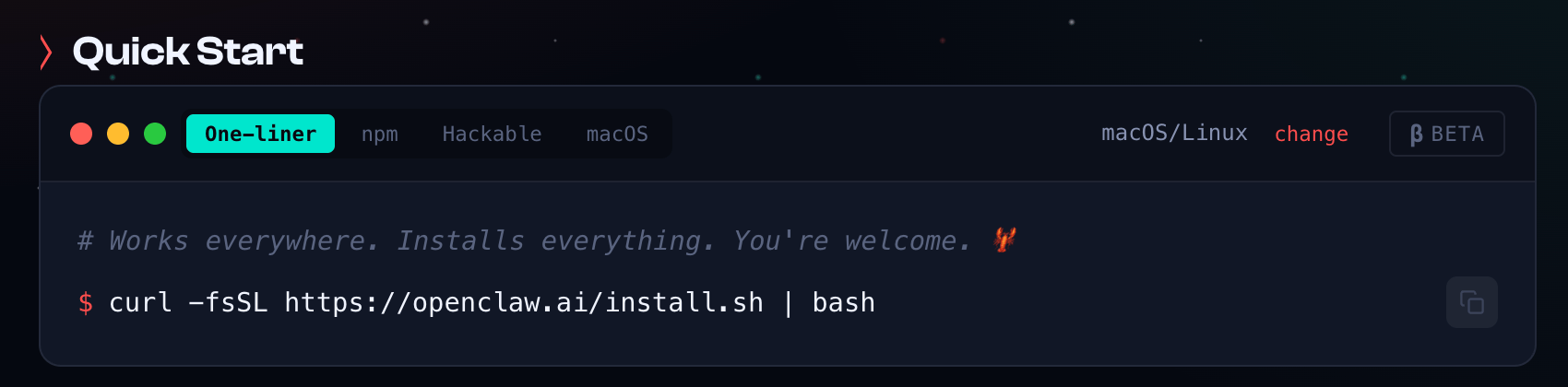
What is OpenClaw - Setup

It works on macOS, Windows & Linux.

For additional installation options, visit the OpenClaw website, their documentation, or DigitalOcean’s OpenClaw documentation.

Learn more about OpenClaw on DigitalOcean and our 1-Click OpenClaw Deploy: security-hardened, production-ready agentic AI.

How to use OpenClaw

OpenClaw is expanding rapidly, thanks to open-source support from community contributors. At publication, it has 50+ integrations that span chat providers, AI models, productivity tools, music and audio platforms, smart home devices, automation tools, and more.**
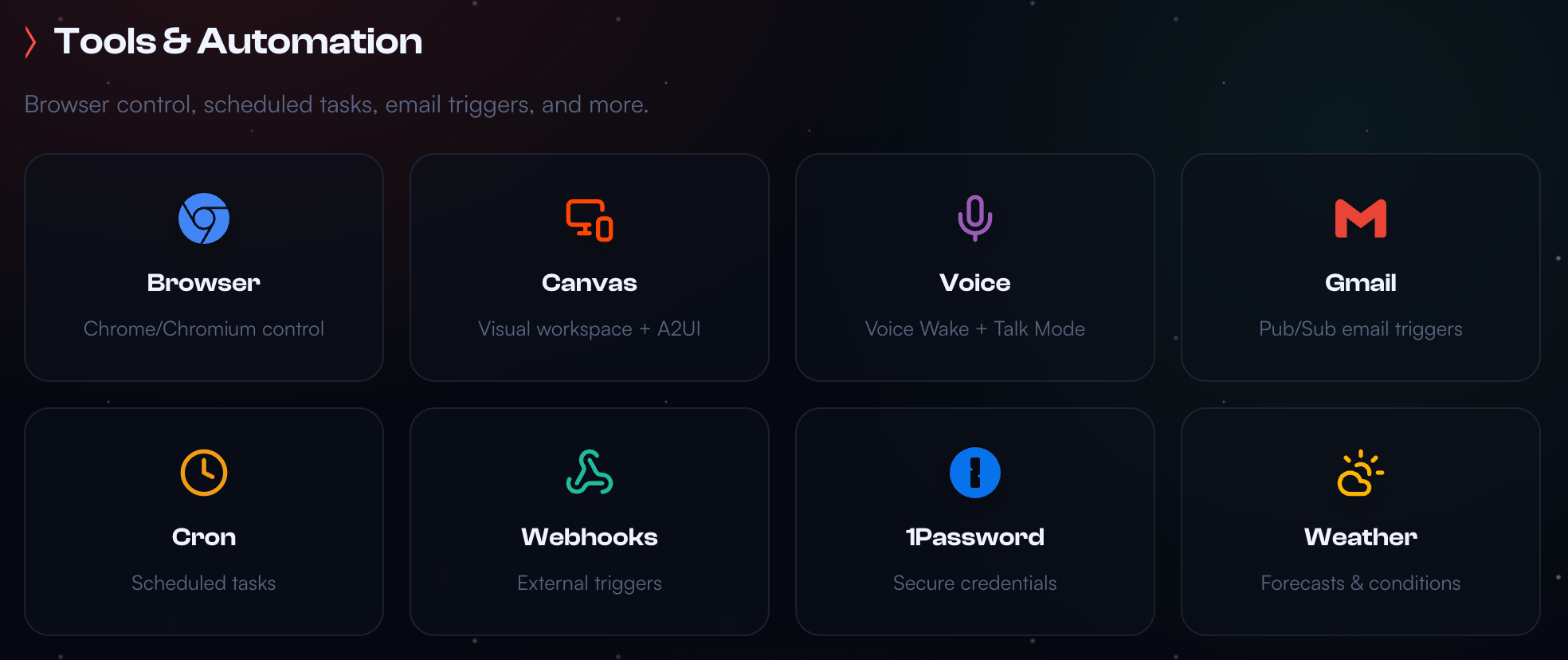
What is OpenClaw - Integrations.png

OpenClaw use cases

In tandem with OpenClaw’s rapidly expanding integrations are numerous use cases for personal and professional tasks, including:

  • Developer and technical workflows. Automate debugging, DevOps, and codebase management with direct GitHub integration, scheduled cron jobs, and webhook triggers that keep your projects running while you sleep.
  • Personal productivity. Manage your day across Apple Notes, Apple Reminders, Things 3, Notion, Obsidian, and Trello—all from a single conversation in WhatsApp or Telegram.
  • Web automation and browser control. Let OpenClaw fill out forms, scrape data, and navigate websites on your behalf using its built-in browser integration.
  • Smart home and health monitoring. Control Philips Hue lights, Elgato devices, and Home Assistant setups, or pull health data from wearables to track your daily metrics.
  • Communication and social. Draft and schedule posts to Twitter/X and Bluesky, or manage email workflows through Gmail—without leaving your chat app.
  • Media and creative tasks. Generate images, search GIFs, create audio content with Spotify and Sonos integrations, or use Replicate for AI-powered media generation.

Here are some real-world examples that savvy early adopters have already put to work to make their lives easier:

Mike Manzano shares how he set up OpenClaw to run his coding agents while he was sleeping:

AJ Stuyvenberg is using OpenClaw to negotiate his next car purchase:

And André Foeken used OpenClaw to coordinate a supermarket order:

…In addition to everything else on his to-do list:

Taking the idea a step further, Steve Caldwell configured OpenClaw to build a weekly meal planning system in Notion, saving his family an hour per week:

Anita Kirkovska used OpenClaw to build her ideal AI assistant entity:

And Andy Griffiths used OpenClaw to build a functional Laravel app while grabbing coffee—on DigitalOcean infrastructure:

YouTuber Craig Hewitt shares additional ideas for OpenClaw automations you can build on DigitalOcean infrastructure:
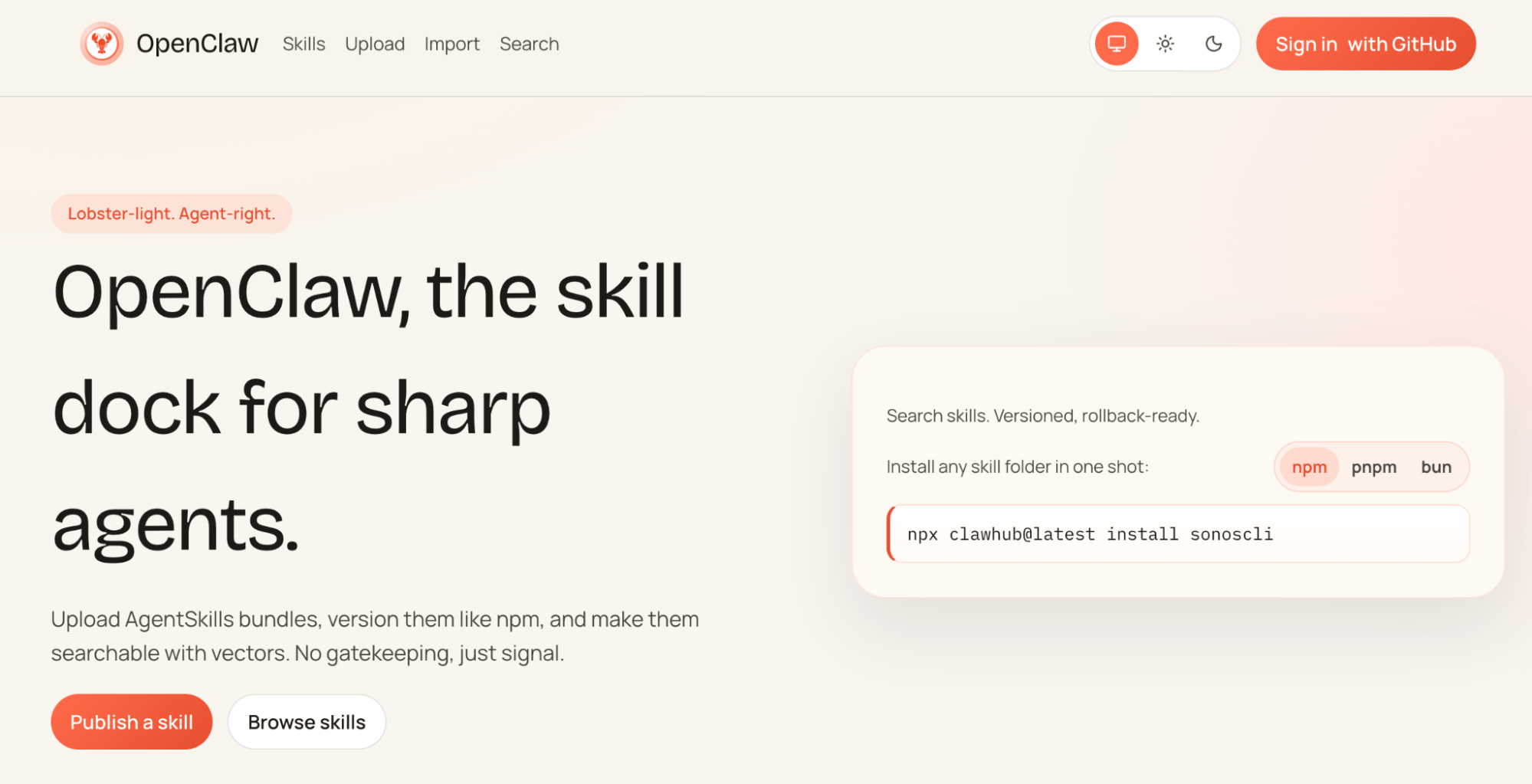
OpenClaw for AgentSkills

What is OpenClaw - AgentSkills

A similar concept to Claude Skills, OpenClaw offers 100+ preconfigured AgentSkills bundles for expanding its usefulness. Users can search the registry to find the skills most relevant to their needs, as well as contribute their own.
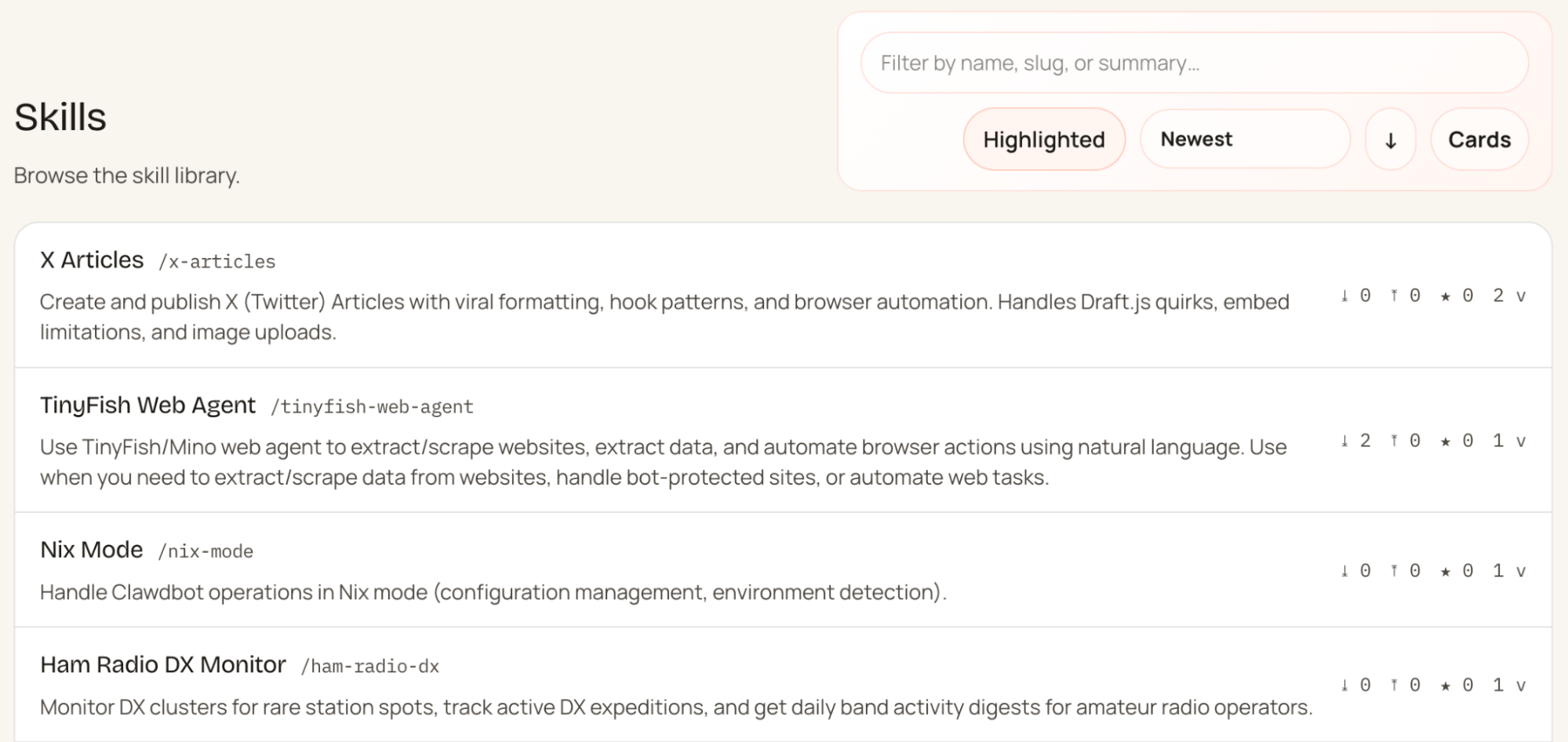
What is OpenClaw - AgentSkills Directory.png

Once you’ve decided on the skills you want to use with OpenClaw, installation is another straightforward terminal command.
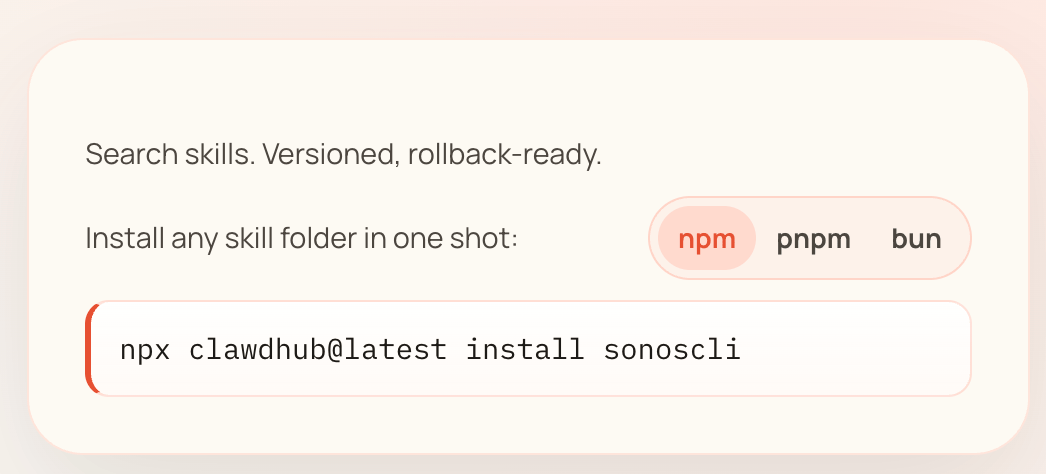
What is OpenClaw - AgentSkills Installation.png

Don’t see a skill that fits your needs, but have an idea for one? Prompt OpenClaw to create it, then share with the class.

Quickly deploy an always-on instance of OpenClaw using a DigitalOcean 1-Click OpenClaw Deploy, which features a hardened security image, starting at $24/month.

What is OpenClaw? FAQ

What is OpenClaw?

OpenClaw is a self-hosted agent runtime and message router that acts as a personal AI assistant running on your own machine. It functions as a long-running Node.js service that connects various chat platforms, like WhatsApp and Discord, to an AI agent that can execute real-world tasks.

Why is OpenClaw going viral?

OpenClaw has become one of the fastest-growing open-source projects in history, exploding from 9,000 to over 60,000 GitHub stars in just a few days. It has captured developer attention by offering a “24/7 Jarvis” experience where a self-hosted AI can proactively reach out to users and execute autonomous tasks across multiple messaging apps.

What can you use OpenClaw for?

You can use OpenClaw to automate digital tasks by giving it the ability to run shell commands, interact with web browsers, and manage local files. It is commonly used as a proactive personal assistant that handles message routing, remembers conversation history, and triggers complex automations through natural language.

How can you set up OpenClaw?

The recommended setup involves deploying a DigitalOcean Droplet and running the official onboarding wizard via a terminal command. This process automatically configures your LLM provider, links chat channels like WhatsApp, and installs a systemd service to keep the gateway running 24/7.