






Companies of all sizes are discovering that cloud-managed AI services offer a practical path to innovation in the cloud without the complexity of building solutions from the ground up. These platforms enable everything from intelligent chatbots and AI agents to automated document processing, predictive analytics, computer vision applications, and natural language processing—all through managed APIs and pre-trained models. With so many options on the market, it can be hard to choose between comprehensive platforms from hyperscalers like AWS and Azure or specialized providers with focused capabilities.
To help, we’ve curated a selection of the leading AI service providers to help you navigate past the marketing noise. Whether you’re a startup seeking affordable pre-built AI models or an enterprise requiring scalable solutions for growth, this article covers what works.
Key takeaways:
Today’s market offers specific hyperscale platforms (AWS SageMaker, Azure AI Foundry, Vertex AI), which are good for deep integration with cloud ecosystems, mid-sized cloud providers (DigitalOcean Gradient™ AI Platform), good for affordability and ease of use, and specialized platforms (Dataiku, Snowflake Cortex, DataRobot, Databricks Mosaic AI) that support use cases from end-to-end ML workflows to data-centric AI and automated agent development.
Pricing structures typically follow pay-per-use, subscription, or enterprise contracts, and successful adoption depends on starting with focused pilot projects, ensuring clean and reliable data, and preparing teams with training and phased rollouts.
Managed AI services act as your dedicated AI department in the cloud. Instead of hiring a team of data scientists and investing in expensive hardware, you gain access to complex AI capabilities through straightforward API calls.
Core functions include:
Model serving and deployment
Fine-tuning and training pipelines
Performance monitoring and optimization
Compliance and security management
Infrastructure scaling and maintenance
These cloud AI services handle the technical complexities—training models, managing servers, scaling resources when demand increases, and maintaining security protocols. This allows you to leverage AI to improve your products, better understand your customers, and expedite operations.
Managed machine learning platforms allow your team to access pre-trained foundation models, automated ML workflows, and enterprise-grade AI infrastructure without requiring deep technical expertise or substantial upfront investment.
Here’s what you typically receive with managed AI services:
APIs that integrate with your existing software
Pre-trained models ready for immediate deployment
Automatic scaling capabilities as your business grows
Built-in security and compliance features
Professional support when challenges arise
When evaluating managed AI services in 2025, focus on these features:
Ready-to-use models: They help to accelerate your initial deployment. Look for platforms with robust libraries covering common use cases, such as document processing, image recognition, and customer sentiment analysis.
Custom training capabilities: These are becoming essential when you need models to understand your business context or industry requirements. Evaluate how easily you can train models on your data without requiring a specialized data science team.
Integration simplicity: Integration ease helps to determine project success or failure. The most sophisticated AI service becomes worthless if connecting it to your existing systems takes months. Prioritize clear APIs, comprehensive documentation, and pre-built connectors.
Scaling flexibility: This is as critical as your AI usage expands. Services should handle increased demand automatically without requiring you to become an infrastructure specialist.
Security and compliance: Ensure the platform meets your industry requirements and provides necessary audit trails and controls.
Most cloud AI services employ similar pricing approaches:
Pay-per-use models work effectively when starting small or handling variable workloads. You pay only for actual usage, making experimentation and gradual scaling more feasible.
Monthly subscriptions provide cost predictability but require accurate usage forecasting. As AI usage increases, these often become more economical.
Enterprise contracts offer optimal rates for large deployments, including dedicated support, but require longer-term commitments.
Hidden costs can include data transfer fees, storage costs for training datasets, compute charges during model fine-tuning, and monitoring/logging expenses that aren’t always transparent in initial pricing estimates.
Inference and training costs differ significantly. Inference (running predictions) typically costs less per operation but scales with usage volume, while training costs are higher upfront but are one-time expenses for custom models.
Picking the right managed AI service is just the starting point—the real challenge is rolling it out successfully. Getting these fundamentals right makes the difference between an AI project that transforms your business and one that is shelved after a few months.
Start with a focused pilot project that addresses a genuine business problem. This will build confidence and help you understand what works before expanding your AI initiatives.
Invest in data quality early. Even the most sophisticated AI service struggles with inconsistent or incomplete data. Clean, well-organized data often matters more than selecting the perfect platform.
Plan for organizational change management. Your team needs to understand and trust AI recommendations. Include comprehensive training and gradual rollout strategies in your implementation timeline.
The AI landscape has evolved rapidly, with managed services becoming essential for businesses looking to integrate machine learning without the complexity of building infrastructure from scratch. These platforms offer everything from serverless model hosting to complete MLOps workflows.
DigitalOcean Gradient AI Platform focuses on building AI agents and applications through a single developer-friendly interface. The platform handles hosting, key management, and invoicing while providing access to different models, including popular LLMs like GPT-4, Claude, Llama 2, Mistral, and other open-source models from Hugging Face. Users can start with no-code templates or dive into complete SDK control for complex implementations. When using open-source models, data stays entirely within DigitalOcean’s infrastructure.
Key features:
Traceability features that expose the reasoning chain behind outputs, including user inputs, model outputs, and function call results
Integrated knowledge base creation with data connectors for AWS S3, Google Drive, and Dropbox
Serverless inference that scales automatically with no idle costs or capacity planning, with easy access to different models from OpenAI, Meta, Anthropic, and other open source providers.
Amazon SageMaker is AWS’s comprehensive machine learning platform, designed specifically for end-to-end ML workflows from data preparation to model deployment and monitoring. The platform supports traditional ML workflows and modern generative AI applications, with specialized features for each use case.
Key features:
Access to multiple foundation models (Claude, Llama, Titan) through a single API
Automated machine learning that builds, trains, and tunes models automatically
Deploy various models on a single endpoint for cost efficiency
Built-in bias detection and explainability tools
Free Tier: 20 MB metadata storage, 4,000 API requests, 0.2 compute units per month
Pay-as-you-go: $0.40/GB storage, $10 per 100,000 API requests, $1.776 per compute unit
AI Features: Amazon Bedrock and Q Developer with consumption-based pricing, no upfront commitments
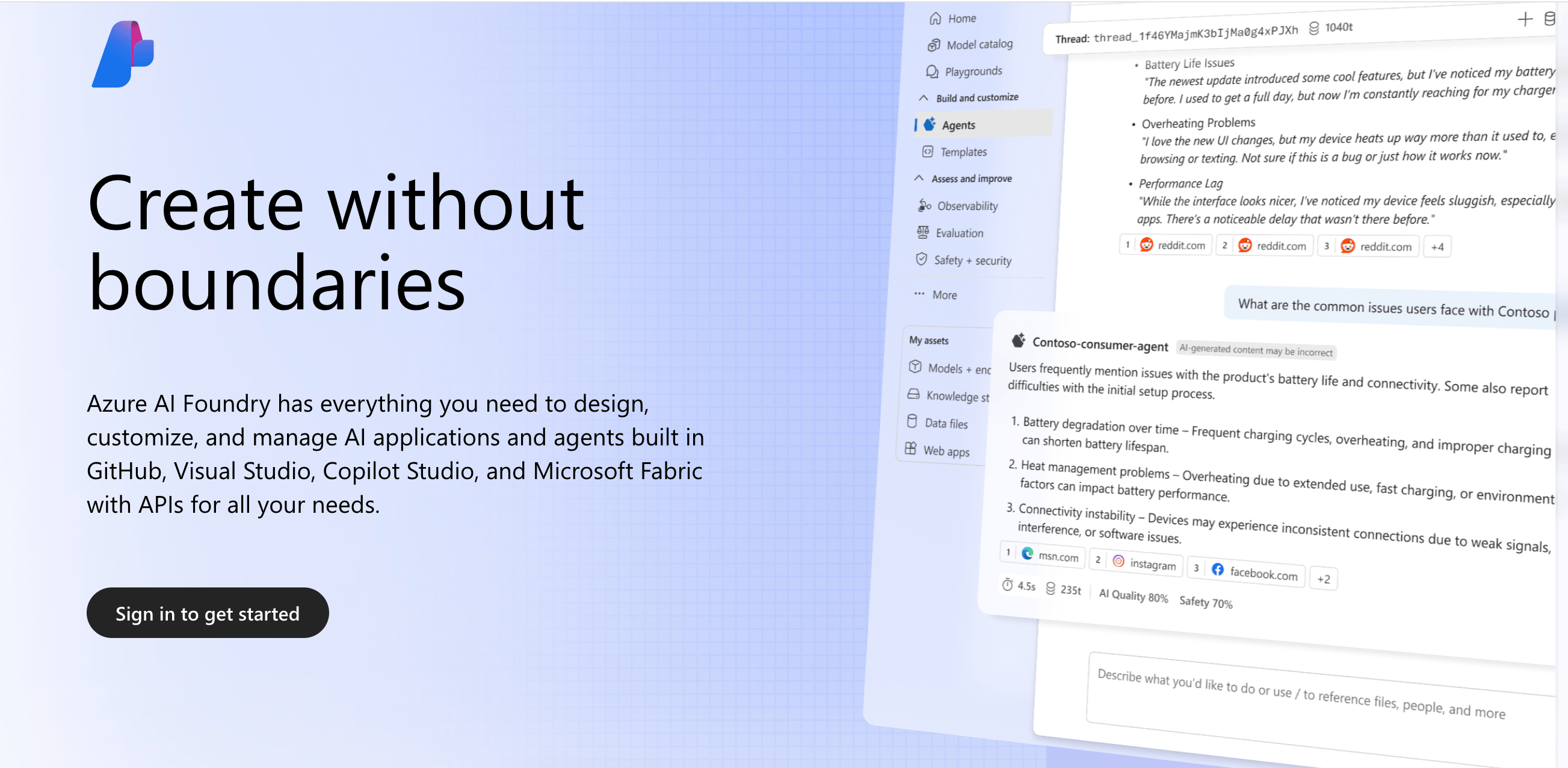
Azure AI Foundry is a unified platform for enterprise AI operations, model builders, and application development. It combines tools, models, and agents under a single management system and offers enterprise features such as monitoring and evaluation. It is most suitable for teams already working with the Microsoft ecosystem.
Key features:
Agent development capabilities with multi-agent orchestration through Azure AI Foundry Agent Service
Access to models from OpenAI, Mistral, Meta, and other providers via a consistent API
Enterprise security through identity management, role-based access control, and network isolation
Google Cloud’s Vertex AI platform simplifies machine learning workflows, while AutoML enables non-technical team members to build custom models. The platform is an enterprise-ready, fully-managed, unified AI development environment that provides access to Vertex AI Studio, Agent Builder, and over 160 foundation models. Vertex AI combines data engineering, data science, and ML engineering workflows, enabling integrated team collaboration using a standard toolset. The TensorFlow integration means you’re utilizing the same tools Google employs internally.
Key features:
Unified Jupyter-based environment for the entire ML workflow
Automatically builds ML models from structured data with minimal coding
Built-in model interpretability for understanding predictions
Access to Google’s latest research models, including PaLM, Imagen, and MusicLM
Generative AI: starting at $0.0001 per 1k characters for input
AutoML: starts at $1.376 per hour for training
Dataiku is a centralized working environment that allows users to manipulate data, explore and share analyses, make predictions, and create AI models. The platform supports building, deploying, and managing data science projects with governance features for documenting objectives, decisions, and models.
Key features:
Secure LLM gateway with no-code to full-code development tools for GenAI applications
AutoML capabilities alongside advanced machine learning techniques with explainability standards
Unified AI governance and operations platform for managing enterprise AI portfolios
Free edition: free trial for 14 days
Paid edition: custom pricing
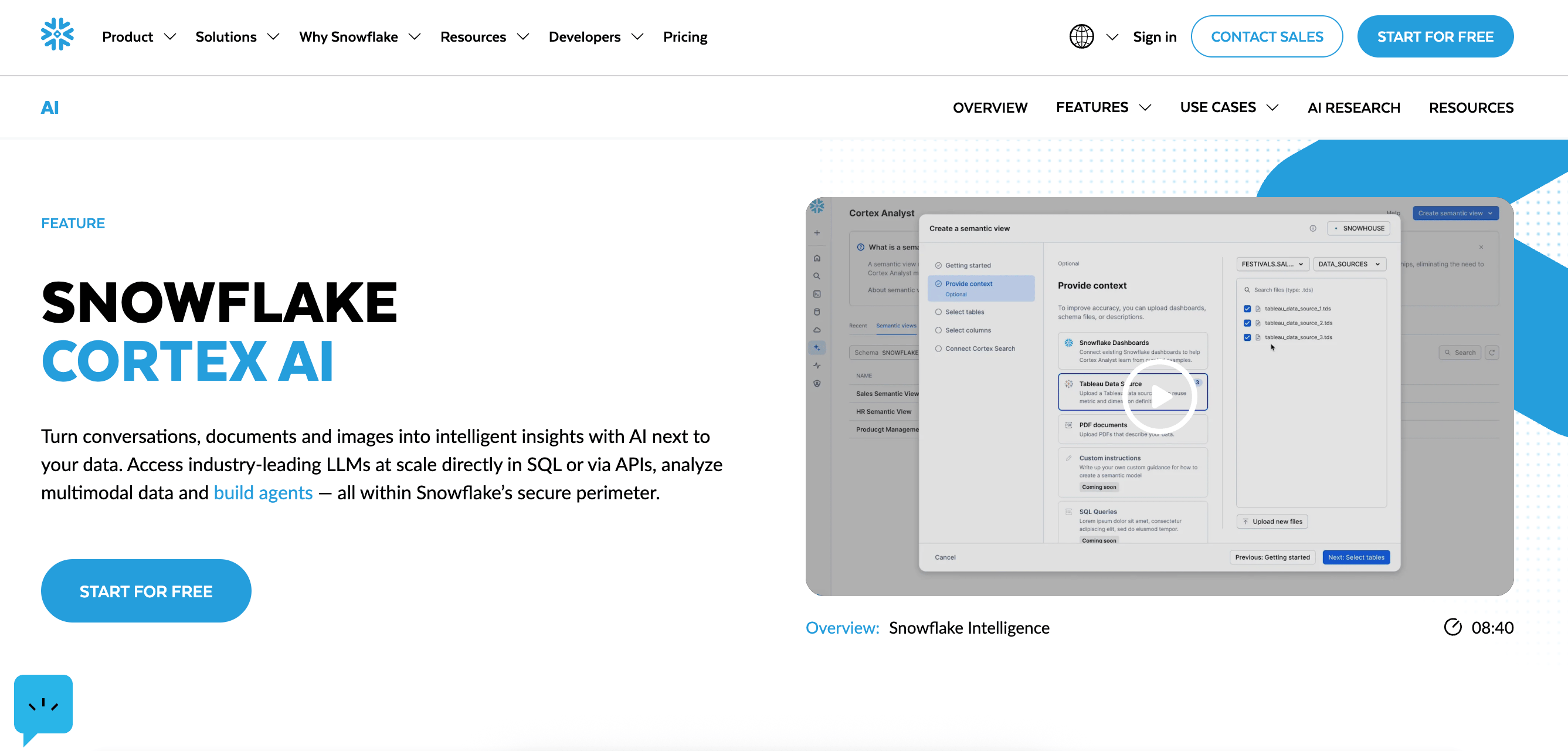
Snowflake Cortex brings AI capabilities directly to your data warehouse, eliminating the need to move data for AI processing. This data-centric approach provides easy integration between data storage and AI analytics.
Key features:
Run AI models directly on data stored in Snowflake without data movement
Vector-based semantic search across your entire data warehouse
Train models using your Snowflake data with privacy guarantees
Use AI capabilities through familiar SQL commands and interfaces
Standard: $2/credit
Enterprise: $3/credit
Business critical: $4/credit
Virtual private: custom pricing
DataRobot empowers data scientists, developers, and engineers to IT with the solutions needed to streamline workflows and deliver secure AI apps quickly. Their platform automates the entire ML lifecycle, from data preparation to model deployment.
Key features:
Automatically builds and tests hundreds of models to find optimal solutions
Specialized capabilities for temporal data and forecasting scenarios
Built-in model governance and audit trails for regulated industries
Mosaic AI agent Bricks transforms enterprise AI development by automating the complex optimization process that traditionally required extensive technical expertise. The platform eliminates guesswork through automatic evaluations and auto-optimizes performance parameters, enabling teams to focus on defining their agents’ purpose rather than managing technical complexity.
Key features:
Auto-optimized agents for structured data extraction and knowledge assistance
Automatic evaluation suite generation and continuous performance optimization
Agent learning from human feedback with natural language guidance
Which managed AI platform offers the best free tier?
Vertex AI provides the most generous free credits, while Sagemaker offers substantial free usage, including 20 MB metadata storage and 4,000 API requests monthly. Snowflake Cortex integrates with existing Snowflake credits for current users.
What AI service is most cost-effective for medium-sized businesses?
Due to integrated ecosystem benefits, Azure AI Foundry delivers optimal value for companies using Microsoft products. Snowflake Cortex is cost-effective for existing customers.
Which platform has the most straightforward setup for non-technical teams?
DataRobot excels with automated machine learning, requiring minimal technical expertise.
Which services offer superior natural language processing capabilities?
Vertex AI and Sagemaker continue to lead in NLP capabilities, with Google providing cutting-edge features and AWS offering comprehensive enterprise tools. Snowflake Cortex provides SQL-native text analysis.
How do these services handle data privacy and security?
All major cloud platforms provide enterprise-grade security with SOC 2 and ISO 27001 certifications. Platforms like DigitalOcean’s Gradient Platform comply with these data privacy and security certifications.
Which platforms offer the best API documentation and development resources?
Vertex AI maintains the most precise documentation with interactive examples, while Sagemaker provides extensive resources across its broad portfolio. DataRobot focuses on business-user-friendly documentation.
How do pay-per-use pricing models function?
Pay-per-use models typically charge based on API calls, processing time, or data volume processed. For example, pay per 1,000 image classifications or minute of video analysis. Most platforms offer pricing calculators and detailed usage monitoring.
How do I migrate existing AI models to managed services?
Migration approaches vary by platform and model type. AWS SageMaker and Google Vertex AI support importing models built with popular frameworks like TensorFlow and PyTorch. Azure Machine Learning offers model conversion tools and containerized deployment options. Many providers also provide migration consulting services for complex deployments.
DigitalOcean Gradient AI Platform makes it easier to build and deploy AI agents without managing complex infrastructure. Build custom, fully-managed agents backed by the world’s most powerful LLMs from Anthropic, DeepSeek, Meta, Mistral, and OpenAI. From customer-facing chatbots to complex, multi-agent workflows, integrate agentic AI with your application in hours with transparent, usage-based billing and no infrastructure management required.
Key features:
Serverless inference with leading LLMs and simple API integration
RAG workflows with knowledge bases for fine-tuned retrieval
Function calling capabilities for real-time information access
Multi-agent crews and agent routing for complex tasks
Guardrails for content moderation and sensitive data detection
Embeddable chatbot snippets for easy website integration
Versioning and rollback capabilities for safe experimentation
Get started with DigitalOcean Gradient AI Platform for access to everything you need to build, run, and manage the next big thing.
此内容由惯性聚合(RSS阅读器)自动聚合整理,仅供阅读参考。 原文来自 — 版权归原作者所有。