


Data is a strategic business asset, and managing its exponential growth is a top priority for enterprises—especially since storage and egress costs can skyrocket as data volumes increase year after year. Traditional data storage solutions, including on-premises infrastructure or legacy file systems, struggle to scale cost-effectively when dealing with large volumes of unstructured data, as well as the expensive hardware upgrades, complex migrations, and prohibitively high bandwidth fees that accompany them. Object storage solutions provide the scalability, resilience, and flexibility needed while maintaining predictable costs through pay-as-you-go pricing and tiered storage options.
According to a 2025 report from The Business Research Company, the global cloud object storage market is expected to grow from $8.14 billion in 2024 to $9.49 billion in 2025, representing a CAGR (Compound Annual Growth Rate) of 16%. This growth highlights the crucial role of object storage as the data layer that powers AI pipelines, analytics platforms, and business intelligence tools, transforming raw data into actionable insights.
Let’s explore the best object storage solutions for your enterprise in terms of their integration capabilities and alignment with your requirements.
Key takeaways:
Object storage has become a strategic pillar of enterprise infrastructure, supporting the high-velocity growth of data from AI/ML pipelines, IoT networks, and real-time analytics. With scalability, data immutability, and API interoperability, it modernizes legacy storage architectures without sacrificing compliance or performance.
Cost predictability and data governance are now core decision metrics. Transparent pricing models from DigitalOcean Spaces simplify billing. Built-in immutability, versioning, and ransomware protection address compliance and security requirements.
The market’s focus has shifted from capacity to capability. S3 API compatibility is now the baseline, while differentiation lies in zero-egress cost models (Cloudflare R2 and Wasabi), edge integration (Cloudflare and MinIO), and AI-native data services (AWS S3 and Google Cloud Storage), all of which directly impact total cost of ownership (TCO) and data accessibility.
Hybrid and multi-cloud interoperability defines the 2025 object storage landscape. Platforms like Cloudian HyperStore, IBM Cloud Storage, and Azure Blob Storage enable the movement of object data across on-premises, public, and private environments, which is critical for regulated industries and disaster recovery strategies.
Selecting the right object storage partner is an architectural decision, not just an IT procurement choice. Enterprises must align object storage solutions with workload demands, striking a balance between latency, durability, API flexibility, and ecosystem integration to ensure long-term scalability and readiness for innovation.
Object storage is a method of managing data that treats each piece of information as its own standalone object—rather than organizing everything into folders. Each object is composed of the actual data (such as a photo or video), detailed information about that data (metadata), and a unique identifier that makes it easy to locate and identify.
Instead of nested folders, everything is organized in a flat structure called a bucket. This structure enables quick searching and retrieval of files based on their content and purpose, not just their location. It’s beneficial for handling messy, unstructured data, such as images, videos, emails, and sensor readings.
The real appeal of object storage is that the cost scales incredibly well when dealing with massive amounts of data. It has become the backbone of cloud computing and data lakes, powering everything from analytics and machine learning to everyday cloud applications. When data is spread across multiple devices and locations, object storage protects against failures. If one system goes down, your data remains safe in another area. It solves the problem of storing a large amount of data with easy and reliable access, without the limitations of traditional storage systems.
Explore high-performance, scalable file storage solutions designed to accelerate AI model training and data processing in our article about Network File Storage Options for Your AI/ML Workloads.
Selecting the best object storage solution requires a systematic evaluation of factors that directly impact application performance, cost structure, and reliability.
Scalability: Storage solutions must offer scalability from gigabytes to petabytes without requiring architectural changes or manual intervention. Look for automatic resource allocation during peak traffic, multi-region distribution capabilities for global applications, and unlimited capacity with no restrictions.
Durability: At the petabyte scale, hardware failures are constant—providers with weak redundancy, no integrity checking, or single-region storage risk permanent data loss from bit rot, hardware failures, or regional outages. Look for 11+ nines durability, automated corruption detection, multi-region replication, and versioning support.
API compatibility: S3 API compatibility is now an enterprise-wide standard, enabling provider migration without requiring code rewrites. It ensures compatibility with existing tools, including SDKs for relevant programming languages and frameworks.
Cost efficiency: Storage pricing represents only one component of total expenses in object storage deployments. A comprehensive cost analysis must account for multiple pricing dimensions (storage cost, egress cost, replication cost, ingress cost, and data retrieval fees) that significantly impact the total cost of ownership.
Edge computing integration: For latency-sensitive applications, integrating content delivery and edge computing capabilities has a significant impact on user experience and application performance. Edge compute functionality enables the processing of workloads near storage locations, thereby reducing data transfer costs and latency for operations such as image transformation, video transcoding, and authentication checks performed before content delivery.
Object storage provides specific technical advantages for certain workloads while presenting constraints that limit its applicability to others. Understanding these characteristics is crucial for making informed architectural decisions.
Horizontal scalability: Object storage architectures scale linearly from gigabytes to exabytes without requiring infrastructure redesign or data migration. Storage capacity can be expanded by adding nodes to the cluster, either automatically managed by providers like DigitalOcean Spaces and AWS S3, or manually in self-hosted deployments such as MinIO and Cloudian.
Pay-per-use economic model: Eliminates capital expenditure for hardware procurement and reduces operational expenses through consumption-based pricing.
Geographic redundancy: Data replication across multiple availability zones or regions provides fault tolerance against hardware failures, facility outages, and regional disasters.
Managed infrastructure: Providers handle the heavy lifting of hardware maintenance, software patching, security updates, and capacity planning, reducing the operational burden on internal teams.
Protocol standardization: HTTP-based APIs provide universal access without specialized drivers or protocols—unlike block storage (iSCSI, Fibre Channel) or file storage (NFS, SMB), which require OS-level integration and can’t be accessed directly from web browsers or mobile apps.
Egress cost structures: Data transfer out of cloud storage often exceeds storage costs by a factor of 10 to 100 times. Amazon Web Services (AWS) documents that outbound data transfer (e.g., egress) can incur substantial charges, for example, approximately $0.09/GB for the first 10 TB per month.
Request latency overhead: Object storage operates at higher latency than block storage because each request must travel over the network to remote servers and back (the “round-trip”), rather than accessing data locally. This makes it unsuitable for applications requiring sub-millisecond response times or frequent minor updates.
Eventual consistency models: Some changes may take seconds to propagate globally, meaning users in different regions may temporarily see other versions of the same file, which is critical for applications requiring real-time data accuracy.
Limited file-system operations: Object storage lacks native support for POSIX operations, including atomic directory renames, file locking, and hierarchical namespace operations. Applications requiring file system semantics need an alternative architecture.
Network latency constraints: Cross-region or cross-cloud data access introduces network latency that is proportional to the geographic distance, affecting global application architectures.
Pricing and feature information in this article are based on publicly available documentation as of January 2026 and may vary by region and workload. For the most current pricing and availability, please refer to each provider’s official documentation.
Providers like DigitalOcean Spaces, Cloudflare R2, and Backblaze B2 prioritize developer simplicity and transparent pricing. At the same time, AWS S3, Google Cloud Storage, and Azure Blob Storage offer advanced compliance and ecosystem depth. Let’s explore the ten most influential platforms of 2025, examining their storage tiers, CDN integration, and pricing models to match your AI pipelines, backup operations, or media delivery needs.
| Provider | Best for | Standout features | Pricing (monthly) |
|---|---|---|---|
| DigitalOcean Spaces | Digital-native enterprises, AI-native businesses, and developers seeking straightforward object storage | Complete S3 API compatibility; Integrated CDN for global content delivery; DigitalOcean ecosystem integration with automatic redundancy and multi-region support | Starts at $5/month for 250GB storage + 1TB outbound transfer |
| AWS S3 | Enterprises running massive-scale workloads, data lakes, and AI/ML pipelines | Tiered storage (Standard, Intelligent-Tiering, Glacier); Fine-grained IAM and encryption controls; Strong integration with AWS services like Athena, SageMaker, and Redshift | $0.023/GB/month, pay-as-you-go |
| Microsoft Azure Blob Storage | Enterprises with hybrid or multi-cloud setups and strict regulatory requirements | Deep integration with Azure Synapse, Defender, and AI services; Hot, Cool, and Archive access tiers; Lifecycle management, replication, and enterprise-grade compliance | $0.015/GB/month, pay-as-you-go |
| IBM Cloud Storage | Regulated industries needing AI-driven data management and hybrid deployments | Information Dispersal Algorithm (IDA) for redundancy; IBM Watson AI and analytics integration; Flexible access policies, encryption, and multi-region replication | Smart tier (Hot): $0.0129/GB/month |
| Google Cloud Storage | AI/ML pipelines, data lakes, and real-time analytics requiring low latency | Unified API across storage classes; Native integration with BigQuery and Vertex AI; Fine-grained IAM, geo-redundancy, and object versioning | $0.020/GB/month (Standard tier) |
| MinIO ALStor | Organizations building hybrid or on-premises environments with open-source flexibility | Cloud-native open-source design; High-performance erasure coding and encryption; Kubernetes-native and scalable from edge to large clusters | Custom pricing |
| Cloudflare R2 | Developers and SaaS businesses seeking zero egress fees and global delivery | Zero egress fees; Global edge caching and smart routing; Durable infrastructure with native S3 API compatibility | $0.015/GB/month |
| Backblaze B2 | SMBs, media companies, and backup workflows needing low-cost storage | S3-compatible API; Simple, transparent pricing; Integrations with Veeam, Synology, and Cloudflare; High redundancy | $6/TB/month, pay-as-you-go |
| Wasabi Hot Cloud Storage | Businesses needing predictable, high-performance storage for active workloads | Flat-rate pricing with no egress or API fees; S3-compatible API; Built-in immutability for ransomware protection | $6.99/TB/month |
| Cloudian HyperStore | Enterprises deploying hybrid or on-premises storage with large-scale compliance needs | Fully S3-compatible hybrid storage; Multi-tenant architecture and metadata analytics; Integrated data protection and replication | Custom enterprise pricing |
DigitalOcean Spaces offers straightforward, S3-compatible object storage tailored for developers and growing businesses who need reliable data storage without complexity. With integrated CDN capabilities and transparent pricing, the platform simplifies global content distribution. The service operates within DigitalOcean’s infrastructure, connecting with Droplets, Managed Databases, and the App Platform, while supporting standard S3 workflows and tools.
DigitalOcean Spaces key features:
Integrated CDN for enhanced content delivery performance worldwide
Native interoperability with DigitalOcean’s compute, database, and application services for cohesive infrastructure management
Full S3 API compatibility, ensuring easy integration with existing storage tools and migration workflows
Automatic data redundancy with multi-region support
💡 New: Spaces Cold Storage
DigitalOcean now offers a cold storage bucket type for data you need to keep but don’t access often—think backups, compliance archives, or old logs. At $0.007/GiB per month, it’s about 65% cheaper than standard storage tiers, with a 30-day minimum retention period. Retrieval is included once per month at no extra cost, and your data is still accessible within seconds (no waiting hours like some cold storage providers). It’s S3-compatible and available in NYC2 and NYC3 datacenters.
AWS S3 (Simple Storage Service) offers seven storage classes, including S3 Standard (frequent access, millisecond retrieval, higher storage cost) to Glacier Deep Archive (long-term archives, 12+ hours retrieval, lowest storage cost), with easy integration across multiple AWS services. S3 offers advanced data tiering, an extensive partner support ecosystem, and AI-driven lifecycle policies. It primarily targets enterprise deployments and organizations already operating within the AWS ecosystem.
AWS S3 key features:
Direct interoperability with SageMaker, Athena, and Redshift simplifies in-ecosystem analytics and machine learning pipelines
S3 Intelligent-Tiering dynamically optimizes storage class selection, lowering costs without manual oversight
Built-in immutability, Object Lock, and region-level redundancy support financial and government data retention mandates
S3 standard: $0.023/GB/month
S3 intelligent tiering: $0.0036/GB/month
Compare the detailed features of Amazon S3 vs. DigitalOcean Spaces, which evaluate pricing, ecosystem, API compatibility, and suitability for various use cases.
Microsoft Azure Blob Storage brings powerful object storage capabilities within Microsoft’s expansive cloud infrastructure. The service’s extensive integration with Azure tools and enterprise systems makes it a suitable option for businesses already operating within the Microsoft environment. With its multi-tier storage architecture, sophisticated data safeguards, and comprehensive backup and recovery features, the platform focuses on managing enterprise-scale workloads with demanding regulatory needs.
Azure Blob Storage key features:
Four access tiers (Hot, Cool, Cold, and Archive), optimizing storage economics
Policy-driven lifecycle automation for intelligent data management
Native Azure Active Directory integration for identity control
Data protection, including soft delete and temporal restoration
Support for both block and append blob types
Pay-as-you-go pricing models
Premium: $0.15/GB/month
Hot: $0.021/GB/month
Cold: $0.0036/GB/month
Cool: $.0.015/GB/month
Archive: $0.00099/GB/month
IBM Cloud Storage combines dependable enterprise performance with its Information Dispersal Algorithm (IDA) for superior data distribution and management. The platform’s comprehensive security framework and hybrid deployment flexibility make it a suitable option for organizations facing stringent regulatory demands. Integration with IBM Watson AI and the wider cloud infrastructure enables businesses to harness sophisticated analytics and machine learning opportunities.
IBM Cloud Storage key features:
Five storage tiers, including a Smart tier that provides autonomous cost optimization
Unified API experience across hybrid and cloud deployments
Comprehensive encryption with managed key services
Aspera-powered acceleration for massive dataset transfers
Smart: $0.0219/GB/month (Hot)
Standard (0-499.9 TB): $0.0230/GB/month
Vault (0-499.9 TB): $0.0125/GB/month
Cold Vault (0-499.9 TB): $0.0063/GB/month
Google Cloud Storage provides flexible object storage that integrates with Google’s extensive cloud platform. With multiple storage tiers and intelligent lifecycle automation, the service helps optimize expenses based on data access frequency. The platform’s tight integration with Google Cloud’s data analytics and machine learning tools, such as BigQuery and Vertex AI, makes it relevant for organizations running data-intensive operations and AI initiatives.
Google Cloud Storage key features:
Autoclass functionality for autonomous tier management and lifecycle optimization
Reliable consistency across all storage transactions, ensuring that every read, write, and update operation immediately reflects the most recent data state across buckets and regions.
Comprehensive versioning and retention policy capabilities
Standard: $0.02/GB/month
Nearline: $0.10/GB/month
Coldline: $0.004/GB/month
Archive: $0.0012/GB/month
MinIo Alstor delivers high-velocity, open-source object storage engineered for contemporary cloud-native architectures. The platform offers complete S3 API compatibility, with adaptable deployment options across bare metal, virtual machines, and Kubernetes platforms. MinIo’s design specifically targets large-scale private cloud implementations, AI/ML operations, and organizations that demand complete operational control over storage infrastructure.
MinIo AIstor key features:
Kubernetes-native design supporting containerized deployments
Performance-optimized operations for analytics and AI/ML pipelines
Integrated erasure coding, corruption protection, and inline encryption
Effortless scaling from edge computing to massive enterprise clusters
Cloudflare R2 leverages Cloudflare’s global network infrastructure to deliver responsive object storage, eliminating bandwidth costs. The platform’s zero-egress pricing model makes it suitable for applications with substantial content delivery and high transfer volumes. With the introduction of Data Catalog functionality supporting Apache Iceberg, R2 evolves into a capable data warehouse requiring minimal operational oversight.
Cloudflare R2 key features:
Complete elimination of egress costs without bandwidth limitations or throttling
Workers’ integration enables computation close to the data for dynamic processing
Full S3 API compatibility facilitates straightforward migration
Worldwide edge caching with intelligent routing mechanisms
Enterprise-level security with integrated DDoS defense
Free: $0/10GB/month
Standard: $0.015/GB/month
Infrequent Access Storage: $0.01/GB/month
Blackblaze B2 combines affordable pricing with enterprise functionality for reliable object storage. The platform’s clear pricing structure and S3-compatible interface make it approachable for organizations wanting dependable storage without hidden costs. Through its Cloudflare partnership in the Bandwidth Alliance, B2 provides complimentary egress, lowering expenses for worldwide content distribution and data backup scenarios.
Blackblaze B2 key features:
S3-compatible interface with dedicated CLI and web management tools
Automated lifecycle rules for efficient data handling and cost management
Integrated versioning and snapshot functionality
Geographic replication for enhanced data availability
Blackblaze B2: $6/TB/month
Blackblaze B2 overdrive: $15/TB/month
 Wasabi Hot Cloud Storage simplifies object storage with a unified tier approach and clear-cut pricing. Wasabi provides cost certainty and uniform performance for all use cases. The service maintains complete S3 API compatibility while guaranteeing hot-tier speeds universally, appealing to businesses wanting hassle-free, high-speed storage without navigating complicated tier structures.
Wasabi key features:
Zero charges for data egress and API interactions
Immutable storage features supporting compliance and data protection
Geographic redundancy with active/active replication capabilities
Pay-as-you-go pricing
Basic support plan: $6.99/TB/month
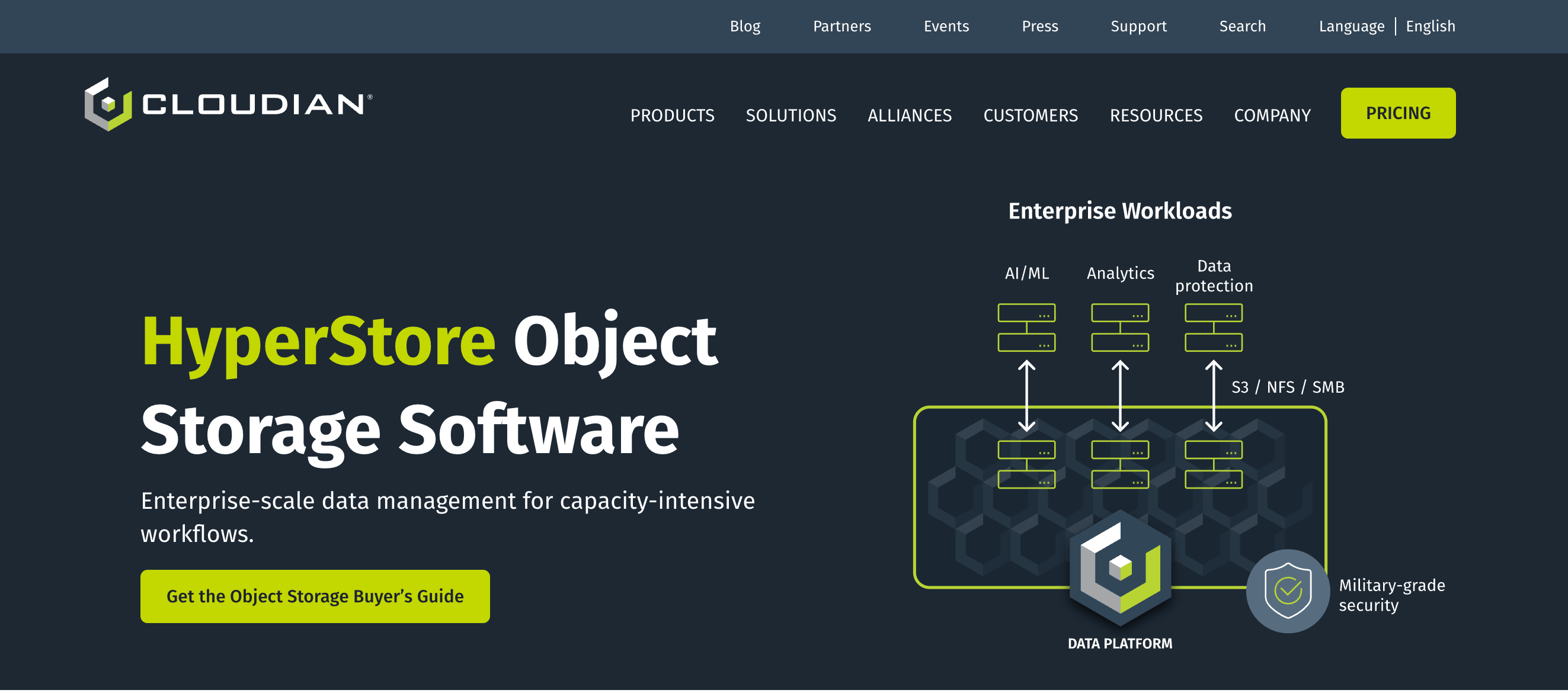
Cloudian Hyperstore provides software-defined object storage engineered for on-premises and hybrid environments. The platform enables organizations to maintain complete data governance while achieving the flexibility and scalability of cloud-scale operations. With full S3 API support and a multi-tenant design, it serves enterprises that require petabyte-scale storage within controlled infrastructure boundaries.
Cloudian Hyperstore key features:
Multi-tenant architecture with resource quotas and performance controls
Automated policy-based tiering for storage cost optimization
Native AWS integration enabling hybrid cloud workflows
Comprehensive protection, replication, and metadata analysis capabilities
Explore a comprehensive overview of Amazon S3 alternatives, featuring a breakdown of modern object storage platforms that provide flexibility, transparent pricing, and S3-compatible APIs for growing businesses.
What is object storage, and how does it differ from block or file storage?
Object storage manages data as individual objects with metadata and unique identifiers, making it ideal for unstructured data such as media files and backups. Unlike block storage (which uses fixed-size blocks for databases) or file storage (which employs hierarchical folders), object storage utilizes a flat structure that scales effortlessly to petabytes. This makes it ideal for cloud-native applications, content delivery, and AI/ML data storage, offering API-based access and built-in versioning.
Which object storage provider offers the best value in 2025?
DigitalOcean Spaces delivers exceptional value starting at just $5 per month, including 250GB of storage, 1TB of transfer, and an integrated CDN, making it ideal for digital-native enterprises, AI-native businesses, and developers. For pure storage volume, Backblaze B2 ($6/GB/month) and Wasabi ($6.99/GB/month) offer affordable pricing with no egress fees. Cloudflare R2 eliminates bandwidth costs at $0.015/GB/month for high-traffic applications.
What are the top S3-compatible object storage options?
DigitalOcean Spaces offers developer-friendly S3 compatibility with integration across the DigitalOcean ecosystem and straightforward setup. AWS S3, Google Cloud Storage, and Azure Blob Storage offer enterprise-grade compatibility with Amazon S3, providing extensive cloud integrations. Wasabi, Backblaze B2, and Cloudflare R2 offer simplified S3-compatible alternatives with transparent pricing, while MinIO and Cloudian cater to the needs of hybrid deployments.
How do I choose between cloud and self-hosted object storage?
Choose cloud storage if you want simplicity and global reach. DigitalOcean Spaces excels in this area with its integrated CDN, one-click setup, and predictable costs. AWS S3, Google Cloud Storage, and Azure Blob Storage suit enterprise multi-cloud strategies. Opt for self-hosted solutions like MinIO or Cloudian HyperStore if you need complete data sovereignty, have existing infrastructure, or face strict compliance requirements.
Which storage services integrate best with AI and ML pipelines?
DigitalOcean Spaces works with DOKS (Kubernetes) for stateful AI workloads via S3-compatible APIs and third-party CSI (Container Storage Interface) drivers. Google Cloud Storage (Vertex AI, BigQuery) and AWS S3 (SageMaker, Athena) are the dominant platforms for AI/ML integration. IBM Cloud Storage offers Watson AI connectivity, while MinIO delivers high-throughput performance for on-premises machine learning pipelines.
What cloud storage provider has the most transparent pricing?
DigitalOcean Spaces offers the clearest pricing: $5/month, all-inclusive, with no surprise charges. This makes it ideal for digital-native enterprises, AI-native companies, and developers who need predictable budgets. Wasabi ($6.99/GB/month) and Backblaze B2 ($0.06/GB/month) also eliminate hidden egress fees. Traditional providers like AWS, Google, and Azure have complex tiering and transfer costs that can increase unexpectedly, making them more challenging to budget for.
What are the leading providers of object storage?
Leading object storage providers include DigitalOcean Spaces, Amazon S3, Azure Blob Storage, and Google Cloud Storage. DigitalOcean Spaces stands out for its simplicity, S3-compatible API, and transparent pricing, making it ideal for developers and growing teams managing large-scale unstructured data.
Accelerate your AI/ML, deep learning, high-performance computing, and data analytics tasks with DigitalOcean Gradient™ AI GPU Droplets. Scale on demand, manage costs, and deliver actionable insights with ease. Zero to GPU in just 2 clicks with simple, powerful virtual machines designed for developers, startups, and innovators who need high-performance computing without complexity.
Key features:
Powered by NVIDIA H100, H200, RTX 6000 Ada, L40S, and AMD MI300X GPUs
Save up to 75% vs. hyperscalers for the same on-demand GPUs
Flexible configurations from single-GPU to 8-GPU setups
Pre-installed Python and Deep Learning software packages
High-performance local boot and scratch disks included
HIPAA-eligible and SOC 2 compliant with enterprise-grade SLAs
Sign up today and unlock the possibilities of DigitalOcean Gradient™ AI GPU Droplets. For custom solutions, larger GPU allocations, or reserved instances, contact our sales team to learn how DigitalOcean can power your most demanding AI/ML workloads.
此内容由惯性聚合(RSS阅读器)自动聚合整理,仅供阅读参考。 原文来自 — 版权归原作者所有。