







OpenAI just released GPT-5, marking arguably the biggest leap in artificial intelligence capabilities since the original ChatGPT launch. For the first time, users don’t need to choose between speed and intelligence. Now, GPT-5 automatically applies the right amount of reasoning for each task.
The newest model can write production-ready code, analyze complex business scenarios, and handle multi-step projects without getting lost halfway through. And OpenAI is making their most advanced model available to free users. Whether you’re shipping code, analyzing data, or building the future with generative AI, GPT-5 just changed the game in ways that’ll matter long after the hype dies down.
We’re excited to announce that GPT-5 is now live on the DigitalOcean Gradient™ AI Platform, giving you immediate access to OpenAI’s most advanced model through our serverless inference APIs and SDK. You can start building with GPT-5’s breakthrough reasoning and coding capabilities right away, or bring your own OpenAI API key to integrate it into your existing Gradient™ AI Platform workflows. This means you get production-ready access to cutting-edge AI without the hassle of GPU setup or model management—just sign in and start deploying in minutes.
Key takeaways:
GPT-5 eliminates the traditional trade-off between speed and intelligence by automatically applying the optimal amount of reasoning for each specific task.
For the first time, OpenAI is making their most advanced AI model available to free users, with paid subscribers receiving unlimited access and enhanced features.
The model achieves significant performance improvements including a 74.9% score on coding benchmarks, 400K token context window, and 97% success rate on complex tool calling tasks.
GPT-5 introduces “safe completion” technology that provides helpful partial answers and alternatives instead of blanket refusals while maintaining safety guardrails.
GPT-5 is OpenAI’s most advanced large language model. It features integrated reasoning capabilities that automatically apply the optimal amount of thinking based on task complexity.
“It aims to think just the perfect amount to give you the perfect answer.” – Mark Chen, OpenAI Chief Research Officer
Where GPT-4 operated more like a very smart autocomplete system, GPT-5 functions as what Sam Altman describes as “a legitimate PhD-level expert in anything, any area you need, on demand.” It can autonomously handle multi-step workflows, write complete applications from scratch, and provide subject matter expertise across virtually every domain.
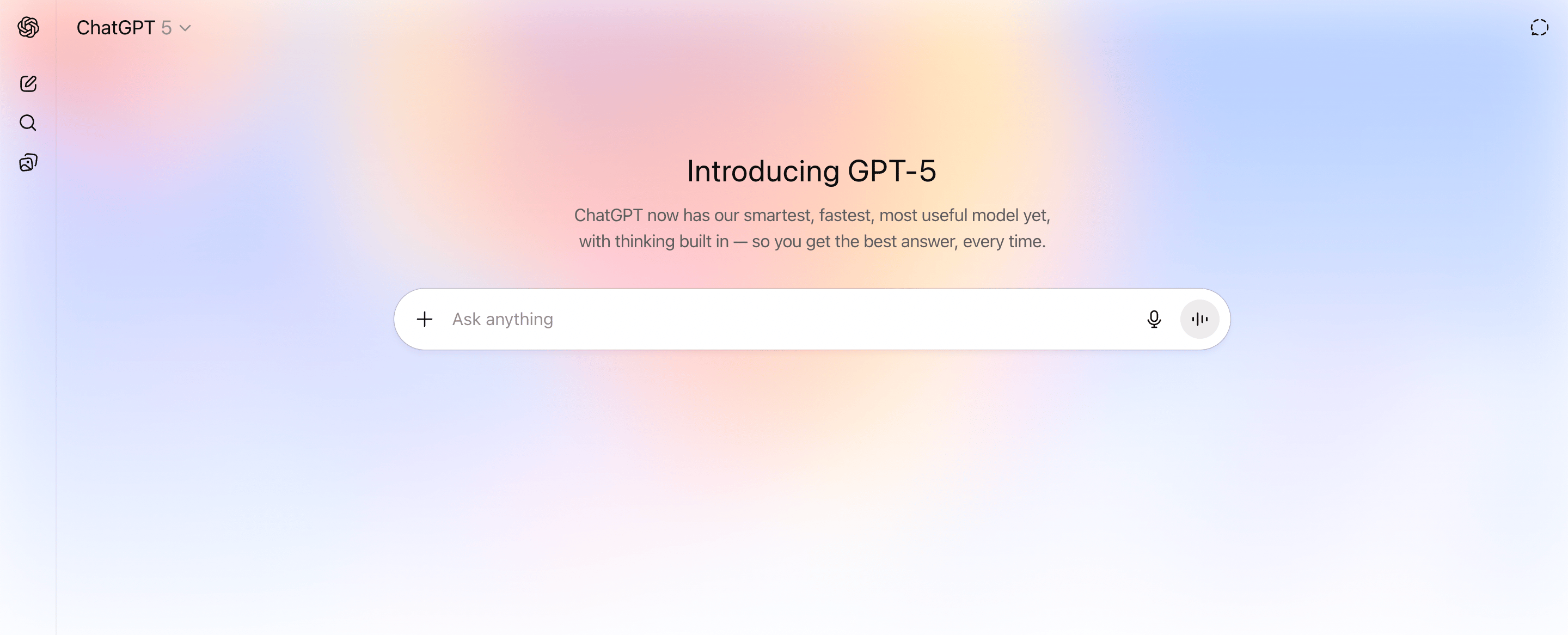
GPT-5 comes in three variants designed for different use cases:
GPT-5 (full model): Maximum capability for complex tasks requiring deep reasoning and expertise.
GPT-5 mini: Smaller but highly capable option that still outperforms the previous o3 model on many benchmarks.
GPT-5 nano: Most cost-effective variant at 25 times less expensive than the full model, ideal for high-volume applications.
GPT-5 takes a new approach to safety and reliability. The model uses a “safe completion” system that provides partial answers and helpful alternatives rather than blanket refusals (while maintaining safeguards against harmful outputs). This creates a more useful experience without compromising safety standards.
For the first time, OpenAI is making their most advanced model available to free users, with paid subscribers getting unlimited access and priority features.
The jump from GPT-4 to GPT-5 gets rid of the trade-offs that made working with AI feel like a constant compromise. GPT-4 forced you to choose your weapon: fast responses that might miss nuances, or slow reasoning that tested your patience. GPT-5 tosses that framework out the window and delivers both intelligence and speed exactly when you need them.
Integrated reasoning: No more choosing between speed and intelligence. GPT-5 automatically applies the right amount of thinking for each task.
Expanded context window: 400K tokens (double GPT-4’s 200K), allowing for much larger document analysis and longer conversations.
Superior coding performance: 74.9% on SWEBench coding benchmark versus GPT-4’s lower scores, with autonomous multi-step coding capabilities.
Better factual accuracy: Reduced AI hallucinations with new “safe completion” approach that provides partial answers rather than blanket refusals.
Tool calling mastery: 97% success rate on complex tool calling benchmarks, enabling sophisticated agentic workflows.
Better instruction following: 99% on COLLIE benchmark and 70% on multi-turn instruction tasks, up 10 points from previous models.
Advanced safety features: Less deceptive behavior and more nuanced handling of sensitive queries without over-restricting legitimate use cases.
Production-ready code generation: Creates modular, well-structured applications that actually work on first try without extensive debugging.
The result is a model and GPTs that feel less like advanced autocomplete and more like smart colleagues who happen to have expertise in every field imaginable.
“I tried going back to GPT-4, and it was quite miserable.” – Sam Altman, OpenAI CEO
The strategy is clear: get GPT-5 into as many hands as possible, then let the capabilities sell the premium tiers. For most users, the free access will provide more AI horsepower than they’ve ever had before.
This isn’t some limited demo or watered-down version, either. Anyone willing to create a free account gets the full GPT-5 experience. The only catch is that free users hit usage limits and then get bumped down to GPT-5 mini, but that still outperforms most models from six months ago.
The GPT-5 announcement was made on August 7th for immediate rollout to all users.
Access tiers and availability:
Free users: Full GPT-5 access with usage limits, then automatic transition to GPT-5 mini when limits are reached.
ChatGPT Plus ($20/month): Unlimited GPT-5 access with priority processing and exclusive features like enhanced voice capabilities.
Team and Enterprise: Generous rate limits for organizational use, rolling out next week with admin controls and compliance features.
API access: Available immediately for developers with three model variants:
GPT-5: $1.25 per 1 million input tokens
GPT-5 mini: More affordable option for standard tasks
GPT-5 nano: 25x cheaper than full GPT-5 for high-volume applications
Geographic rollout: Starting with US users, expanding to international markets over the coming weeks.
New features included across all tiers:
Voice interaction (hours for free users, unlimited for paid)
Gmail and Google Calendar integration (starting with Pro users)
Custom personalities and chat interface colors
Improved memory capabilities
All existing tools (search, file upload, image generation, Python analysis)
The shift from “AI-assisted coding” to “AI-driven development” changes everything. Instead of asking GPT-5 to write individual functions, you can assign it entire features or applications. Instead of debugging AI-generated code, you’re reviewing and directing autonomous development processes.
This has never been about replacing developers. Instead, it’s about amplifying what experienced developers can accomplish while making complex development accessible to non-technical team members.
For infrastructure teams, GPT-5’s understanding of cloud architectures and deployment patterns means faster prototyping and more reliable production deployments from day one.
New coding capabilities:
Agentic workflows: GPT-5 can work autonomously for extended periods, handling multi-step tasks like refactoring entire codebases or building full applications from scratch.
Production-ready output: Generates modular, well-structured code that actually compiles and runs on first try (no more “almost working” demos that need extensive debugging).
Superior language support: 88% score on Aider Polyglot benchmark, with native-level proficiency across programming languages and frameworks.
Front-end excellence: Creates beautiful, interactive UIs with proper responsive design, accessibility features, and modern best practices built-in.
Self-debugging capabilities: Identifies errors in its own code, runs builds, interprets error messages, and fixes issues without human intervention.
Better API and tooling:
Custom tools: Free-form plaintext tool calling instead of rigid JSON schemas to make complex integrations easier.
Context-aware development: 400K token window allows for full codebase understanding and architectural decision-making.
Structured outputs: Regular expressions and context-free grammar constraints for accurate API responses and data formatting.
Verbosity controls: Dial response length up or down based on whether you need quick fixes or detailed explanations.
GPT-5 is already deployed in production environments solving real business problems. Early enterprise testers report productivity gains with complex workflows that previously took weeks now completed in hours. The use cases below were all explored in OpenAI’s GPT-5 announcement video, covering everything from interactive educational demos and coding projects to healthcare support and voice-powered language learning.
Amgen (the biotechnology giant fighting some of humanity’s toughest diseases) became one of GPT-5’s first enterprise testers for drug discovery workflows. The model’s deep reasoning capabilities analyze scientific literature and clinical data at a scale and speed that human researchers simply can’t match. Meanwhile, Oscar Health insurance company deploys GPT-5 for clinical reasoning tasks to match complex patient conditions to policy requirements with accuracy that exceeds traditional automated systems.
Most importantly, healthcare organizations are using GPT-5 to empower patients themselves. The model translates complex medical reports into plain language to help patients understand their conditions and make informed treatment decisions.
BBVA, the multinational bank headquartered in Madrid, says that GPT-5 beats every competing model for financial analysis tasks in terms of both accuracy and speed. Tasks that previously required three weeks of expert analysis now complete in just a few hours.
This is more than just efficiency, too. It’s also about the quality of insights GPT-5 can extract from complex financial data to identify patterns and risks that traditional analysis might miss.
The model’s reasoning capabilities are great at evaluating loan applications, investment risks, and regulatory compliance scenarios. Financial institutions find that GPT-5’s ability to process nuanced, context-dependent information makes it super helpful for tasks that require both technical expertise and business judgment.
OpenAI announced that 2 million US federal employees will have access to GPT-5 and ChatGPT. This signals a major shift in how government agencies approach citizen services and administrative efficiency. Early implementations focus on policy analysis, regulatory response drafting, and automated processing of citizen requests and permit applications.
The model’s improved safety features and factual accuracy make it usable for public sector applications where precision and reliability are non-negotiable.
The shift from GPT-4 to GPT-5 changes how you can approach problem-solving. The old model of asking for quick answers is giving way to collaborative workflows where GPT-5 acts as a thinking partner rather than a smart search engine.
For developers, start experimenting with agentic workflows instead of one-off code generation. Give GPT-5 complex, multi-step projects and let it work autonomously. The model excels when you provide clear objectives but trust it to determine the implementation path. As Cursor’s CEO noted, “GPT-5 is a step forward towards a real power programmer—start using it as a daily driver model for you.”
For business leaders, identify processes that require expert-level reasoning across multiple steps. GPT-5 shines in scenarios that combine domain expertise with complex decision-making. Think less “write me an email” and more “analyze this market situation and recommend a strategic response.”
For everyone else, embrace the model’s ability to adapt to your communication style and work patterns. Use the new personality features, integrate it with your calendar and email, and let GPT-5’s improved memory build context about your preferences over time.
Think about shifting from transactional AI interactions to collaborative relationships where GPT-5 becomes an extension of your thinking process rather than just another tool in your toolkit.
When is GPT-5 available?
GPT-5 is available now. OpenAI released the model on August 7, 2025, with immediate access for free users, ChatGPT Plus subscribers, and API developers.
Is GPT-5 free to use?
Yes, GPT-5 is available to free users for the first time in OpenAI’s history. Free accounts get access to the full GPT-5 model with usage limits, then automatically transition to GPT-5 mini when limits are reached. ChatGPT Plus subscribers ($20/month) get unlimited GPT-5 access.
How much better is GPT-5 than GPT-4?
GPT-5 scores 74.9% on coding benchmarks versus GPT-4’s lower performance, achieves 97% on tool calling tasks (up from 49% maximum just two months ago), and features a 400K context window (double GPT-4’s capacity). The model also integrates reasoning capabilities automatically rather than requiring users to choose between speed and intelligence.
What are the main safety improvements in GPT-5?
GPT-5 introduces “safe completion” technology that provides partial answers and helpful alternatives instead of blanket refusals. The model is less deceptive than previous versions and better handles nuanced, dual-use scenarios without sacrificing safety guardrails.
What’s the difference between GPT-5, GPT-5 mini, and GPT-5 nano?
GPT-5 is the full-capability model for complex tasks. GPT-5 mini offers strong performance at lower cost, still outperforming the previous o3 model. GPT-5 nano provides the most economical option at 25 times less expensive than the full model, perfect for high-volume applications.
DigitalOcean Gradient™ AI Platform makes it easier to build and deploy AI agents without managing complex infrastructure. Build custom, fully-managed agents backed by the world’s most powerful LLMs from Anthropic, DeepSeek, Meta, Mistral, and OpenAI. From customer-facing chatbots to complex, multi-agent workflows, integrate agentic AI with your application in hours with transparent, usage-based billing and no infrastructure management required.
Key features:
Serverless inference with leading LLMs and simple API integration
RAG workflows with knowledge bases for fine-tuned retrieval
Function calling capabilities for real-time information access
Multi-agent crews and agent routing for complex tasks
Guardrails for content moderation and sensitive data detection
Embeddable chatbot snippets for easy website integration
Versioning and rollback capabilities for safe experimentation
Get started with DigitalOcean Gradient™ AI Platform for access to everything you need to build, run, and manage the next big thing.
此内容由惯性聚合(RSS阅读器)自动聚合整理,仅供阅读参考。 原文来自 — 版权归原作者所有。