


With the rise of AI writing tools, more marketing content, copywriting, and blog posts you encounter online are likely AI-generated. You may not have even noticed: about 50% of readers cannot distinguish between AI-generated and human-written content. These tools can be helpful, speeding up content production and allowing teams to scale their output without adding more writers. They excel at generating first drafts and handling repetitive writing tasks, freeing up human creativity for more strategic work.
However, they come with risks: without the right prompting and specificity, you risk your content sounding like everyone else’s, missing the human touch. AI content detectors can be used to help you ensure that your content sounds human and passes authenticity checks. Outside of business in education settings, where academic rules limit AI use in student work, AI-generated content has become a concern. If you’re an administrator or instructor at a university or college, you may be exploring these AI detection tools to ensure that students submit unique and original work; if you’re a student, it’s worth understanding how these tools work to identify content that doesn’t meet your institution’s requirements.
Read on to learn about how AI content detectors work, their benefits and limitations, and the best AI content detector tools available.
Key takeaways:
AI content detectors analyze text to predict whether it was written by a human or generated by an AI model, looking for patterns or anomalies that are characteristic of machine-generated text.
They work by using algorithms or models trained on examples of human vs AI-written text, catching subtle differences in phrasing, randomness, or consistency that might not be obvious to human readers.
With AI-written content on the rise, these detectors are becoming important for educators, publishers, and platforms to verify authenticity, though they have limitations and must evolve as AI text generation becomes more sophisticated.
AI content detectors determine whether a given piece of content is generated using AI content generation tools or is written by a human. These tools aim to identify the authenticity of a content piece and determine the extent to which AI content generation tools have been used.
Think of these AI content verification tools as ‘content authenticators’, enabling you to distinguish between AI and human-written text. These tools help businesses check if their AI-written content looks natural enough to pass as human-created, letting them refine drafts before publishing anything that might seem too robotic or generic to their audience. For academic institutions, these detectors help instructors identify submissions where students may have used AI instead of developing their ideas and work.
AI content detectors usually detect AI-generated content by identifying specific phrases, words, or repetitive patterns. These tools use statistical analysis to determine text patterns, sentence structures, and phrases to determine the extent of AI content generation. Machine learning, which trains these detection models, is the backbone of these detections.
Some of the more complex detection algorithms look for semantic coherence, styling consistency, and grammatical framing of the sentence to determine the use of AI content generation tools. AI detection tools also analyze patterns in word usage, flagging content when it contains suspiciously high frequencies of LLM favorites like “delves,” “showcasing,” “underscores,” “crucial,” and “insights”—telltale markers that appeared up to 25 times more often in scientific abstracts after large language models became widespread.
AI content detectors vary wildly in accuracy, with even the best tools frequently misidentifying human-written content as AI-generated. These false positives occur because the detectors rely on statistical patterns and word frequency analysis, flagging text that contains specific phrases or structures common in AI writing—words like “delves,” “showcasing,” and “crucial” that appear much more frequently in machine-generated text. The problem worsens with shorter writing pieces, with less data for the detector to analyze.
OpenAI acknowledged the limitations of detection technology when they abandoned their classifier tool. As they stated on July 20, 2023: “The AI classifier is no longer available due to its low accuracy rate.” Before shutting it down, their tool correctly identified only 26% of AI-written text while incorrectly labeling human-written text as AI-written 9% of the time—hardly reliable enough for serious use.
Companies and universities should proceed with extreme caution when implementing these detection tools. Businesses might wrongly reject genuine marketing copy or job applications based on faulty AI flagging. For academic institutions, the stakes are even higher—students writing original work could face accusations of cheating simply because their writing style triggers algorithmic red flags. Until detection technology improves dramatically, these tools should be used as just one data point in a broader evaluation process, never as the basis for important decisions.
Every technology has two sides; using AI content detectors is no different. Below are some pros and cons to help understand the opportunities and limitations of these apps:
Authenticity of content: Detecting AI-generated content can verify the authenticity of the overall content and help ensure that published content sounds human.
Quality control: Several AI content detectors also improve content readability, sentence structure, and polish before publishing it, which helps raise the content’s quality level.
Maintain academic integrity: AI content detector tools provide educational institutions with tools to check student assignments and detect AI-generated content. This encourages students to create more unique and genuine content and urges them to work on their creative thinking.
False positives: Although these tools accurately detect AI-generated content, some false positives diminish the authenticity of human-generated content. This is one of the significant challenges of using these AI content detector tools, as they can falsely identify human-generated content as AI content at any given time, resulting in considerable error.
Technical writing misdirection: These tools cannot identify highly complex and technical writing, which can sometimes be misinterpreted as AI-generated content, reducing the efficiency of human-generated content.
Limited transparency: Some tools offer limited transparency regarding their detection methods, making it difficult to understand the reason behind the false positives and rectify the AI-generated content.
With the rise of AI-generated content, ensuring the authenticity of the content being published online is essential. AI content detectors are now playing a crucial role in establishing the authenticity of the content. Below are some of the most popular AI content detector tools.
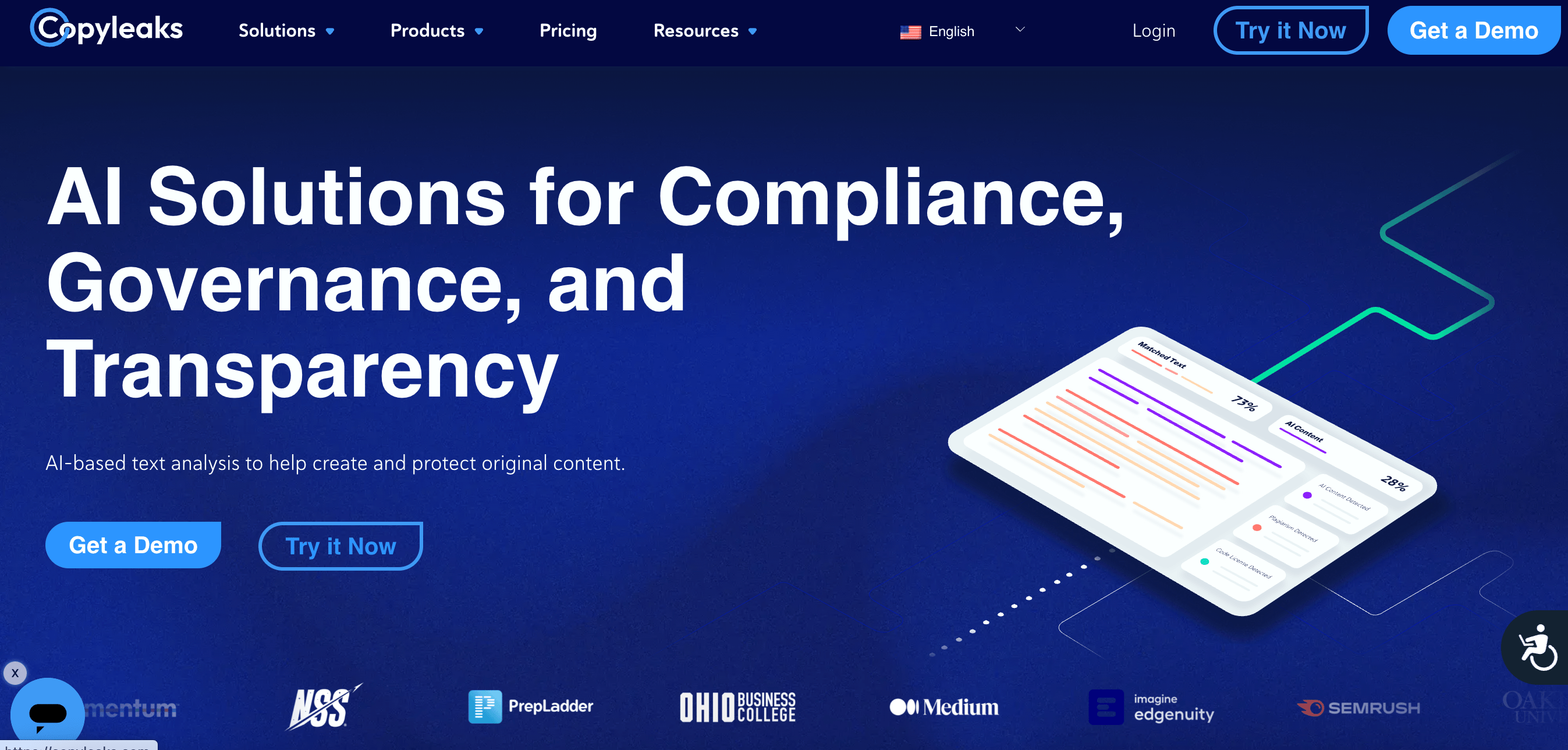
Copyleaks offers enterprise-grade content verification tools that can help detect AI content in multiple languages. It uses advanced machine learning algorithms to detect the presence of AI-generated content in the given content. This AI-ML model compares and identifies any instances of copying or paraphrasing in the text from its database. With Copyleaks, you get detection analysis on most AI writing tools and models, including ChatGPT, Claude, and Gemini.
Key features:
PDF and document format scanning
GenAI Governance and Compliance
LMS integration with platforms like Blackboard, Canvas, D2L, and others
AI+Plagiarism Detection: $16.99/month. It includes 100 credits, multi-language detection, two users included, multiple paraphrasing detection, and detection of models like ChatGPT, Gemini, and Claude.
AI Detector: $9.99/month. It includes up to 100 credits, two uses, multilingual detection, and AI model detection.
Enterprise &LMS: custom pricing. It includes white label API integration, Turnkey LMS integration, customer permission +SSO, and a dedicated customer support team.
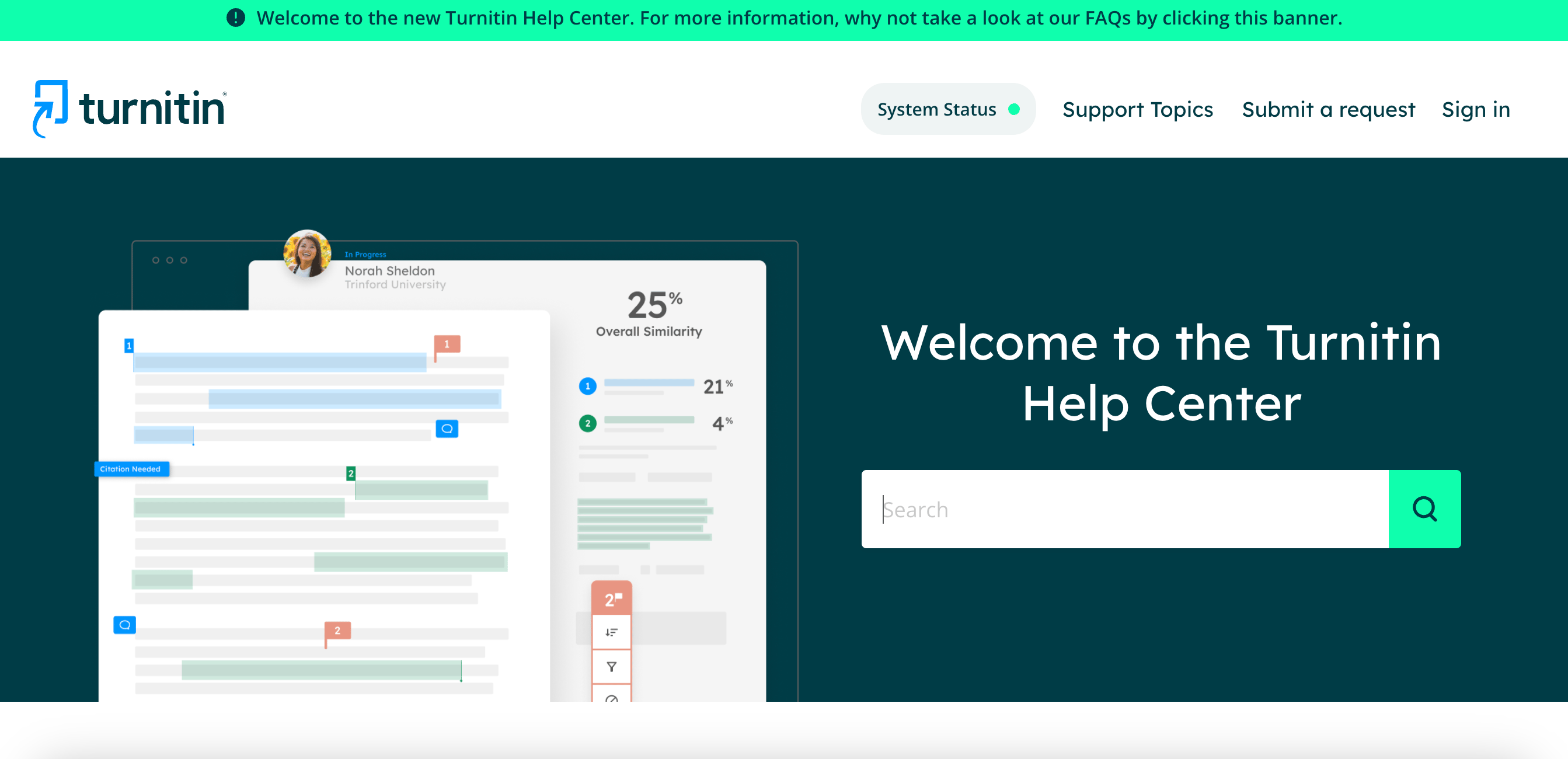
Turnitin is one of the most commonly used AI-written content checkers in educational institutions, such as schools or universities. It compares the given text to a database of other existing texts to identify the chances of paraphrasing and copied content.
It claims to detect writing from models such as Bard, Claude, and ChatGPT. In addition to student assignments, Turnitin offers solutions for academic publications and research papers, helping maintain the originality of scholarly work across the entire educational ecosystem.
Key features:
Integration with the LMS platform
Detailed feedback on writing style, along with AI content detection
Institutional reporting dashboards
Originality report with AI probability score
Plagiarism and AI content detection
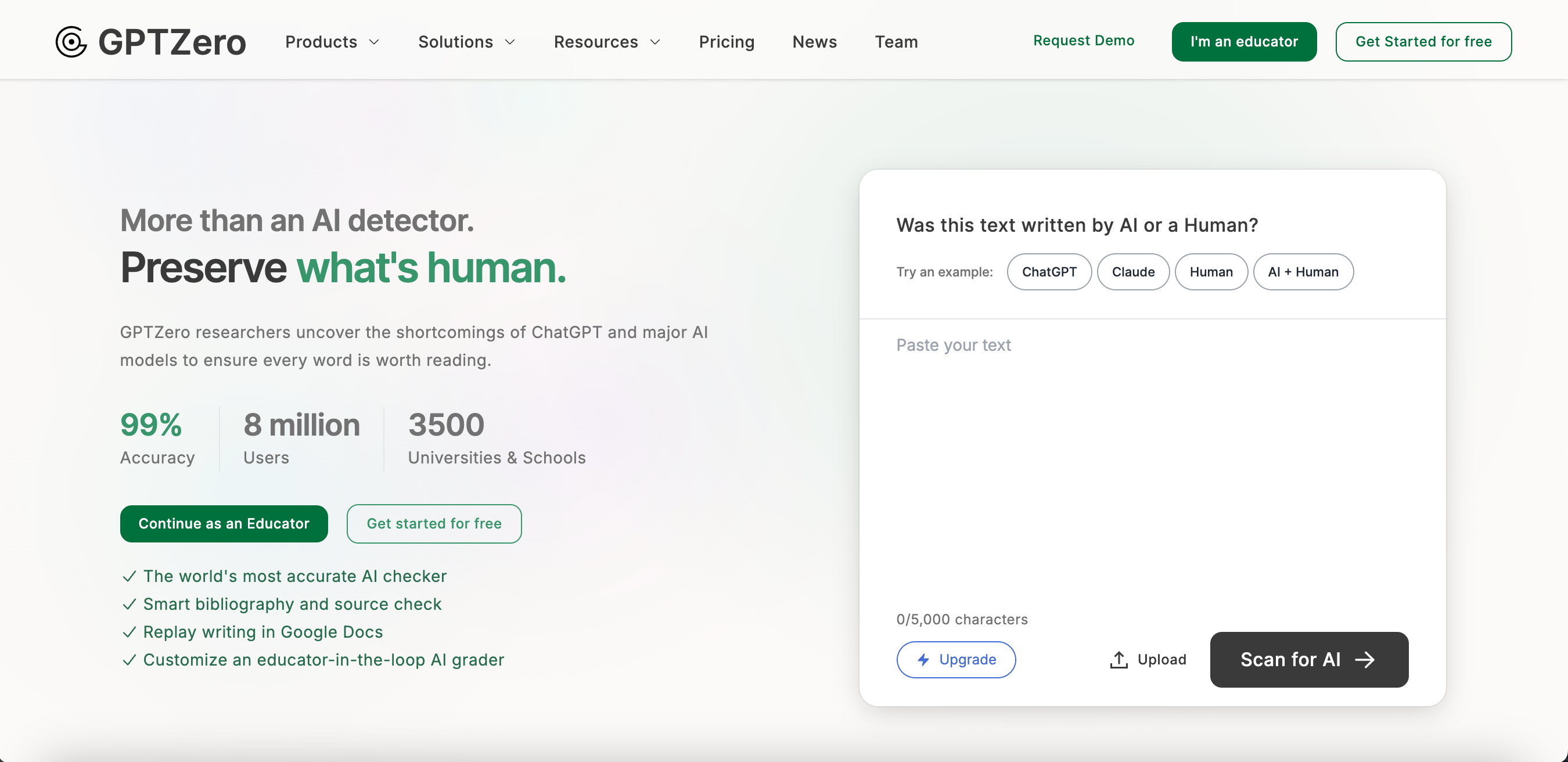
GPTZero is a leading name in AI content detection tools. It is built with a seven-layer detection program, contributing to its accuracy in detecting most AI writing models. It includes a Google Chrome extension, making it convenient to use, and document and sentence-level detection for offering detailed insights into AI content generation. Beyond basic detection, these tools provide specialized features including vocabulary analysis to identify standard AI terms, authorship verification to confirm content origin, and source verification to validate claims with reliable references.
Key features:
Classroom mode is specific for educational institutions to check student assignments
Mobile app for on-the-go AI content detection
Video replay to ensure the authenticity of content
AI detection for workspace and classroom, including Google Docs, Chrome, Canvas, Moodle, and Zapier
Essential: $14.99/month. It includes 150,000 words per month, grammar and vocabulary checks, and a Chrome extension.
Premium: $23.99/month. It includes 300,000 words per month, all basic features, advanced scan, writing feedback, plagiarism check, and source and generate citations.
Professional: $45.99/month. It includes 500,000 words per month with all premium features and additional features, including scanning 250 files simultaneously, page-by-page scanning, team collaboration, and enterprise-grade security.
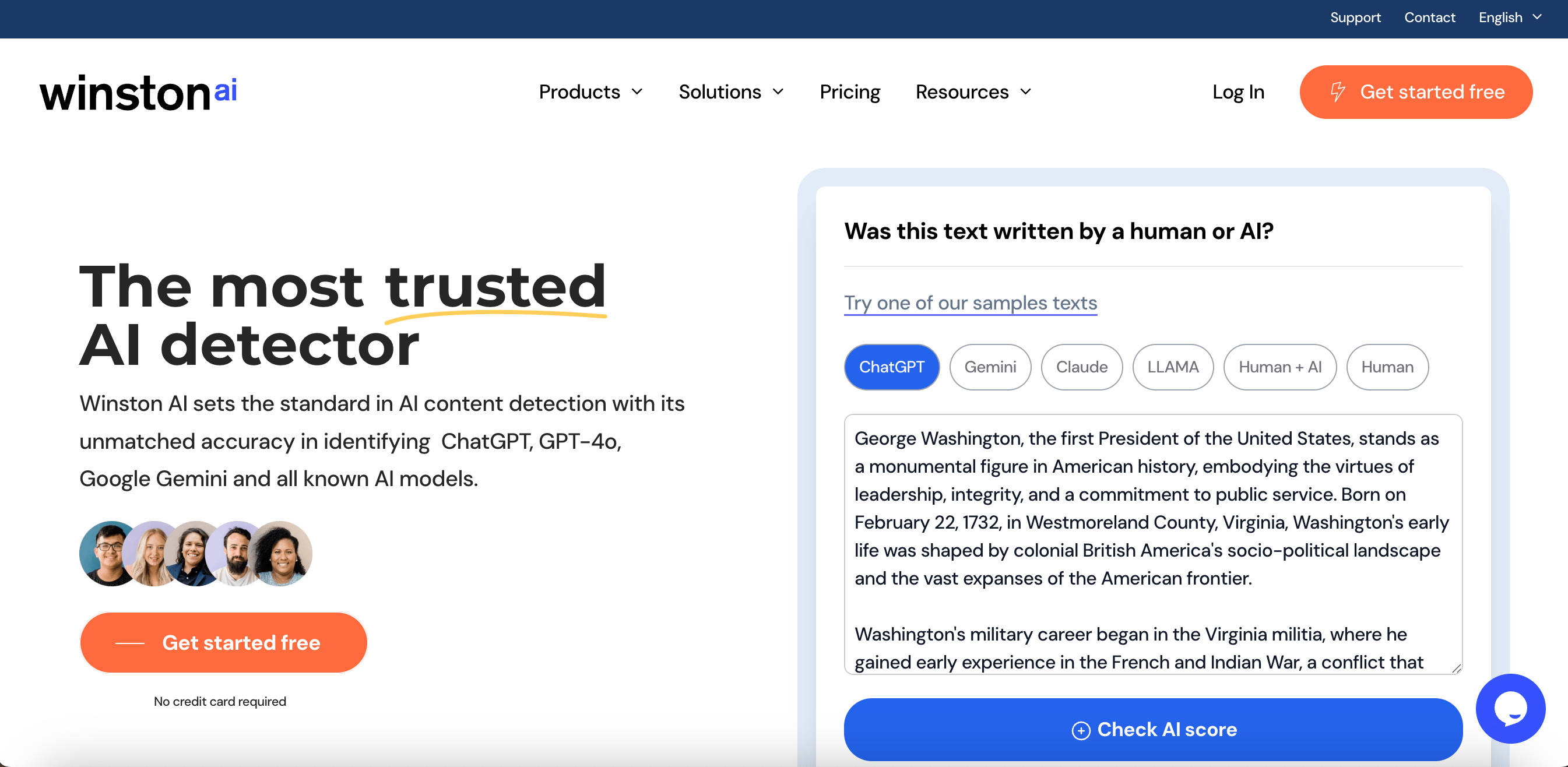
Winston AI is an enterprise solution that emphasizes the scalability and integration capabilities for organizations that create high volumes of content. It implements multiple content detection strategies simultaneously and cross-references all the results to increase the accuracy of the content detection. The tool analyzes text patterns and compares them against known AI writing samples from different models like ChatGPT, Claude, and Gemini. It offers a probability score indicating whether the content was human-written or machine-generated.
The company works to keep pace with new AI writing technologies, making it valuable for organizations with future-proof detection capabilities.
Key features:
Enterprise-grade security with SOC 2 compliance
OCR technology (Optical Character Recognition) to extract text from scanned documents, pictures, and handwriting
AI prediction map with color-coding and detailed results, along with shareable reports
Free: $0. It includes 2000 credits and comes with a 14-day trial. AI content detection (ChatGPT, Claude, Gemini), AI image and deepfake image detection, e-mail and chat support, along with scanning of documents, and scanning of pictures and handwriting (OCR)
Essential: $18/month. It includes 80,000 credits/month, all features of the free version with writing feedback, and PDF reports for sharing.
Advanced: $29/month. It includes 200,000 credits/month with all features of the Essential package, advanced plagiarism detection, HUMN-1 website certification, and up to 5 team members to be added.
Elite: $49/month. It includes 500,000 credits/month, all the Advanced version features, unlimited team members, and top-up credits.
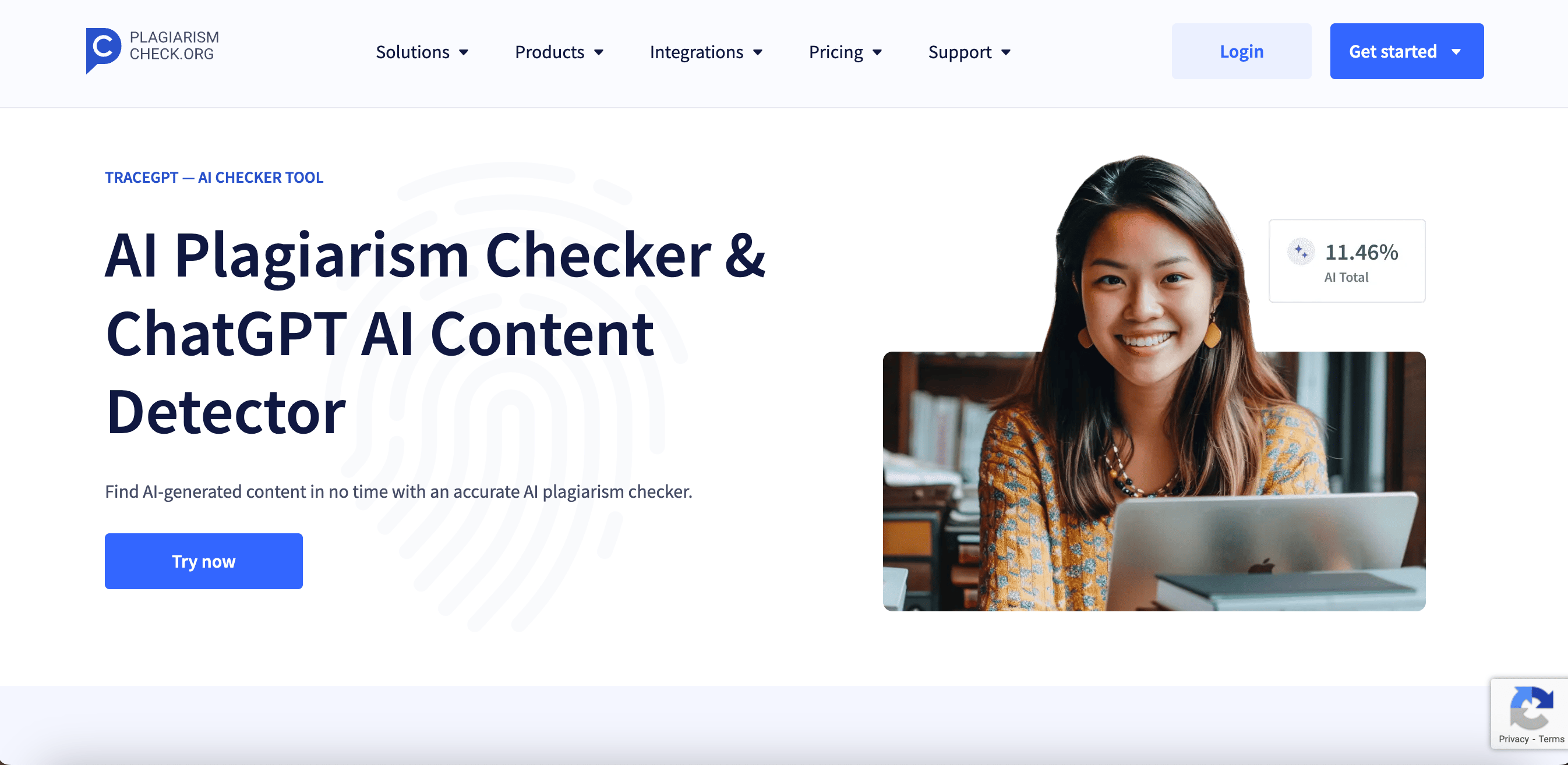
TraceGPT distinguishes itself from other tools with its open-source approach, offering a specialized focus on open AI platforms. It also provides absolute transparency by detecting content from widely available online research papers and articles. It provides a browser extension for better usability and works easily with Google Docs and other LMSs.
Key features:
Academic citation system tracking AI content in research articles
Command-line interface for technical users
Developer-friendly API and comprehensive documentation
Offers you a detection limit of 97 pages
AI Standard: $4.99/month. It offers AI detection up to 750 pages, downloadable AI reports, no daily limits, and customer support.
Individuals: $9.99/month. This Light plan offers AI detection (250 pages) and plagiarism check (50 pages) with no daily limit, citation generator, and grammar check.
Business: $299/month. This Light Teams plan offers Plagiarism detection (5000 pages) and AI content detection (25000 pages) with no daily limits, a citation generator, and a grammar check.
Organizations: custom pricing. It offers search via publicly available records, grammar check, Google Docs add-on, and integration with LMS, including Google Classroom, Moodle, and Canvas.
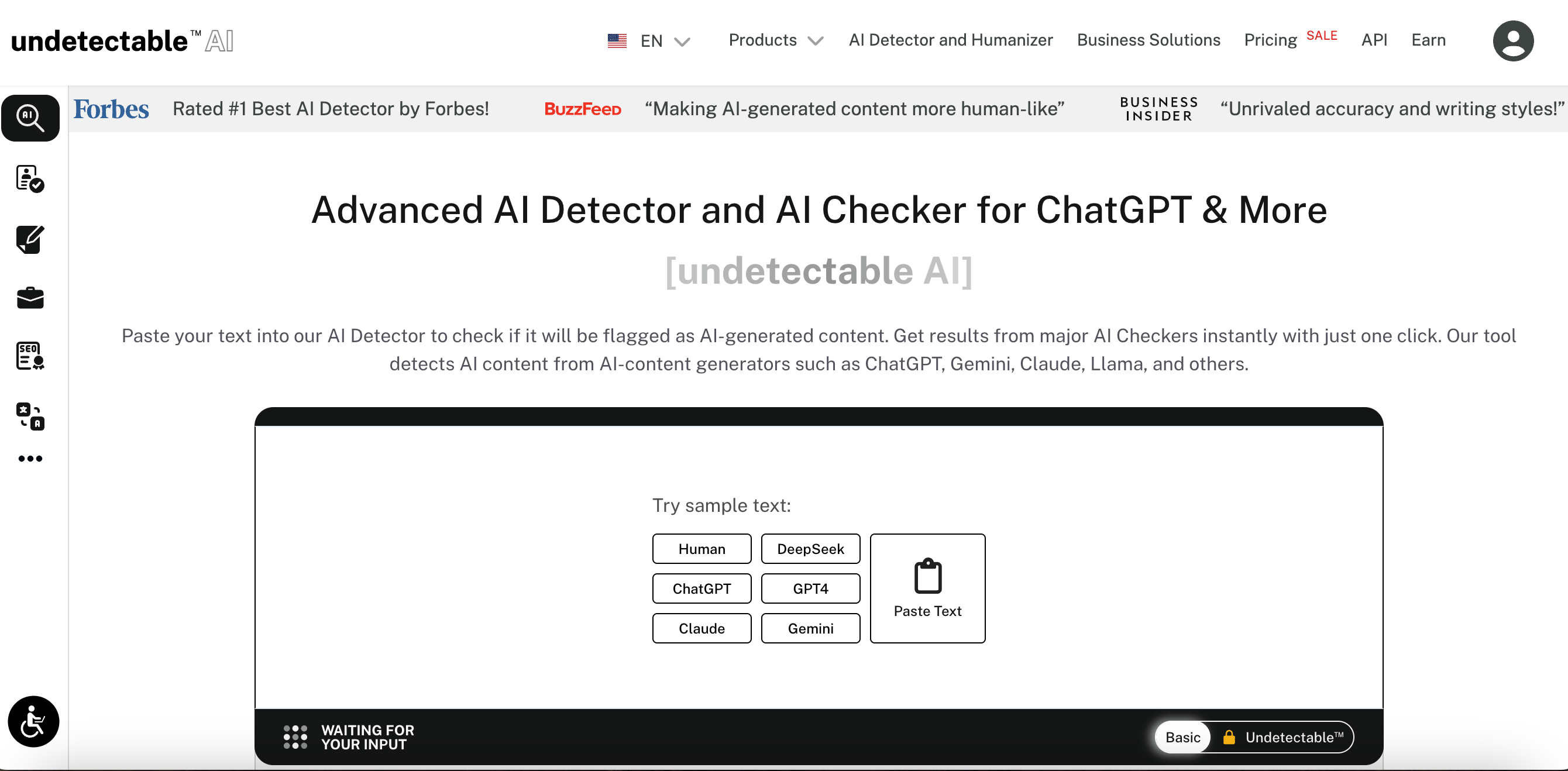
Undetectable AI is one of the most renowned AI content detector tools among industry experts. This tool offers a comprehensive analysis of the content’s AI detection probability. It can easily detect models such as ChatGPT, GPT4, GPT3, Llama, Claude, Gemini, and various other tools. This tool offers dual functionality of an AI content detector and a content humanizer to offer your AI-generated content a more personalized tone.
Key features:
Real-time content detection reports
Learning algorithms to adapt to new detection methods
Widget integration on the website for businesses
Monthly: $15.99/month, with a word limit of 15,000 words/month. It includes an unlimited AI detector, a human auto typer, and API compatibility.
Yearly (discounted): $5.00/month with a word limit of 10,000 words/month. It includes API compatibility, unlimited AI detector, and a human auto-typer.
Business: Custom pricing. It includes non-expiring credits, API compatibility, priority support, redistribution, white-labeling, and unlimited AI content detection.
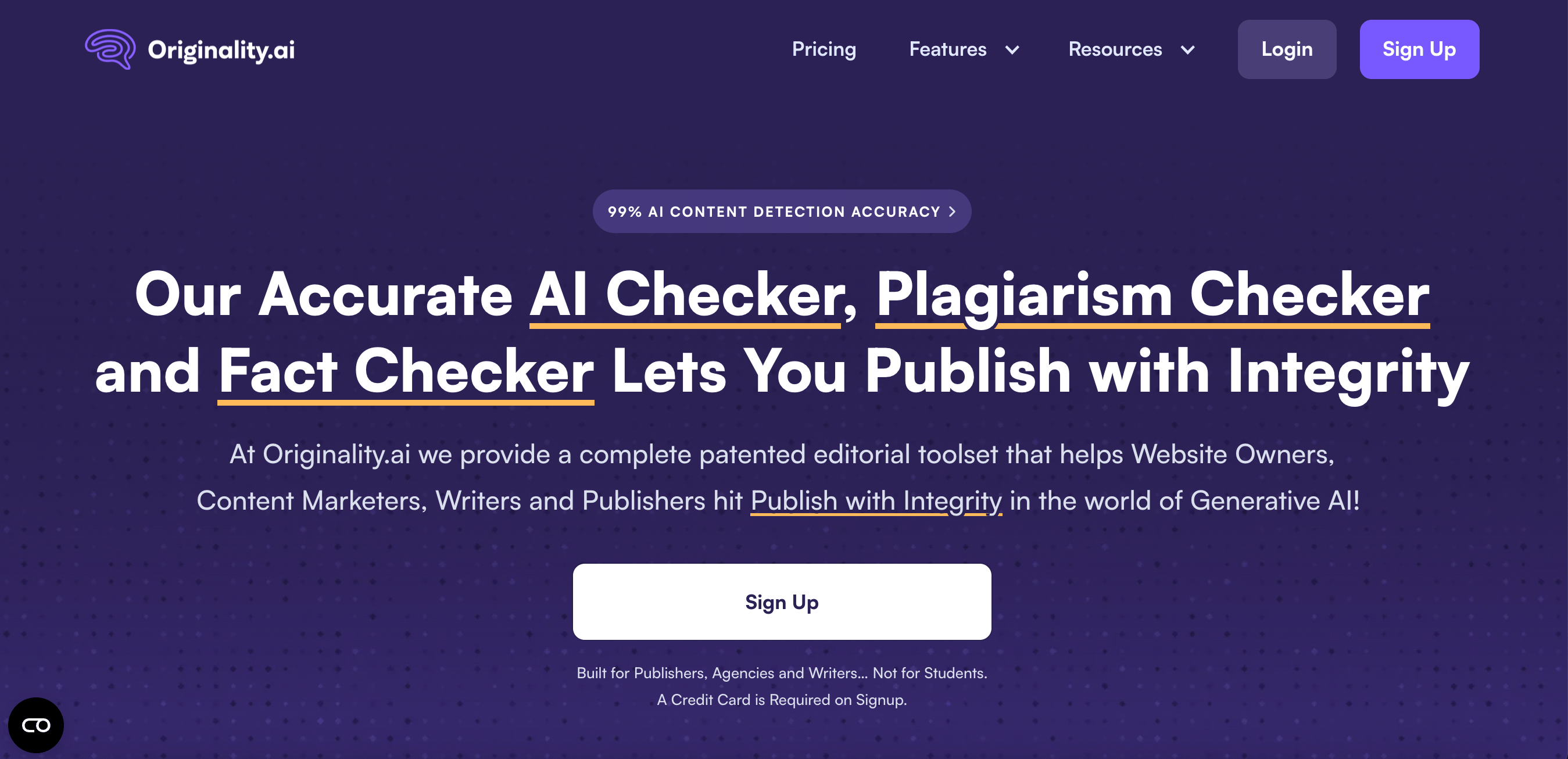
Originality AI is designed with content creators and SEO professionals as the primary users. It focuses mainly on digital publishing. The platform is designed to understand and detect the common phrases and patterns used in online articles and marketing content to enhance the authenticity of the content. The tool helps manage expectations around AI content usage, enables proof against false positives through its “watch a writer write” feature, reduces factual errors and hallucinations, and provides editorial controls that improve content quality and search ranking.
Key features:
WordPress plugins for integration into the publishing workflow
Chrome extension for easy usability
Built and trained on ‘adversarial datasets’
Team management dashboards for content teams to access
Pay-as-you-go: $30. It comes with 3000 credits and a 2-year subscription. It offers an AI detector, plagiarism detection, readability checker, grammar and spelling checker, fact-checking, SEO optimizer, shareable and downloadable reports, and a WordPress plugin.
Pro: $14.95/month. It includes 2000 credits (renews monthly), all the features of the pay-as-you-go plan, Chrome extension, full site scan, scan from URL, and file upload.
Enterprise: $179/month. It includes 15,000 credits (renews monthly), all the features of the Pro version, priority customer support, and API access.
What are AI content detectors and why are they important?
AI content detectors are specialized tools that analyze text to determine whether it was written by artificial intelligence or humans, using machine learning algorithms to identify patterns and characteristics typical of AI-generated content. These tools have become increasingly important as AI-generated content proliferates across academic, professional, and creative domains, helping maintain content authenticity and academic integrity.
How accurate are current AI content detection tools?
Current AI content detection tools typically achieve accuracy rates between 70-95%, but their effectiveness varies significantly based on the sophistication of the AI model used to create the content and the length of the text being analyzed. Detection becomes more challenging with newer AI models and shorter text samples, and tools may produce false positives when analyzing human-written content that happens to follow patterns similar to AI generation.
What are the main use cases for AI content detectors?
Educational institutions use these tools to maintain academic integrity and prevent AI-assisted cheating on assignments and exams. Content creators, publishers, and SEO professionals employ them to verify the authenticity of submitted work, ensure compliance with platform policies, and maintain quality standards for human-authored content.
What limitations should users be aware of when using AI content detectors?
AI content detectors may struggle with mixed human-AI content, produce false positives on legitimate human writing, and become less effective as AI models continue to evolve and improve. Users should treat detection results as one data point rather than definitive proof, and consider multiple factors including context, writing style consistency, and subject matter expertise when evaluating content authenticity.
DigitalOcean Gradient Platform makes it easier to build and deploy AI agents without managing complex infrastructure. Build custom, fully-managed agents backed by the world’s most powerful LLMs from Anthropic, DeepSeek, Meta, Mistral, and OpenAI. From customer-facing chatbots to complex, multi-agent workflows, integrate agentic AI with your application in hours with transparent, usage-based billing and no infrastructure management required.
Key features:
Serverless inference with leading LLMs and simple API integration
RAG workflows with knowledge bases for fine-tuned retrieval
Function calling capabilities for real-time information access
Multi-agent crews and agent routing for complex tasks
Guardrails for content moderation and sensitive data detection
Embeddable chatbot snippets for easy website integration
Versioning and rollback capabilities for safe experimentation
Get started with DigitalOcean Gradient Platform for access to everything you need to build, run, and manage the next big thing.
此内容由惯性聚合(RSS阅读器)自动聚合整理,仅供阅读参考。 原文来自 — 版权归原作者所有。