





Python Data Types are used to define the type of a variable. In this article, we’ll list out all the data types and discussion the functionality of each. If you are starting out in Python, don’t forget to first visit the Python tutorial for beginners. And if you’ve already gone through the same, don’t forget to check out our previous tutorial on Python Comments and Statements.
memoryview and bytearray enable high-performance manipulation of binary data, reducing memory usage and copy operations for large datasets.decimal over floating-point types to avoid rounding errors.There are different types of data types in Python. Some built-in Python data types are:
Python numeric data type is used to hold numeric values like;
In Python, we need not declare a datatype while declaring a variable like C or C++. We can simply just assign values in a variable. But if we want to see what type of numerical value is it holding right now, we can use type(), like this:
    #create a variable with integer value.
    a=100
    print("The type of variable having value", a, " is ", type(a))

    #create a variable with float value.
    b=10.2345
    print("The type of variable having value", b, " is ", type(b))

    #create a variable with complex value.
    c=100+3j
    print("The type of variable having value", c, " is ", type(c))
If you run the above code you will see output like the below image. 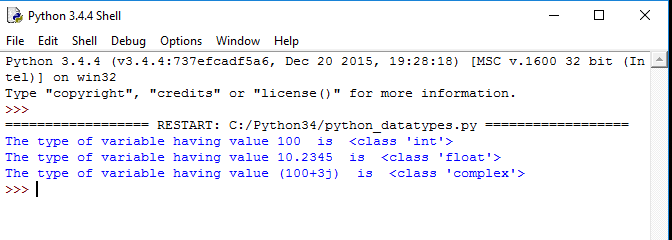
The string is a sequence of characters. Python supports Unicode characters. Generally, strings are represented by either single or double-quotes.
    a = "string in a double quote"
    b= 'string in a single quote'
    print(a)
    print(b)

    # using ',' to concatenate the two or several strings
    print(a,"concatenated with",b)

    #using '+' to concate the two or several strings
    print(a+" concated with "+b)
The above code produces output like the below picture- 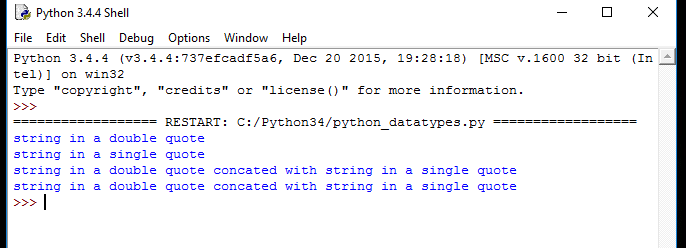
The list is a versatile data type exclusive in Python. In a sense, it is the same as the array in C/C++. But the interesting thing about the list in Python is it can simultaneously hold different types of data. Formally list is an ordered sequence of some data written using square brackets([]) and commas(,).
    #list of having only integers
    a= [1,2,3,4,5,6]
    print(a)

    #list of having only strings
    b=["hello","john","reese"]
    print(b)

    #list of having both integers and strings
    c= ["hey","you",1,2,3,"go"]
    print(c)

    #index are 0 based. this will print a single character
    print(c[1]) #this will print "you" in list c
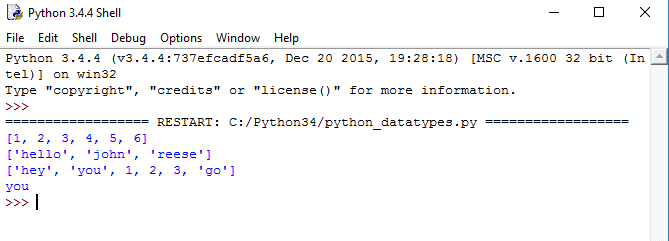
The above code will produce output like this-
The tuple is another data type which is a sequence of data similar to a list. But it is immutable. That means data in a tuple is write-protected. Data in a tuple is written using parenthesis and commas.
    # tuple having only integer type of data.
    a=(1,2,3,4)
    print(a) #prints the whole tuple

    # tuple having multiple type of data.
    b=("hello", 1,2,3,"go")
    print(b) #prints the whole tuple

    #index of tuples are also 0 based.
The output of this above python data type tuple example code will be like the below image. 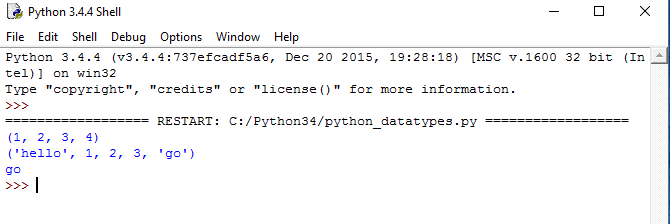
Python Dictionary is an ordered collection of key-value pairs. As of Python 3.7, dictionaries maintain insertion order as a language guarantee. It is similar to the hash table type. Dictionaries are written within curly braces in the form key:value. It is very useful to retrieve data in an optimized way among a large amount of data.
    #a sample dictionary variable

    a = {1:"first name",2:"last name", "age":33}

    #print value having key=1
    print(a[1])
    #print value having key=2
    print(a[2])
    #print value having key="age"
    print(a["age"])
If you run this python dictionary data type example code, the output will be like the below image. 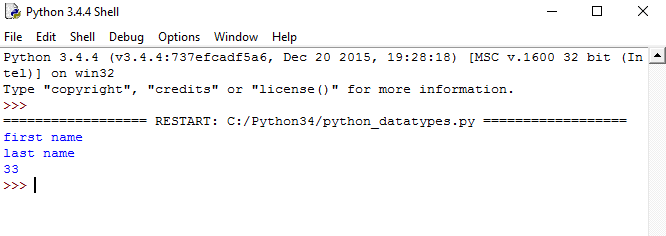
What are common pitfalls when working with mutable and immutable data types in Python?
Mutable types like lists and dictionaries can be unintentionally modified when passed as function arguments, leading to hard-to-track bugs. In contrast, immutable types like tuples and strings prevent such side effects. Expert practice involves using immutable types for data that should not change and being cautious with mutable defaults in function definitions to avoid unexpected behavior across function calls.
How does Python’s dynamic typing affect performance and code maintainability?
Python’s dynamic typing enables rapid prototyping but can lead to runtime errors that are hard to detect early. For performance-critical code, dynamic typing can slow execution due to type checks at runtime. Advanced developers often use type hints and static analysis tools like mypy to improve maintainability, catch type-related bugs early, and optimize performance-critical sections with type-specific code or C extensions.
What are the best practices for selecting between list, tuple, and set for large datasets?
Lists are ideal for ordered, mutable collections where element positions matter. Tuples offer immutability and can be used as dictionary keys, providing safety in multi-threaded contexts. Sets are optimal for membership testing and eliminating duplicates. For large datasets, consider the operation frequency: use sets for fast lookups, tuples for fixed records, and lists for frequent insertions or deletions.
How do Python’s data types interact with memory management and garbage collection?
Python’s memory management relies on reference counting and a cyclic garbage collector. Large objects like lists or dictionaries holding references to other objects can create reference cycles, delaying memory reclamation. Expert developers minimize memory leaks by breaking cycles manually, using weak references, or leveraging context managers for temporary data structures that need deterministic cleanup.
What are the nuances of using dictionaries with complex keys, such as tuples or custom objects?
Dictionaries require keys to be hashable and immutable. Tuples can serve as keys if all their elements are immutable and hashable. Custom objects must implement __hash__() and __eq__() correctly. Overlooking mutability or improper implementation can result in inconsistent dictionary behavior, such as missing keys or data corruption, especially in high-concurrency environments.
How does Unicode support in Python strings impact data processing in multilingual applications?
Python 3’s native Unicode support in strings simplifies multilingual processing, but developers must be vigilant about encoding and decoding when interacting with external systems (files, databases, APIs). Mishandling encodings can lead to data corruption or exceptions. Best practice involves explicitly specifying encodings (e.g., UTF-8) and using libraries like unicodedata for normalization to ensure consistent string comparison and storage.
What are the implications of using floating-point data types for financial or scientific applications?
Floating-point arithmetic can introduce precision errors due to binary representation limitations. For financial applications, experts recommend using the decimal module for fixed-point arithmetic to avoid rounding issues. In scientific computing, libraries like NumPy offer specialized data types and functions for controlled precision and performance, but developers must remain aware of cumulative errors in large-scale computations.
How can advanced data types like memoryview and bytearray improve performance in data-intensive applications?
memoryview allows direct access to an object’s memory without copying, which is crucial for large binary data manipulations (e.g., image processing, networking). bytearray provides mutable sequences of bytes, enabling in-place modifications. These types reduce memory overhead and increase speed, but require careful management to avoid segmentation faults or data corruption, especially when interfacing with C extensions or low-level APIs.
In this tutorial, you covered the core Python data types: numeric types (int, float, complex), strings, lists, tuples, dictionaries, and the binary types bytearray and memoryview. You also saw how Python’s dynamic typing works through the type() function and how each data type behaves differently in terms of mutability and ordering.
Choosing the right data type for a given problem directly affects the correctness, performance, and readability of your code. Immutable types like tuples and strings are safer to pass between functions, while mutable types like lists and dictionaries offer flexibility at the cost of requiring more careful handling.
To continue building on these fundamentals, the following resources will help:
 This work is licensed under a Creative Commons Attribution-NonCommercial- ShareAlike 4.0 International License.
此内容由惯性聚合(RSS阅读器)自动聚合整理,仅供阅读参考。 原文来自 — 版权归原作者所有。