






Deploy ADX Business on DigitalOcean when you need regional control, predictable bandwidth pricing, and managed data services for programmatic ad exchange (ADX) workloads. The ad exchange industry drives digital advertising by automating the buying and selling of ad inventory through real-time auctions.
The ad exchange industry could not exist at its current scale without cloud computing. This guide explains ADX architecture, keeps the latency and cost numbers ADX teams plan around, and maps each layer to DigitalOcean products with links to official documentation.
Ad exchanges sit between publishers and advertisers. Supply-side platforms (SSPs) offer inventory. Demand-side platforms (DSPs) submit bids. The exchange normalizes messages, runs the auction, and returns the winner.
An ADX system divides into three major layers: SSP / ADX / DSP.
| Layer | Full name | Role |
|---|---|---|
| SSP | Supply-side platform | Publisher inventory and ad requests |
| ADX | Ad exchange | OpenRTB auction and routing |
| DSP | Demand-side platform | Bidder logic and campaign execution |
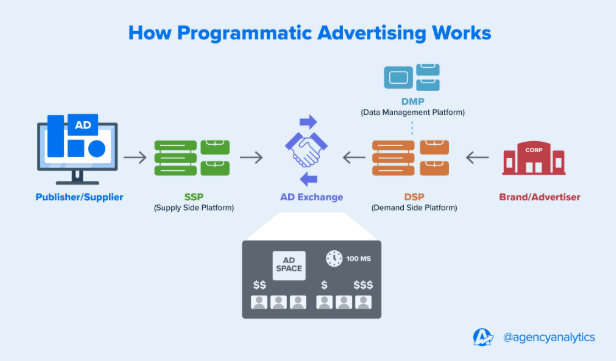
When a user opens an app or page, the pipeline runs as follows:
Performance targets for this path:
Sources:
Key components:
Characteristics:
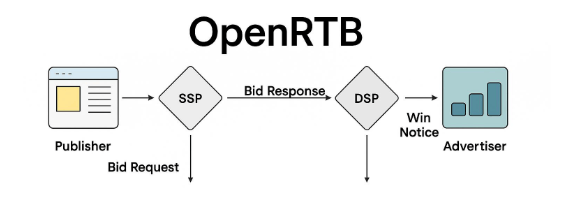
The exchange core behaves like a high-frequency trading system for ads.
Core components:
Technical characteristics:
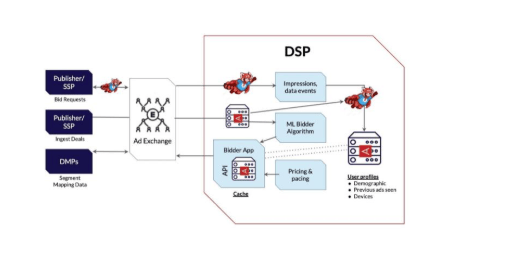
Core systems:
For ML scoring on the buy side, teams often pair self-managed inference on CPU-Optimized or GPU Droplets with DigitalOcean Inference.
See Serverless vs Dedicated vs Batch Inference for serving mode tradeoffs.
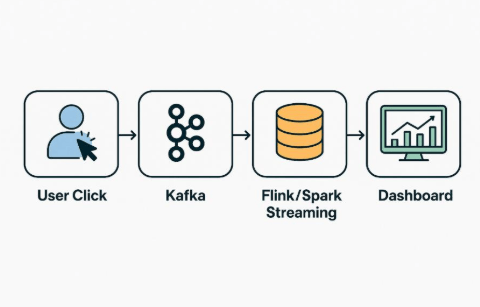
Types of logs: impressions, clicks, conversions, bid logs.
Tech stack:
Use cases: billing and revenue calculation, reporting dashboards, attribution modeling, ML training pipelines.
Data tiers:
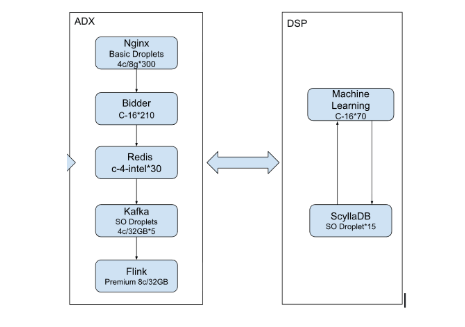
DigitalOcean offers low-cost infrastructure, strong regional presence, and an ecosystem suited to ADX sell-side and buy-side workloads. The sample layout below reflects common ADX customer needs. Your sizing will vary by QPS, fanout, and logging volume.
Global deployment in days: multiple datacenters on the U.S. East and West coasts, Southeast Asia (SGP), and Europe (FRA and AMS).
Below are key points to consider when deploying the sell side:
Low network bandwidth cost: network bandwidth takes about 30% to 40% of total billing for many ADX deployments. If an ADX stack moves 1 PB of DTO on AWS, list-tier egress pricing lands near ~$50K per month (about $57K at current published AWS tier rates for 1,000,000 GB of internet egress).
Based on AWS public tiered pricing for data transfer out to the internet:
| Tier | Rate |
|---|---|
| First 10 TB | $0.09 per GB |
| Next 40 TB | $0.085 per GB |
| Next 100 TB | $0.07 per GB |
| Next 350 TB | $0.06 per GB |
| Over 500 TB | $0.05 per GB |
On DigitalOcean, outbound transfer included with Droplet plans is pooled at the team level. When DTO stays within the pooled allowance, overage cost is $0. Additional outbound transfer is $0.01 per GiB (bandwidth billing). VPC traffic between resources in the same datacenter uses private networking.
Managed DNS: DigitalOcean DNS with auto-renew and free HTTPS certificate management on Load Balancers via Let’s Encrypt.
Load Balancer: scalable Regional Load Balancers scale to 200 LB nodes without service interruption (load balancer limits). Per load balancer pricing, each additional regional HTTP node adds up to 10,000 requests per second and 10,000 simultaneous connections. At the maximum 200-node configuration, that is up to 2 million HTTP requests per second aggregate across the load balancer (not per single node). DigitalOcean recommends running your own benchmarks because performance varies by protocol and payload.
Droplets: Droplet autoscale pools support auto-scaling to optimize cost under variable QPS.
Network bandwidth: 2 Gbps+ network bandwidth on many Droplet plans offers a strong cost-to-performance ratio for small and medium ADX customers.
Premium Droplets: Premium CPU Droplets deliver up to 10 Gbps public throughput and use current-generation Intel Xeon Scalable or AMD EPYC processors. Top-tier ADX customers use these plans to scale auction workloads toward millions of QPS.
DOKS: DigitalOcean Kubernetes is a managed native Kubernetes service that lets teams scale workloads in minutes.
Managed databases: MySQL, Kafka, MongoDB, and OpenSearch are widely used by ADX customers as operational stores and data lakes.
Storage-Optimized Droplets: NVMe local SSD on Storage-Optimized plans delivers 200K+ IOPS in customer benchmarks for ClickHouse and other analytics workloads. DigitalOcean does not publish a fixed IOPS SLA. Run your own disk benchmarks before production cutover.
High-performance Spaces: Spaces supports StarRocks, Doris, Flink, and other S3-compatible data lake workloads. Spaces does not charge API call fees. Subscriptions include 250 GiB storage and 1,024 GiB outbound transfer per month.
These snippets follow DigitalOcean documentation. Replace regions, tags, and IDs with your values. Install doctl and run doctl auth init first.
Create a regional HTTP load balancer in nyc3 for Droplets tagged adx-auction:
doctl compute load-balancer create \
  --name adx-nyc3-lb \
  --region nyc3 \
  --size-unit 3 \
  --tag adx-auction \
  --forwarding-rules entry_protocol:http,entry_port:80,target_protocol:http,target_port:8080 \
  --health-check protocol:http,port:8080,path:/health
Create an autoscale pool for auction workers (autoscale pool API):
curl -X POST \
  -H "Content-Type: application/json" \
  -H "Authorization: Bearer $DIGITALOCEAN_TOKEN" \
  -d '{
    "name": "adx-auction-pool",
    "config": {
      "min_instances": 2,
      "max_instances": 20,
      "target_cpu_utilization": 0.6,
      "cooldown_minutes": 5
    },
    "droplet_template": {
      "size": "c-8",
      "region": "nyc3",
      "image": "ubuntu-24-04-x64",
      "tags": ["adx-auction"],
      "ssh_keys": ["YOUR_SSH_KEY_ID"],
      "vpc_uuid": "YOUR_VPC_UUID",
      "user_data": "#cloud-config\nruncmd:\n  - systemctl start adx-auction\n"
    }
  }' \
  "https://api.digitalocean.com/v2/droplets/autoscale"
Provision Managed Kafka for impression and bid logs (Kafka create docs):
doctl databases create adx-kafka-nyc3 \
  --engine kafka \
  --region nyc3 \
  --size db-s-2vcpu-4gb \
  --num-nodes 3
An ad exchange system is a technology platform where publishers and advertisers buy and sell ad space through automated real-time auctions. Supply-side platforms offer inventory, demand-side platforms submit bids, and the exchange matches buyers and sellers using protocols such as OpenRTB. On DigitalOcean, the exchange core typically runs on CPU-Optimized Droplets or DOKS behind Regional Load Balancers.
When a user loads a page, the SSP sends an ad opportunity to the exchange. The exchange builds a bid request, fans it out to eligible DSPs in parallel, collects bids within a timeout window (often 50 to 120 ms), runs an auction, and returns the winning ad. The full user-facing path targets ~150 ms, with the pipeline under 100 ms and internal ADX work often under 20 ms.
RTB stacks target the < 100 ms pipeline budget described above, with internal ADX processing often under 20 ms so DSP round trips use the remaining window. Exchanges colocate ingress, auction, and cache tiers in the same region, keep state in memory, and avoid disk I/O on the hot path. Measure p95 and p99 from load balancer health checks before you add more DSP fanout.
Bid requests, responses, and tracking pixels all generate egress. For many ADX teams, bandwidth is 30% to 40% of total cloud spend. At 1 PB of DTO, AWS list-tier pricing is on the order of ~$50K per month. DigitalOcean pools included outbound transfer and charges $0.01 per GiB for overage (bandwidth billing). Managed database traffic does not count against bandwidth billing.
Yes. DigitalOcean provides multi-region Droplets, Regional Load Balancers (up to 200 nodes, 10,000 RPS per HTTP node), Droplet autoscale pools, Managed Kafka/MySQL/MongoDB/OpenSearch, Spaces, and VPC networking. Start in one region, load-test against your millions of QPS target, then expand to SGP, FRA, and AMS as metrics allow.
You now have a map of ADX components (SSP, exchange core, DSP/DMP, and logging pipeline) and the technical requirements to run them on cloud infrastructure: ~150 ms user budgets, < 100 ms pipelines, < 20 ms internal ADX targets, and millions of QPS at scale.
On DigitalOcean, sell-side teams focus on bandwidth cost (the 30% to 40% line item and $0.01/GiB overage model), Regional Load Balancers, and autoscale pools. Buy-side teams focus on managed databases, 200K+ IOPS Storage-Optimized analytics nodes, and Spaces for the data lake. Validate every capacity number against your own benchmarks before production launch.
 This work is licensed under a Creative Commons Attribution-NonCommercial- ShareAlike 4.0 International License.
此内容由惯性聚合(RSS阅读器)自动聚合整理,仅供阅读参考。 原文来自 — 版权归原作者所有。