

惯性聚合 高效追踪和阅读你感兴趣的博客、新闻、科技资讯
阅读原文 在惯性聚合中打开

推荐订阅源

F
Fortinet All Blogs
V2EX - 技术
V2EX - 技术
The Last Watchdog
The Last Watchdog
宝玉的分享
宝玉的分享
T
Tenable Blog
WordPress大学
WordPress大学
K
Kaspersky official blog
Microsoft Security Blog
大猫的无限游戏
大猫的无限游戏
H
Hackread – Cybersecurity News, Data Breaches, AI and More
Hacker News - Newest:
Hacker News - Newest: "LLM"
P
Palo Alto Networks Blog
Help Net Security
Help Net Security
V
Vulnerabilities – Threatpost
Know Your Adversary
Know Your Adversary
C
CXSECURITY Database RSS Feed - CXSecurity.com
A
Arctic Wolf
Forbes - Security
Forbes - Security
Microsoft Azure Blog
爱范儿
爱范儿
cs.AI updates on arXiv.org
The Cloudflare Blog
Hugging Face - Blog
Hugging Face - Blog
H
Hacker News: Front Page
W
WeLiveSecurity
博客园 - 【当耐特】
G
Google Developers Blog
Martin Fowler
Martin Fowler
TaoSecurity Blog
TaoSecurity Blog
Hacker News: Ask HN
Hacker News: Ask HN
人人都是产品经理
人人都是产品经理
CTFtime.org: upcoming CTF events
AI
AI
N
Netflix TechBlog - Medium
C
Cisco Blogs
I
Intezer
aimingoo的专栏
aimingoo的专栏
博客园 - 聂微东
G
GRAHAM CLULEY
Threat Intelligence Blog | Flashpoint
cs.CL updates on arXiv.org
Apple Machine Learning Research
月光博客
月光博客
Exploit-DB.com RSS Feed
www.infosecurity-magazine.com
小众软件
小众软件
Blog — PlanetScale
Blog — PlanetScale
MyScale Blog
MyScale Blog
L
Lohrmann on Cybersecurity
Engineering at Meta
Engineering at Meta

DigitalOcean Community Tutorials

Mastering grep with Regular Expressions for Efficient Text Search It's Time to Break Up with Your Cloud: Why AI Teams are Switching We Built a Private-Document AI App to Test Platform Security. Here Is What We Could Actually Verify. PostgreSQL Explained: A Complete Beginner-to-Advanced Guide How To Install and Configure Postfix on Ubuntu How To Build a Web Application Using Flask in Python 3 Build AI Reading List with DigitalOcean Functions and Mistral How To Concatenate Strings in Python How to Allow MySQL Remote Access Securely How To Install and Use Docker on Rocky Linux How To Build a Multi-Agent AI System with Docker Agent DSPy Use Cases: Build Optimized LLM Pipelines How To Submit AJAX Forms with jQuery Build an AI-Powered GPU Fleet Optimizer with the DigitalOcean AI Platform ADK Monitor GPU Utilization in Real Time: A Complete Guide Reduce File Size of Images in Linux - CLI and GUI methods Reduce PDF File Size in Linux: Tools and Methods How To Set Up a Private Docker Registry on Ubuntu How To Troubleshoot Terraform: Errors and Fixes How to Use Go Modules Python Multiprocessing Example: Process, Pool & Queue Convert Class Components to Functional Components with React Hooks How To Install and Configure Ansible on Ubuntu LLM Tokenizers Simplified: BPE, SentencePiece, and More How To Monitor System Authentication Logs on Ubuntu How to Use Traceroute and MTR to Diagnose Network Issues How to Deploy Postgres to Kubernetes Cluster Importing Packages in Go: A Complete Guide Create RAID Arrays with mdadm on Ubuntu How To Make an HTTP Server in Go How To Set Up Time Synchronization on Ubuntu How To Use Struct Tags in Go apt-key Deprecation: Add Repositories with GPG on Ubuntu Linux ps Command: 20 Real-World Examples Python struct.pack and struct.unpack for Binary Data Deadlock in Java: Examples, Detection, and Prevention How To Use Find and Locate to Search for Files on Linux Structured Resume Skill Extraction Using Mistral-7B Inference How to Use the Python Main Function How to Set Up NemoClaw on a DigitalOcean Droplet with 1-Click Build an End-to-End RAG Pipeline for LLM Applications From Single to Multi-Agent Systems: Key Infrastructure Needs Back Up Data to Object Storage Using Restic How to Generate Videos with LTX-2.3 on DigitalOcean GPU Droplets How To Install LAMP Stack (Apache, MySQL, PHP) on Ubuntu How to Download Files with cURL How To Use Variadic Functions in Go Generate UUIDs with uuidgen on Linux How To Use EJS to Template Your Node Application How to Install Node.js on Ubuntu (Step-by-Step Guide) MongoDB Indexes: Improve Query Performance with Node.js LLM Tool Calling with DigitalOcean AI Platform and Databases What are Text Diffusion Models? - An Overview Crafting a Game from Scratch with GPT-5.4 Building Long-Term Memory in AI Agents with LangGraph and Mem0 How To Install PHP 7.4 and Set Up a Local Development Environment on Ubuntu 20.04 Build a GraphQL API in Go to Upload Files to Spaces How To Lint and Format Code with ESLint in Visual Studio Code Train YOLO26 for Retail Object Detection on DigitalOcean GPUs How To Work with JSON in MySQL How to Use the JavaScript .map() Method Building a Scalable App with MongoDB Using DigitalOcean's MCP Server How to Create an SSH Key in Linux: Easy Step-by-Step Guide Measure MySQL Query Performance with mysqlslap How To Use *args and **kwargs in Python 3 Nemotron 3 helped me find the perfect dish rack? How To Install and Manage Supervisor Docker Container Images with Watchtower on Ubuntu Getting Started with Qwen3.5 Vision-Language Models How To Create a New Sudo-Enabled User on Ubuntu How to Use Ansible to Install and Set Up Docker on Ubuntu How To Enable Remote Desktop Protocol Using xrdp on Ubuntu 22.04 How To Convert a String to a List in Python How To Check If a String Contains Another String in Python How to Read a Properties File in Python Python Command Line Arguments: sys.argv, argparse, getopt Mastering Grep command in Linux/Unix: A Beginner's Tutorial Understanding Python Data Types How to Implement a Stack in C With Code Examples Python os.system() vs subprocess: Run System Commands How To Install and Use Docker Compose on Ubuntu How to Add and Delete Users on Ubuntu How To Order Query Results in Laravel Eloquent How To Define and Use Handlers in Ansible Playbooks How To Install and Use SQLite on Ubuntu How To Install and Use Homebrew on macOS How To Manage DateTime with Carbon in Laravel and PHP How To Install Git on Ubuntu How To Install and Secure Redis on Ubuntu How To Build and Install Go Programs on Linux Using ldflags to Set Version Information for Go Applications How To Build a Node.js Application with Docker How To Add JavaScript to HTML How To Reset Your MySQL or MariaDB Root Password How To Add Images in Markdown How To Set Up a Production Elasticsearch Cluster with Ansible How To Set Up a Firewall Using firewalld on CentOS Understanding Systemd Units and Unit Files How To Set Up Replication in MySQL How To Use the .htaccess File
A2A vs MCP - How These AI Agent Protocols Actually Differ
Adrien Payong · 2026-03-06 · via DigitalOcean Community Tutorials

As AI applications scale, more teams are relying on agents. Agents are autonomous software components that can think, plan, act, and interact with other agents. When designing large-scale multi-agent systems, architects have built two families of protocols to address distinct interoperability problems. Agent‑to‑Agent protocols define how one agent communicates with another agent. Model context protocols standardize how your AI application or agent connects to tools, resources, prompts, APIs, agents, or other systems. Understanding the distinction between the two will help you build secure, reliable, and scalable agent‑based systems.

In this article, we’ll examine both protocols. We’ll define them, compare them, highlight their security considerations, list their pros and cons, and discuss a real-world workflow that uses them. By the end, you’ll know when to use each protocol and how to leverage them together.

Key Takeaways

  • Different layers, complementary roles: Think of A2A as solving inter‑agent communication primitives (delegation, discovery, streaming), while MCP solves agent/app–to‑tool grounding, and contextualizes integration. They’re perfectly complementary: in most cases, you’ll want both.
  • Choose A2A for multi‑agent orchestration: Consider A2A if you want to orchestrate multiple autonomous agents that coordinate as peers while preserving agent boundaries and execute tasks asynchronously. It is ideal for complex workflows such as a research assistant, customer support swarm, or planning pipeline.
  • Choose MCP for tool integration: Use MCP when your AI model or agent needs to access external data, tools, or prompts in a consistent way. MCP is a drop‑in layer for IDE assistants, chatbots, and other host applications.
  • Layer protocols thoughtfully: Many architectures layer the protocols. For example, a planner agent might reach out to other agents via A2A, which in turn uses MCP to fetch tools. Separating tool integration from agent orchestration logic can make your system more secure and easier to maintain.
  • Mind the security context: Keep in mind that because A2A and MCP operate at different layers, each will have distinct security implications. Limit privileges, authenticate properly, validate inputs, and audit operations.

What Is A2A (Agent‑to‑Agent)?

A2A is an open standard that defines how agents should communicate with one another. Its goals include capability discovery, task delegation, modality negotiation, and secure information sharing. It enables autonomous agents to communicate while preserving privacy and proprietary internal processes.

Agents that support A2A publish an agent card (a structured descriptor) advertising what capabilities, modalities, and endpoints they support. Other agents can discover cards and delegate tasks without understanding how the target agent is implemented internally. Primary goals of A2A include:

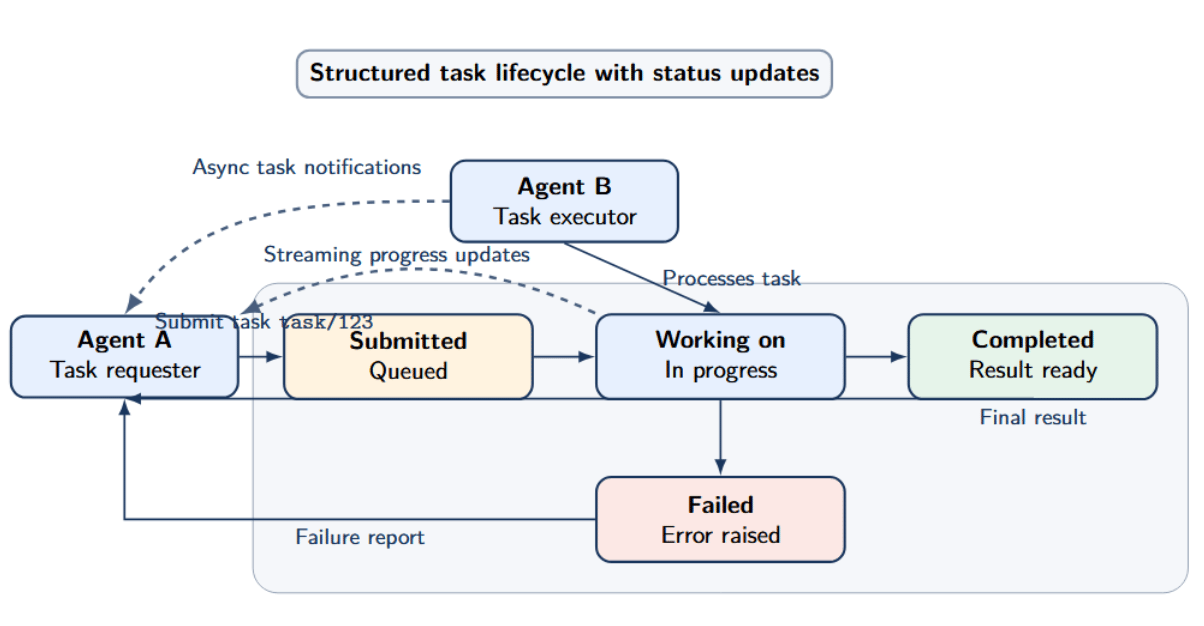
1. Task‑centric communication: Agents communicate using structured tasks with well-defined lifecycle states (submitted, working on, completed, failed). Agents can send updates by streaming long‑running tasks or sending asynchronous task notifications.
image

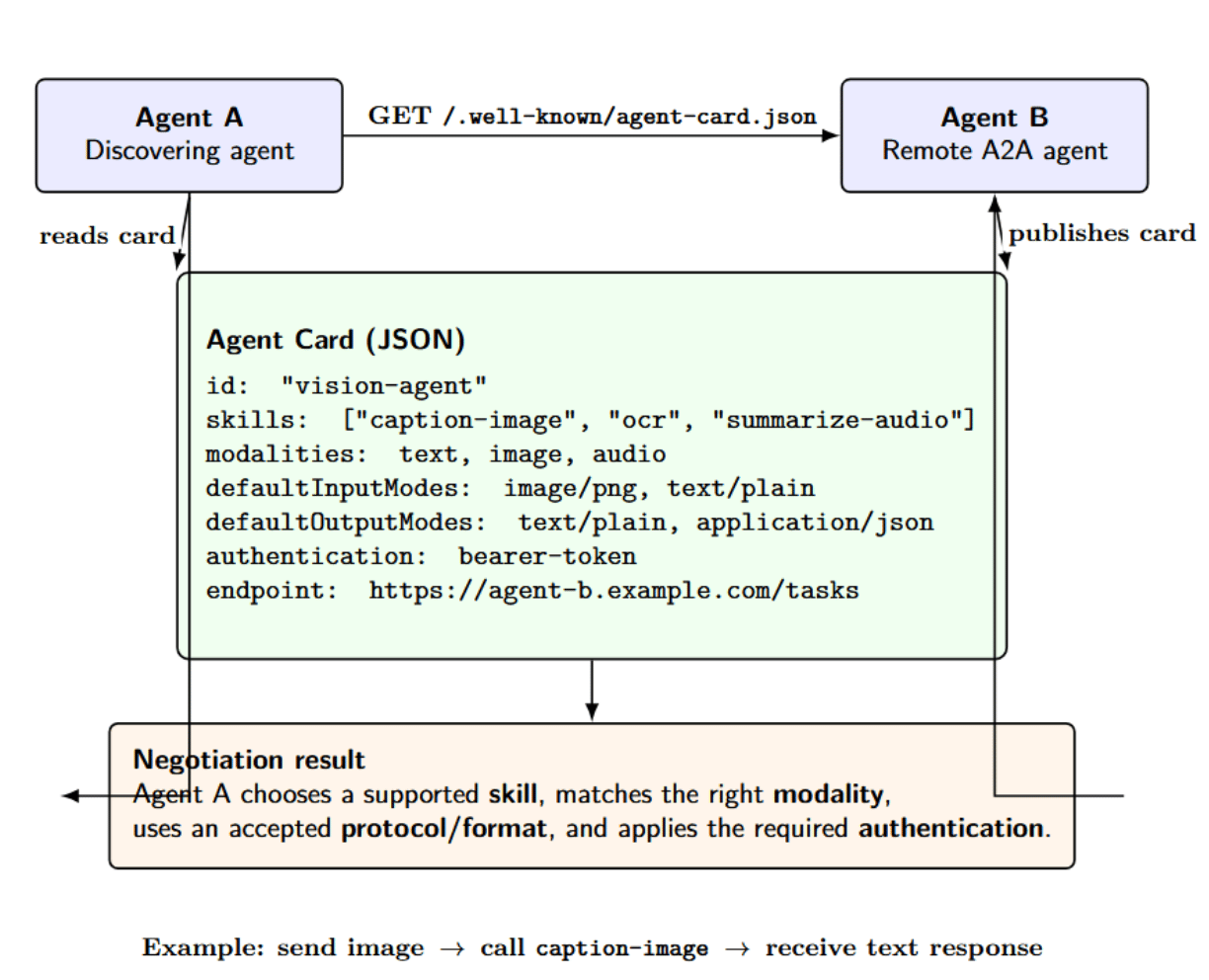
2. Discovery and negotiation: Agents publish agent cards in well-known locations such as /.well‑known/agent‑card.json. These cards detail actions an agent supports, modalities they accept and work with (text, images, audio), and the protocols they will accept.
image

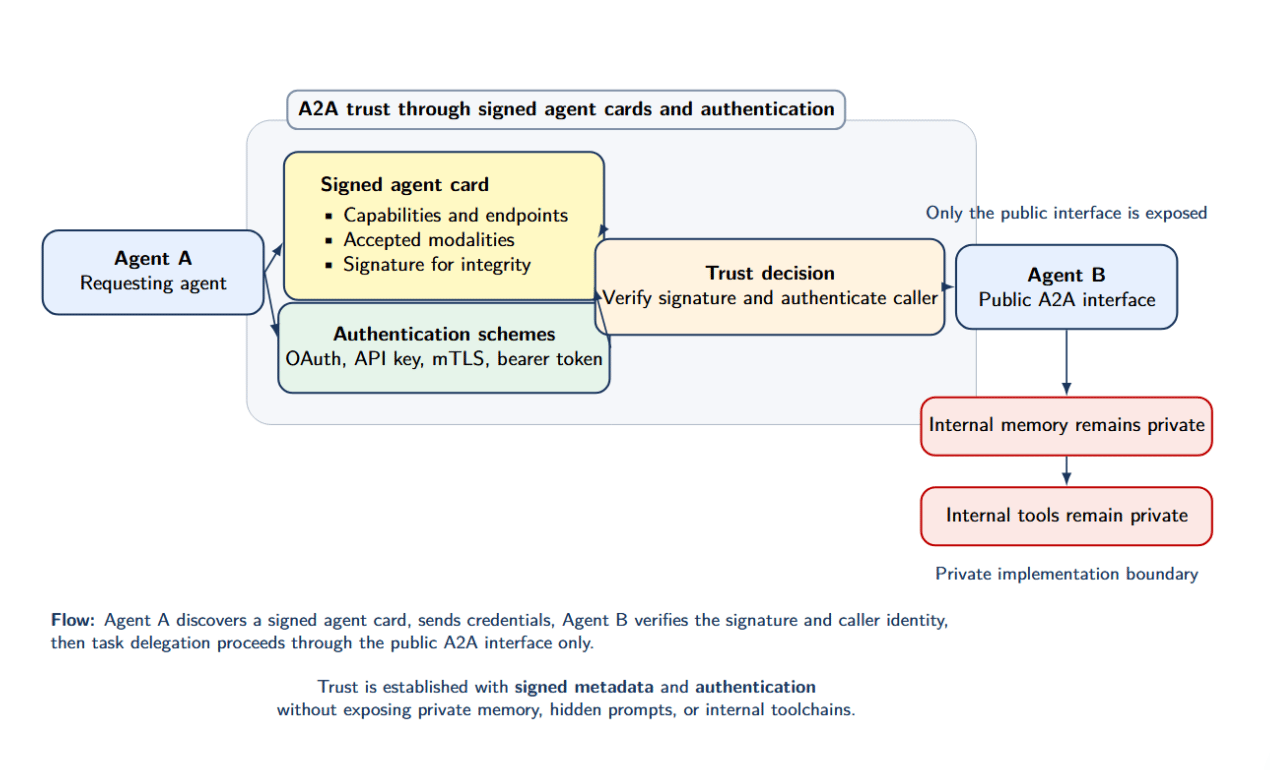
3. Security and authentication: A2A can support signed agent cards and use multiple authentication schemes. This enables agents to trust each other without having access to internal memory or tools.
image

4. Layered design: A2A runs on top of transports like HTTP or websockets. It can interoperate with other protocols.

Key A2A Concepts

  • Agent Card: An agent card is a JSON document that describes an agent’s ID, supported modalities (text, image, audio), tool capabilities, authentication schemes, endpoints, etc.
  • Task: It is the fundamental unit of work. A client agent submits a task with descriptive metadata (e.g., inputs required, expected outputs) and the server agent executes that task, responding with updates about its status and final results. Tasks may be synchronous (single response) or asynchronous (streaming or polling interval).
  • Capabilities: Capabilities describe functions an agent can perform, like “translate text”, “generate image”, or “summarize document”. Capabilities can express preconditions and postconditions, include authentication requirements, and optionally describe expected latency.
  • Status Codes: Agents may communicate standardized Status Codes to allow robust orchestration and error handling. For example: submitted, queued, running, succeeded, failed.

Why A2A Exists

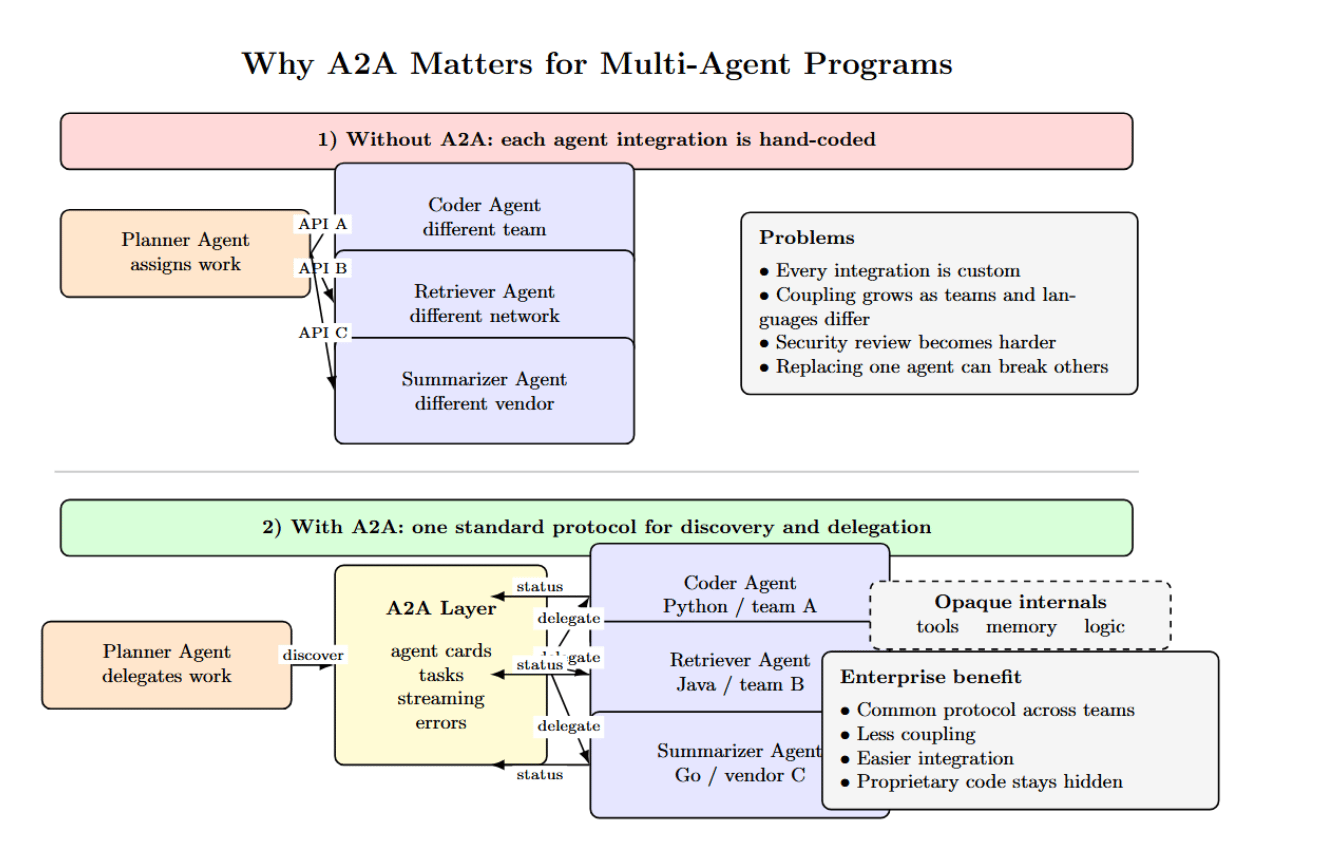
Single‑agent programs naturally call functions internally. However, monolithic programs get brittle as organizations scale. Software teams will eventually reach a point where they want to split duties: a planner agent assigns tasks to a coder agent, a retriever agent, and a summarization agent. These agents reside on separate networks, use different programming languages, or are managed by distinct teams or vendors within an organization. To work together without a universal bus standard such as A2A, agents must hard‑code APIs into other agents, resulting in tight coupling and security concerns.
image

A2A aims to fill this gap by standardizing how agents announce themselves, negotiate tasks, stream outputs, and handle errors in a framework-agnostic and language-neutral manner. A2A is particularly well-suited to enterprise deployment where teams or different vendors want to design their own custom agents with proprietary internal code.

What Is MCP (Model Context Protocol)?

The Model Context Protocol is an open standard that allows AI applications or agents to access external resources. While Autonomous Agents communicate with each other via A2A, MCP enables AI models to access tools, resources, and prompts in a standard way. The MCP specification outlines a host‑client‑server model. At a high level:

  • Host: It owns the user experience for end-users. Hosts connect to AI models. Example hosts include IDE plugins, chat interfaces, or agent orchestrators.
  • MCP Client: A library that the host integrates, which performs communications with MCP servers. It manages details like authentication, transport specifics, session state, and message framing.
  • MCP Server: A service that exposes capabilities (tools, resources, prompts). It might be a local process (e.g., a Python server started by the host) or a remote HTTP service.

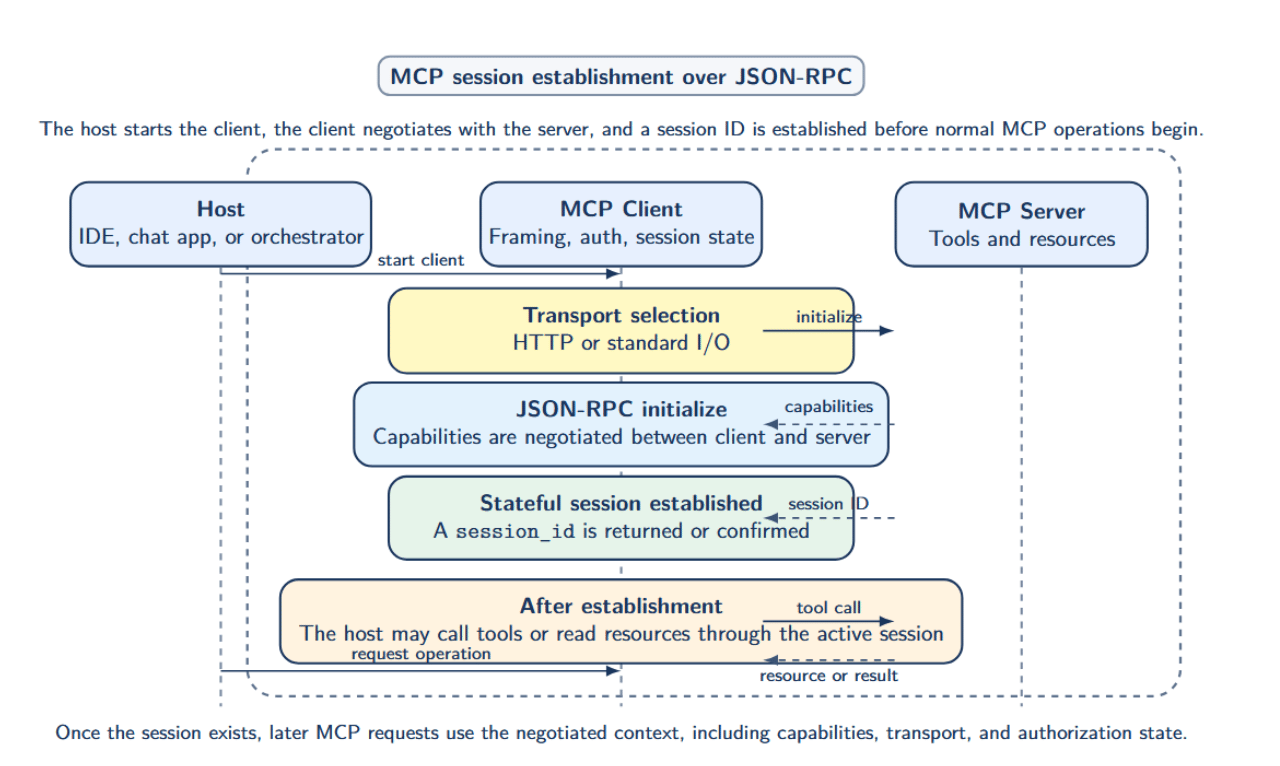
MCP uses JSON‑RPC as its transport and defines a stateful session establishment model.
image

The host, when starting a client, negotiates capabilities with servers, declares what transports it supports (HTTP, standard I/O), and obtains a session ID. After session establishment, the host may call tools or read resources.

Core MCP Primitives

  1. Tool: A function or operation that can be called by the client. Tools are defined by schemas for their input and output, as well as a name and description. Tools may also specify optional parameters. Tools might implement everything from database queries to filesystem operations, search APIs, and workflows. When a tool is invoked over MCP, the client sends arguments conforming to the input schema. The server executes the operation and returns results or an error.
  2. Resource: Resources are referenced pieces of structured data made available by the server. Resources could be a file, a schema, a document, or an application’s own custom knowledge base. The client may enumerate resources and read them from the server in a normalized format (binary or structured). MCP allows resources to be streamed to support large resources.
  3. Prompt: They are reusable templates of text or code that the host can fetch and insert variables to direct the AI model. Having prompts served dynamically allows prompting workflows for retrieving domain-specific instructions or query templates, etc.
  4. Authorization: Authorization of MCP when using HTTP transports leverages OAuth 2.1 and conforms to secure metadata discovery. For transports using standard I/O (such as locally running servers invoked through subprocess), MCP defines how tokens are passed through. This prevents external servers from acting on behalf of the user without permission or making arbitrary requests.
  5. Session: The interaction between an MCP client and server occurs within a session, which has its own context. This includes the negotiated capabilities, call quotas, and resource pointers. Sessions enable a consistent state across multiple calls and support stateful features such as conversation history.

Why MCP Exists

AI models require context to return helpful answers. This context could be local files, remote APIs, database records, or customized prompts. Without a standard, developers must build custom connectors for each LLM model or hard-code environment‑specific logic into the model interface. MCP separates the model from external data and tool access. Tools and resources exposed to an MCP server can be consistently consumed by any compliant host. This enables LLM agent interoperability across different models or frameworks by sharing the same definition of capabilities.

Key Differences Between A2A and MCP

While both protocols support AI agent workflows, they operate at different layers:

Dimension A2A MCP
Primary purpose Agent-to-agent communication, discovery, delegation, streaming Agent/app-to-tool and context communication
Main actors Two (or more) autonomous agents Host, MCP client, MCP server
Core unit Task (work assignment with lifecycle) Tool, resource, prompt
Discovery model Agent cards and capability discovery Capability negotiation plus tool/resource listing
Typical use case Delegating work to specialist agents Exposing APIs, files, DBs, workflows to models
Communication style Messaging, streaming, asynchronous task updates JSON-RPC sessions, tool calls, resource reads
Internal opacity Strongly preserves agent boundaries; no access to internal memory/tools unless explicitly exposed Focuses on structured capability exposure; internal state not specified.
Best fit Multi-agent orchestration, inter-agent coordination Tool interoperability, context plumbing, agent integration

Use A2A if you have multiple agents that need to work together as peers. Utilize MCP when you have an AI application or agent that needs standardized access to tools and external data. Use them together when architecting a complex multi‑agent solution that requires both delegation and tool access patterns. (An agent using A2A may delegate work to other specialized agents that use MCP to call tools and fetch resources.)

Real‑World Agent Workflow

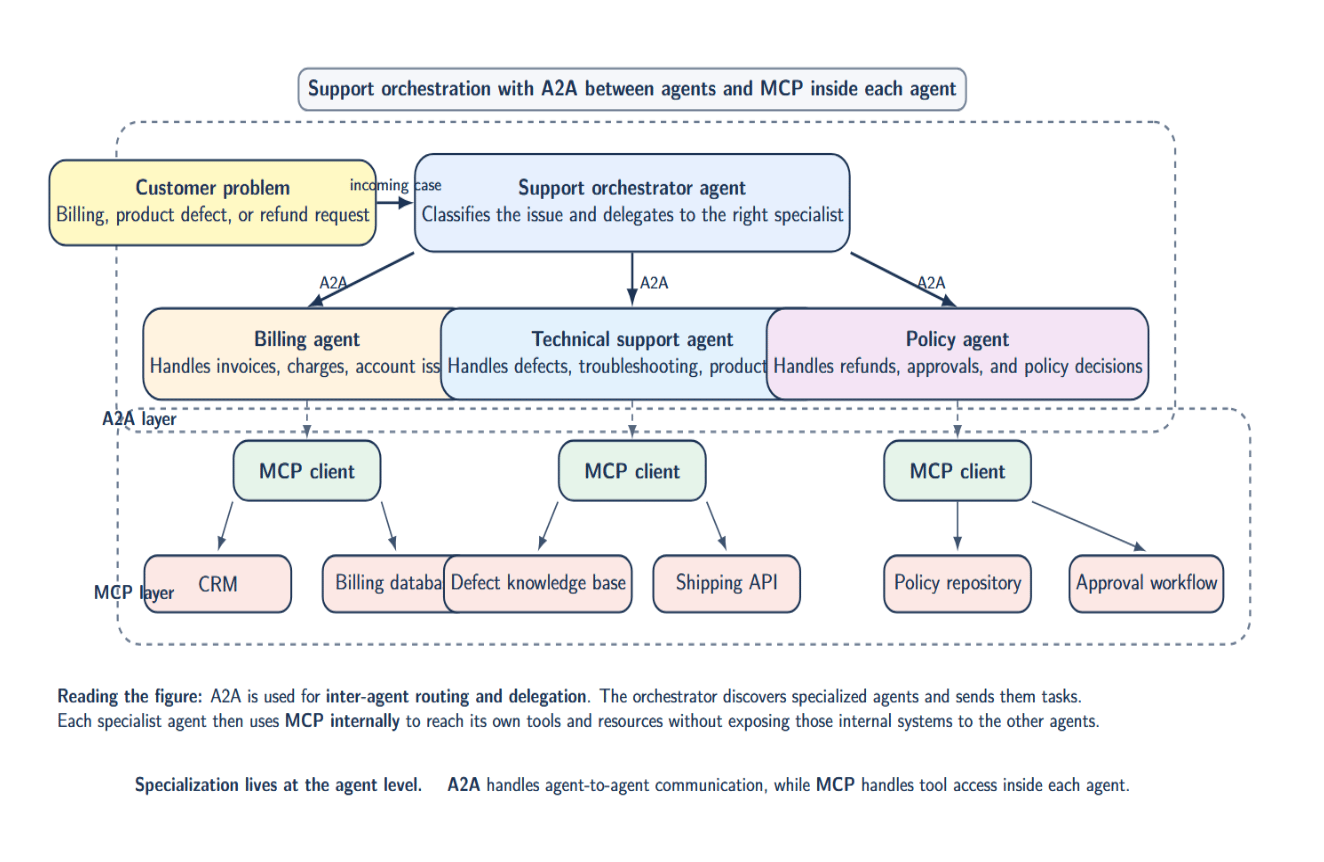
Suppose a support orchestrator agent receives a customer issue.
image

It assigns billing queries to a billing agent, issues with product defects to a technical support agent, and refund approvals to a policy agent. The orchestrator discovers and communicates with these agents using A2A, and they may use MCP internally to call their CRM, policy repository, or shipping API. The specialization is at the agent level. A2A routes inter‑agent communication; MCP handles tool access.

A2A vs MCP in Python

People commonly search for “A2A vs MCP in Python,” trying to find real-world code examples. Here are simplified patterns.

Minimal MCP server in Python

from mcp.server.fastmcp import FastMCP
# 1. Instantiate a FastMCP server with a namespace
mcp = FastMCP("my_app")
# 2. Expose a tool via MCP
@mcp.tool()
def get_customer_balance(customer_id: str) -> str:
    """Return the customer's current balance."""
    # In practice, fetch from a database or API
    return "Balance: $120"
if __name__ == "__main__":
    # 3. Start the MCP server with stdio transport (via CLI or wrapper)
    mcp.serve()  # or however the FastMCP server starts the stdio loop

With the FastMCP class, you can declare tools using decorators. The docstring for each tool becomes its description. When the host calls for get_customer_balance through the MCP client, it gets a structured response.

Conceptual A2A pattern in Python

# 1. Expose a specialist agent via A2A (run this via CLI)
#    adk api_server --a2a --module check_prime_agent
# 2. Discover and consume the remote agent via its agent card
from google.cloud import agent
remote_agent = agent.RemoteA2aAgent(
    name="prime_checker",
    description="Checks whether a number is prime",
    agent_card="https://specialist.company.com/a2a/check_prime_agent/.well-known/agent.json",
)
# 3. Delegate a task to the remote agent
result = remote_agent.invoke(
    tool_name="prime_checking",
    inputs={"nums": [47]}   # ADK pattern: list of numbers
)

# 4. Extract and print the output
print(result["output"])   # -> e.g., {"is_prime": true, "number": 47}

The above code:

  • Uses RemoteA2aAgent as in the ADK‑Python quickstart, with an explicit agent_card URL.
  • Follows ADK’s schema‑like pattern (a tool_name and inputs dict, where nums is a list of integers).
  • Expose a specialist agent via A2A, discover it via agent card, and delegate a “check prime”‑style task.

Security Considerations

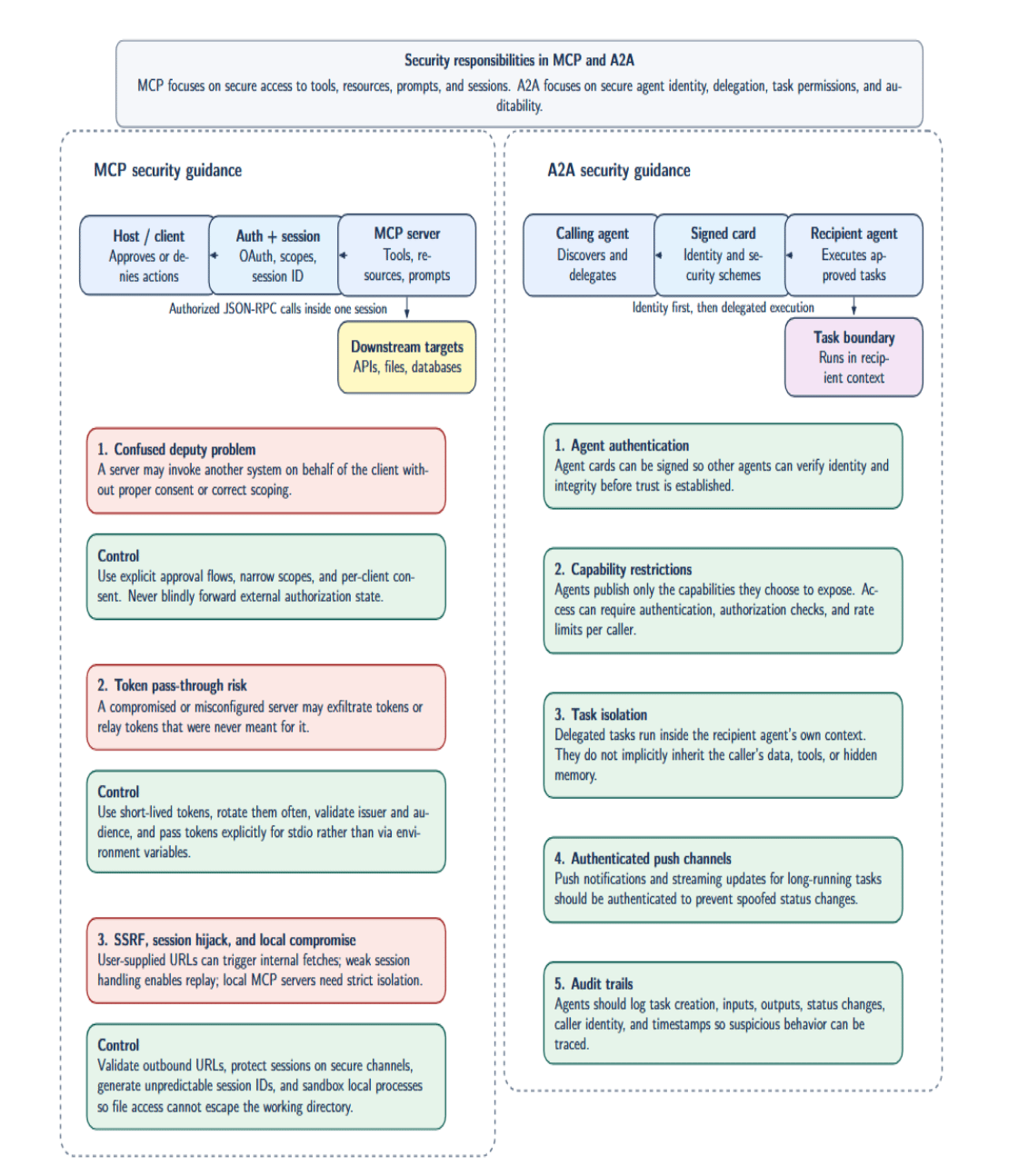
Security is where conflating A2A and MCP is most dangerous. Because they operate at different layers, their attack surfaces differ.
image

MCP Security

MCP’s security guidance points out risks like:

  • Confused deputy problem: A MCP server might invoke another system on behalf of the client without proper consent or scoping. Servers should implement scopes and approval flows. Clients should limit privileges and should not blindly forward tokens.
  • Token pass‑through risks: When using HTTP transports, tokens may be passed in authorization headers. If your server is compromised, it may exfiltrate tokens. Use short‑lived tokens that are rotated frequently with limited scopes. When using standard I/O transports, MCP clients should provide tokens explicitly rather than passing them as environment variables.
  • Server‑side request forgery (SSRF): If your client application passes user‑supplied URLs to an MCP server, the server may inadvertently fetch resources from internal-only systems. To mitigate this risk, servers should validate inputs and enforce strict controls on outbound network requests.
  • Session hijacking and replay attacks: MCP is session‑based; thus, session IDs should be generated from unpredictable entropy and protected over HTTPS and secure channels.
  • Local server compromise: If hosts are spawning local MCP servers (using mcp.run(transport=“stdio”), for example), they must isolate that process such that any file I/O cannot escape the working directory.
  • Human‑in‑the‑loop: The official MCP spec allows gating certain tools behind human intervention to approve sensitive operations, such as sending an email, purchasing a device, etc.)

A2A Security

A2A secures communication by focusing on agent identity and task permissions:

  • Agent authentication: Agents can authenticate themselves by signing their agent cards (i.e., via JSON Web Signatures) to allow others to verify their identity and integrity.
  • Capability restrictions: Agents only publish the capabilities they want to expose. Capabilities can require authentication and rate-limiting per client.
  • Task isolation: Delegated tasks run within the recipient agent’s context. Tasks don’t provide implicit access to the caller’s data or tools. Agents can choose which tasks they allow being called on, and can terminate tasks.
  • Push vs pull: Agent-to-agent allows for push-based notification about the status of long-running tasks. Push notification channels should be authenticated to prevent spoofing.
  • Audit trails: Agents should log tasks, inputs, outputs, and status transitions, including metadata (e.g., caller ID, timestamps) for traceability. Without proper logging, malicious tasks may go undetected.

Pros and Cons of A2A and MCP

The following table summarises the key pros and cons of A2A and MCP. It provides a comparative view of the strengths each protocol has and where teams will need to trade off on architecture, scalability, and security.

Protocol Advantages Disadvantages
A2A Enables rich collaboration between autonomous agents without custom glue code. Scales across platforms because new agents can connect through standard JSON task exchanges. Uses established web standards such as HTTPS, JSON, and SSE, which makes enterprise integration easier. Supports real-time progress updates and streaming for long-running workflows. Adds architectural complexity because each agent may need to run as a server. Cross-network calls can introduce more latency than local tool execution. Data freshness may depend on the remote agent rather than direct source access. Security management is more involved because agents must authenticate and exchange sensitive credentials. Adoption is still relatively early compared with more established integration patterns.
MCP Simplifies tool integration by standardizing LLM-to-tool communication. Benefits from a growing ecosystem of MCP-compatible tools and servers. Improves robustness through structured schemas that reduce formatting and injection issues. Remains vendor-neutral, helping teams avoid lock-in to a single LLM provider or backend. Does not handle native multi-agent coordination or task routing between agents. Legacy systems may require wrappers before they can participate in MCP workflows. For very simple lookups, MCP can feel heavier than calling an API directly. The protocol continues to evolve, so teams must watch for changes in implementations and versions.

FAQ SECTION

What is the difference between A2A and MCP?

A2A standardizes agent-to-agent communications, including discovery, task delegation, asynchronous updates, and streaming. MCP standardizes how agents or applications call tools and access resources and prompts through a host‑client‑server model. A2A handles delegation; MCP handles capability integration.

Is MCP a replacement for agent‑to‑agent communication?

No. MCP is not intended to replace agent‑to‑agent communication. While they can be used together, they address different needs. MCP is intended to provide a standardized tool and context integration. A2A is intended to allow communication between peer agents. A2A and MCP address different layers in the overall agent stack.

Can A2A and MCP be used together?

Yes, with complex enough systems, you will have a “planner” agent that delegates work to “specialist” agents using A2A. Those agents may then use MCP to call tools, read files, or retrieve prompts. Used together, they provide a clean separation between orchestration and tool integration.

Which is better for multi‑agent systems?

A2A is a much better fit for pure multi‑agent systems. It provides built-in discovery, task lifecycle management, asynchronous updates, and negotiated capabilities. MCP by itself provides none of those features. It is focused on calling tools and providing resources.

Does MCP handle agent memory?

Not directly. MCP provides the model for exposing resources and calling tools to the host. While you could build a memory interface as a resource server (ex, vector store), MCP does not standardize how memory or context should be stored. Long‑term memory is still an application-level concern.

How do A2A systems scale?

A2A scales by decomposing work into coarse‑grained tasks and delegating them to agents that specialize in those tasks. Agent capabilities are published with agent cards, and specialized routing logic or “orchestrators” are responsible for routing tasks to available agents. You can horizontally scale by adding more agents, provided you scale your discovery services and manage trust relationships.

What are the security risks of agent communication?

Risks include weak identity controls, over‑broad permissions, prompt injection, data exfiltration, SSRF, session hijacking, and malicious tasks. Both A2A and MCP require careful authentication, authorization, input validation, output filtering, and auditing to mitigate these risks. A2A adds its own concerns around task acceptance, identity of remote agents, and stream integrity.

Conclusion

A2A and MCP should not be viewed as competing standards; they merely address distinct problems present within contemporary AI systems. A2A is the better fit for agent-to-agent delegation, coordination, and orchestration in multi-agent environments. MCP is the better fit for standardized tools, data, and an external system. Many robust AI architectures will use both A2A (agents collaborating with other agents) and MCP (agents securely interacting with tools). Teams that clearly distinguish between these two concepts will be better equipped to build scalable, interoperable, secure AI systems.

References and Resources

Creative CommonsThis work is licensed under a Creative Commons Attribution-NonCommercial- ShareAlike 4.0 International License.