





AI is transforming both software development and software risk. What started as a productivity boost has quickly become something more disruptive. AI no longer just helps developers write code faster. It accelerates how vulnerabilities are discovered, how exploits are developed, and how quickly attacks move from idea to execution. The result is a new reality with more vulnerabilities, less time to respond, and increasing pressure on software supply chain security. The emergence of systems like Mythos marks the beginning of this AI vulnerability storm. Recent advancements in AI-driven vulnerability discovery signal a fundamental shift in cybersecurity. The Mythos moment made this shift visible. Traditionally, vulnerability discovery followed a predictable cycle. Researchers identified issues, disclosed them responsibly, and organizations had time to patch. But AI changes the equation: Vulnerabilities can be identified in minutes instead of months. Discovery and exploitation timelines compress rapidly. Attackers and defenders now operate with similar capabilities. The gap between discovery and exploitation is shrinking toward zero, and in some cases, disappearing entirely. Security teams are not only managing risk, but also racing against machine-speed discovery and attack cycles introduced by the Mythos era of AI-driven security research. AI is now embedded in the SDLC. Code is being generated, modified, and deployed faster than ever. Iteration cycles are compressing. Development is moving toward autonomous and agent-driven workflows. This shift brings clear benefits in speed and productivity, but it also introduces new risks. As development accelerates: More applications are created. More builds are executed. More dependencies are consumed. Open source already makes up the majority of modern applications. AI doesn't reduce that reliance. It increases it. Every new package and dependency becomes a potential entry point for risk on a newly expanded attack surface. AI-driven discovery amplifies everything downstream. Mythos is not the end state. It's the signal of what comes next. More vulnerabilities are found. Exploits are developed faster. Malicious actors automate both discovery and attack workflows at scale. At the same time: Malicious packages are easier to create and distribute. Dependency confusion and supply chain attacks become more effective. Attackers can target both developers and CI/CD pipelines directly. This creates a compounding effect. The same tools that help developers fix issues also help attackers find and exploit them. Security teams are facing a system that operates at an entirely different speed and scale. Most organizations are not built to operate at this pace. Reactive patching cannot keep up with exponential growth in vulnerabilities. Manual triage collapses under increasing volume, and scanning after code is written is simply too late. At the same time, critical sources of vulnerability intelligence are under pressure. Public databases struggle to keep up with the volume and complexity of new disclosures, creating gaps in coverage and prioritization. Recent research suggests CVEs published after March 1, 2026 will land without a CVSS score, CPE list, or severity rating from NIST AI can find vulnerabilities faster. But discovery is not control. Models rely on lagging data, lack organizational context, and cannot enforce real-time decisions. As a result, they often recommend outdated, vulnerable, or even malicious dependencies. At the same time, development is becoming agent-driven. Agents don't just suggest. They act, installing dependencies and modifying systems at machine speed. This shifts the risk model: Errors scale instantly. Bad dependency choices spread. Malicious inputs can be executed automatically. Attackers are already exploiting these patterns. Without real-time governance, AI accelerates risk, creating a new attack surface inside modern workflows. Adapting to the AI vulnerability storm in the wake of Mythos requires both immediate action and longer-term transformation. Start with the fundamentals: Route all open source through controlled repositories. Block untrusted and malicious packages at ingress. Generate and manage SBOMs across applications. Equip developers and AI tools with real-time intelligence. If a critical vulnerability emerged today, could you instantly identify every affected application and remediate it quickly? If not, that gap needs to be addressed now. Once visibility is established, focus on speed and consistency: Standardize dependency management practices. Apply contextual prioritization based on risk and exploitability. Define clear ownership for remediation. Measure and reduce mean time to remediation (MTTR). Security responses must move from reactive to continuous. At this stage, automation becomes critical: Integrate policy enforcement into CI/CD pipelines. Automate dependency updates and remediation workflows. Govern both human and AI-driven development processes. Continuously validate and improve response readiness. Automation is no longer optional. It is required to operate at AI speed. Explore your organizations can prepare with our detailed AI Vulnerability Storm report that includes an actionable plan grounded in data. Organizations that succeed will not avoid AI, but operationalize it with discipline. That means: Embedding governance into development workflows. Controlling what enters the software supply chain. Automating security at scale. Aligning development and security teams around shared practices. The AI vulnerability storm is already here. Mythos was the wake-up call. The question is whether your security program is ready. To learn more about how to prepare your organization and implement a practical 30-60-90 day action plan, watch our on-demand webinar.The Inflection Point for Vulnerability Management
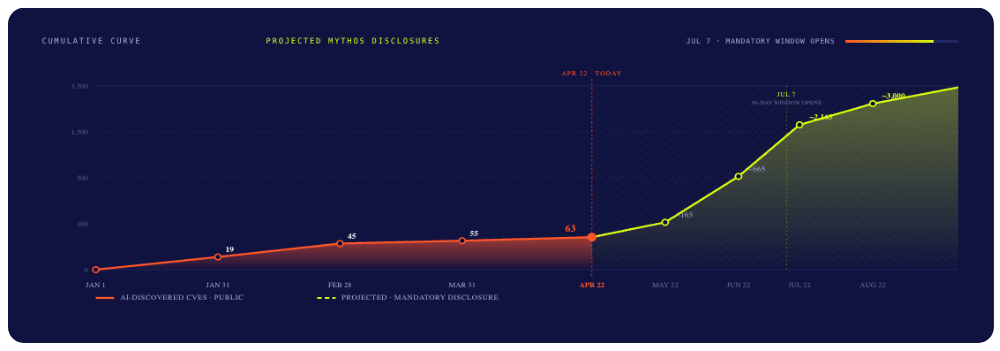 The forecast shown above is derived from Anthropic's disclosure-window policy: 90 days from vendor report, with an optional 45-day extension, then mandatory publication.
 The AI-SDLC Is Here
The AI Vulnerability Storm
Why Traditional Approaches Break Down
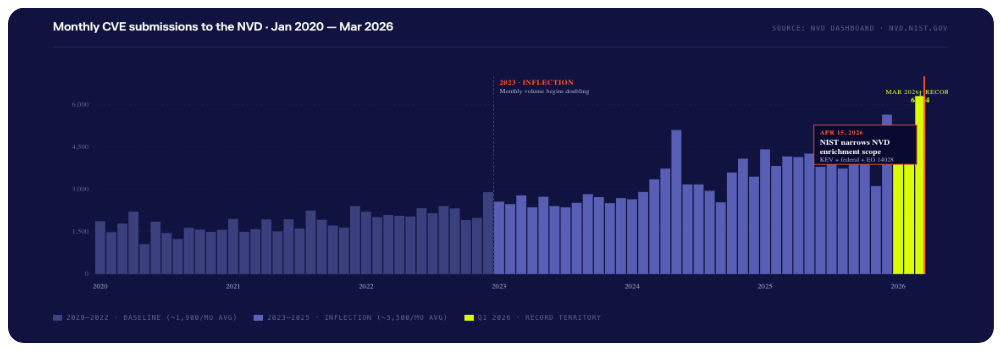 The result is increased exposure across the software supply chain.
AI Acceleration Changes the Risk Model
What Organizations Should Do Next
In the Next 30 Days: Establish Control and Visibility
In 60 Days: Standardize and Accelerate Response
In 90 Days: Automate at Scale
Secure Acceleration, Not Slower Innovation
Tags
secure software supply chain Application Vulnerabilities dependencies Events and Webinars artificial intelligence AI
此内容由惯性聚合(RSS阅读器)自动聚合整理,仅供阅读参考。 原文来自 — 版权归原作者所有。