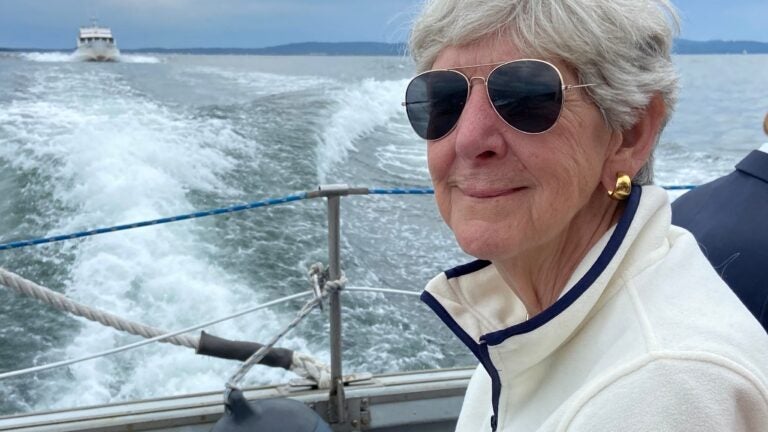
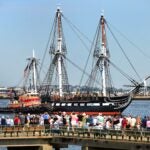
This will be the trailblazer's fifth time bringing the tall ships to Boston during her illustrious career.
Share
Send this article to your social connections.
Dusty Rhodes is proud to be known as “the tall ship lady” in Boston.
The Pennsylvania-native from Weston has brought the majestic vessels to Boston four times during her long, trailblazing career in marketing and event planning. And her fifth tall ships extravaganza, which has been eight years in the making, is just weeks away.
Rhodes has been organizing events in and around Boston for nearly five decades. The mother of six and grandmother of five founded marketing and event-planning firm Conventures in 1977 and is the executive director of Sail Boston, which is behind the dozens of tall ships gliding into Boston next month as part of Sail250.
The pioneering business leader launched Conventures back when women-owned companies in Boston were rare. But Rhodes, the first female general manager in professional football, was used to leading the way. A 1992 Boston Globe article called her “the unsinkable Dusty Rhodes.”
Rhodes has organized thousands of events, including the Boston 10K for Women and First Night Boston. Oh, and she was also a driving force behind FIFA selecting Boston for the World Cup in 1994. Rhodes has been named one of the most influential Bostonians of 2026 by Boston magazine and just received the 2026 HTM Lifetime Achievement Award from UMass Amherst’s Isenberg School of Management.
As the events maven prepares to welcome the tall ships to Boston yet again (she orchestrated their visits in 1992, 2000, 2009, and 2017), Rhodes chatted with us about how she wound up in Boston after college, the biggest challenge when planning massive events, and what’s next for her when the ships leave the harbor.
Boston.com: Talk a little bit about how and when you came to Boston.
Rhodes: I grew up as a child in the suburbs of Philadelphia and went to the great Penn State. I came out with a degree and got in my car and said, ‘I’m either going to drive south on 95 or north on 95,’ and ended up driving north on 95 and coming to Boston. And it was a great move many, many years ago.
Boston.com: How did you get involved in event planning?
Rhodes: I was very fortunate when I first came to get a job at the then-known Boston Patriots. I had worked for Joe Paterno at Penn State and came from a family of football aficionados. I landed a job selling, quote, tickets for the Boston Patriots, which quickly transformed to working for the head coach and then later into player personnel … Events are 50 percent planning and 50 percent reacting to what’s going wrong. That’s the truth. And you’re only as good as what you get done on your feet when things go left when they should go right.
Boston.com: This summer, Boston is hosting the FIFA World Cup, the tall ships, and celebrating America’s quincentennial. Would you say this is Boston’s busiest summer ever?
Rhodes: I would absolutely agree with that comment And it’s all sort of stacked right in the beginning. But the beauty is, and this is what we learned in ’92 when we first started Sail Boston, is Boston is totally capable of doing these things. We all can get distracted with different strategies or egos or whatever, but when it comes to producing a safe, strong, public-safety oriented mega event — whether there’s one or two or three — I mean, we do a great job in producing events. I think, quite frankly, a lot of that is because this is in many ways a small town. When you can pick up the phone and call the fire chief or pick up the phone and call the DPW, or reach out to certain corporations to help us get over the goal line, because it’s a town driven by that partnership of civic and public, it’s all very doable.
Boston.com: How did you became involved in planning these tall ship events?
Rhodes: It was 1989 and Massport said, ‘We hear there is an effort to celebrate the Quincentenary,’ which is the 500th anniversary of Columbus. And what Dave Davis [former executive director of Massport] said to me is, ‘If anybody can pull something off like this, it’s you, Dusty. So go for it.’ And so we went out and went to Europe and went to Washington a lot and determined that in order to have the tall ships visit in a successful way, a grand way, it would take several year’s effort, which is what we launched to get to ’92 — which turned out to be very good.
Boston.com: What are some of the biggest behind-the-scenes challenges in planning an event like this?
Rhodes: Public safety, public safety, public safety. Between transportation and police and FAA, we have a list of 67 different public safety agencies that are cooperating in planning this event. And we applaud them because they are working wonderfully together. And part of the reason is we put them all in a room monthly and we talk through changes in street direction or challenges by new development or neighborhood concerns about parking. And all of those things granularly we look at and step by step we get to an operating plan which is where we are now for transportation and visitor access.
Boston.com: Is this the highest amount of ships we’ve ever had?
Rhodes: This, and 2000 was a very big year. Each of these ships is a floating embassy, to be honest with you. So the care and the attention and the communication to bring an Argentinian ship here, for example, you’re talking about years of working with the Argentinian ambassador, maybe the head of state, definitely the CNO [chief of naval operations] of the Argentinian navy, and this goes on and on and on and on. And at the same time, reaching into your community to the Argentinian populace to be ready to welcome their homeland arriving on our shore. And you take that times 20 cultures and you’ve got a lot of diplomacy.
Boston.com: What do you love about the tall ships?
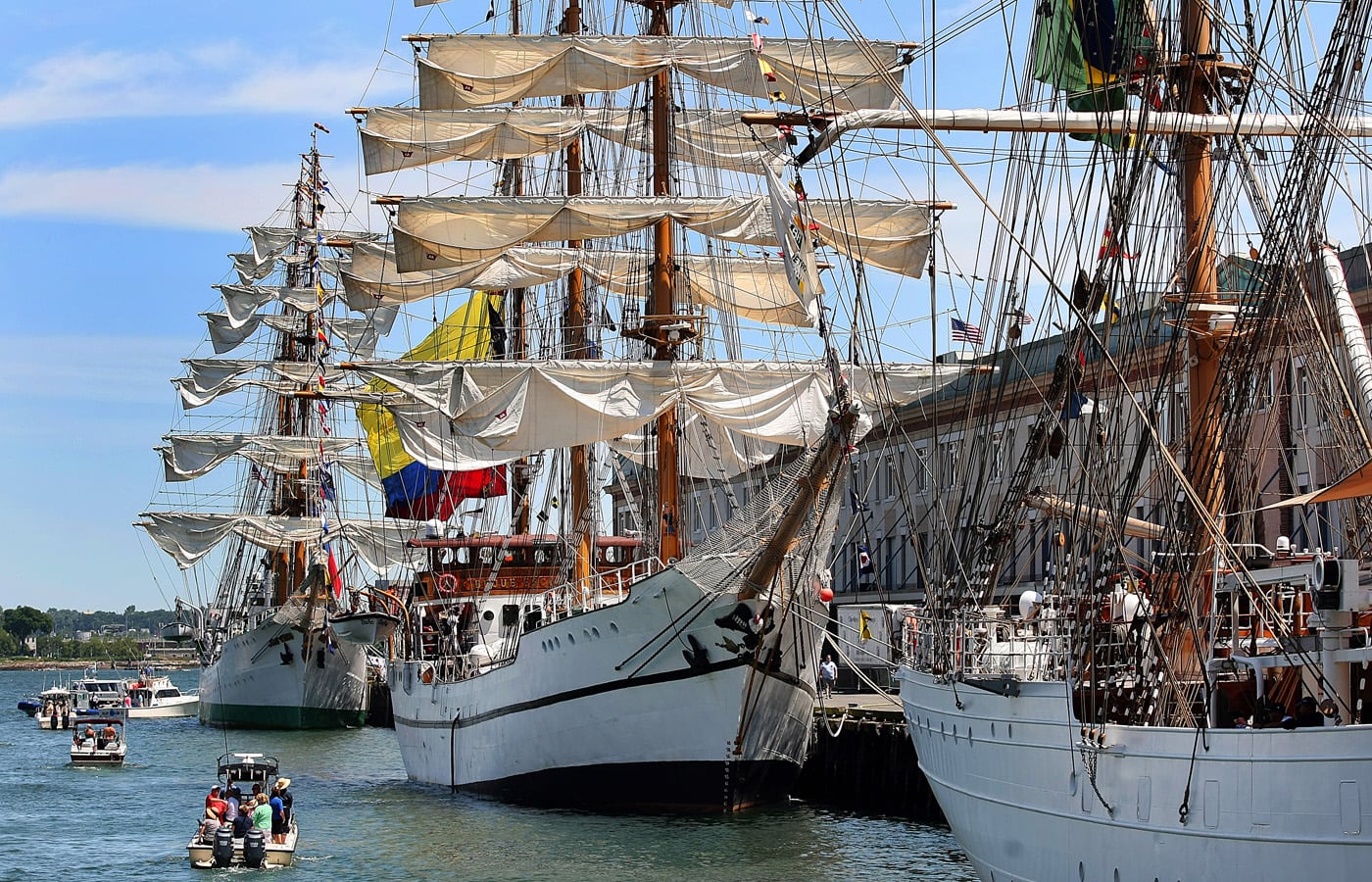
Rhodes: I love the excitement on the faces of the little kids. And they wave the little flag and they’re just awe struck because they’ve never seen anything like this.
Boston.com: Boston is expecting more than 60 ships representing more than 20 countries. Can you tell us about some of the ships that are coming?
Rhodes: A couple of the really nifty ships are Esmeralda from Chile, which is four masted. She has hundreds of crew persons, they have their own band on board and it’s a great showpiece. Also, one of the most popular is the Amerigo Vespucci from Italy. She’s a showpiece. She’s got gold leaf … the crew and the captains have all got magnificent uniforms, and it’s just sort of like going into a palace. It’s beautiful.
Boston.com: What makes Boston a great host for the tall ships?
Rhodes: Strangely enough, part of the reason we’re so successful is because our harbor is narrow. The fact that you can stand on the shoreline in South Boston and you’re looking right over into East Boston so if the ship is coming north into the port and swinging around and coming south you are seeing the ship twice plus you can see it on the other shoreline. Also, our port is downtown. In ports like Miami, you’re a long way from where the restaurants, hotels, and residents live. With Boston, they’re right at your front door.
Boston.com: What will the economic impact of this event be on Boston?
Rhodes: Conservatively, $180 million. The idea is to get people to come into Boston, take the T, take the commuter rail, go to restaurants, have events, stay in hotels. While the event is free, the opportunity for tourism is huge. Again, this is sometimes considered a once-in-a-lifetime. I mean, it only happens every nine or 10 years. And we’re not so sure what the future brings for a lot of these ships.
Boston.com: What do you love about Boston?
Rhodes: The friendliness of working with the agencies and making everybody feel proud. I mean, I bumped into the police commissioner the other day and he said, ‘Our guys are so pumped, so ready.’ And that really makes you feel good. When you walk down the street and [someone says], ‘Oh, you’re the tall ship lady! I love that event!’ They’re so proud.
Boston.com: Once the ships have left, what’s next for you?
Rhodes: We’re coming up on the 50th anniversary of the Women’s 10K. When we started a women’s only race in 1977 everybody said, ‘You’re nuts, you’re crazy.’ And the first year we had 2,000 women show up. At the time, women in sports was not where it should be. So we’re very proud to be coming up upon the 50th anniversary of the Women’s 10K and hopefully there will be about seven or eight or 10,000 women on Boston Common.
This interview has been condensed.

Kristi Palma is the travel writer for Boston.com, focusing on the six New England states. She covers airlines, hotels, and things to do across Boston and New England. She is the author of the award-winning Scenic Six, a weekly travel newsletter.
Sign up for Scenic Six
Navigate the endless possibilities of New England travel with Boston.com.