









The swimmers were met with wind and choppy water, causing their 18-mile swim to stop short.
Share
Send this article to your social connections.
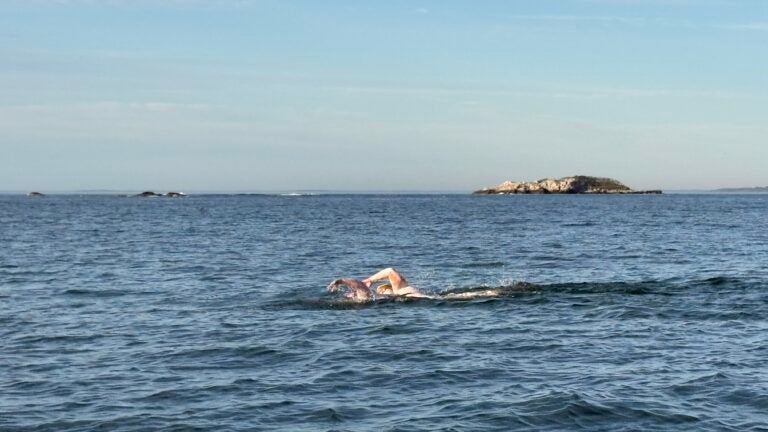
Two women attempted to complete an 18-mile open-water route from Marblehead to Scituate Tuesday — an effort that ultimately fell short, but still achieved a key goal: qualifying for marathon swims in Ireland later this summer.
“It’s fun to go try something new, something that hasn’t been done before,” Abigail Fairman, one of the swimmers, said. “That’s part of the joy of this sport.”
Fairman, 49, and Sarah Roberts, 42, entered the water at Deveraux Beach in Marblehead shortly before 6:30 a.m. Tuesday. The two athletes, both California residents, were aiming to reach Minot Beach in Scituate.
To qualify for the Irish races, swimmers must spend between six and eight hours in water temperatures ranging from 55 to 57 degrees Fahrenheit, Fairman said. Because California waters are typically warmer, Fairman and Roberts traveled across the country to train in Massachusetts in partnership with the Massachusetts Open Water Swimming Association.
“The Deveraux Beach to Minot Beach swim with Abby and Sarah is special because it is truly open-ocean swimming, with chilly waters and various sea creature encounters with the swimmers being 10-plus miles off shore,” John Forgione, a “pilot” who accompanies open-water swimmers in a boat for safety, said in a statement to Boston.com.
Both women are experienced marathon swimmers with globe-spanning resumes. Roberts has completed 334 swims from Alcatraz — site of the infamous prison — since taking up the sport a decade ago and previously swam Lake Titicaca in Bolivia. Fairman, who began marathon swimming 15 years ago, recently completed a series of swims in Tasmania.
For the first several hours Tuesday, the swimmers had “pretty much ideal conditions,” with no wind and “flat water,” Roberts said.
But, around the four-hour mark, conditions shifted dramatically.
“It got super choppy. The swell picked up, so it was harder to swim over,” Roberts said. “Then at maybe six hours or so, it was very obvious that we weren’t making any progress — if not going backwards.”
The pair remained side-by-side throughout the swim.
“We were stroke for stroke the whole way,” Fairman said, noting that the two train together frequently.
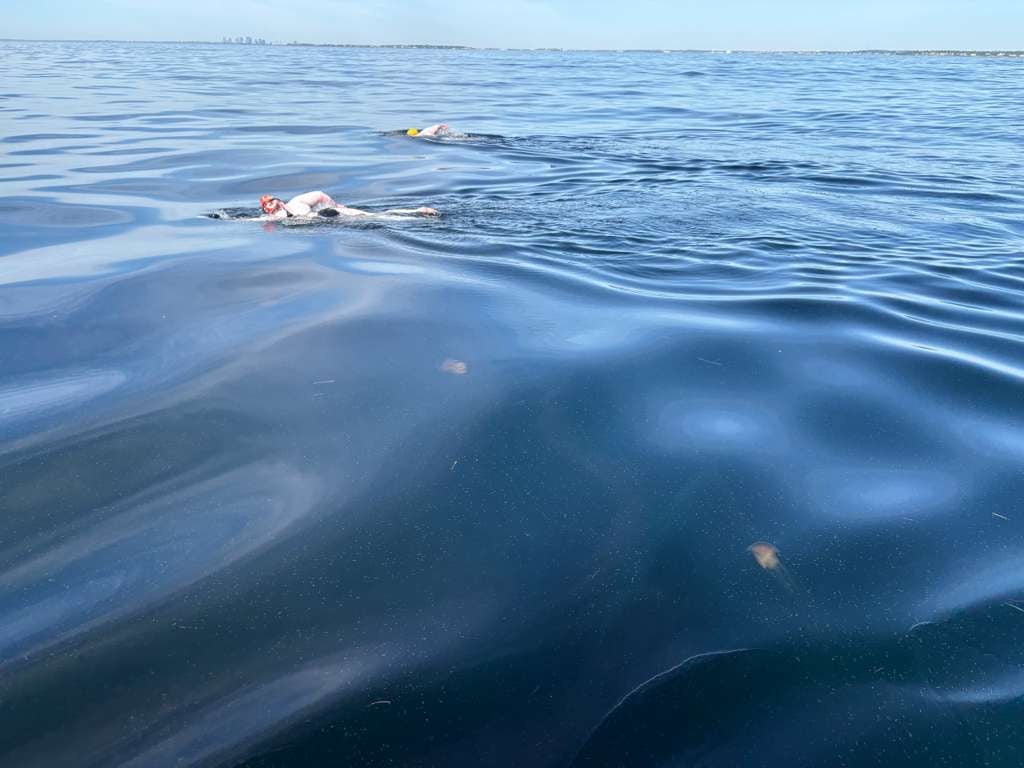
The swimmers also endured a steady barrage of jellyfish stings. Roberts said jellyfish appeared within the first 30 minutes and remained a near-constant presence for the rest of the swim.
“It’s sort of a joke amongst our friends that pretty much every swim I go on, where there’s the potential for jellyfish, I find them, and I get stung quite a bit,” she said.
“Indeed, a few whelps and comments were heard throughout the swim,” Forgione, who piloted Tuesday’s swim, said of the jellyfish stings.
Fairman ended her swim at the eight-hour qualification mark. Roberts remained in the water for roughly another 90 minutes before also returning to the support boat.
By that point, the swimmers were still several miles from Nantasket Beach, and worsening wind conditions made continuing to find shore unsafe and impractical, Fairman said. Instead, the group stopped the journey and turned around.
Elaine Howley, the swim’s official observer, called the effort an “amazing feat.”
“As a fierce wind kicked up in the afternoon, the swim became an entirely different animal,” she said. “It was a real encapsulation of what open water marathon swimming can be and how fickle the weather can be.”
Despite falling short of the planned finish, both swimmers accomplished their broader objective.
Later this summer, Fairman will attempt the 34.5-kilometer (21.4-mile) North Channel swim between Northern Ireland and Scotland — a course Roberts completed in 2023. Two weeks later, the pair plans to attempt the 21-kilometer (13 mile) Fastnet Swim together.
Fairman said the Massachusetts swim provided valuable lessons ahead of those challenges, particularly about navigating tides far offshore.
“The challenge was the tides and winds,” she added. “The water temp was right in our wheelhouse.”
For Roberts, she enjoys the “puzzle” of marathon swimming, especially analyzing how conditions affect strategy and what could be done differently on a future attempt.
Fairman said the pair would consider attempting the route again — possibly in reverse — though warming summer water temperatures may make Massachusetts less useful for cold-water training.
The swim also gave Roberts a memorable first glimpse of Boston, a city she has yet to visit.
“I could see downtown Boston from the water,” she said. “It’s a cool way to see the city.”
Sign up for the Today newsletter
Get everything you need to know to start your day, delivered right to your inbox every morning.

To comment, please create a screen name in your profile
Conversation
This discussion has ended. Please join elsewhere on Boston.com