The bill gives school librarians primary authority over selecting library materials.
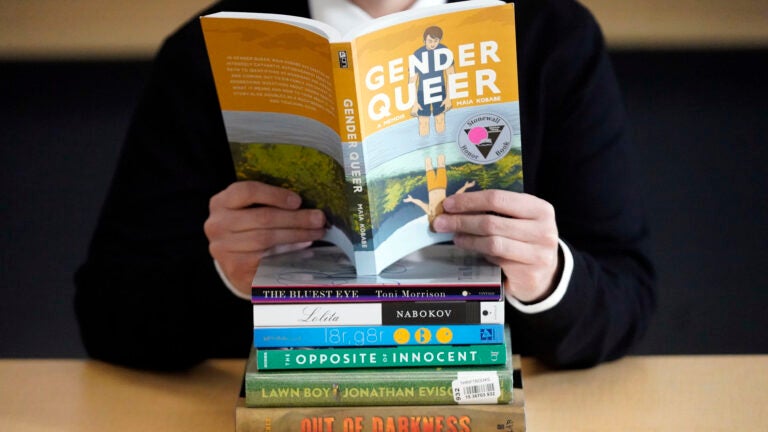
By JAMIE PERKINS/The New Bedford Light, Associated Press
7 minutes to read
Share
Send this article to your social connections.
Home to the first public library and the first public school in the country, Massachusetts is known for education. Yet in 2025, the state ranked fourth in the nation for attempts to restrict access to books, behind Texas, Florida and Pennsylvania.
Seeking to address the issue, the House passed a bipartisan bill earlier this month designed to protect access to books in school and public libraries.
The bill gives school librarians primary authority over selecting library materials. It requires that materials be age-appropriate, serve an educational purpose and be chosen based on professional training rather than personal or political views.
Massachusetts School Library Association President Reba Tierney said almost every school librarian already follows these standards. Though they can’t always read every book on the shelf, librarians read multiple reviews and rely on publishers’ recommended age ranges when determining whether a book is age-appropriate, she said.
“I think that’s the piece people don’t fully understand — books that make their way to our shelves have purposely been curated and added to the collection,” Tierney said.
The House bill would require every school in Massachusetts to adopt a library policy that includes criteria for handling book challenges. Rather than a complaint going directly to the school committee, the committee and the superintendent would appoint a review committee of school personnel to review the book in question.
The review committee would hold a public hearing and then make a recommendation to the school committee, which would vote on the book’s removal.
The bill stipulates that the school librarian’s book selection couldn’t be overruled unless there is “clear and convincing evidence” that the book is “devoid of any educational, literary, artistic, personal or social value,” or isn’t age-appropriate for any child at the school. During this process, the book would remain on the shelf.
Rep. Mark Sylvia, D-Fairhaven, said he recognized the importance of having clear procedures for reviewing challenged books in 2023, when the Old Rochester Regional School Committee reviewed and ultimately approved 10 commonly challenged books.
Joe Pires, the school committee member who at the time pushed to have the books removed, did not respond to a request for comment.
Tierney said the Massachusetts School Library Association already recommends that every school have a reconsideration policy on file, but it’s difficult to determine how many districts lack one because there is no centralized database.
Dartmouth Middle School librarian Laura Gardner, who said she spoke only on behalf of herself, told The Light that the district’s reconsideration policy can help put an “early end” to book challenges. The policy requires complainants to read each book and specify why they would like it removed.
“For districts that do not yet have that policy, now is an especially difficult political climate in which to pass one,” Gardner said, adding that she was pleased the bill would require every district to adopt one.
Madeline Pimentel, the New Bedford High School librarian, declined to comment, noting that she hasn’t faced any book challenges at the school.
Public libraries would need book challenge policies
Public libraries would be required to adopt policies that incorporate the American Library Association’s Library Bill of Rights and prevent books from being selected or removed because of personal or political beliefs.
Like school libraries, many public libraries in the state already have collection development and reconsideration policies, including the New Bedford Free Public Library and the Dartmouth Public Library. The Westport and Fairhaven library directors did not respond to a request to comment by deadline.
Dina St. Pierre, director of libraries in Dartmouth, said the town has not received a formal or informal request for reconsideration in many years. Like Tierney, she said librarians put considerable thought into the books they select.
“We take our jobs seriously,” St. Pierre said. “Most of us have pursued master’s degrees in library science, so we’ve invested a lot of time and money into educating ourselves to be librarians.”
The bill would also require annual reporting on book challenges and complaints and strengthen protections for school and public librarians against discipline related to their selection of library materials.
New Bedford representatives support the bill
Rep. Christopher Hendricks, D-New Bedford, said protecting librarians is important because threats are “trending up” in Massachusetts.
In 2023, a survey of school and public librarians in Massachusetts found that nearly 25% of respondents reported being harassed on social media; 22% reported being harassed via email; and 18% reported being harassed in person because of book or program challenges.
“(Librarians) are hired based on their background and training,” Sylvia said. “It’s important to ensure that you’re protecting the professional integrity of a process, and that includes indemnifying the people that make those decisions using those qualifications.”
These protections were the focus of a Republican amendment filed by Rep. John Gaskey, R-Carver. Gaskey’s amendment attempted to remove existing protections for librarians.
“If a school employee is acting in genuine good faith to educate, they have absolutely nothing to fear,” Gaskey said. “But if they are using their taxpayer-funded position to expose children to explicit content under the guise of ideology, then yes, they should face the chill of handcuffs, the loneliness of a cold, dark jail cell.”
The amendment was voted down nearly unanimously. Each of New Bedford’s representatives voted in favor of the bill and against Gaskey’s amendment.
Rep. Christopher Markey, D-Dartmouth, said the House bill is a direct response to the increasing number of book challenges and threats.
“I think it’s just one of these things that we’ve always taken for granted,” Markey said. “But as with everything, it seems every typical standard has been changed in the last 10 years.”
Hendricks said he supports the bill because it gives libraries a “definitive process” for handling book selection and challenges and sets clear standards for which books should stay on shelves.
Rep. Steven Ouellette, D-Westport, gave similar reasoning in a written statement. He said he voted in favor of the bill because it “gives people the right to access reading material, doesn’t attack librarians, requires policies to be done, and has follow-up procedures to address complaints on materials that someone may have an issue with.”
In a written statement, Rep. Antonio F.D. Cabral, D-New Bedford, told The Light he supports the bill because it establishes clear standards and a fair, transparent review system.
“I strongly believe in safeguarding the freedom to read, to explore ideas, and to encounter perspectives that reflect the full diversity of our communities,” Cabral said. “While I recognize the importance of ensuring that age‑appropriate materials are selected with care and professional judgment, it is essential that we stand firmly on the side of intellectual freedom.”
Sen. Mark Montigny, D-New Bedford, voted in favor of a similar bill that the Senate passed in November 2025.
“There is no place for politically motivated censorship within our public schools and libraries,” Montigny said in a written statement. “Freedom of thought and being able to see oneself reflected in the stories and ideas available on our bookshelves is an important aspect of one’s development and learning experience.”
Like the House bill, the Senate bill allows parents to challenge books they believe are not age-appropriate for any child in the school or lack value. Montigny said the regulation strikes an “essential” balance.
The House bill will now go to a conference committee with the Senate.
Which books are challenged most frequently?
According to an American Library Association report in April, 4,235 unique titles were challenged in the U.S. in 2025. Of these titles, 39% focused on LGBTQ+ people or people of color.
Rep. Christopher Markey, D-Dartmouth, said it’s “absolutely” important to keep books that feature diverse perspectives on the shelf.
“Government’s job is to get people to reach their potential,” Markey said. “The way you get people to reach their potential is, they’ve got to love themselves first. They’ve got to understand who they are.”
He added that books also help people to understand others’ experiences.
Several librarians agreed with Markey’s perspective.
“We want books in our libraries that represent all of our students, and also give a window into other people’s lives,” Gardner from Dartmouth Middle School said. “It’s all about choice — students don’t have to read books that they don’t want to, but those books are there for the students who do want to read them.”
Tierney, who is also a high school librarian, has seen firsthand the impact of representation in books. A student and their parent read “ Gender Queer: A Memoir ” by Maia Kobabe — a graphic novel that “charts (Kobabe’s) journey of self-identity,” including coming out to family and society.
The novel was the third most challenged title in 2025, according to the American Library Association. Many complaints about the book stem from what critics say are explicit images. But Tierney’s student had a different takeaway — they saw their experience reflected in writing.
“There’s some mature content in that book, and I definitely wouldn’t put that book in an elementary school,” Tierney said. “But that is an actual memoir of someone’s lived experience, and there are some students that for them, that’s a lifeline … That is so powerful.”
New Bedford Free Public Library Director Olivia Melo said the library system has not faced any book challenges in recent years.
The American Library Association’s data shows that most book challenges don’t come from parents or library patrons. Nearly 92% of complaints and challenges in 2025 were initiated by “pressure groups and decision makers swayed by them,” the report says. Only 3% came from parents and only 1% were initiated by library patrons.
Several organizations that have spearheaded the campaign to remove books they consider inappropriate from libraries — including Moms for Liberty, Defending Education and Massachusetts Family Institute — did not respond to requests for comment.
This story was originally published by The New Bedford Light and distributed through a partnership with The Associated Press.
Sign up for Book Club
Stay up to date on local books news, events, and recommendations from Boston.com.