





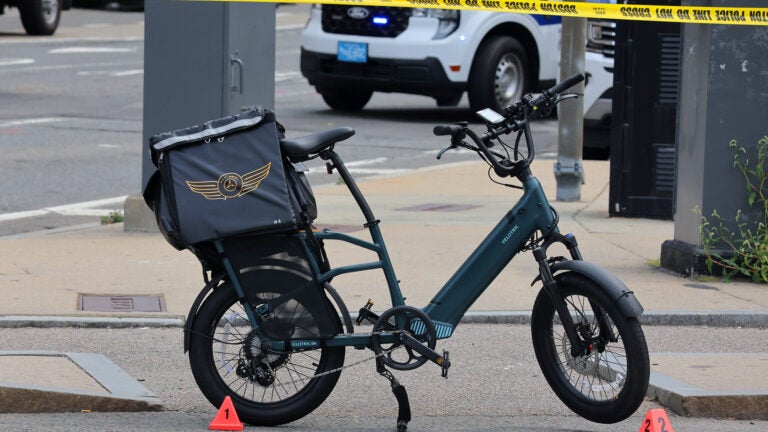
Several recent high-profile incidents have drawn attention to safety concerns and the lack of clear regulations for e-bikes, scooters, and mopeds.
Send this article to your social connections.
Gov. Maura Healey filed legislation Monday that would introduce a host of new regulations on “micromobility devices” such as e-bikes, scooters, and mopeds. As these devices become more widespread and powerful, advocates and lawmakers say they are playing catch up to implement much needed safety guidelines.
The centerpiece of the bill, dubbed the Ride Safe Act, is a new speed-based framework for classifying micromobility devices. The Healey administration says it would be the first of its kind in the nation.
Devices would be regulated differently based on their maximum speed, and split into four tiers. The first would encompass all unpowered devices and those that can only go as fast as 20 mph. A second tier would contain devices that have a maximum speed between 21 and 30 mph, a third tier would contain devices that have a maximum speed between 31 and 40 mph, and a fourth tier would include devices that can exceed 40 mph.
Advertisement:
Lower-speed devices would follow rules that govern bike lanes, with helmet requirements and other restrictions for users under the age of 16. Stricter requirements would be set up for higher-speed devices, like mopeds, meaning riders would have to get their vehicles registered and insured. Higher-speed devices would be prohibited from traveling on sidewalks, in bike lanes, or on shared-use paths.
“Micromobility is already a part of how people get to work, school and around their communities, but right now, the rules are unclear and inconsistent,” Healey said in a statement. “We are seeing too much reckless behavior, more crashes and close calls, and too many people, especially pedestrians and young riders, are at risk.”
Advertisement:
The bill seeks to impose restrictions on modifications that can increase speeds on devices beyond manufacturer limits. It would establish “clear enforcement authority” for police officers, allowing them to be more consistent in combating unsafe behavior, officials said.
The proposed legislation is based on recommendations set forth by a Special Commission on Micromobility, which was created by an economic development bill that Healey signed into law in 2024. The commission met with a variety of stakeholders and produced a 116-page report, along with a shorter document summarizing its findings.
These recommendations were crafted as micromobility devices continued to surge in popularity. E-bikes, as one example, made up just 2 percent of U.S. bicycle sales revenue in 2016. They now account for 28 percent of the market, according to the commission’s report. At the same time, experts are documenting a steady rise in serious injuries tied to high-speed micromobility devices.
The public conversation around micromobility devices is often skewed because there are not clear, well-known definitions for them, Brendan Kearney, executive director of the advocacy group WalkMassachusetts, said. When people complain about e-bikes, they are often referring to heavy, high-powered vehicles that can go as fast as 60 mph. These should not be lumped together with pedal-assist bikes that top out at 20 mph, he said.
Advertisement:
“Once you get a consistent definition, it helps you identify what the problem issues are, and then you’re able to say ‘those things can’t go on shared-used paths, those things need to be on the roadway because they go as fast as regular vehicles,’” Kearney said.
In Massachusetts, several high-profile incidents spurred an increased awareness of safety concerns. A man died after being struck by an e-bike near Copley Square last year, and a teenager died in Stoneham after crashing an electric dirt bike into a car. A Brewster woman was seriously injured by an e-bike on the Cape Cod Rail Trail. Police in Milford recently issued a warning to residents after seven e-bike-related incidents occurred in a span of 10 days.
Galen Mook, executive director of the advocacy group MassBike, said that some high-profile incidents have led to “hyperbole” in the public discourse about the safety of micromobility devices. That said, the incidents have also woken people up to the fact that there are real problems with the current laws and that new regulations are needed, Mook added. He applauded Healey’s efforts and said that policymakers should act now while public interest remains high.
Advertisement:
Mook credits the bill as being “expansion-minded,” as it could help further MassBike’s goal of encouraging people to move away from single-occupancy vehicles. As more people continue to adopt micromobility devices, leaders should think about wider changes that better accommodate the new transportation landscape, he said.
“Let’s not lose the thread that, by having more people out on micromobility, it’s going to require us to re-think our infrastructure as well. We need to have safer routes, we need to have safer roads, we need to have education for drivers as well as for micromobility users in order for us to actually implement the safety nature of what this bill is trying to achieve,” Mook said.
Kearney shares Mook’s concerns about improving infrastructure. One of the commission’s recommendations was an increase in appropriations for the state’s Complete Streets Funding Program, something Kearney would still like to see lawmakers pursue.
For Kearney, one of the most exciting aspects of the proposed bill concerns crash data collection. The bill would better incorporate information from crashes involving micromobility devices into police data, which drives a lot of policy changes, he said.
“This is trying to plug a hole in that and help us identify where there might be hot spots, or try to understand where there are problems because then you can actually make fixes happen,” he said.
Mook is encouraged by the fact that the legislation is supported by both the Senate chair and the House chair of the Joint Committee on Transportation, and he’s hoping that lawmakers can move quickly.
Advertisement:
He sees Healey’s proposed bill as a crucial step toward making a larger, multi-sector impact that could have a lasting “ripple effect.”
“Ten, 20, 30 years down the line, if we do this right, we might really have a whole new framework of how people get around in the commonwealth,” Mook said.
Ross Cristantiello, a general assignment news reporter for Boston.com since 2022, covers local politics, crime, the environment, and more.
Sign up for the Today newsletter
Get everything you need to know to start your day, delivered right to your inbox every morning.


Want to leave a comment?
To comment, please create a screen name in your profile