Experts say maritime slow zones protect the whales, but a major rollback of these rules could be on the horizon.
Share
Send this article to your social connections.
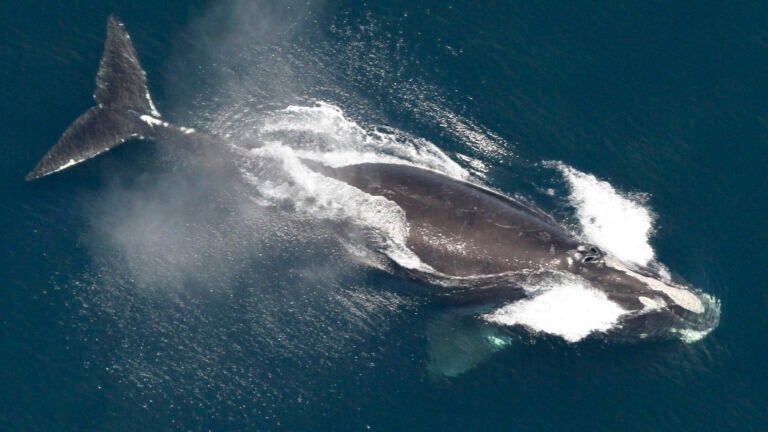
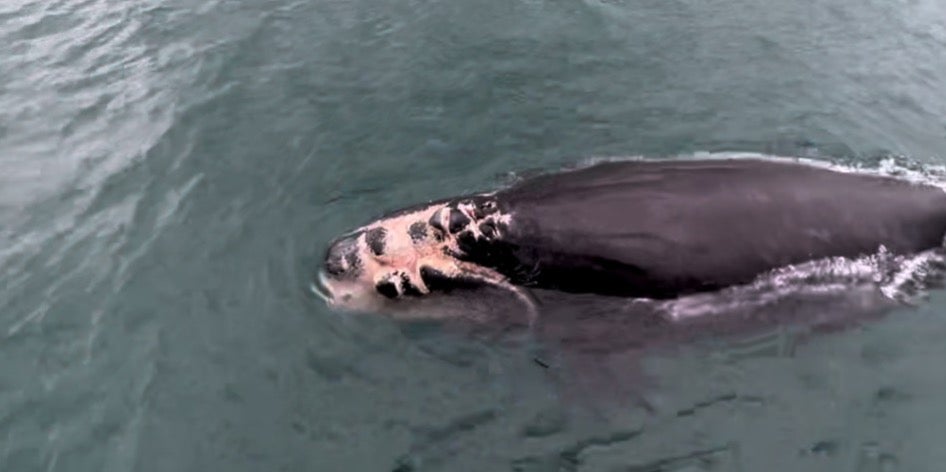
North Atlantic right whales, which frequent the waters off Massachusetts, are some of the most endangered marine mammals on the planet. The animals, named because they were the “right” whales to hunt, were brought to the brink of extinction by the 1890s. Whaling is no longer a threat, but other forms of human activity still pose serious dangers.
One of the most prominent threats right whales face is vessel strikes. Even if whales survive a collision with a vessel, any injuries can have long-lasting effects not just on that individual whale but on the species as a whole. For almost a decade, the federal government has enforced rules designed to slow boats down and decrease vessel strikes with North Atlantic right whales along the East Coast.
Now, a high-stakes battle over the future of these rules is playing out as the Trump administration explores deregulatory action that could eliminate slow zones in places with heavy maritime traffic.
Proponents of rule changes say that whale-detection technology has advanced to the point where slow zones can be relaxed, and highlight the economic impacts associated with them. But conservationists and whale researchers are alarmed. They worry that these changes could undo years of progress and further threaten the already fragile North Atlantic right whale population.
How many right whales are left?
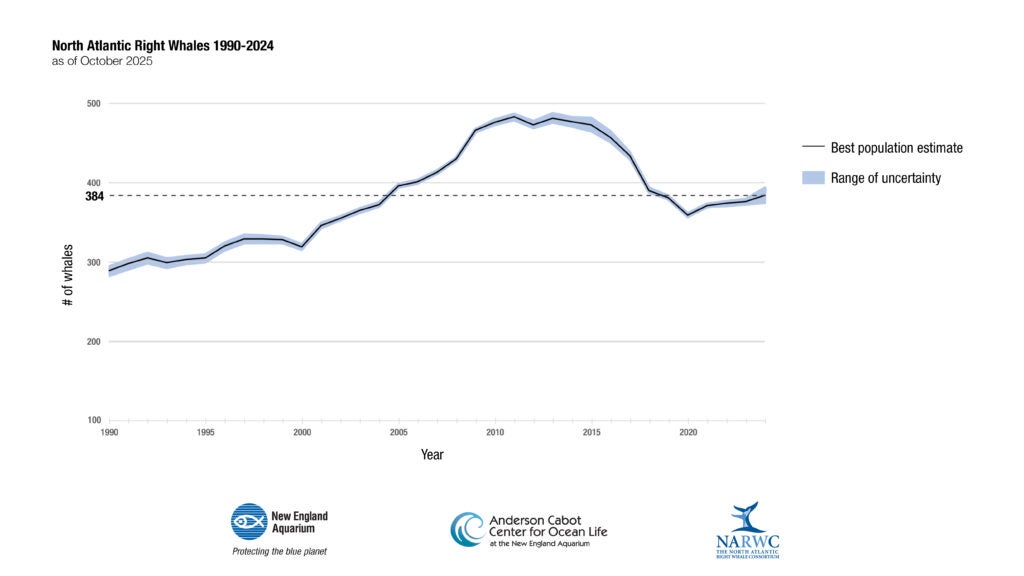
According to the latest population estimates, which are for 2024, there are only about 380 North Atlantic right whales left. This marked a roughly 2% increase from 2023, and researchers were heartened by the slow but noticeable population growth.
There were fewer than 300 right whales left in 1990. But population numbers steadily increased over the following two decades before peaking around 2010, when close to 500 right whales were estimated to be alive.
Population estimates dropped again from 2013 to 2020, then started steadily climbing again.
Researchers meticulously track individual whales through an extensive online catalog, giving them unique names based on their markings. Special attention is paid to females, who can give birth as many as nine times in their lives, according to Jessica Redfern, the associate vice president of ocean conservation science at the New England Aquarium’s Anderson Cabot Center for Ocean Life.
In a recent interview with Boston.com, Redfern highlighted one matriarch that has given birth at least seven times since 1982. Through her calves and their offspring, this one whale is responsible for 31 others being added to the population, she said.
Vessel strikes are particularly dangerous for mothers and their calves, who spend the majority of their time at or near the surface.
“The survival of every individual matters, and even one human-caused mortality puts the species at risk of extinction,” Redfern said.
According to data from NOAA Fisheries, there have been 15 right whales that have died from vessel strikes since the government declared an “Unusual Mortality Event” in 2017. But this only captures a snapshot of the impact of vessel strikes, Redfern said.
“We observe such a small fraction of serious injuries and deaths. Whatever we’re seeing, there’s a lot more that’s happened that we’re not seeing,” she said.
What rules are currently in place?
In 2008, NOAA promulgated its Vessel Strike Reduction Rule, which requires vessels 65 feet or longer to keep their speeds at 10 knots or less in certain locations. These Seasonal Management Areas go into effect in specific areas at specific times of the year.
Cape Cod Bay is affected between January and May, the waters to the east and north of Cape Cod are affected in March and April, and a wider swath of ocean further east is affected between April and July.
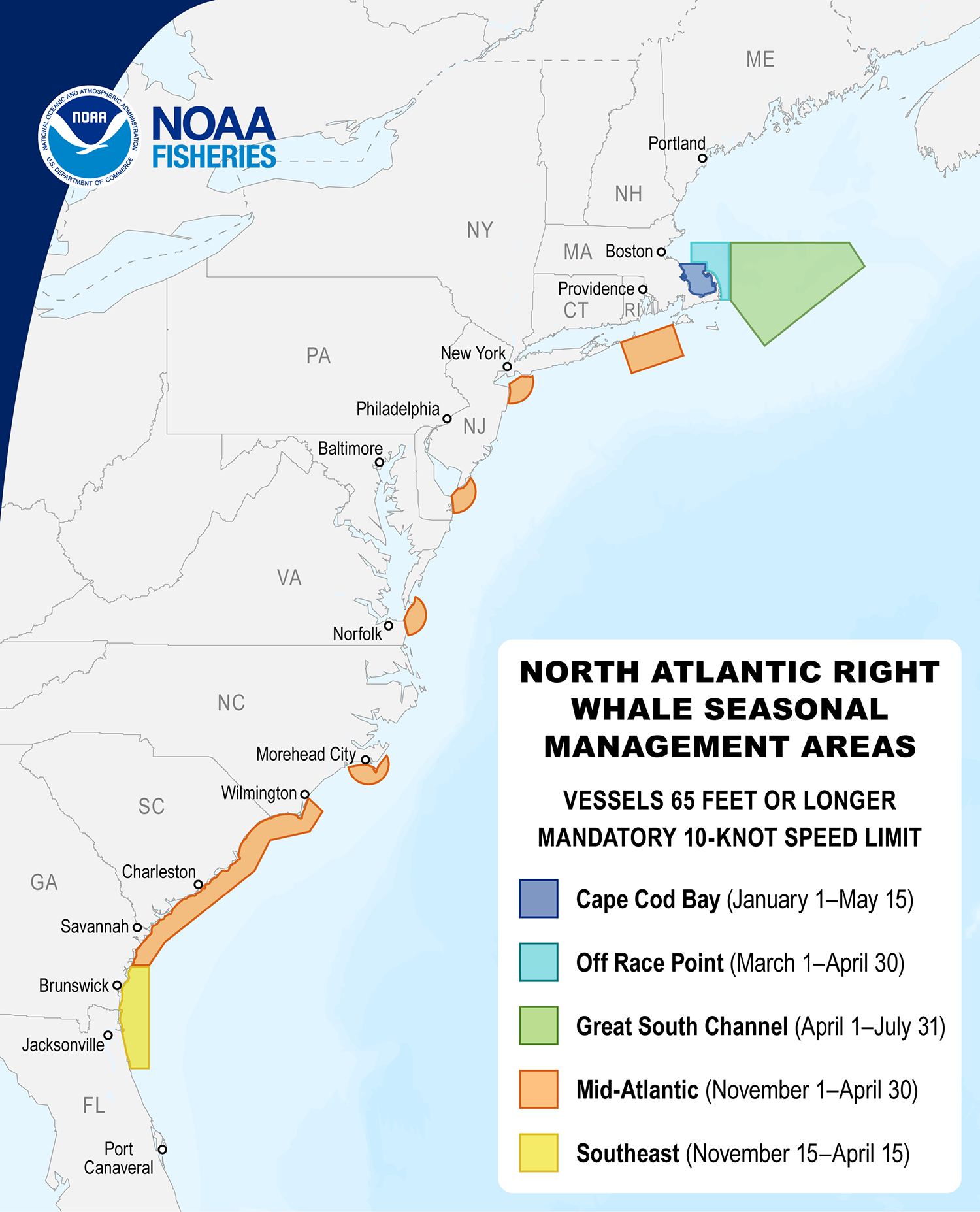
Before the implementation of the Vessel Strike Rule, the rate of North Atlantic right whale vessel strikes in or near these areas was 0.72 per year. For the first five years after the rule was implemented, this rate dropped to 0 per year, which Redfern called a “significant decrease” in a recent letter to NOAA officials.
In addition, NOAA has a system for declaring “dynamic” slow zones when right whales are detected either visually or acoustically. Unlike the Seasonal Management Areas, these are voluntary. Mariners entering into them are alerted that a whale was seen nearby and encouraged to slow down. They last for 15 days.
NOAA has found that mariner cooperation with the speed restrictions in the voluntary zones “fell well short” of compliance levels reached in the Seasonal Management Areas.
What could change?
Two drastically different changes to the existing vessel speed rules have been publicly debated in recent years.
Under the Biden administration in 2022, NOAA proposed changes that would have approximately doubled the areas subject to speed restrictions along the East Coast and included smaller vessels. NOAA withdrew the proposal about two weeks before President Donald Trump began his second term.
Now, NOAA is considering changes that go in the opposite direction. Officials want to “reduce unnecessary regulatory and economic burdens.” They are exploring ways to leverage new technologies with an eye towards potentially replacing all static seasonal slow zones with automated, realtime dynamic slow zones.
Specifics are light, and a public comment period only ended earlier this month. Officials received more than 29,000 responses, and it is unclear when further details will be announced.
Redfern, who testified before lawmakers years ago in favor of the Biden-era slow zone expansions, said that the scientific basis for those proposed changes was strong. She is now advocating in favor of a “comprehensive strategy” that maintains the current slow zone rules.
Redfern, writing to NOAA on behalf of the Aquarium, said the institution supports the continued evaluation of whale-detection technology, but stressed that this approach and maintaining the current rules are not mutually exclusive.
“I feel very deeply concerned about what would happen to right whales if we removed all vessel speed restrictions. It’s such an important protection,” she said.
One of the most prominent voices arguing against the Biden-era expansion proposals was the National Marine Manufacturers Association. Robyn Boerstling, that organization’s senior vice president of government relations, described that discussion as an “inflection point” that led to advances in technology and a wider understanding of the economic impacts associated with the slow zones.
NOAA has historically “grossly underestimated” the economic costs of vessel speed restrictions, which “deter recreational boating and fishing trips due to time, costs, and safety concerns,” the NMMA said in public comments to the agency.
Boerstling stressed that the NMMA supports the protection of right whales, but questions whether blanket speed limits across “broad swaths” of the Atlantic are the right way to protect them. The organization submitted public comments to NOAA applauding the agency’s “willingness to take a closer, more thorough look at the underlying data used to justify” the current speed rules.
“We think there’s a much better way to achieve the same, if not better outcomes by introducing technology into the rule and really refreshing and updating how the rule is managed,” she told Boston.com.
Details of these whale-detecting technologies, which include satellite and infrared imaging as well as acoustic sensing and aerial surveys, were outlined in a report released last year by the MITRE Corporation.
Boerstling and NMMA also say that vessel speed restrictions can pose dangers to mariners.
“For many recreational vessels, especially smaller planing vessels, forced low-speed operation can reduce maneuverability and create safety risks in certain offshore conditions,” the organization said in a recent press release.
Boerstling said that the increasing right whale population estimates are a positive sign, and attributed some of this progress to increased “public awareness.” She credited NOAA for stepping up its work with NMMA’s member organizations over the past year to achieve this.
“Reduced speeds may be a tool,” Boerstling said. “I’m not erasing them from the board. But they’re one tool in limited circumstances and the public record supports a much smarter approach that is technology-driven, risk-based, and safer for mariners. I think there’s more effective ways to protect the species.”
Ross Cristantiello, a general assignment news reporter for Boston.com since 2022, covers local politics, crime, the environment, and more.
Sign up for the Today newsletter
Get everything you need to know to start your day, delivered right to your inbox every morning.