Industrial and Operational Technology (OT) networks present monitoring requirements that standard IT-grade equipment handles poorly. Control systems, SCADA platforms, and Industrial Control Systems (ICS) run legacy protocols on segmented networks. Uptime is non-negotiable. Any packet loss can mask a safety-critical anomaly. Convergence with IT networks has also widened the attack surface significantly. The OT security market is projected to reach $50.29 billion by 2030, up from $23.47 billion in 2025. That is a 16.5% compound annual growth rate. Organisations operating refineries, utilities, manufacturing facilities, and critical infrastructure need network TAPs that deliver passive, zero-impact capture.
This guide evaluates six verified vendors for industrial network TAP deployments in 2026. It covers specifications, OT fit, and deployment realities.
Network TAP Vendors for Industrial Networks: At a Glance
| Vendor | Key Strength | Max Throughput |
|---|---|---|
|
Passive fiber TAPs, hybrid TAP plus broker, zero-power OT capture |
Up to 400G |
|
|
OT-focused TAP portfolio, hardware data diodes, US manufacture |
Up to 100G |
|
|
Industrial TAPs, portable ProfiShark field units, European coverage |
Up to 100G |
|
|
FPGA-based zero-packet-loss TAPs, high-density chassis |
Up to 400G |
|
|
GigaTAP passive and active series, deep observability platform |
Up to 400G |
|
|
IntellaView packet broker, compliance-grade data masking, 400G blade |
Up to 400G |
Network Critical – Passive Fiber Optical TAPs, SmartNA, SmartNA-PortPlus
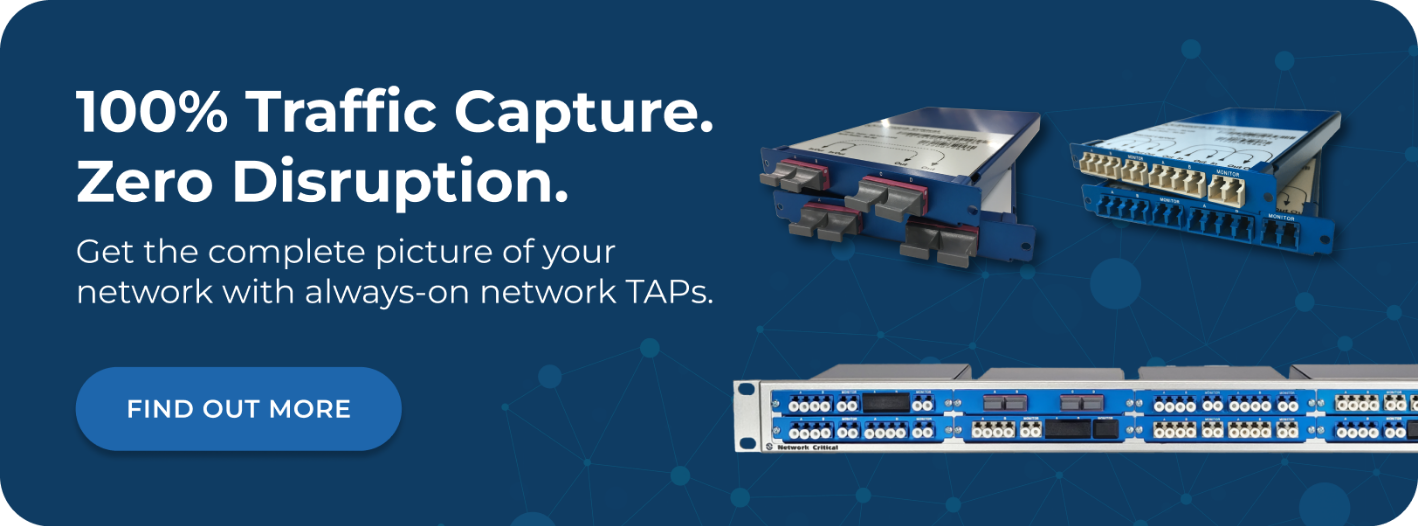
Network Critical's OT network monitoring portfolio is centred on hardware designed for the physical constraints of industrial deployments. The passive fiber tap range requires zero power and carries no active electronics. This removes any risk of power-related disruption in remote OT locations such as drilling platforms, substations, and refinery buildings. Up to 16 TAPs fit into a single 1RU chassis, preserving rack space in environments where space is restricted. Speeds cover 1G to 100G across single-mode and multi-mode fibre, with units shipping preconfigured to the required split ratio.
Some industrial deployments require aggregation and filtering across segmented ICS traffic. The modular 1G SmartNA delivers a hybrid TAP and packet broker in a compact chassis for these environments. It supports 4-slot hot-swap TAP modules covering failsafe copper, passive optical, and bypass options. AC input accepts 85–264 VAC. DC input covers -36V to -72 VDC. This range accommodates the variable power conditions common in industrial facilities. The Drag-n-Vu GUI lets network admins configure traffic mapping without specialist engineers. Typical deployments complete in under two hours. For higher-speed environments, the SmartNA-PortPlus scales from 48 to 194 ports across 1G, 10G, 25G, 40G, and 100G. It delivers 1.8 Tbps line-rate throughput. Output feeds any SIEM, NDR, or ICS security platform via standard PCAP with no proprietary lock-in.
Proven results:
- BP: Deployed passive fiber optical TAPs across 10–12 refinery buildings to enable centralised monitoring of IT and OT systems, supporting security and firmware inventory tools without impacting production traffic.
- Airbus: Deployed network TAPs across aircraft test rigs to achieve 100% visibility during flight safety testing, completing first flight test objectives on schedule.
- HSBC: Achieved zero latency on monitoring technologies across a global network using passive fiber optical TAPs and SmartNA modular TAPs.
Garland Technology – EdgeLens Inline Bypass TAP, OT TAP Series, Hardware Data Diodes
Garland Technology is a US-based TAP specialist with one of the most active OT-focused product lines in the market. Their OT TAP series is designed for ICS and SCADA environments. It integrates with OT security platforms including Nozomi Networks, TXOne, EmberOT, and Radiflow. The EdgeLens inline bypass TAP series delivers sub-microsecond failover for 1G–100G links. This protects inline security tools from disruption during power events or appliance failure.
Garland's hardware data diode product line is a distinctive capability for critical infrastructure buyers. It enables unidirectional data transfer between segmented OT and IT zones. No other vendor in this set offers a comparable product. Maximum verified throughput reaches 100G. The company operates a "no hidden fees, no subscriptions" commercial model. US manufacture is a stated advantage for federal and defence buyers with data sovereignty requirements. Garland maintains an active presence at OT-focused events including S4, CyberSecure OT, and BSides ICS/OT. Configuration uses standard TAP management workflows rather than a drag-and-drop GUI.
Profitap – Industrial TAPs, ProfiShark Field Units, IOTA All-in-One
Profitap is a Netherlands-based vendor covering TAPs, packet brokers, portable field troubleshooters, and their distinctive IOTA product. IOTA combines TAP, full-packet capture, storage, and protocol analysis in a single appliance. This makes it useful for point-in-time OT incident investigation. No additional capture infrastructure is required at the investigation point. The ProfiShark line provides portable field units for engineers troubleshooting specific segments of an industrial network without permanent TAP deployment.
For fixed infrastructure monitoring, Profitap's industrial TAP range covers copper and fibre media at up to 100G. The Supervisor centralised management layer aggregates configuration across multiple deployed units. Profitap also offers vTAP support for VMware and Kubernetes environments. This is relevant for hybrid OT-IT architectures where monitoring extends to virtualised workloads. European reseller coverage is strong across the Netherlands, Germany, and the Nordics. North American field presence is thinner than US-headquartered vendors in this set.
Keysight (Ixia) – Ixia Network TAPs, Vision ONE Packet Broker, IFC Centralised Manager
Keysight's Network Visibility business unit is built on the Ixia acquisition. It covers TAPs, inline bypass switches, and the Vision packet broker family. The Ixia TAP portfolio includes passive optical and active bypass options at speeds from 1G to 400G. Keysight's FPGA-based architecture is validated by The Tolly Group for zero-packet-loss performance under full-duplex load. The IFC Centralised Manager provides a unified management interface across deployed TAPs and packet brokers.
For industrial environments, Keysight's OT motion is relatively new. The Forescout partnership was announced in January 2026 as part of the Application Fusion Program. TAP configuration uses a drag-and-drop GUI comparable to Drag-n-Vu functionality. Keysight received the Frost & Sullivan 2024 Global New Product Innovation Award for the Vision 400 series. Pricing is positioned at the premium end of the market. Network visibility is one business unit among many within a broader Keysight portfolio, which affects visibility-specific support responsiveness.
Gigamon – GigaTAP Series, GigaVUE-TA Traffic Aggregators, GigaVUE HC Series
Gigamon is the market-share leader in the deep observability segment. Per 650 Group data from Q1 2026, it holds 51% of the segment. The GigaTAP series covers passive optical and active bypass TAPs at 1G, 10G, 40G, and 100G. The GigaVUE-TA series acts as traffic aggregators feeding the broader GigaVUE fabric. Gigamon's Precryption technology provides TLS visibility without a traditional decryption-proxy architecture. This is relevant for IT-OT convergence environments where encrypted lateral traffic needs inspection.
For industrial deployments, Gigamon's platform scales into enterprise and service-provider environments with broad tool ecosystem integration. GigaVUE-FM Copilot and AI Traffic Intelligence capabilities launched in Q1 2026 add automated traffic analysis above the physical TAP layer. Deployment typically requires specialist engineers and multi-day implementation cycles. The 3-year total cost of ownership (TCO) is materially higher than mid-market alternatives. Subscription pricing has been identified as a customer friction point, particularly at renewal. Gigamon holds Frost & Sullivan 2026 Company of the Year recognition for the public sector.
APCON – IntellaView Platform, IntellaStore IV, APCON Intelligent Processor
APCON is a Wilsonville-based packet broker specialist. The IntellaView platform covers 1G to 400G with compliance-grade capabilities. These include data masking, packet slicing, and HIPAA and PCI-DSS aligned configurations. The January 2026 IntellaStore IV launch introduced on-box ThreatGuard IDS capability. This is delivered via the APCON Intelligent Processor (AIp), which allows security applications to run directly on the packet broker. This is an unusual architecture in the industrial TAP and broker segment.
APCON supports 400G blade configurations in the IntellaView platform. It provides 60 days of free ThreatGuard access with IntellaStore IV as a try-before-buy mechanism. Pricing is quote-based via resellers. APCON's primary field presence is in the United States. UK and European enterprise buyers should verify local partner coverage before procurement. Advanced feature configuration requires specialist knowledge. APCON's deployment at scale in OT-specific reference cases has not been publicly validated as of Q1 2026.
How to Choose the Right Network TAP for Your Industrial Environment
Selecting a network TAP for an OT or ICS deployment involves requirements that differ significantly from standard IT infrastructure procurement. The following criteria help frame the decision.
Passive vs Active Capture
Passive fibre optical TAPs draw no power and introduce no active electronics into the monitored path. For industrial environments with variable power, remote siting, or strict change-control requirements, passive TAPs are the lowest-risk access method. Active copper TAPs and bypass switches are appropriate where failover protection for inline tools is required. However, they introduce a power dependency that needs planning in remote OT locations.
Consider:
- Does your OT site have stable, clean power?
- Are your monitored links copper or fibre?
- Do you need failover protection for inline security tools, or is out-of-band passive monitoring sufficient?
Zero-Impact Deployment on Production Systems
Industrial networks tolerate almost no disruption. Any TAP solution deployed in an ICS environment must demonstrably have zero impact on production traffic. Passive optical TAPs achieve this by splitting the optical budget without touching the electrical path. Active TAPs and bypass switches must be validated against the specific latency and failover requirements of each control system.
Space and Power Constraints at Remote Sites
Refineries, substations, and remote drilling platforms frequently operate with tight rack space and limited power budgets. High port density reduces the physical footprint needed for comprehensive monitoring coverage. For example, network taps that provide up to 16 passive TAPs per 1RU are well suited to space-constrained industrial enclosures. DC power input support is important for environments running on -48V DC plant power.
Integration with ICS Security Tools
Your TAP feeds security and monitoring tools. Confirm that the TAP vendor's output format is compatible with your ICS security platform. This may be Nozomi Networks, Claroty, Dragos, or a PCAP-based SIEM ingestion path. A tool-agnostic architecture delivers standard PCAP output and reduces integration complexity. It also avoids locking your visibility layer to a single security vendor's platform.
Scalability from Legacy to High-Speed Links
Industrial networks frequently mix decades-old 10/100 Mbps links with modern 10G or 100G backbone connections. A TAP portfolio that covers this full range in a single vendor relationship simplifies procurement, support, and spare-parts management. The hybrid packet brokers that aggregate legacy link traffic into a single high-speed monitoring feed are particularly useful here. Link diversity is typically high in refinery and utilities deployments.
Total Cost of Ownership
OT budgets are typically tighter than enterprise IT. Vendors operating on perpetual hardware licences with no per-port subscription fees provide a predictable cost model. This fits OT capital expenditure cycles well. Subscription-based pricing introduces recurring costs that require ongoing OpEx approval. In industrial procurement environments, this can complicate deployment timelines. Model the 3-year TCO – including maintenance and any required specialist engineering time – rather than comparing list prices alone.
Frequently Asked Questions
What Is a Network TAP and Why Does It Matter for Industrial Networks?
A network TAP is a hardware device that creates a passive copy of live network traffic. It forwards that copy to monitoring or security tools without affecting the production link. In industrial networks, TAPs are essential because SPAN ports on managed switches drop packets under load. They cannot provide the forensic-grade capture fidelity that ICS security platforms require. For ICS and SCADA environments, any missed packet can represent an undetected control system anomaly or a masked intrusion attempt.
What Is the Difference Between a Passive Fiber TAP and a Bypass TAP?
A passive fiber optical TAP splits the light signal on a fibre link. It directs a copy to monitoring tools using no power and no active electronics. A bypass TAP is an inline device that protects security tools. It automatically fails open if the inline appliance loses power or becomes unresponsive, keeping production traffic flowing. Passive TAPs are used for out-of-band monitoring with zero production risk. Bypass TAPs are used where inline security appliances sit in the traffic path directly. Examples include IPS devices and next-generation firewalls.
How Many Network TAPs Does an Industrial Site Typically Need?
The number of TAPs depends on the number of network links requiring continuous monitoring. Complex industrial environments with multiple ICS zones and IT-OT convergence points may require dozens of TAPs. These feed a centralised packet broker for aggregation before delivery to monitoring tools. A general planning ratio is one TAP per monitored link. The packet broker then aggregates traffic from multiple TAPs before forwarding to the tool stack. The OT network monitoring requirements of a refinery will differ significantly from those of a small manufacturing facility.
Can Network TAPs Be Deployed Without Disrupting Live OT Systems?
Yes. Passive fibre optical TAPs are deployed by inserting them into the fibre path at a breakout point. Live traffic is unaffected because the optical split is passive. Active copper TAPs are inserted inline but include failsafe bypass circuitry. This maintains traffic continuity even if the TAP loses power. Planned maintenance windows may be required for physical cable work. Modern TAPs are designed so that the installation step is the only potential disruption point.
Do Network TAPs Support Compliance Frameworks Such as IEC 62443 and NERC CIP?
Network TAPs themselves are infrastructure, not compliance tools. However, passive TAPs provide continuous, forensic-quality packet capture. This is what IEC 62443, NERC CIP, and NIS2 auditors require as evidence of network monitoring coverage. Compliance frameworks specify that OT network traffic must be monitored continuously. They also require that evidence of anomaly detection be available. TAPs provide the access layer that makes that monitoring possible without modifying the production network.
Build Your Industrial Visibility Architecture With Network Critical
Choosing the right TAP for an industrial network means matching OT environmental realities to a vendor designed for those conditions. Power constraints, space restrictions, legacy link speeds, and strict uptime requirements all shape the decision. Network Critical's passive fibre TAP range, modular SmartNA platform, and hybrid TAP-plus-broker architecture address these requirements directly. The perpetual licence model fits OT capital expenditure cycles. The 3-year TCO runs 40 to 60% lower than enterprise incumbent alternatives. Typical deployments complete in under two hours without specialist engineer dependency.
To understand which products fit your industrial monitoring requirements, speak to the Network Critical team.