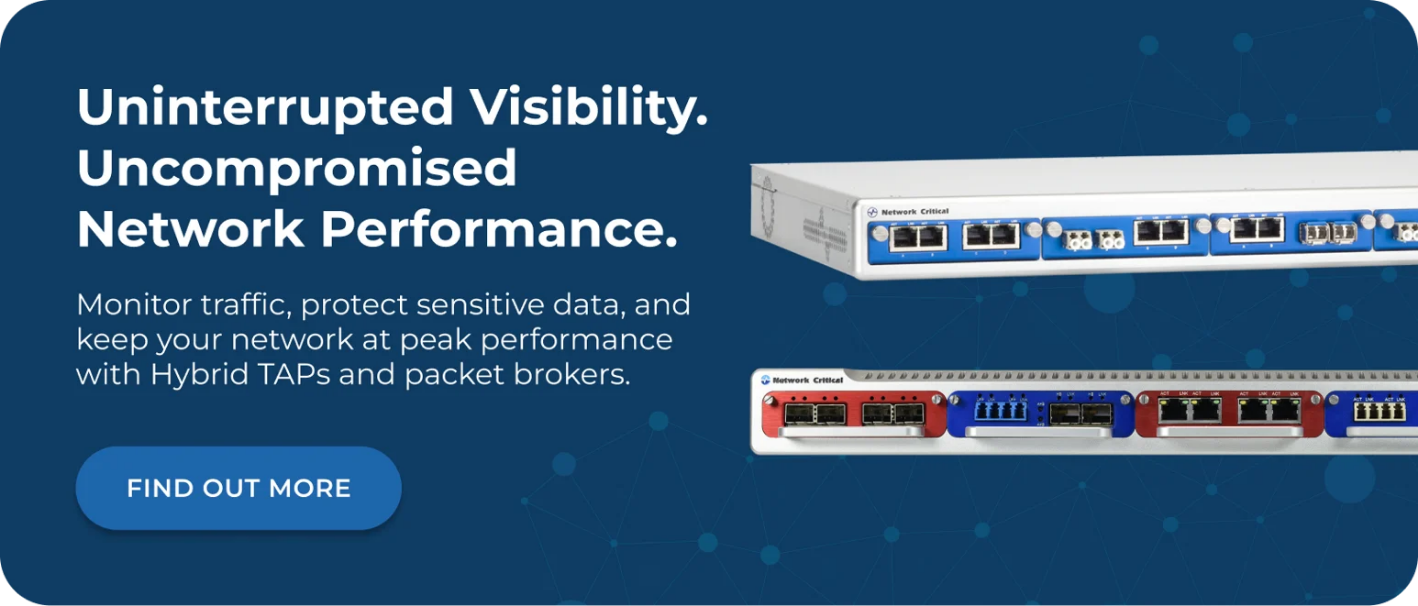
The Network and Information Systems Directive 2 (NIS2) raises the bar for critical infrastructure operators across the European Union. Energy and water utilities, transport networks, and digital infrastructure providers now face mandatory incident reporting and supply chain security requirements. They must also demonstrate active control over their network environments. Meeting these obligations demands complete, uninterrupted traffic visibility. Purpose-built hardware with audit-grade packet capture fidelity is required – SPAN ports that drop packets at peak load are not sufficient. Choosing the right network visibility infrastructure matters beyond tick-box compliance. Those same tools also reduce mean time to respond when a threat actor moves laterally across your OT or IT network. This article compares five verified vendors offering network TAPs, packet brokers, and hybrid visibility platforms for NIS2 critical infrastructure deployments in 2026. Hybrid TAP + packet broker in single chassis, perpetual licensing, Drag-n-Vu GUI Up to 400G Deep observability pipeline, 4,000+ enterprise deployments, AI traffic intelligence Up to 400G Hardware data diode, dedicated OT/ICS ecosystem, "no subscriptions" model Up to 100G FPGA zero-packet-loss architecture, Vision 400 packet broker, strong service-provider credentials Up to 400G IOTA all-in-one TAP + capture + analysis, creator-led European market presence Up to 100G Network Critical designs and manufactures network TAPs, packet brokers, and hybrid visibility platforms purpose-built for regulated, high-availability environments. For NIS2-scoped operators, the platform delivers the continuous, full-fidelity traffic access that audit-grade incident documentation requires. The SmartNA-PortPlus scales from 48 to 194 ports across 1G, 10G, 25G, 40G, and 100G in a single 1RU chassis. Non-blocking throughput reaches 1.8 Tbps. It combines network TAPs and network packet brokers in one unit. This eliminates the separate-SKU complexity that inflates deployment cost in critical environments. For 400G deployments, the SmartNA-PortPlus HyperCore extends this architecture to 32 QSFP-DD interfaces and 25.6 Tbps aggregate throughput. Drag-n-Vu software provides graphical port mapping, filtering, and aggregation configuration. It eliminates REGEX and CLI dependency, enabling network administrators to self-serve configuration without specialist engineers. Typical deployments complete in under two hours. For OT environments subject to NIS2 Article 21 security measures, passive fiber TAPs provide zero-power, zero-latency optical access. Installation creates no production disruption risk. Network Critical's tool-agnostic architecture outputs standard PCAP to any SIEM, Network Detection and Response (NDR), or capture platform. Splunk, Microsoft Sentinel, Darktrace, ExtraHop, and Wireshark are all supported without per-port licensing fees. Perpetual hardware licensing means no annual subscription surprises at renewal. Proven results: Gigamon is the largest dedicated network visibility vendor, holding approximately 51% of the deep-observability segment per 650 Group as of Q1 2026. Their GigaVUE HC Series packet brokers and GigaSMART processing modules serve over 4,000 organizations including 83 of the Fortune 100. For NIS2-scoped critical infrastructure, Gigamon's deep observability pipeline addresses the need for encrypted traffic context, application-layer metadata extraction, and centralized visibility fabric management. GigaVUE-FM Copilot adds AI-assisted traffic analysis in the Q1 2026 release. It enables automated anomaly detection aligned with NIS2 Article 23 incident detection obligations. The Precryption technology provides TLS session visibility without inline decryption infrastructure for supported environments. Gigamon received Frost & Sullivan's 2026 Company of the Year (Public Sector) award and carries Gartner Reference Architecture citations. These credentials carry weight in national authority and regulated-sector procurement processes. Platform scale and analyst validation make Gigamon the default shortlist entry for large public-sector and enterprise RFPs. However, 3-year total cost of ownership is materially higher than mid-tier alternatives. PeerSpot user feedback from March 2026 cites filtering improvement requirements and the absence of built-in traffic flow visualization as friction points. Garland Technology is a US-based TAP specialist with an explicit critical infrastructure and OT positioning. Their EdgeLens inline bypass TAP, PacketMAX advanced packet broker, and hardware data diode product line address the specific access and isolation requirements of NIS2-regulated industrial environments. The data diode is a distinctive capability – it enforces one-way data transfer at the hardware level, satisfying NIS2 Article 21 network segmentation requirements for the most sensitive OT segments. Garland operates a "no hidden fees, no subscriptions, no extra fees after purchase" commercial model – a direct equivalence to perpetual licensing. Their OT partner ecosystem includes Nozomi Networks, TXOne Networks, and Radiflow. They maintain a dedicated NIS2-focused content and events presence at InfoSecurity Europe and BSides ICS/OT. Maximum verified throughput reaches 100G. US field coverage is strong; European distribution depends on reseller partnerships. Configuration tooling is TAP-focused and does not include a visual packet broker GUI equivalent to competitor offerings. Keysight Technologies sells the Vision packet broker family – Vision 400, Vision X, and Vision Edge – through their Network Visibility business unit. The Vision 400 received Frost & Sullivan's 2024 Global New Product Innovation Award. FPGA-based architecture delivers validated zero-packet-loss performance independently verified by The Tolly Group, a relevant credential for NIS2 Article 23 incident-reporting fidelity requirements. Vision packet brokers include drag-and-drop GUI configuration, FPGA filtering, and 400G and 800G capacity. They serve service-provider and regulated-enterprise verticals where test and measurement credentials build buyer confidence. Keysight launched a formal OT motion in January 2026 through the Forescout Application Fusion Program partnership. Pricing is positioned at the premium end, with 3-year total cost of ownership modeled at comparable levels to Gigamon. Network visibility is one business line within a multi-billion-dollar test and measurement portfolio. This can dilute visibility-specific support responsiveness for smaller accounts. Profitap is a Netherlands-based vendor with a product line spanning TAPs, packet brokers, the ProfiShark portable field troubleshooter, and the IOTA all-in-one capture and analysis appliance. For European NIS2-regulated organizations, Profitap's IOTA combines TAP access, packet capture, on-box storage, and analysis tooling in a single device – reducing the tool stack footprint for smaller OT or edge environments that need to demonstrate audit-grade capture without deploying a full visibility fabric. IOTA's all-in-one model is distinctive in this category. Profitap also offers vTAP for VMware and Cloud TAP for Kubernetes and AWS Elastic Kubernetes Service (EKS) environments. The Supervisor management layer provides centralized visibility across deployments. Their creator-partnership content strategy drives technical awareness with network engineers. This includes regular appearances with David Bombal's YouTube channel (over 1.6 million subscribers). Maximum throughput on the IOTA reaches 100G. Architecture flexibility is limited by the integrated capture-and-analysis model. Organizations requiring separation of the access layer from multiple analysis tools will need a different approach. NIS2 distinguishes between essential and important entities, with different supervisory and penalty regimes for each. Start by mapping which Article 3 criteria apply to your organization. Then inventory the network segments – IT, OT, and the interfaces between them – that fall under scope. Visibility gaps in OT segments are the most common compliance exposure. Your chosen platform must cover those environments without introducing production disruption risk during deployment or maintenance. NIS2 Article 23 requires incident notification within 24 to 72 hours of detection. That timeline depends on your monitoring tools receiving complete, uninterrupted traffic. Verify that any shortlisted solution guarantees zero packet loss at line rate under full duplex load – including peak periods. SPAN port alternatives drop packets during congestion by design, which produces incomplete forensic data and undermines audit-grade reporting. Hardware TAPs with passive fiber options remove the switch CPU contention that causes SPAN degradation. Most NIS2-regulated operators run mixed environments: enterprise IT networks alongside Industrial Control Systems (ICS), SCADA, or process-control OT. The visibility platform you choose should cover both without requiring a separate vendor relationship for each. Consider whether the solution supports: Network TAPs with integrated broker functions reduce the physical footprint in constrained industrial rack environments. They also minimize configuration surface area and change-management risk during maintenance windows. NIS2 compliance is an ongoing program, not a one-time audit. Factor licensing model, maintenance, and expansion costs across a realistic three-year horizon. Subscription-based platforms accumulate OpEx that is difficult to predict at procurement. Perpetual hardware licensing with a defined maintenance fee provides a defensible cost model for NIS2 budget submissions. Modeled comparisons show 40 to 60% lower 3-year TCO for perpetual-license vendors versus subscription incumbents, based on a $500K CapEx reference deployment. Your NDR, SIEM, or packet-capture platform may already be specified. Confirm that the visibility layer outputs standard PCAP and integrates with your chosen security tools without proprietary middleware. Vendor lock-in at the visibility layer can force unnecessary tool replacements as your security architecture evolves. Network packet brokers with open API and SNMPv3 management integrate with all major Network Management Systems (NMS). They do so without restricting your downstream tool choices. NIS2 implementation timelines are not flexible. Prioritize platforms your team can deploy, configure, and maintain without ongoing specialist-engineer dependency. Graphical configuration interfaces that support network administrator self-service reduce deployment time. They also minimize change-management errors in high-stakes environments where misconfiguration creates security gaps. Ask vendors for deployment time benchmarks and whether GUI-based configuration is included as standard. NIS2 is the European Union's updated directive on network and information systems security, replacing NIS1 and entering enforcement from October 2024. It requires essential and important entities in energy, water, transport, digital infrastructure, and healthcare to implement appropriate technical measures. These include network monitoring, incident detection, and supply chain security controls. Network visibility infrastructure provides the traffic access layer that security monitoring tools need. Without complete packet capture, audit-grade evidence of network activity cannot be produced. A network TAP creates a hardware-level copy of all traffic on a link, with zero packet loss and no production network impact. A SPAN port mirrors traffic in software on a managed switch. It drops packets when CPU load peaks or when too many source ports feed a single destination. For NIS2 Article 23 incident-reporting, SPAN-derived forensic data is unreliable: packets dropped during an incident are exactly those needed to establish what happened. Hardware TAPs are the appropriate access method for any audit-grade or compliance-grade monitoring deployment. OT environments require a different approach to network access. Passive fiber TAPs connect to optical links without drawing power, introducing no electronic components into the production network path. For copper links in legacy Industrial Control Systems (ICS) and SCADA environments, failsafe copper TAPs maintain connectivity even without power. Hybrid packet broker solutions combine TAP access and traffic aggregation in a single chassis. They reduce rack space in constrained OT environments and feed OT-specialist security platforms with full-fidelity traffic. Costs vary by network scale, speed requirements, and licensing model. Entry-level deployments covering a limited number of critical links can be achieved for tens of thousands of euros. Modular TAP and packet broker platforms provide the appropriate entry point. Large-scale deployments across multi-site critical infrastructure at 100G or above will reach six figures. Licensing model has a significant impact on 3-year total cost: subscription-based platforms add annual fees that accumulate. Perpetual-license hardware platforms with a defined maintenance fee are easier to budget across the multi-year compliance horizon NIS2 demands. Request a network audit from your chosen vendor before procurement to scope the correct solution. Yes. Tool-agnostic visibility platforms output standard PCAP to any connected monitoring, SIEM, or NDR tool regardless of vendor. The packet broker layer aggregates traffic from multiple TAP access points. It distributes filtered, deduplicated traffic to each tool in the format it expects. This preserves your existing investment in security tools and avoids forcing a tool replacement alongside the visibility infrastructure upgrade. Confirm that any shortlisted platform provides open API access and supports SNMPv3 integration with your existing network management environment. Selecting the right network visibility platform is the foundation of a defensible NIS2 compliance program. Network Critical's hybrid TAP and packet broker portfolio combines perpetual hardware licensing with sub-two-hour deployment via Drag-n-Vu graphical configuration. It integrates with any SIEM, NDR, or capture platform you operate. Network Critical delivers audit-grade traffic visibility at 40 to 60% lower 3-year TCO than subscription-based incumbents, without per-port licensing fees. The modular SmartNA platform scales from 10 Mbps to 400 Gbps in a single vendor portfolio. It covers legacy OT links and high-speed data center interconnects within the same compliance architecture. To discuss your NIS2 network visibility requirements and receive a free network audit, speak to the Network Critical team.
NIS2 Network Visibility Platforms at a Glance
Vendor
Key Feature / Strength
Max Throughput
Network Critical
Gigamon
Garland Technology
Keysight Technologies
Profitap
How to Choose the Right Network Visibility Platform for NIS2
Understand Your NIS2 Scope and Asset Inventory
Verify Zero-Packet-Loss Under Peak Load
Evaluate Hybrid IT/OT Coverage
Assess Total Cost of Ownership Over Three Years
Check Tool Integration and Architecture Neutrality
Evaluate Deployment Speed and Ongoing Management Overhead
Frequently Asked Questions
What Is NIS2 and Why Does It Require Network Visibility?
What Is the Difference Between a Network TAP and a SPAN Port for Compliance Use Cases?
How Do I Extend Network Visibility Into OT Environments for NIS2?
What Does NIS2 Compliance Cost in Terms of Visibility Infrastructure?
Can I Use Existing Monitoring Tools Alongside a New Visibility Platform?
Build Your NIS2 Visibility Architecture With Network Critical