Financial services networks carry a demanding compliance burden. Every packet crossing a trading platform or core banking switch is subject to PCI DSS, DORA, and internal SLA obligations. Dropped data is a liability, not just a performance concern. Achieving zero latency on monitoring links while feeding multiple security and performance tools simultaneously is a genuine infrastructure challenge.
Network TAPs create passive, hardware-level copies of live traffic with no impact on production flows. For banks, insurers, trading firms, and payment processors, they provide forensic-grade capture. SPAN ports cannot reliably deliver this under real trading loads. SPAN drops packets during peak traffic. Hardware TAPs do not. This guide compares six verified vendors. Use it to select the right TAP infrastructure for financial network environments in 2026.
Vendor Comparison: Network TAPs for Financial Services
| Vendor | Key Strength | Max Throughput |
|---|---|---|
|
Zero-latency passive fiber TAPs, hybrid TAP and packet broker in a single chassis |
Up to 400G |
|
|
Deep observability pipeline with encrypted traffic intelligence |
Up to 400G |
|
|
FPGA-validated zero-packet-loss architecture, 400G and 800G capable |
Up to 800G |
|
|
Purpose-built TAP specialist, no subscriptions, US manufacture |
Up to 100G |
|
|
On-box security intelligence with compliance-led packet broker |
Up to 400G |
|
|
All-in-one capture and analysis appliance, European field presence |
Up to 100G |
Network Critical – Passive Fiber Optical TAPs, SmartNA, SmartNA-PortPlus
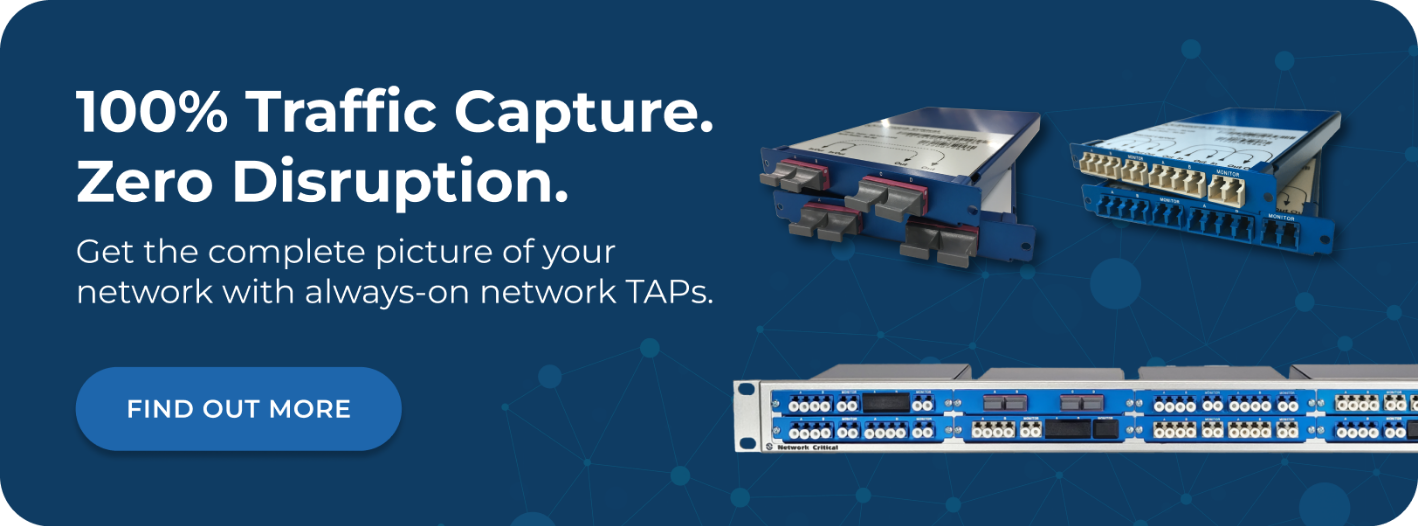
For financial services teams where latency is measured in microseconds, Network Critical's passive fiber taps are the primary deployment choice. These optical TAPs create a passive split of live traffic using no power and no active electronics. No latency is introduced. There is no single point of failure. Up to 16 TAPs ship preconfigured in a single 1RU chassis. This preserves rack space in dense trading floor and data centre environments.
Where aggregation and filtering are required across multiple monitoring tools, the 1g smartna is the right choice. This modular TAP and packet broker handles copper, passive fiber, and bypass connections in a four-slot hot-swap chassis. The backplane runs at 1 Gbps. For higher-speed core banking links, the 100gb smartna portplus scales from 48 to 194 ports. It covers 1G, 10G, 25G, 40G, and 100G speeds with a non-blocking 1.8 Tbps throughput.
Drag-n-Vu software provides graphical drag-and-drop configuration across the full SmartNA platform. Network admins complete typical deployments in under two hours. No specialist engineers or CLI expertise are required for day-to-day changes. The tool-agnostic architecture delivers standard PCAP output to Splunk, Microsoft Sentinel, Darktrace, and ExtraHop. It feeds any other SIEM or NDR platform in your stack.
The platform carries a perpetual hardware licence. There are no per-port fees and no annual subscription renewals. Over a three-year period, this model runs 40 to 60 per cent lower TCO than subscription-based incumbents.
Proven results:
- HSBC: Achieved zero latency on monitoring technologies deployed globally, from the UK to Hong Kong, across critical SLA links
- Vodafone: Delivered 100% accurate traffic visibility on key links, enabling accurate KPI development and regulatory compliance
- Darktrace: Integrated SmartNA-PortPlus API to automate threat detection and enable real-time security response across monitored links
Gigamon – GigaVUE HC Series, GigaSMART
Gigamon is the market-share leader in what it terms "deep observability." It serves more than 4,000 organisations. This includes 83 of the Fortune 100. The GigaVUE HC Series hardware TAPs and packet brokers feed the GigaSMART intelligence layer. GigaSMART adds metadata enrichment, deduplication, and SSL/TLS session visibility. The GigaVUE-FM Copilot interface introduced AI-assisted configuration in Q1 2026.
For financial services, Gigamon's Precryption technology addresses encrypted east-west traffic in on-premises data centres. The platform supports hybrid cloud deployments across GCP, AWS, and Azure alongside physical network links. Verified throughput scales to 400G on the HC Series chassis.
Deployment typically requires specialist engineers. The subscription pricing model generates recurring OpEx. This can be difficult to predict across multi-year infrastructure cycles. NWC persona research models a 500K CapEx Gigamon deployment at approximately $680K total over three years, including annual subscription costs.
Keysight (Ixia) – Vision ONE, Vision X, Vision Edge 100
Keysight's Network Visibility business unit builds on the Ixia acquisition. It sells the Vision packet broker family alongside TAPs, bypass switches, and the IFC Centralised Manager. The Vision 400 series earned the Frost and Sullivan 2024 Global New Product Innovation Award. An FPGA-based zero-packet-loss architecture is validated by The Tolly Group.
The Vision X platform supports 400G and 800G throughput. It includes advanced filtering and load balancing for high-frequency trading and core banking environments. The drag-and-drop GUI removes REGEX and CLI complexity for packet broker configuration. Keysight's Q1 FY2026 revenue reached $1.6B, providing strong platform stability assurance.
Pricing is aligned with Keysight's premium test-and-measurement positioning. Network visibility sits as one business unit among many. This can affect dedicated support responsiveness. Buyers whose primary requirement is physical TAP infrastructure should factor this into vendor evaluation.
Garland Technology – TAP Series, PacketMAX Advanced Broker, EdgeLens
Garland Technology is a Buffalo, New York-based TAP specialist. Its product line covers copper and fiber TAPs, the PacketMAX Advanced Broker, EdgeLens inline bypass switches, and hardware data diodes. The company operates on a no-subscription, no-hidden-fees commercial model. It states plainly on its homepage that there are no fees after purchase. This positioning resonates with financial services procurement teams managing multi-year budgets.
For financial networks, Garland's TAP portfolio covers 1G to 100G speeds with copper and fiber options. The EdgeLens bypass series supports sub-millisecond failover for inline security tools. Garland's compliance-aligned content covers PCI DSS and NIS2 frameworks. The product feature set is more TAP-focused than advanced packet-broker-focused. US manufacture provides data sovereignty assurance for North American buyers. European coverage relies primarily on distributor channels rather than owned field presence.
APCON – IntellaView, IntellaStore IV, HyperEngine
APCON is a Wilsonville, Oregon-based packet broker specialist. In February 2026, it launched IntellaStore IV, which adds on-box ThreatGuard IDS running on the APCON Intelligent Processor (AIp). The IntellaView platform supports 400G blade configurations with packet slicing, data masking, and deduplication.
For financial services compliance programmes, APCON's positioning covers PCI-DSS and HIPAA alignment. Data masking is applied at the packet level before distribution to downstream analysis tools. A bundled 60-day free trial of ThreatGuard with IntellaStore IV provides a structured evaluation path for security teams. Pricing is quote-based via partner channels. US-centric field presence means EMEA buyers typically engage through distributor relationships.
Profitap – IOTA, ProfiShark, HW-10G TAP Series
Profitap is a Netherlands-based vendor. Its IOTA product combines TAP, packet capture, storage, and analysis in a single appliance. For financial forensics teams needing self-contained evidence capture, IOTA removes the need for a separate analysis platform. The ProfiShark line serves portable field troubleshooting. The HW-10G TAP Series handles standard copper and fiber monitoring links at up to 100G.
Profitap's European field presence is strong across the Netherlands, Germany, and the Nordics. The Supervisor centralised management layer extends visibility across multiple deployed IOTA units. The all-in-one architecture limits deployment flexibility. Teams wanting to separate the access layer from the analysis layer across a larger fabric may find this constraining. At 400G scale, Profitap's throughput is weaker than Gigamon, Keysight, or Network Critical.
How to Choose the Right Network TAP for Financial Services
Latency Requirements on Trading and Payment Links
Zero-added latency is a hard requirement for high-frequency trading, real-time payment processing, and algorithmic execution. Passive fiber optical TAPs use no active electronics and introduce no latency. Copper TAPs and some packet broker configurations add nanoseconds. For links serving trading or payments infrastructure directly, passive optical TAPs are the correct access method. For aggregation and distribution layers, non-blocking packet broker architectures ensure monitoring tools receive full traffic streams without backpressure.
PCI DSS and DORA Compliance Evidence
PCI DSS 4.0 requires continuous monitoring of all traffic in and out of the cardholder data environment. DORA mandates that financial entities capture and retain network evidence for incident investigation. Both frameworks depend on complete packet capture. SPAN-based monitoring drops packets during peak loads and provides no audit guarantee of completeness. Dedicated hardware TAPs provide the forensic-grade fidelity required to satisfy compliance auditors. If field-level redaction is required, confirm whether your vendor offers packet slicing and data masking at the broker layer.
Tool Distribution Across Security and Performance Stacks
A typical financial services environment needs to feed many tools from the same links. These include IDS, NPM probes, SLA monitoring tools, SIEM ingestion, and NDR platforms. Sending full line-rate traffic to every tool is neither practical nor cost-effective. A network packet broker sits between your TAPs and your tools. It aggregates, filters, and load balances traffic so each tool receives only what it needs. Session-aware load balancing across multiple NPM probes is valuable on high-volume financial links. A single probe would be overwhelmed by full line-rate traffic on a busy core switch.
Deployment Complexity and Change Management
Financial network change windows are short and tightly controlled. Misconfigurations carry direct regulatory risk. Look for vendors whose management interfaces allow network administrators to complete filter and mapping changes without vendor engineers on-site. GUI-led configuration with built-in rule validation prevents the class of human error that CLI configuration routinely introduces. A platform your own team deploys in under two hours carries materially less change risk. One requiring multi-day specialist engagement does not.
Scalability Across Speed Tiers
Financial infrastructure spans legacy 1G trade feeds, 10G core banking links, and 100G data centre interconnects in the same estate. TAP infrastructure that forces forklift upgrades as link speeds increase creates unnecessary capital cycles. Modular scale-out architectures allow new port speeds to be added to existing chassis without removing and redeploying the initial investment. Confirm that your chosen platform covers your current speeds and your planned upgrade path. If a core data centre refresh is on your roadmap, 400G support should be a selection criterion. Leaving this unaddressed will require a platform change mid-cycle.
Total Cost of Ownership Over Three Years
Subscription pricing converts a predictable CapEx investment into a variable OpEx line. Annual per-port fees compound at scale. A perpetual hardware licence with a fixed annual support contract is easier to defend in a budget review. It also removes the forced-upgrade risk that subscription renewals introduce. Traffic conditioning via a packet broker can reduce SIEM ingestion volumes significantly. This multiplies the direct infrastructure saving across your analytics platform costs.
Frequently Asked Questions
What Is a Network TAP in Financial Services?
A network TAP is a hardware device that creates a passive copy of live network traffic. It feeds monitoring, security, and compliance tools without touching the production flow. In financial services, TAPs provide the packet-level access that trading surveillance, NPM, and SIEM platforms require. They do this without introducing latency or disruption to the production network. Unlike SPAN ports, hardware TAPs do not drop packets during peak loads. They provide a complete, auditable copy of all traffic on a monitored link.
Do Financial Services Networks Need Hardware TAPs or SPAN Ports?
Hardware TAPs are the appropriate choice for regulated financial environments. SPAN ports drop packets under sustained load and create CPU contention on managed switches. They also support only a limited number of concurrent monitoring sessions. For PCI DSS, DORA, and internal audit requirements that demand complete, unmodified packet capture, SPAN is not a reliable mechanism. Dedicated network taps provide guaranteed capture fidelity that compliance programmes can be built on.
What Is the Difference Between a Passive TAP and an Active TAP?
A passive fiber optical TAP splits light from a fiber link using no power and no active components. It introduces zero latency and creates no single point of failure. An active or regeneration TAP uses electronics to regenerate the copied signal. This enables distribution to multiple tools simultaneously. For the highest-value financial links – trading connections, payment gateways, SLA-monitored links – passive fiber TAPs are preferred. They add nothing to the transmission path. Active TAPs are used where multiple tool destinations each require independent signal regeneration.
How Many Tools Can One Network TAP Feed?
A standalone passive TAP typically outputs a single copy of traffic. This feeds one monitoring tool or one input to a packet broker. To feed multiple tools from a single access point, a packet broker aggregates TAP outputs. It then distributes filtered traffic to each downstream tool. This architecture allows a team to feed IDS, NPM, SIEM, and network forensics platforms from the same physical access point. The number of tools is determined by the packet broker's port count and filtering logic, not the TAP itself.
What Throughput Do Financial Services TAPs Need to Support?
Requirements vary by network tier. Edge access and branch links typically operate at 1G to 10G. Data centre core switches and high-frequency trading infrastructure often require 10G to 100G TAP access. For Tier 1 financial institutions with large data centre interconnects, 400G capability is increasingly relevant. Select a platform covering your current speeds and your planned upgrade path. The finance network visibility solutions page covers deployment context specific to financial environments.
How Does a Network TAP Support PCI DSS Compliance?
PCI DSS 4.0 Requirement 10 mandates continuous logging and monitoring of all access to network resources and cardholder data. Hardware TAPs provide the continuous, zero-packet-loss traffic access that IDS, logging, and SIEM tools require. They ensure the monitoring infrastructure captures every transaction passing through the CDE, not a statistical sample. Where field-level masking is required before traffic reaches an analysis tool, a packet broker layer adds redaction. This occurs without modifying the original captured stream.
Build Your Visibility Architecture With Network Critical
Selecting the wrong TAP infrastructure in a financial services environment creates compliance exposure. It increases MTTR on network incidents and forces forklift upgrades when link speeds change. Getting it right means choosing a platform that delivers complete capture fidelity from day one and scales without re-architecture.
Network Critical's passive fiber optical TAPs are deployed at HSBC and across blue-chip financial networks globally. The SmartNA modular platform combines hybrid TAP and packet broker functionality in a single chassis. Drag-n-Vu software enables GUI-led configuration that network admins complete without vendor engineers. The entire architecture feeds any SIEM, NDR, or NPM tool in your stack.
Speak to the Network Critical team to request a free network visibility audit for your financial services environment.