Oil and gas networks carry some of the most operationally sensitive traffic in any industry. Upstream drilling platforms, midstream pipelines, and refining facilities all depend on Operational Technology (OT) and Information Technology (IT) systems. These were not originally designed for network-level scrutiny. Digitization has changed that. Remote monitoring, Industrial Internet of Things (IIoT) sensors, and cloud-connected control systems have expanded the attack surface significantly. Purpose-fit network visibility is now a core requirement. Solutions must passively tap OT links, handle harsh physical environments, and deliver complete traffic to security tools without disrupting production. This article compares five verified vendors serving oil and gas network visibility requirements in 2026.
How the Top 5 Network Visibility Solutions for Oil and Gas Compare
| Vendor | Key Feature / Strength | Max Throughput |
|---|---|---|
|
Passive fiber TAPs with zero-power OT deployment; hybrid TAP plus broker in single chassis |
Up to 400G |
|
|
Purpose-built industrial TAPs with rugged enclosures and ICS-focused design |
Up to 100G |
|
|
Deep observability pipeline with encrypted traffic visibility |
Up to 400G |
|
|
Compact portable TAPs and inline probes suited for edge and remote OT sites |
Up to 100G |
|
|
High-density Vision packet broker family with broad TAP portfolio |
Up to 400G |
Network Critical – Passive Fiber Optical TAPs, SmartNA-PortPlus, SmartNA-XL
Network Critical's passive fiber taps are a natural fit for oil and gas environments. They require no power, carry no active electronics, and deploy without configuration. There is no risk of disrupting live OT links during installation. The units ship preconfigured to the required split ratio. They support multi-mode fiber at 1G to 10G and single-mode fiber at 1G, 10G, 40G, and 100G. Up to 16 TAPs fit within a single 1RU enclosure – high port density where rack space is restricted.
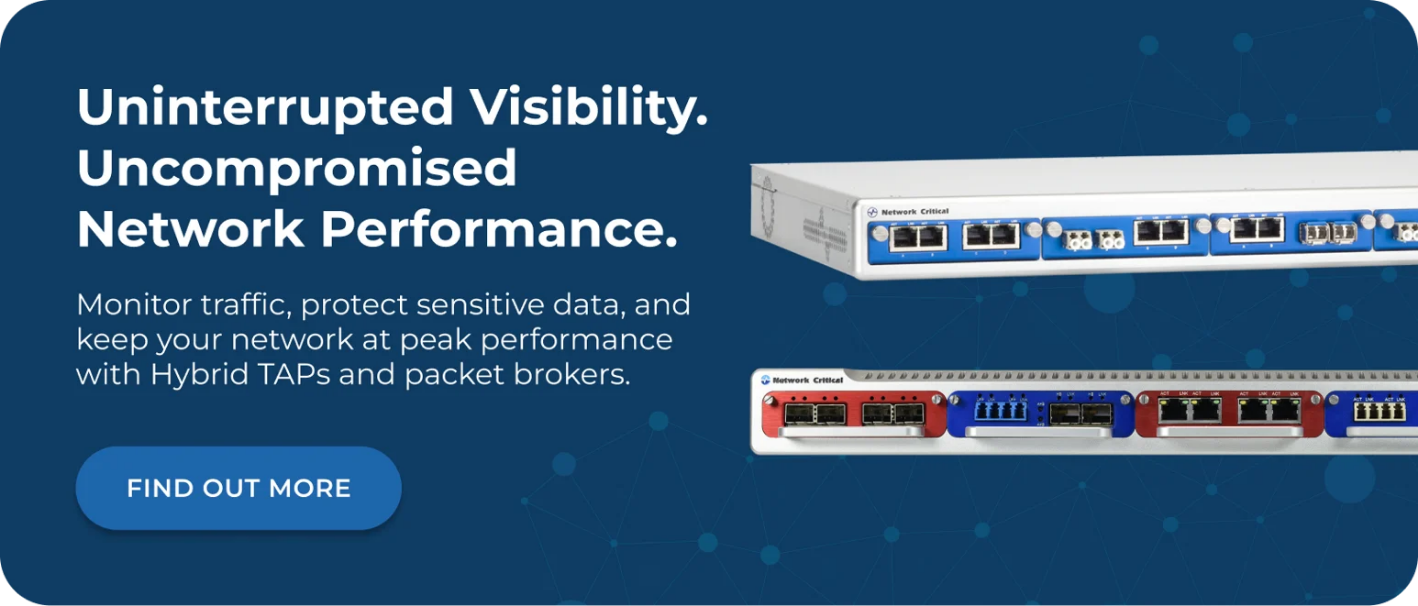
The network packet brokers in the SmartNA-PortPlus range handle 1G to 100G with 1.8 Tbps non-blocking throughput. The platform scales from 48 to 194 ports in a modular 1RU chassis. The SmartNA-PortPlus HyperCore extends the platform to 400G with 32 QSFP-DD interfaces. Both platforms use Drag-n-Vu, a drag-and-drop graphical interface network administrators can operate without specialist vendor training. Typical deployment time is under two hours. The hybrid TAP-plus-broker architecture consolidates access and distribution in a single chassis, reducing the footprint that constrains OT deployments.
For IEC 62443 and NIS2 compliance, Network Critical's architecture outputs standard PCAP to any connected security or monitoring platform. There is no per-port licensing and no subscription requirement. The perpetual hardware model supports predictable CapEx budgeting – relevant in oil and gas capital planning cycles.
Proven results:
- BP: Passive Fiber Optical TAPs enabled centralized monitoring of critical IT and OT systems across 10 to 12 refinery buildings, with zero impact on live production traffic
- Vodafone: 100% accurate traffic visibility on key links supported QoS monitoring and European cross-border compliance reporting
- HSBC: Achieved zero latency on monitoring technologies at global scale using Passive Fiber Optical TAPs and SmartNA modular TAP deployments
Garland Technology – Industrial TAP Portfolio
Garland Technology is a pure-play TAP and packet broker specialist with an established OT and industrial focus. Their EdgeLens and PacketMAX series address both inline bypass and out-of-band aggregation requirements. Garland's industrial TAP line includes DIN-rail-mountable options and ruggedized enclosures. These suit plant floor environments where temperature, vibration, and physical access are constraints. Throughput reaches 100Gbps with zero packet loss under full duplex load. Garland has become a recognized name in OT security integration, particularly in manufacturing and energy.
Gigamon – GigaVUE-HC Series
Gigamon's GigaVUE-HC Series forms the core of their hardware visibility infrastructure. Chassis-based packet brokers are available at 1G through 400G. The platform delivers traffic aggregation, filtering, deduplication, and application intelligence via GigaVUE-FM. Gigamon's Precryption technology provides TLS traffic visibility without requiring inline decryption appliances. For oil and gas buyers with enterprise security operations centers, Gigamon's SIEM, NDR, and APM connector support is broad. The tradeoff is cost. Gigamon's subscription pricing and multi-year contracts result in a higher 3-year total cost of ownership than perpetual-licence alternatives. Gigamon claims 51% of the deep observability segment per 650 Group (Q1 2026) and serves 83 of the Fortune 100.
Profitap – IXTAP and NETASSIST
Profitap offers a compact, portable TAP and packet broker portfolio suited to distributed OT sites and field deployments. The IXTAP series provides passive fiber and copper tapping at 1G to 10G. Portable form factors are useful for temporary monitoring points at remote pipeline and terminal sites. The NETASSIST Network Packet Broker (NPB) handles traffic aggregation, filtering, and distribution from multiple TAP inputs. Profitap's ProfiShark line supports mobile capture for field engineers. Specifications for throughput above 10G on their inline probe range are not publicly listed. Verify current 40G/100G capability directly with the vendor for high-bandwidth OT backbone requirements. Profitap has a strong European market presence.
Keysight Technologies – Vision 400 / Vision X / Vision Edge
Keysight Technologies' network visibility portfolio – built on the Ixia acquisition – spans TAPs, bypass switches, and the Vision packet broker family. Vision 400 delivers high-density packet brokering at 400G. Vision X provides a modular chassis for complex enterprise and service-provider deployments. Vision Edge addresses distributed edge environments with a smaller-footprint appliance. IFC Centralized Manager provides unified management across the Vision family. Keysight won a Frost & Sullivan 2024 Global New Product Innovation Award for the Vision 400 series. For oil and gas buyers, the Vision Edge is the most relevant entry point for remote or edge OT sites. The broader Keysight portfolio is oriented toward large-enterprise and service-provider use cases, and pricing typically reflects this positioning.
How to Choose the Right Network Visibility Solution for Oil and Gas
Understand Your OT Environment Before Selecting Hardware
Oil and gas network visibility starts with knowing your traffic access requirements. Upstream, midstream, and downstream environments differ significantly. Remote drilling platforms require compact, low-power solutions – particularly passive fiber optic taps that carry no active electronics. Refinery control networks often need centralized aggregation of distributed monitoring points. Confirm whether your OT links are fiber or copper. Verify the speed range across Industrial Control System (ICS) segments before specifying hardware.
Passive vs. Active Tapping for OT Links
Passive fiber taps add no power draw to a monitored link and introduce zero latency. For Supervisory Control and Data Acquisition (SCADA) and distributed control system links, passive tapping is the lowest-risk access method. Active solutions offer more traffic management flexibility but introduce a potential failure point. Where any link disruption carries production or safety consequences, passive optical access is generally preferred by OT security architects.
Aggregation and Filtering Requirements
- How many monitoring tools need to receive traffic from each access point?
- Do you need protocol-aware filtering to reduce tool ingestion load?
- Is load balancing required across redundant toolsets?
If your monitoring architecture routes traffic from multiple field TAP points into centralized security tools, a packet broker is required. The SmartNA-PortPlus scales from 48 to 194 ports across 1G to 100G. It covers the aggregation needs of most oil and gas installations without a forklift upgrade as the network expands.
Compliance and Regulatory Fit
IEC 62443, NIS2, and NERC CIP all place obligations on visibility and logging in industrial and critical infrastructure environments. Your chosen platform must deliver complete, unmodified packet capture to the connected compliance and security toolset. Confirm that the solution outputs standard PCAP or compatible formats to your SIEM, NDR, or ICS-specific security platform. Vendor lock-in on telemetry formats can create ongoing compliance exposure as toolsets evolve.
Deployment Complexity and Internal Resource Availability
OT environments often lack the specialist vendor engineers that large IT organizations use for network visibility deployments. Choose a platform your network team can configure and maintain without external support for routine changes. GUI-based management reduces configuration error risk and accelerates MTTR when modifications are needed.
Total Cost of Ownership
Capital planning in oil and gas runs on multi-year cycles. Subscription-based visibility platforms introduce OpEx variability that is difficult to budget in regulated project environments. Perpetual hardware licensing with transparent annual maintenance costs aligns better with typical oil and gas procurement structures. Model the 3-year total cost – CapEx, licensing, maintenance, and support – rather than hardware list price alone. This identifies the lowest-risk commercial option.
Frequently Asked Questions
What Is Network Visibility in Oil and Gas?
Network visibility in oil and gas is the ability to capture and analyze network traffic across IT and OT infrastructure. This includes SCADA, ICS, IIoT sensors, and control systems. It is achieved by deploying hardware TAPs on network links and feeding traffic to monitoring and security tools. Visibility is a prerequisite for anomaly detection, compliance reporting, and incident response across upstream and downstream operations.
What Is the Difference Between a Network TAP and a SPAN Port?
A network TAP creates a physical, passive copy of all traffic on a monitored link with zero packet loss. A SPAN port mirrors traffic through switch software, shares switch CPU resources, and can drop packets during high-traffic periods. In OT environments, SPAN's packet-drop risk makes it unsuitable for compliance-grade capture and forensic analysis. TAPs provide the complete, unmodified traffic record required for ICS security monitoring.
Do I Need a Packet Broker for OT Network Monitoring?
With multiple TAP points feeding several security tools, a network packet broker is required to aggregate, filter, and distribute traffic. Without one, each tool must receive full traffic from every TAP – overloading capacity – or miss traffic from unconnected points. Packet brokers solve the distribution problem while reducing the total number of monitoring appliances required.
How Do Passive Fiber TAPs Work in Remote OT Locations?
Passive fiber TAPs split a fiber link's light signal, sending a copy to a monitoring port. They require no power, introduce no latency, and have no active components that can fail. For remote oil and gas sites with limited power availability, passive optical tapping is the standard access method. Units ship preconfigured to the required split ratio and need no ongoing management.
What Compliance Standards Apply to Network Visibility in Oil and Gas?
The main compliance frameworks for oil and gas network visibility are IEC 62443 (industrial cybersecurity) and NIS2 (EU critical infrastructure). NERC CIP applies to North American electric utility and pipeline operations. Each requires monitoring, logging, and anomaly detection for OT and control system networks. These frameworks generally require passive monitoring without disruption to production traffic. Your visibility platform must support complete packet capture and integration with ICS security tools recognized under the relevant framework.
How Much Does Oil and Gas Network Visibility Hardware Cost?
Passive fiber TAPs are the lowest-cost entry point. Packet broker chassis costs scale significantly with port count and throughput. Passive optical fiber TAPs are typically the lowest-cost entry point. Packet brokers scale in cost with port count and throughput. The total 3-year cost – including licensing, maintenance, and support – is the more meaningful figure. Perpetual-licence platforms with transparent maintenance fees generally produce lower 3-year totals than subscription-based alternatives at comparable port counts.
Build Your Visibility Architecture With Network Critical
Selecting the wrong visibility platform for an oil and gas network is both a budget risk and an operational one. Dropped packets in an OT environment mean incomplete security records, potential compliance exposure, and slower incident response.
Network Critical's OT network monitoring solutions are built for the constraints oil and gas networks present. Passive fiber access adds no production impact. The hybrid TAP-plus-broker chassis reduces footprint. Drag-n-Vu lets network teams configure and maintain the platform without specialist vendor dependency. The perpetual hardware licensing model produces a 3-year total cost of ownership 40 to 60% lower than subscription-based alternatives. Deployments typically complete in under two hours. To discuss your specific visibility requirements or request a free network audit, speak to the Network Critical team.