






It might look like a map of the London Underground designed by a madman, but Gartner's newly-completed DBMS Market Share Ranks: 2011-2025 has an important message. The change may be glacial, but (most of the) dominant database vendors are slowly losing their grip on the market.
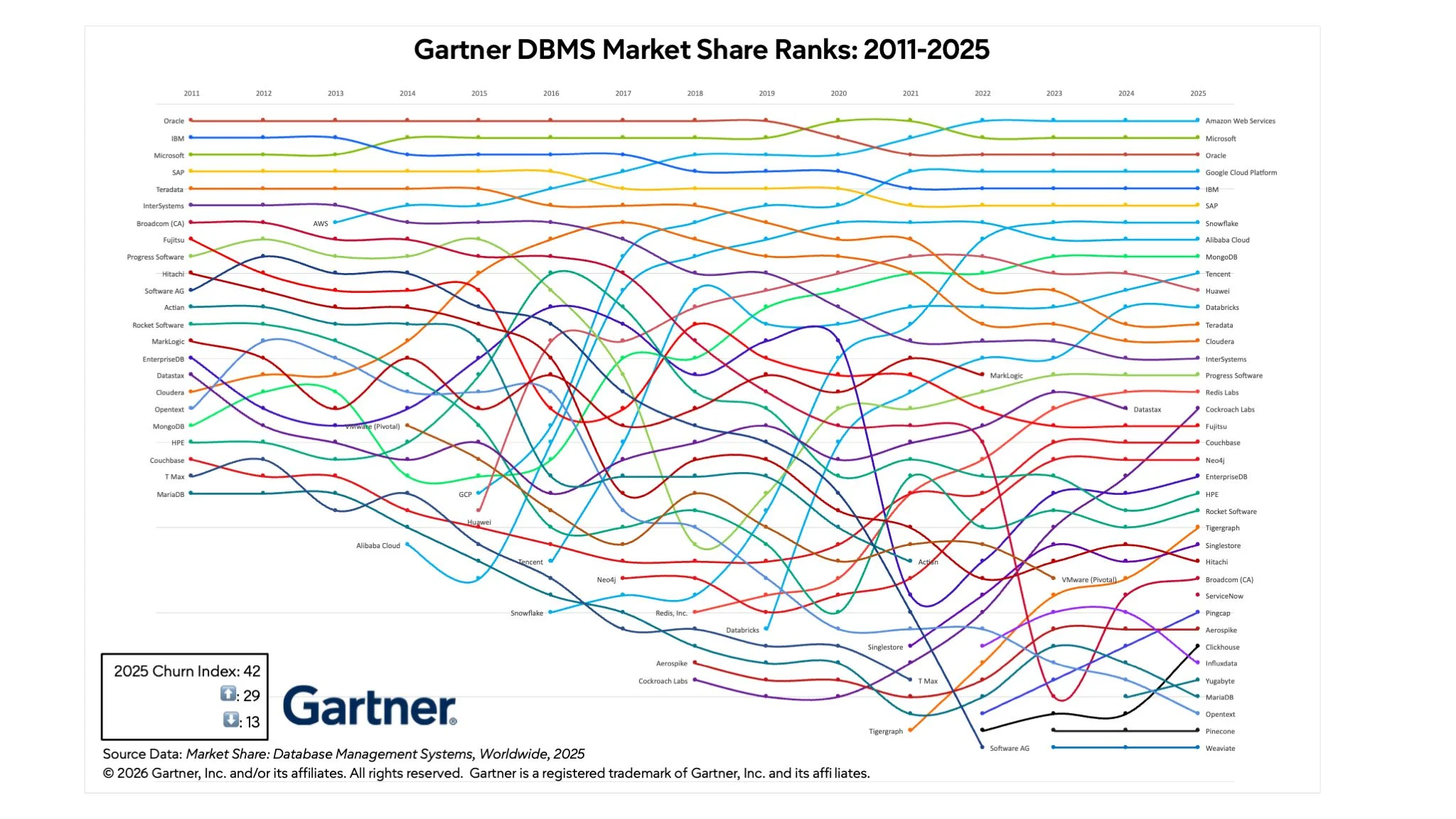
Author Adam Ronthal, vice president analyst at Gartner, pointed out: "Of the leading vendors in 2011 (Oracle, IBM, Microsoft, and SAP), only Microsoft has grown their market share in the last 15 years. The others have ceded market share to Amazon, Google Cloud Platform, and a handful of smaller but emerging vendors like Snowflake, Databricks, and MongoDB. There is no reason to expect this trend to reverse itself in the foreseeable future."
Gartner's DBMS Market Share Ranks is a stack ranking of revenue. PostgreSQL, MySQL, Cassandra, and other popular open source systems are not measured in and of themselves – only as part of commercial services.
The market is stable at the top. AWS, Microsoft, Oracle, Google Cloud Platform, and IBM have been the top five vendors — in that order — since 2022. The only dramatic change this year is the continuing meteoric rise of Cockroach Labs, the company behind CockroachDB, the RDBMS with a PostgreSQL-like front end and a distributed back end.
"The primary drivers of growth in the DBMS market in 2025 remained cloud, analytics, and AI. The relatively stable stack ranks at the top half of the market indicates that leading vendors are adapting well to the demands of AI and cloud. There is much more 'churn' in the bottom half of the market, where revenue numbers are smaller and it's far easier for even a single large deal to impact the stack ranks. Users remain committed to their strategic investments while actively seeking differentiated offerings from up-and-coming vendors," Ronthal said.
So what of Oracle, the market leader until 2019? In the world of databases, Oracle can be both a good idea and a bad idea, depending on where you start. A newly-appointed CIO walking into Global Corp ABC would be in deep trouble if they said, "That wall-to-wall Oracle setup: it's expensive and old-fashioned, let's get rid of it." Equally, anyone asked to build a brand new, global, cloud-based application may not see Oracle as their first choice.
Nonetheless, the direction of travel is clear. As old systems are gradually retired and new ones built, Oracle's influence may wane. The company will say Oracle Cloud Infrastructure is a great place to build new applications, and many organizations are doing just that. Yet OCI is not be an obvious place to start if there is no existing relationship with Oracle.
Big Red's market share in cloud infrastructure is tiny compared with the top three cloud vendors, and it is largely reliant on its dominance of the enterprise application market to tempt customers onto its cloud platform. Its database services are available on other clouds, but, again, users may not select them without a pre-existing Oracle relationship, as there are already mature open source alternatives available as cloud services.
As Ronthal points out, there is no reason to expect the long-term trend in the database market to go into reverse.
Since Gartner's spaghetti chart measures revenue, it excludes the open source DBMS. However, the picture looks different over at DB-Engines, a database ranking system based on website mentions, Google search trends, technical discussions, and job ads (among other metrics). Here, Oracle is top, but MySQL is second and has been there since about 2011. Presumably benefiting from its popularity as an AWS/AZURE/GCP database service, PostgreSQL has steadily grown and looks set to overtake third place SQL Server.
Among developers, PostgreSQL became the most popular database in 2023, while Oracle was down to 9th place, where it still sits today in the StackOverflow rankings.
In terms of straight-up revenue, change is slow, according to Ronthal. "The relatively stable stack ranks at the top half of the market indicate that leading vendors are adapting well to the demands of AI and cloud. There is much more 'churn' in the bottom half of the market, where revenue numbers are smaller and it's far easier for even a single large deal to impact the stack ranks. Users remain committed to their strategic investments while actively seeking differentiated offerings from up-and-coming vendors."
Oracle's dominance of the database market looks set to gradually fade, although there will be a long tail. A newly-qualified Oracle DBA may well look forward to a long and lucrative career. But the vendor's priorities lie elsewhere as its stratospheric investment in AI infrastructure shows.®
此内容由惯性聚合(RSS阅读器)自动聚合整理,仅供阅读参考。 原文来自 — 版权归原作者所有。