







As open relationships dominate major TV shows, we must ask: are these artistic portrayals fair and accurate?
By

Charley Ross
Writer
Charley Ross is a freelance interviewer and feature writer covering film and TV, sex, relationships, health, empowerment and politics. As well as her work for Mashable, she has written features for GLAMOUR, Stylist, Grazia, Radio Times, Cosmopolitan, Elle, The Independent, Time Out London and Refinery29. Her interviews have also appeared in Vogue and Vogue India.
on
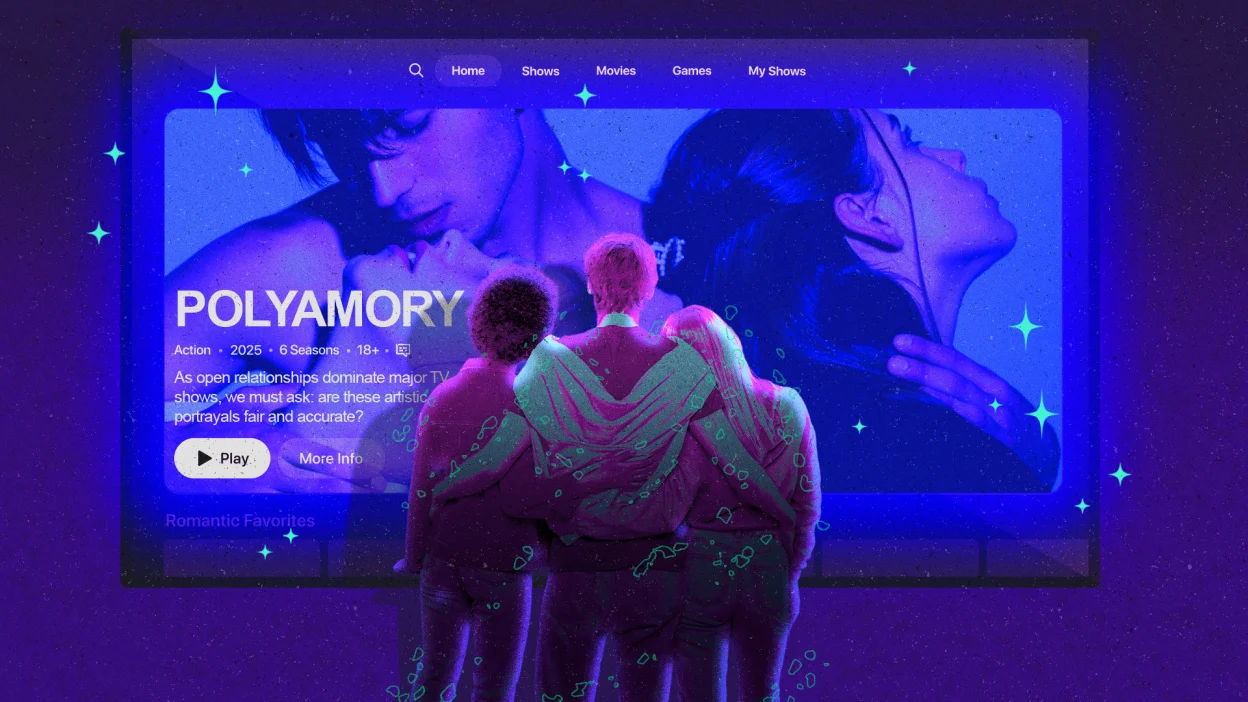
Credit: Ian Moore/Mashable/Adobe Stock
Our appetite for hearing more about open relationships is increasing.
While monogamy may have been considered a given in previous generations, the big "tick" of conventional relationships, Google search interest in "ethical non-monogamy" (ENM) has increased astronomically, with searches increasing by 400 percent over the last five years. IRL, more people are considering giving ethical non-monogamy a whirl. In June 2025, Feeld's State of Dating report found that a third of heterosexual men and 11 percent of women in the UK said they'd be open to more than one long-term partner.
Perhaps it's not surprising, then, that representations of ENM have become increasingly visible in pop culture, from HBO's Industry to high-profile memoirs to Lily Allen's West End Girl. But how exactly do these books, TV shows, and albums represent ethical non-monogamy and do they get it "right"?
You May Also Like
Hookup apps for everyone
AdultFriendFinder — readers’ pick for casual connections
Tinder — top pick for finding hookups
Hinge — popular choice for regular meetups
Products available for purchase through affiliate links. If you buy something through links on our site, Mashable may earn an affiliate commission.
Depicting open relationships in pop culture
Open relationships appear to be everywhere right now, from our shelves to our screens. Writer Lindy West's explosive memoir Adult Braces: Driving Myself Sane explored her experiences of polyamory within her marriage, setting the internet ablaze with TikTok theories about whether West is fully on board with the arrangement.
Ask Me How It Works: Love in an Open Marriage by Deepa Paul explores her experience of being a mother and wife within an open marriage. Miranda July's novel All Fours, which sees a perimenopausal woman open up her marriage, also caused intrigue and critique.
On TV, in the latest season of Industry, Marisa Abela's Yasmin navigates opening up her relationship with her husband Henry (Kit Harington) as a means of escaping the "gilded cage" her marriage represents to her, and encouraging a sexual encounter with a younger employee. Abuse of power, much? Robin Wright's The Girlfriend and Dakota Johnson's Splitsville explored open relationships within the thriller and comedy genres. And reality TV series Open House: The Great Sex Experiment saw therapists guide real-life couples through the reality of open relationships.
Probably one of the most famous discussions of non-monogamy of the last year, Lily Allen's explosive album West End Girl includes tracks such as "Nonmonogamummy," "Pussy Palace," and "Dallas Major," which outline Allen's personal experiences of being in an open marriage, the latter depicting her discomfort navigating dating apps within that space ("I hate it here"). Most notably, the legendary song "Madeline" explores her partner breaking the boundaries of their open agreement with one specific woman. The release of West End Girl led to a huge spike in Google searches around non-monogamy and open marriages, with Google searches around Allen and her open marriage reaching towering levels.
With this kind of notoriety came thinkpieces, TikToks, and conversations down the pub. Can open marriage work? Who is the ultimate villain here? One TikTokker called Allen's album a "warning label for anyone thinking of opening their relationship". Allen herself said in an Elle UK interview that while music execs were concerned that material about open relationships wasn't universal enough, after its release, women inundated her DMs with their own negative experiences of non-monogamy.
But is one woman's experience a fair assessment of an entire community and their relationship dynamics? Is the way pop culture represents open relationships and non-monogamy reflective of, and faithful to, the actual reality of ENM?
Biased on-screen depictions of non-monogamy
When it comes to recent pop culture representations of polyamory, there may actually be such a thing as bad publicity.
The mass reaction to West End Girl and other pop culture representations of open relationships leaves a lot of nuance to be desired. While many people, women in particular, felt seen by Allen's raw lyrics, her story is an example of non-monogamy practiced unethically, or perhaps, one-sidedly. Does West End Girl and other stories like it reflect the reality and nuance of all non-monogamous relationships? Or are they giving them a bad name?
Mashable Trend Report
Polyamory educator and queer sex therapist in training Leanne Yau, who has worked with over 1,000 polyamorous clients as a relationship coach, believes that portrayals like West End Girl do, unfortunately, "add to quite a lot of stigma about polyamory in our culture."
"A lot of the narratives around polyamory are so overwhelmingly negative."
"If there was already a lot of positive representation to balance it out, then whatever," Yau adds. "But a lot of the narratives around polyamory are so overwhelmingly negative." Yau says there wasn't enough positive representation of polyamory in the album to "balance out what was otherwise a vulnerable and emotionally resonant piece of art." Entertainment and education are both important here, and they can be hard to reconcile.
In Michael Angelo Covino's Splitsville, a 2025 screwball comedy, two couples open up their marriages to avoid divorce. Yau views this as a trope used often in portrayals of open relationships, describing the film as "passive aggressive," lacking honest communication, and concentrating on the "wrong reasons" that couples may choose to open up their marriage, namely to not split up. For these reasons and more, Yau commended Splitsville in terms of entertainment value but she didn't view it as a good portrayal of polyamorous relationships.
Non-monogamy can be portrayed as entertainment, instead of truthful experiences
For relationship therapist and sexologist Madalaine Munro, a key issue with these portrayals of ethical non-monogamy is a prioritised "desire to entertain" within pop culture. This is arguably what leads portrayals to be sensationalised and dramatised, instead of being accurate.
"When looking at how ethical non-monogamous relationships are portrayed in TV, film, music, and literature, we can see that most mainstream media is driven primarily by the desire to entertain, which means stories are crafted around conflict, rupture, and emotional intensity rather than how harmonious healthy relationships can be," Munro tells Mashable.
"Because of this, the love, trust, and communication that are central to healthy ENM are rarely depicted, and instead what we see are exaggerated scenarios in which boundaries are ignored, agreements are broken, or characters behave with secrecy and betrayal."
Munro adds that these portrayals subsequently shape false ideas about how non-monogamy functions. "This narrow, sensationalised framing is unhelpful because it can lead people to associate ENM with instability, chaos, or betrayal, rather than recognising that when practiced with integrity, these relationships rely on a strong foundation of trust, transparency, and clear communication," Munro says. "It subtly reinforces the idea that anything outside of monogamy must naturally involve harm or irresponsibility, which can deepen the social stigma around ENM and lead to the assumption that non-monogamous people are somehow less loyal or less committed."
Here, Munro says, many storylines and character arcs don't reflect "the emotional maturity and relational skill involved in sustainable ENM."
Yau agrees with Munro that ENM relationships are so often portrayed with betrayal or conflict at the centre. "One of my main gripes about polyamorous representation in the media is that so many stories start from a place of cheating. I don't think that's actually representative of reality," she says.
"In real life, if a polyamorous relationship starts from a place of cheating, it is very, very unlikely to survive, because you need such a foundation of trust in order to be in a relationship anyway, and you need to trust each other even more to navigate polyamory. And starting from a place of cheating completely destroys the trust that you would need… So it's just not realistic."
The impact of novels about open marriage and relationships on representation
Like West, July, and Paul, writers are exploring the world of open relationships and ethical non-monogamy in novels and memoirs — and they seem to be doing a much better job at representation.
Author and journalist Cassie Werber, who has been in an open relationship for a decade with her now husband, published her 2024 novel Open Season wanting to see more realism in written relationships.
"All the depictions of open relationships I had seen or read assumed that they were actually about betrayal, and that they would always end in heartbreak," she tells Mashable. "Open relationships can be very complex and hard to explain. I had seen it done badly, and wanted to do it better."
Author Roxy Dunn's second novel, which was released in Jan. 2026, sees protagonist Misty come out of a long-term, conventional relationship and connect with Christopher, who is in a long-term, open relationship with the mother of his child, Sara. Dunn tells Mashable that her central question when writing the book was whether relationships – monogamous or non-monogamous – can offer a form of safety. Dunn was inspired by the cultural shift towards exploring non-monogamy, particularly on dating apps like Feeld. "I think people are questioning the status quo a lot more in terms of what a relationship ought to look like," she tells me, adding that having books that reflect the lives and situation of those practicing ENM is "really important".
With more elements of pop culture touching on the experience of polyamory and open relationships, diverse representations of these dynamics has never been more important. As Munro says, inaccurate portrayals of polyamory and open relationships in pop culture "flatten a complex, intentional, and relationally rich way of loving into a dramatic device".
"As a result, they fail to represent the depth of inner work, clear communication and care that takes place in relationship structures outside monogamy, and by doing so may stop people from exploring something that may support their relationship needs."

Writer
Charley Ross is a freelance interviewer and feature writer covering film and TV, sex, relationships, health, empowerment and politics. As well as her work for Mashable, she has written features for GLAMOUR, Stylist, Grazia, Radio Times, Cosmopolitan, Elle, The Independent, Time Out London and Refinery29. Her interviews have also appeared in Vogue and Vogue India.
