


There are free mail-in or in-store drop-off programs for a ton of elusive categories.
By

Leah Stodart
Senior Shopping Reporter
Leah Stodart is a Philadelphia-based Senior Shopping Reporter at Mashable where she covers and tests essential home tech like vacuums, TVs, beauty devices, and eco-friendly hacks. Her ever-evolving experience in these categories helps her make thoughtful recommendations for how to spend your money during shopping holidays like Black Friday, which Leah has been covering for Mashable since 2017.
on
All products featured here are independently selected by our editors and writers. If you buy something through links on our site, Mashable may earn an affiliate commission.
Even "disposable" items like toothbrushes, razors, and Swiffer pads can be recycled responsibly. Credit: Zain bin Awais / Mashable composite; Anna Efetova / tenkende / Tara Moore / Wirestock / Javier Zayas Photography/Yaorusheng via Getty Images
Table of Contents
To skip down to a certain product category in this recycling guide, use the table of contents dropdown at the top of this story.
When you really think about it, life is just a constant cycle of acquiring new stuff and figuring out what to do with the old stuff. And when there's little straightforward guidance on how to properly get rid of the old stuff, it quickly turns into clutter — or trash.
Most of us have been conditioned to recycle things like aluminum cans and cardboard boxes. But past those traditional curbside recyclables, other everyday items like batteries, beauty empties, toys, and even clothes can feel impossible to get rid of sustainably. Is throwing them away the only option?
You May Also Like
All of those everyday items can actually be recycled. It just requires some research and an extra step or two. But I've already done the first part for you, and compiled everything into a straightforward "how to" recycling guide.
Why does it feel like nothing is recyclable?
Perhaps you've Googled "how to recycle insert item here" just to be given some vague instructions like "Check locally." If you did check locally, you probably learned that most municipal recycling programs max out at trash-like recyclables. This isn't because recycling everything else is impossible on a technical level — it often just costs more than most local authorities feel like covering.
But that doesn't mean the items not mentioned in your county's recycling PDF have to be thrown away or forced upon an overflowing thrift store. Straightforward recycling options do exist for famously tricky product categories, like skincare, cleaning supplies, electronics, and the other junk you've crammed under the bed or in that one drawer.
Most involve easy (and free) mail-in programs or quick drop-offs at chain stores — much more reliable methods than plopping junk in the recycling bin and hoping the recycling fairy whisks it away to the right place.
That's called wishcycling, but you're out of that phase of your life now. Because below, I'm breaking down how and where to recycle all of those famously hard-to-recycle items.
How to recycle electronics
As is the case with plastic pollution, a good chunk of e-waste (the umbrella term for improperly discarded electronic devices and the toxins they leak into the ground) comes from big tech corporations. But as a species that has treated our personal devices as extra limbs for almost two decades, it's also our individual responsibility to deal with our old gadgets in the most sustainable way possible.
To be fair, people aren't exactly given clear instructions on how or where to safely recycle old devices. A CNET survey found that over 30 percent of U.S. adults hold onto old phones, tablets, and chargers simply because they don't know what to do with them. So here's your crash course.
How to recycle cellphones, laptops, TVs, and more tech
You're probably aware of the trade-in promos that your smartphone carrier offers. Similar incentives exist for devices like iPads and tablets. But even if the device in question isn't exactly in trade-in or sell-on-Mercari condition, there are still super accessible ways to recycle the gadget without smashing it for parts.
Best Buy and Staples have robust in-store recycling programs for everyday e-waste. Both stores can recycle the following tech products and accessories for you:
Laptops and monitors
Keyboards and mice
Cellphones and landline phones
Chargers, cables, and dongles
Headphones (wireless or wired) and speakers
Hard drives
Surge protectors
Routers and modems
Printers, plus ink and toner cartridges
Gaming consoles and controllers
Digital cameras and camcorders
Car GPS devices and dash cameras
Calculators
Stores may limit the number of items in a certain category that one household can recycle per day — don't just dump years' worth of junk drawer tech into a few cardboard boxes and drop them off.
Once received, recyclers disassemble the tech to pull out and properly get rid of ozone-depleting chemicals like PCBs, mercury, and insulation, then separate materials like plastic, glass, and metal to be repurposed when possible.
Samsung has its own e-cycling drop-off centers, often located at Best Buy and Staples, and sometimes even at your local solid waste authority. Apple offers its own recycling program for old Apple devices and chargers, and you can even get a prepaid shipping label.
Where Staples and Best Buy's lists differ
Tech products that are strictly recyclable at Staples include discs like CDs and DVDs and phone cases. Tech products that are strictly recyclable at Best Buy include TVs 50 inches or smaller, drones, and some small appliances like fans and heaters (scroll down for a deeper dive into that list). You can also pay Best Buy to come haul away larger items, like TVs over 50 inches, an old fridge, or a treadmill.
How to recycle batteries
Old batteries can be recycled for free at stores like The Home Depot, Lowe's, and Staples through a partnership with call2recycle. Head to the website and enter your zip code to find the closest drop-off location to you. Note that not all participating locations accept every type of battery, so be sure to check the box of the battery type you've been collecting (i.e., lithium vs. rechargeable).
If no collection boxes are popping up in a practical distance, call2recycle also has a mail-in battery recycling program — though at $80 for the smallest battery and cellphone recycling kit, it's not exactly the cheapest route.
How to recycle clothes and shoes
If you take one thing from this recycling guide, let it be this: Goodwill is not a bottomless pit, or a one-size-fits-all solution to get rid of clutter fast. Instead of forcing more stuff upon stores with no hangers to spare, there are more thoughtful ways to clean out your closet.
Mashable Trend Report
If the garments are in decent enough condition, consider trying to sell your stuff online. It requires a bit of extra time than dropping off a garbage bag, but it ensures each piece is going to someone who specifically searched for it. The secondhand apparel market is going to pop off in 2026 even more than it already did in 2025, according to ThredUp's latest sale report — so now is definitely a good time to get into resale apps.
You don't need a ton of followers or an inventory of vintage holy grails to get eyes on your items on Depop, Mercari, or Poshmark. Just take well-lit, clear photos of items that aren't covered in pet hair, write a detailed and honest description, and add a reasonable price.
If you don't feel like reselling, a mail-in donation option could be easy. Give Back Box is a non-profit that partners with a slew of small charities from which you can choose to send your items, depending on what they need (i.e., kids' shoes or gently used women's clothes). Once you find a good fit, Give Back Box will just ask for $20 to cover the pre-addressed shipping label and the weight of the box. Pack your items in any random box you were going to recycle anyway, and send it off.
Is your pile of doom riddled with clothes that are too worn to donate? Viral sustainable clothing brand Girlfriend Collective works with SuperCircle (a growing textile recycling platform) to facilitate ReGirlfriend: an amazingly easy mail-in garment recycling program. Shipping labels are free, and you can pack multiple pieces in each bag, regardless of brand. As a "thank you" for not contributing to the pile of textiles in landfills, Girlfriend offers credits to girlfriend.com. Trashie is another clothing recycling program where you fill a Take Back Bag and mail it back — you'll get rewards to shop at partnering brands.
How to recycle vacuums and other appliances
Your local Goodwill actually is not home to a fleet of magic-working repairpeople who know how to revive every busted gadget manufactured in the past few decades. Instead of trying to donate rusty, sticky, straight-up broken appliances, see if Best Buy's in-store recycling program can take them off your hands. Fans, robot vacuums, upright and canister vacuums, personal heaters, and pod-only coffee makers are a few of the appliances that Best Buy can recycle for free. There's a limit of three per household per day.
For a $199.99 haul-away fee, Best Buy can pick up larger appliances like refrigerators, air conditioners, microwaves, dishwashers, washing machines and dryers, ovens and ranges, and ice makers for recycling.
Black+Decker kitchen appliances and home cleaning products can be recycled for free through TerraCycle.
If you're not ditching the appliance for a functional reason, perhaps it'd be a good contender for Facebook Marketplace or resale apps. Gently used countertop appliances like air fryers and blenders are popular on Mercari. It's OK if it's old, too: Vintage collectors would be overjoyed to come across a listing for your grandma's vintage yellow hand mixer, as long as it's not dilapidated.
How to recycle cleaning supplies and more household junk or trash
Food wrappers, cleaning supplies, and other packaging
The concept of disposable plastic household items seemed like the most genius idea ever in the 1950s. Guess what? Virtually all of the plastic products thrown away since then are still decomposing in landfills today.
And we're adding to the problem every single day. Swiffer pads come to mind when I think about the dire disposables situation. They're super convenient, but they're not recyclable through the standard plastic or paper system. For all of those everyday household items that we mindlessly trash, more people need to know about TerraCycle's free mail-in recycling programs.
These give consumers a rare, yet easy way to recycle everyday "trash" items from big household brands — items that most local recycling authorities don't accept in the regular bins.
Participating brands include Swiffer, Tide and Downy, Pop-Sockets, Arm + Hammer, and Mr. Clean. You can recycle air fresheners or scented plug-in products from any brand for free via Febreze's TerraCycle program. Some food and snack brands are also on the list: Collect wrappers and bags from Babybel, Gatorade, Kroger brands, and Takis. Plastic drink pouches from any brand can be recycled for free through Honest Kids' program, and sauce packets from any brand can be recycled for free through Taco Bell's program.
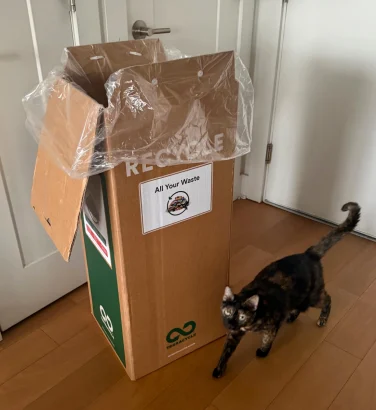
It's not cheap, but you can recycle nearly anything with TerraCycle's All-In-One Zero Waste Box. Credit: Leah Stodart / Mashable
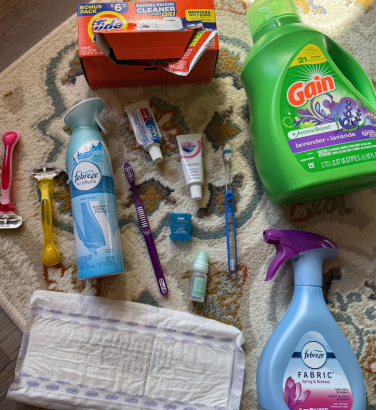
All of these items can be recycled for free by mailing them to TerraCycle. Credit: Leah Stodart / Mashable
The idea is to collect enough from each brand's program to fill up a box that you can then mail back to TerraCycle. (Some programs have a weight minimum, but it could be as little as three pounds.) The cost of the shipping labels is covered by the brands themselves, who also fund the tricky sorting process required to recycle their products.
Coffee pods
Nespresso has a ton of drop-off points across the country to recycle pods. You can also request free pre-labeled recycling bags on Nespresso's website to fill and eventually mail back to Nespresso. (Each mailer can hold up to 200 Original Line pods or 100 Vertuo pods.)
Keurig has a similar setup, but it's not free — and Keurig only describes the program through the lens of office use (like "use the small box in offers that brew 24 K-Cups or less in day") with no mention of keeping a box at home in a Keurig-heavy household.
Water filters
Your collection of used Brita filters and old filter pitches themselves can be mailed to TerraCycle for free recycling.
ZeroWater filters can be properly discarded with a mail-back recycling program as well, but you'll have to cover shipping up front. Fill out the recycling form ahead of sending your used filters back to the address provided. You'll then receive a $20 coupon for your next round of replacement refills. It's a more convoluted process than Brita's, but if it's the difference between drinking microplastics, I'll do it Zerowater's way.
Old writing utensils
Drop off pens, markers, and mechanical pencils at Staples to be recycled for free.
How to recycle beauty empties and bathroom stuff
Makeup and skincare
The majority of beauty brands are way too comfortable using packaging that looks recyclable, while conveniently forgetting to tell consumers that it's not. Many skincare bottles that feel like glass aren't the same easy type of glass as a beer bottle or jelly jar, and many plastic containers and plastic pumps are actually a peculiar type of mixed plastic that doesn't fall under the number system used to sort at recycling plants.
For beauty empties with a non-accepted number or no number at all, beauty-centric take-back programs are the move. Both Ulta and Sephora have partnered with Pact Collective to offer recycling bins for your empties in a ton of stores across the country. Nordstrom has a partnership with TerraCycle, offering a similar in-store drop-off option for beauty packaging.
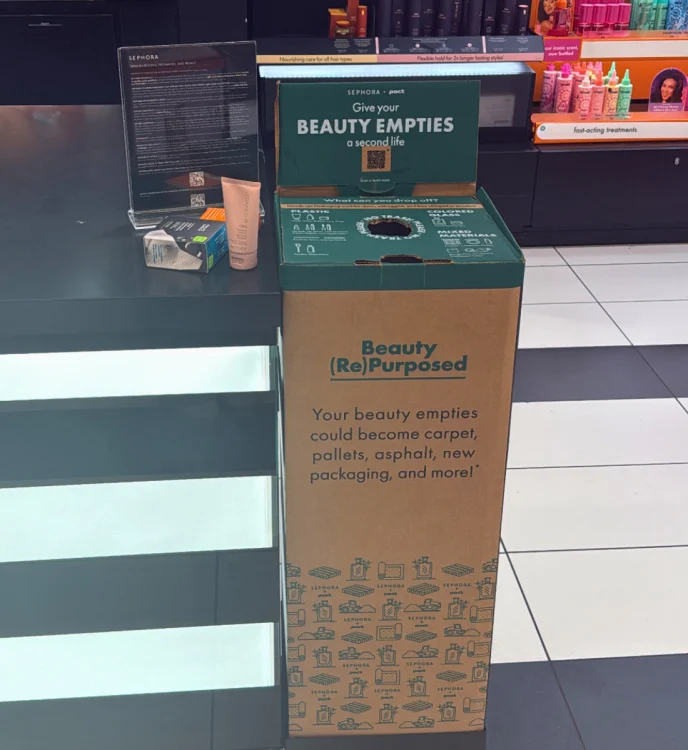
My bag of beauty empties was so full, I had to take this Pact bin's lid off. Credit: Leah Stodart / Mashable
Project Beauty Share is one great option for giving opened skincare products a new home, as long as they're not expired. Accepted gently-used beauty items include moisturizers and serums, cleansers, body lotions, shower gels, perfumes, and sunscreens. Squeeze tubes of foundation or primer and pressed eyeshadow, blush, and highlighter are accepted if they're open but only barely used.
Hair tools
Beauty brand Mane partners with Pact Collective to take your unwanted hot hair tools, whether they work or not. Hair tools in good working condition will be properly sanitized and shipped off to be distributed to young women through Project Glimmer, an organization dedicated to helping end gender and racial inequality for women and girls. Hair tools that don't work will be taken apart and processed for proper recycling. Labels are prepaid by Mane, as long as you use your own box.
Toothbrushes
National Geographic clocks around one billion plastic toothbrushes ending up in landfills annually, and toothpaste tubes are a similar story. If you use Colgate, Arm & Hammer, or Tom's of Maine products, there's a free mail-in TerraCycle program for that. Old toothbrushes, electric toothbrush replacement heads, mouthwash bottles, used flossers, and toothpaste tubes from Crest, Oral-B, or Fixodent can be recycled by mail via TerraCycle or Oral-B's direct recycling program.
Razors
Sure, most disposable razor handles are plastic, and razor blades are metal. Both materials are technically recyclable separately, but mixed materials like that bar disposable razors from being curbside recyclable. Luckily, TerraCycle has a free recycling program for common shaving brands like Gillette and Venus, from handles to blades to the bags the replacements come in. If people caught on to collecting their dull razors for eventual recycling, just think of the dent we'd put into the estimated two billion disposable razors thrown out each year.
How to recycle toys
Like everything else on this list, getting rid of toys isn't as easy as tossing them in the regular recycling bin — no matter how perfectly plastic they feel.
Hasbro, VTech and Leapfrog, and Spin Master all have free mail-in recycling programs through TerraCycle. TerraCycle's recyclers will ensure that toys and games are broken down and properly sorted for recycling of different parts and materials. If a toy's condition wouldn't be up to your gifting standards for a friend or family member's kid, it's better off being recycled than donated.
Lego bricks can be recycled for free via Lego Replay. Pack up Lego System Bricks, Duplo and Technic bricks, minifigures, baseplates, tires, rims, and axles, download a free shipping label, and send it off.
Yard sales aren't the only way to make a few bucks off of gently-used toys. Toys are consistently a top-selling category on Mercari — if you're not sure if a brand or model is in demand, just do a quick search to see what listings are out there (Pokémon, Barbies, and toys from the '90s are usually safe bets.) There's a surprisingly bumpin' market for spare game pieces sold by themselves, like replacement Monopoly tokens or Sorry! pawns.
Frequently Asked Questions
Electronics left to break down in landfills release dangerous toxins like lead, cadmium, and arsenic into soil and groundwater. Those leaked toxic substances can be deadly for the ecosystems in the area, as well as the people — of the up to 1,000 chemicals that can seep out of a degrading gadget, most are detrimental to the human body in some way. Several are considered carcinogens.
Lithium-ion batteries (used in almost all smartphones, laptops, and vapes) are also a major fire hazard when smushed, cracked, or overheated, none of which are unlikely in a landfill or the back of a garbage truck. It's the same logic behind Southwest Airlines' policy that bans charging electronics in overhead bins.
Trashing electronics also creates a missed opportunity to recover and reuse the precious metals inside them. Reusing the gold, silver, and copper found in e-waste could decrease the need for their environmentally-destructive mining processes.
The presence of the triangle of arrows symbol on packaging doesn't confirm that said item can be recycled. The number in the triangle is merely a Resin Identification Code that identifies the material. From there, you'll need to Google whether that material is recyclable in your area.
For example, I live in Philadelphia, and plastics 1, 2, and 5 are cleared for curbside here. Plastic 6, polystyrene, is one you'll see all the time, from clear takeout boxes to red Solo Cups. Polystyrene (PS) is just a fancy term for styrofoam, and it's nearly impossible to recycle.
Goodwill says that it only throws away clothing that's unsellable (stained, damaged, etc.). But some folks are convinced that stores are tossing more donations than the unsellable ones, maybe for the sole reason that there's literally no room to sell them. If you've been thrifting in recent memory, you know that the overflow is real — so many Goodwill clothing sections are overwhelmingly full to the point that shoppers avoid the section altogether.
Even if it is just the damaged stuff that's tossed, that's still millions of pounds of clothing sent to landfills each year. A deep dive by the Seattle Times found that one local Goodwill sent 15 percent of its donated goods from that year to the landfill, which shook out to about 21 million pounds of trashed items.
Most places that recycle typical e-waste, like Best Buy and Staples, don't want to deal with magnetic media like VHS tapes. There are technically some niche recycling services that accept VHS tapes, like GreenDisk. But because of the extra disassembly and granular sorting required, VHS recycling services aren't cheap.
The good news is that the internet has a big appetite for physical media in 2026. VHS tapes and cassette tapes sell on platforms like eBay or Poshmark way faster than you'd expect. Before dumping your whole shelf into a garbage bag, try listing some old movies online. One person's 25-cent yard sale is another person's $15 eBay profit.

Senior Shopping Reporter
Leah Stodart is a Philadelphia-based Senior Shopping Reporter at Mashable where she covers and tests essential home tech like vacuums, TVs, beauty devices, and eco-friendly hacks. Her ever-evolving experience in these categories helps her make thoughtful recommendations for how to spend your money during shopping holidays like Black Friday, which Leah has been covering for Mashable since 2017.
