









A growing number of medical professionals and consumers alike are now leaning on AI to manage health in new ways, and tech companies are competing to meet the demand.
AI health products can generate patient visit notes for physicians and help consumers learn insights about their health at home. Even with all the possible upsides, experts recommend caution, particularly for consumers who share sensitive medical and personal information with an AI-powered device or chatbot, or buy into AI health offerings that haven't yet been proven as effective or safe.
With the January launch of ChatGPT Health, a sister experience to OpenAI’s ChatGPT, the public has a new option for seeking medical guidance. ChatGPT Health, like Claude for Healthcare and Microsoft Copilot Health, allows users to upload medical records and data from wellness apps to AI assistants, ostensibly providing more accurate guidance.
You May Also Like
The fact that ChatGPT Health is free (for now) may prove enticing to some of the 25 million uninsured Americans or those worried about medical debt — Americans currently owe over $220 billion to healthcare providers.
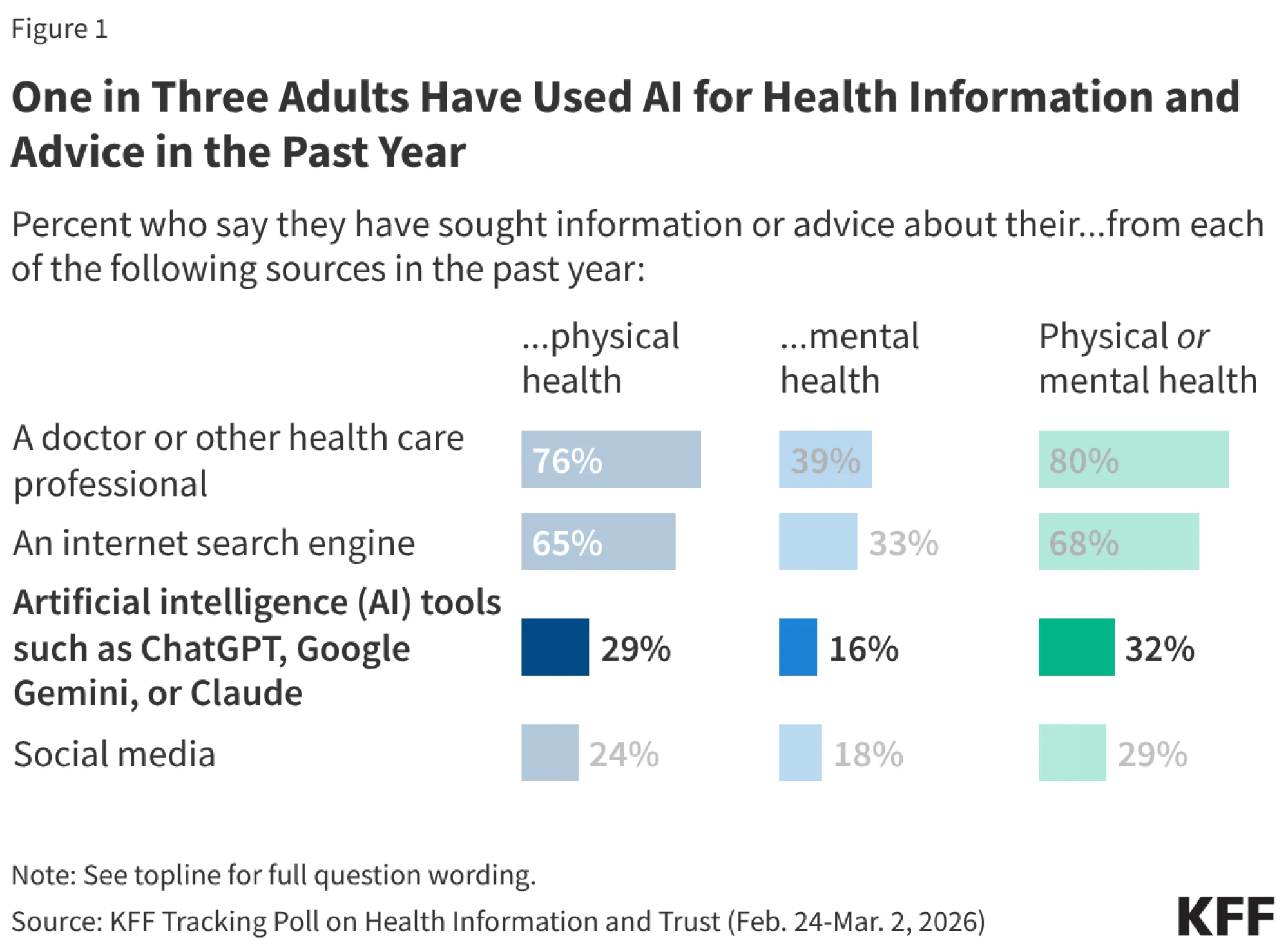
And many are already turning to AI-powered sources. A KFF health tracking poll released this month found that a third of U.S. adults used AI for information or advice about their physical health in the last year. Those numbers are on par with those seeking health advice from social media, according to KFF.
Health AI: Reducing costs, growing access
Health-centered AI may be a good option for those anxious about healthcare expenses because it has the potential to reduce costs through early diagnosis, according to Harvard's School of Public Health.
While the majority of people polled by KFF said they turned to AI because it provided quick, immediate answers, about a fifth cited not having access to a provider or being unable to afford an appointment as motivations. Health-trained chatbots could help patients better understand their bodies and provide helpful insight before they visit their doctor, according to companies like Amazon, which recently launched its Amazon Health AI.
Carri Chan is Faculty Director, Healthcare and Pharmaceutical Management Program at Columbia Business School, and also leads Columbia's AI+Healthcare initiative. Chan has many reservations about patients substituting human-centered care for AI. Still, she believes that AI tools, including a correctly executed, specially trained AI chatbot, could help reduce costs and increase access to care.
"The fact that [tech companies] are curating and at least training a model specifically for [health], thank goodness," Chan says. "That's what we really need. We don't want something that's been trained on all the data on the internet where we know there's a lot of misinformation and just, like, garbage information." In other words, the data needs to be high-quality and validated.
Mashable Trend Report
Chan generally sees the greatest promise coming from AI tools specifically designed to improve healthcare delivery.
KFF Tracking Poll on Health Information and Trust (Feb. 24-Mar. 2, 2026) Credit: KFF
A new Mashable series, AI + Health, will examine how artificial intelligence is changing the medical and health landscape. We'll explore how to keep your health data safe, using AI to decipher your blood work, prompting chatbots effectively when it comes to health questions, how two women are using AI to detect a dangerous form of heart disease, and more.
AI privacy, hallucination concerns in healthcare
Many health industry experts advise proceeding with caution when using health-centered AI, especially if you’re uploading medical documents or private health information. Privacy watchdogs are particularly worried about chatbot products entering the world of healthcare without federal regulation, Mashable learned.
Aside from privacy concerns, there is the possibility that AI hallucinations could steer patients down rabbit holes of misinformation, or that AI could further reinforce medical biases. Recent studies on health-related AI queries showed that chatbots sometimes dispense unreliable information, with ChatGPT Health under-triaging slightly more than half of the cases presented to it.
AI health tools: Proceeding — with caution
Experts suggest that anyone using health-related AI products test the models with known inaccuracies first, frame questions carefully, and check where chatbots get their answers, ensuring they come from reliable sources like medical organizations — not Reddit.
While there is much to be skeptical about when it comes to AI’s role in health, experts including Dr. Robert Wachter, professor and chair of the Department of Medicine at the University of California, San Francisco, are optimistic about the role health-centered AI can play in bettering people's lives. Wachter views products like ChatGPT Health as a significant improvement over a Google search when it comes to investigating symptoms or deciphering medical jargon.
And Wachter thinks the chatbots will only get better and more accurate with time. For now, Wachter stresses prompting the AI as clearly as possible, fact-checking the responses, and then taking that information to a human medical professional — and skipping right over AI and heading to a hospital when experiencing a potentially life-threatening emergency like severe chest pain.
"You put something into [Chat]GPT or Gemini, and what you get back is better than what you would have gotten back in Google," Wachter says. "The downside is the tools are imperfect and can do everything from giving you really smart answers to answers that are just downright wrong."
________________________________________________________________________________________________________
The information contained in this article is for educational and informational purposes only and is not intended as health or medical advice. Always consult a physician or other qualified health provider regarding any questions you may have about a medical condition or health objectives.
Disclosure: Ziff Davis, Mashable’s parent company, previously filed a lawsuit against OpenAI, alleging it infringed Ziff Davis copyrights in training and operating its AI systems.