


By Orna Herr, Communications Officer (Education) at the British Science Association
------------------------------
Earlier this month, the Met Office reported that 2023 was the UK’s second hottest year on record. The 10 warmest years in the UK have all happened since 2003, a phenomenon which wouldn’t have occurred, say climate scientists, without the warming of the planet as a result of human activity.
Statistics like this can be worrying; taking radical action on the climate crisis is undoubtedly an urgent issue - and it’s an issue of time. According to the UN, to keep global warming below 1.5 degrees “emissions need to be reduced by 45% by 2030 and reach net zero by 2050”. It’s important to remember that, although time is ticking by, it hasn’t run out yet.
Today’s generation of young people will be instrumental in building a net zero world, and they have an appetite to learn how to equip themselves. We surveyed 1,000 14-18-year-olds as part of our Future Forum programme and found that secondary school students want a more comprehensive, solutions-based climate education.
British Science Week 2024 is coming on 8-17 March (marking its 30th anniversary!), and as part of the celebrations we have published free activity packs filled with ideas to celebrate the Week at home, in nurseries, schools and community group settings. The theme of this year’s packs is ‘Time’.
Time and taking action on the climate crisis are tightly linked and so the environment, and steps we can take to protect it, is a sub-theme that runs through all four packs – we offer packs for Early Years, Primary, Secondary and Community groups.
These activities can be used in lead up to, and during, British Science Week, as part of sessions on the climate getting children and young people thinking about the ways that the environment is related to their everyday lives.
Let’s explore the outdoors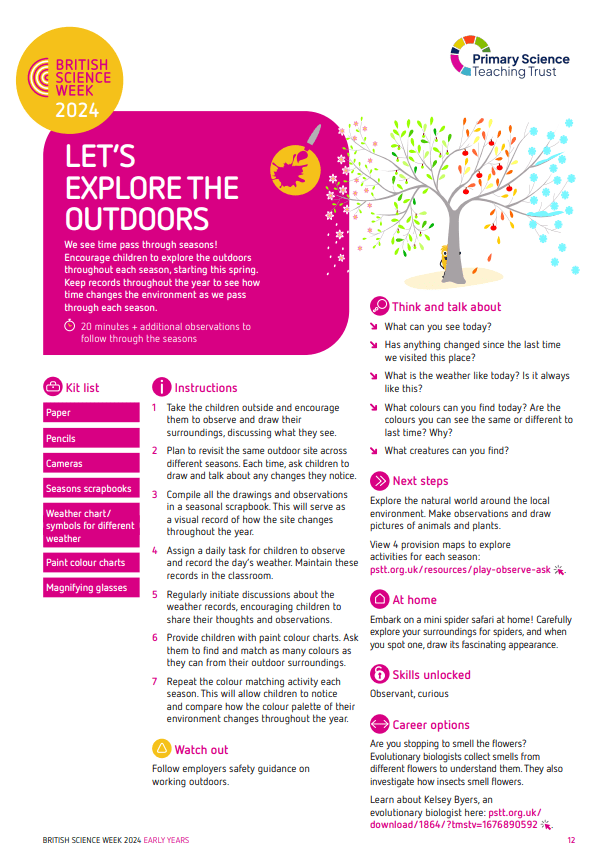
The Early Years pack for under-5s is a great resource for starting small children off on their STEM* journey – it really is never too early. Little ones have a natural curiosity about the world around them which, if nurtured, can turn into a passion for science.
This is especially true of the environment; studies show that if children spend a lot of time outdoors, they value connectedness with nature and are more likely to develop pro-environment attitudes and behaviours.
On page 12 of the Early Years pack you’ll find ‘Let’s explore the outdoors’, created in partnership with the Primary Science Teaching Trust. This activity can span a whole year - it’s all about children familiarising themselves with the natural world, and noticing how it changes as the seasons come and go. This foundational STEM learning can be the first step for children on their path to conservationism.
Design a farm of the future & Making biodegradable plastics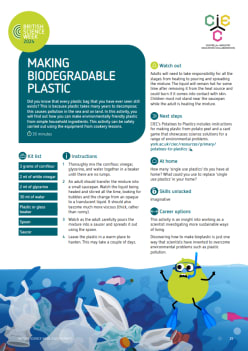
As children move up through their primary school education, they’ll be learning more about the environment, the threats it faces and what they might do in the future to protect it.
Food systems account for over a third of global greenhouse gas emissions, but the global population is growing, so producing more food year-on-year is essential.
‘Design a farm of the future’, created in partnership with NFU Education, asks children to think about how they might solve this problem by designing an efficient, sustainable farm. They could use craft materials or building blocks to build a model of their farm, or use design software.
The Primary pack also includes ‘Making biodegradable plastic’, created in partnership with the Centre for Industry Education Collaboration. Plastic is hard to avoid, and, due to how long it takes to decompose, single-use plastic in particular has a severe impact on the environment.
This activity is brilliant for showing children how climate science is embedded in their everyday lives, It allows them to roll up their sleeves and make an eco-friendly alternative, cultivating their inventive and innovation skills.
How much rain?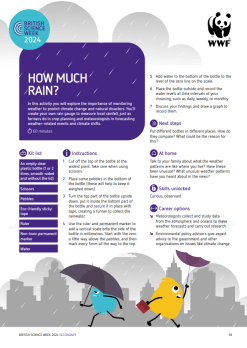
Secondary school students may be starting to think about their future careers, and the best way to show them how interesting and rewarding a STEM career can be is to let them try it on for size.
‘How much rain?’ in the Secondary pack, created in partnership with WWF, has students making a rain-catcher, placing it outside then monitoring and recording the results over weeks or months. Analysing weather patterns over extended periods of time can help predicate climate change and natural disasters – a role that will be crucial as the need to combat the climate crisis intensifies.
Giving students a chance to behave like a scientist and collect real data could empower and inspire them to pursue a future role in climate science.
Sustainable transport futures design challenge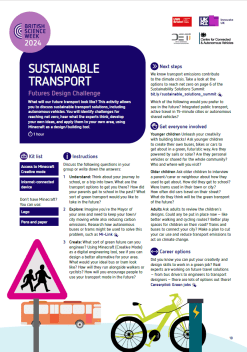
You’ll find the ‘Sustainable transport futures design challenge’, created in partnership with the University of the West of England and UKRI, in the Secondary and Community packs.
This activity is not only about designing a more sustainable transport for the future, but it’s also about considering the steps we can take today to reduce our carbon footprint.
Thinking about how we travel around our local area, to school, to work, to the shops, can prompt discussions about more environmentally friendly options we have – walking, cycling, using public transport – and how our town and cities could be adapted to make these options more accessible and attractive.
British Science Week is a fantastic opportunity to make science the star of the show, and show children, young people and community group members how they can play their part in combatting the climate crisis, while there is still time.