

惯性聚合 高效追踪和阅读你感兴趣的博客、新闻、科技资讯
阅读原文 在惯性聚合中打开

推荐订阅源

T
Threat Research - Cisco Blogs
freeCodeCamp Programming Tutorials: Python, JavaScript, Git & More
cs.AI updates on arXiv.org
V
Vulnerabilities – Threatpost
GbyAI
GbyAI
P
Proofpoint News Feed
L
LINUX DO - 热门话题
P
Palo Alto Networks Blog
A
About on SuperTechFans
T
Tenable Blog
M
MIT News - Artificial intelligence
IT之家
IT之家
I
Intezer
D
DataBreaches.Net
爱范儿
爱范儿
T
Threatpost
C
CERT Recently Published Vulnerability Notes
云风的 BLOG
云风的 BLOG
博客园 - 三生石上(FineUI控件)
WordPress大学
WordPress大学
K
Kaspersky official blog
大猫的无限游戏
大猫的无限游戏
A
Arctic Wolf
Y
Y Combinator Blog
Cyberwarzone
Cyberwarzone
酷 壳 – CoolShell
酷 壳 – CoolShell
D
Darknet – Hacking Tools, Hacker News & Cyber Security
H
Help Net Security
Microsoft Security Blog
Spread Privacy
Spread Privacy
奇客Solidot–传递最新科技情报
奇客Solidot–传递最新科技情报
AWS News Blog
AWS News Blog
博客园 - 聂微东
C
Check Point Blog
S
Securelist
有赞技术团队
有赞技术团队
雷峰网
雷峰网
aimingoo的专栏
aimingoo的专栏
Last Week in AI
Last Week in AI
Stack Overflow Blog
Stack Overflow Blog
MongoDB | Blog
MongoDB | Blog
D
Docker
G
GRAHAM CLULEY
T
The Exploit Database - CXSecurity.com
C
Cybersecurity and Infrastructure Security Agency CISA
T
Tailwind CSS Blog
L
Lohrmann on Cybersecurity
G
Google Developers Blog
C
Cyber Attacks, Cyber Crime and Cyber Security
L
LangChain Blog

British Science Association

Countdown is on to British Science Festival in Southampton Insight into action – exploring the Public Attitudes to Science Survey Celebrating British Science Week 6-15 March 2026 British Science Association selected as the future host of EDIS APPG on Diversity & Inclusion in STEM launches new project on AI equity Smashing Stereotypes is back for British Science Week 2026 Guest blog: Community Led Research Pilot, funder’s reflections Public Attitudes to Science Survey shows the public values science, but highlights concerns over AI, quality of information, and representation Sir Roland Jackson Putting communities in the driving seat: report explores impact of participatory research Dr Alex Lathbridge and Karen Blake MBE named British Science Association Honorary Fellows 2025: Our past year, wrapped A-Level student builds highly-accurate budget Sign-Language-to-speech wrist technology A cautious welcome for key recommendations in Curriculum and Assessment Review Confidence and support to teach science has fallen, primary education report suggests 'It’s through change that science progresses’: Disabled staff in science and medicine lead action for equity Reflections on the British Science Festival in Liverpool Julia King, Baroness Brown of Cambridge's presidential address Report highlights disconnect between data collection and action on EDI in UK science and tech sector CREST website upgraded to transform STEM learning and empower educators across the UK Robo-chemists, eye-trackers and a VR fishing boat: the last day of the British Science Festival 2025 Phages, geophonics and prosthetics: the fourth day of British Science Festival 2025 Whale song, urban farming and science comedy: the third day of the British Science Festival 2025 Climate solutions, pioneering women and particle detectors: the second day of the British Science Festival 2025 Chatbots, ghost particles and neurodiversity: the first day of the British Science Festival 2025 Supporting inclusive entrepreneurship and innovation among and through micro, small and medium sized enterprises (M-SMEs) CREST Awards now free for all young people in Scotland The power of plants: eight events to dig into at this year’s British Science Festival Five health and humanity highlights from this year’s British Science Festival Exploring the wonders of space: five unmissable British Science Festival events ‘Early and meaningful’ public involvement in shaping engineering biology research and policy vital What's it like to work at the British Science Festival as an Evaluations Assistant? Blackpool school pupil launches pop-up science museum and fundraiser in campaign against ‘science deserts’ British Science Festival in Liverpool programme launches Education | Keeping STEM learning going at home From Awareness to Action: Creating Authentic Neurodiversity Support in STEM Workplaces Baroness Brown appointed 2025-26 President of the British Science Association Education | Our Engage Teacher Conference 2025 round-up British Science Association Trustee awarded MBE Introducing our new Head of Marketing and Communications Navigating eco-anxiety in the face of the climate change crisis Education| Ten top tips for adapting resources for SEND learners Education| Adapting resources for SEND learners Announcing our British Science Festival 2025 Section Presidents British Science Festival 2025 Award Lecturers announced Education | British Science Week, CREST and going cross-curricular! British Science Association signs open letter on improving climate change education Education | Tips from ten-year-old Poppy and her mum on doing CREST Education | Ten-year-old Poppy explores STEM accessibility - a CREST case study Briefing on Equality, Diversity and Inclusion strategies in STEM makes business case for growth From WhatsApp Group to Nationwide Network: The Birth of the Afro-Caribbean Commercial Science Network ‘Creating knowledge together’ essay series explores power of community-engaged research ‘Action over optics’ - APPG event explores EDI strategies in STEM A celebration that highlights the crucial role of science in our lives British Science Association Council welcomes two new trustees Bringing back Smashing Stereotypes for its sixth year for British Science Week 2025 Science education vital for UK growth and fighting misinformation, British Science Week survey shows Where next for attitudes to science? UKRI, Ipsos, and the BSA announce launch of 2025 public attitudes to science survey British Science Association’s lead strategic partner UKRI welcomes new CEO The Ideas Fund awards £1.73m to community wellbeing projects For Thought | Science, innovation, and society: working together for long-term change Change and adapt for the better with the British Science Week 2025 activity packs! Education | Using Engage Grants to run CREST Discovery Days Diversity and inclusion in engineering are vital for innovation and growth – exploring the evidence Alom Shaha, Gisela Abbam and Tom Crick named British Science Association Honorary Fellows 2024: Our past year, wrapped Education | A Gold CREST Awards case study: bringing AI into dementia healthcare Education | How showcasing STEM careers in the classroom can broaden aspirations New report reveals the impact of communities in the Highlands and Islands leading climate change research AI is ‘the conversation everyone is having’ – but how do we bring in missing voices? University of Southampton to host the British Science Festival in 2026 The BSA's response to the Autumn 2024 Budget Public views on ultra-processed foods Using nature-based learning to inspire young people Black History Month 2024: Celebrating MSD scientists and employees in STEM In conversation with Rob Deeks, CEO of Together As One (TAO) BSA Presidential Address: Professor Kevin Fenton CBE (part three) A tribute to Professor William Gosling DSc FIET BSA Presidential Address: Professor Kevin Fenton CBE (part two) British Science Festival 2024: Highlights BSA Presidential Address: Professor Kevin Fenton CBE (part one) Guest blog: Life’s Big Questions - inspiring connection, curiosity & understanding in young minds Education | How to use a British Science Week Kick Start Grant to help students connect with nature Five must-see events at #BSF24 you don’t want to miss out on! The British Science Festival will be heading to Liverpool in 2025 Professor Kevin Fenton CBE announced as President-Elect of British Science Association Education | CREST and the changes to the UCAS personal statement Make the Most of Plastic-Free July! Education | Early years maths engagement can help combat the attainment gap Education | Our Engage Teacher Conference 2024 round-up Education | Make your medical school application stand out with a CREST Award! Celebrate International Women in Engineering Day with Smashing Stereotypes! Education | Widening access to STEM resources for SEND learners Community Led-Research Pilot: successful grant recipients announced Education | Help students make the most of the summer by earning a CREST Award! Education | Leeds celebrated 2023 with CREST Awards! BSA’s election manifesto calls for a fairer and more prosperous future through science What’s it like to work at the British Science Festival? Education | Exploring reproductive health with CREST!
Education | CREST Awards and design & technology – perfect bedfellows
2023-12-06 · via British Science Association

By Orna Herr, Communications Officer (Education) at the British Science Association

---------------------------------

Back in November 2022, we explored the decline in students choosing to study design & technology (D&T) at GCSE, and why this might be happening.

Between 2010 and 2022, the number of students who earned a D&T GCSE fell by an astonishing 71%. In 2023, the figure had climbed a little compared to 2022, but it’s still a long way off the halcyon days of 2010.    

Our research uncovered several reasons why this is happening. Along with a lack of funding and specialist teachers, a crucial issue is that students often aren’t actively engaged with the subject from a young age, meaning when they come to make their GCSE choices, D&T doesn’t hold much appeal.

These issues and more are something Matt James, a D&T teacher at Lewis Girls’ School in the South Wales, knows only too well about. We spoke to Matt about the decline in D&T, why it matters, and how he’s been using the British Science Association’s CREST Awards scheme (investigative, student-led STEM* projects from ages 5-19) to help bring the subject to life for younger students.

Modern design & technology

“[D&T] sets up the pupils with problem-solving, technical skills, resilience and creativity skills, and those are skills that are increasingly required by, not just jobs that people would associate with D&T, but by all jobs”, Matt told us. D&T gives students the vital opportunity “to think outside the box, [achieve] a degree of independence and not be afraid to fail while developing so many skills needed in the modern world.”

However, students are choosing to study D&T for GCSE in very low numbers across the country, meaning very few students are then able to progress to A Level, degrees or careers in D&T-related areas.

Timetable space is an issue, Matt tells us – students don’t have much of a chance to engage with a subject they only study for one or two hours a week depending on their schools timetable – as well as a misconceptions by parents and even some senior leadership teams in schools about what D&T actually is. Of course, this is not the case at Lewis Girls' School, where the senior leadership team embrace D&T and its integration with STEM!

I think a lot of people have still got this assumption that in D&T you make a spice rack or something similar, but the reality is that modern D&T covers…problem solving, critical thinking, creativity, computer aided design and manufacturing, coding and robotics.

Modern D&T teaching is about running projects that link to the real world; a crucial element in engaging students. This is something Matt has been particularly effective at, with the help of CREST Awards resources.
CREST helps design and technology take off

At Lewis Girls’ School, the Key Stage 3 (Years 7, 8 and 9) curriculum** is centred around a different ‘big question’ each year; sustaining planet Earth, living on planet Earth, then leaving planet Earth.

In line with this arc, Matt’s Year 9 students were working on designing and making rockets that could ‘reach Mars’, should humans need to make this intragalactic move. This is something students could relate to, as they see reports on the news and online about space agencies around the world who are aiming to achieve the same.  

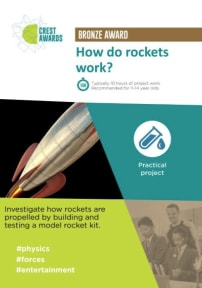
Matt knew of the Bronze CREST project ‘How do rockets work?’, and noticed that a lot of the questions in the booklet were very similar to those in the workbook his students were using for their rocket project. He then replaced the original questions with the CREST questions.

The CREST wording is intended to be slightly more scientific…it helps make a stronger connection between D&T and science.

Matt lightly adapted a project his class was already working to ensure their work was eligible for a CREST Award.

This is a fantastic way to utilise our resources; you don’t have to stick to the projects we offer in our CREST resource library – with a little guidance, many projects your students are working on as part of the curriculum could tick the boxes to earn them an Award. Matt said:

If you were to look at a lot of the projects that your department was already delivering and then you looked at what you needed to do to get a CREST Award, you would probably be quite surprised by how close you were.

The photo to the left shows a rocket one of Matt's students made, about to launch!

After Matt integrated Bronze CREST into lesson time this way for his Year 9 class, he looked into how younger students could benefit and discovered Discovery.

Using CREST across multiple age groups

Discovery Awards are group projects typically completed by 10-14 year olds, making them perfect for Year 7 students. To fit the curriculum topic of sustaining planet Earth, Matt’s Year 7 class explored how we could feed the growing population by building towers in which vegetables can be grown over several floors in a process of vertical farming, utilising hydroponics.    

Again, we realised that we’d already come up with a project, and when I saw the Discovery CREST Awards, I realised that it was prolonged research & design, an iterative process that fits into a certain time frame.

And so, the hydroponics project became a CREST project for year 7. Matt repeated the technique of taking questions from the Discovery CREST workbook and applying them to his students’ work.

CREST Awards aren’t just for secondary school students – the British Science Association also provides SuperStar activity collections for ages 7-11. Matt told us that the science and D&T departments (linked through the Area of Learning Experience ) made use of this with Year 6 pupils from nine feeder primary schools who came to Lewis Girls’ School for a transition day. The pupils then built on this when they joined the secondary school, to meet the requirements for a SuperStar Award - marking the start of their D&T CREST journey.

Instilling pride and confidence

So if your students are already working on a project as part of the curriculum, what is the benefit of submitting their work for CREST Awards?

Students who earn a CREST Award receive a certificate – an achievement that is recognised across the UK which they can add to UCAS forms or job applications. A CREST Award helps students stand out and demonstrate their aptitude to future university admissions boards and/or employers. Matt reiterated this point to his class.

"You're doing a project to learn and to develop skills”, Matt told them, “but this project will also give you something tangible when you leave [school] and start university or a new job."

Receiving a certificate also imbues young people with a sense of confidence and pride in their achievement, and gives them something to take home and show their parents/carers.

Instilling these feelings in children around STEM subjects from a young age could help build a strong foundation that they can keep working on throughout their education. A CREST Award earned for a D&T project in Year 7 may lead to choosing D&T when GCSE options come around.

“It’s a useful tool to run as part of your curriculum. It gives the pupils that extra bit of authenticity to their project, creating an invaluable learning experience” said Matt. “It works.”

Read part 2 of this blog here

Check out the press coverage of this story:

Herald Wales

South Wales Chronicle 

Other blogs and links you may be interested in:

CREST resource library

Building girls' confidence in STEM with CREST Awards

How CREST can help schools achieve the four purposes of the new Curriculum for Wales

How CREST Awards can boost UCAS applications and university admission interviews

To stay up to date with all our latest blogs and CREST news, sign up to our monthly education newsletter.

Sign up here

* STEM is an acronym for science, technology, engineering and maths

** Developed by The Science and Technology Area of Learning Experience within the Curriculum for Wales