Today (Friday 30 December) the British Science Association (BSA) have published the fourth Future Forum report. The report, titled ‘Creativity in STEM: young people's views on using collective collaboration to build a better future’ presents insights from 14-to-18-year-olds across the UK on the arts, science and the relationship between them.
The purpose of this Future Forum was to ascertain the place of collective creativity within STEM and its impact on global challenges.
The report reveals that young people think there is very little overlap in the teaching of science, technology, engineering and maths (STEM) and creative subjects. The next generation believe this is a problem because it stifles creative thinking in STEM subjects; it does not reflect ‘real life’ (where this siloed way of learning/working does not exist); and sets students on a path of being either a ‘creative’ person or a ‘STEM’ person.
Read the full report
Other key findings: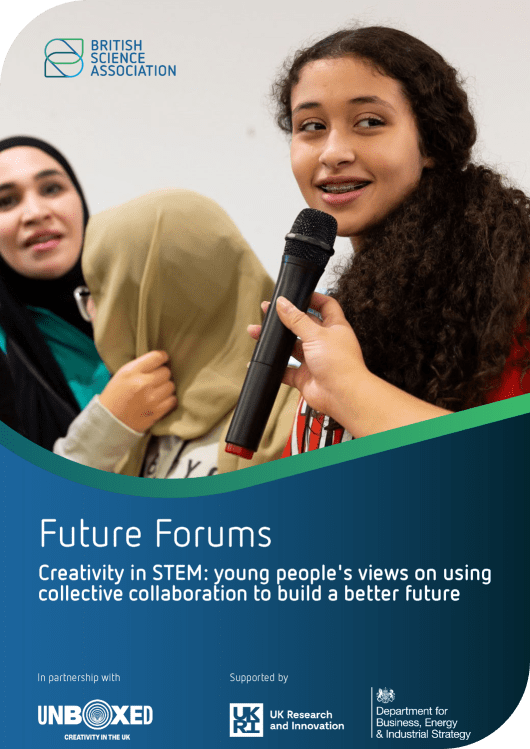
- When asked to consider what changes they would like to see in the UK and globally within the next 10 years, young people focused on tackling urgent, near-term societal challenges, such as the climate emergency, cost-of-living crisis and young people’s mental health and wellbeing.
- Young people value the role that creativity can play in helping to solve the challenges of the future with eight in ten (81%) young people saying they think that creativity will play an important role in solving the societal challenges we face in the next 10 years.
- Young people proposed that structural changes are needed to both the education system and government funding to encourage meaningful collaboration between STEM and creative disciplines.
Some recommendations
Policymakers should:
- Use initiatives such as the National Youth Guarantee (including the National Citizen Service, the #iwill fund, and the Youth Investment Fund) to build agency in young people and provide them with the skills and knowledge they need to contribute towards societal change.
- Consider the integrated teaching of creativity as a skill across all subjects (including STEM subjects) as part of the National Plan for Cultural Education (due to be published in 2023). This report adds to the evidence that young people want to be given the opportunity to study a broad, engaging and relevant curriculum.
- Ensure that all young people are aware of the potential of STEM careers, and address stereotypes that STEM is not creative by making sure the recommendation in the Careers Strategy (2017) that “careers services play a key role in encouraging people of all ages and backgrounds to consider the value of STEM” is being implemented.
- Ensure that STEM and arts engagement opportunities are easily available and free to access across the whole of the UK.
Science and arts engagement organisations should:
- Listen to young people about the societal issues and challenges that matter most to them when planning engagement activities, and not shy away from topics such as cost of living, energy supply, or the climate crisis.
- Visibly work across generations to address societal challenges – young people see a need for older generations to shift their mindsets and behaviours.
Future Forums are BSA-run programmes which gather the views of young people on science and other topics.
The BSA commissioned a survey of 1,000 14-to-18-year-olds across the UK and held in-depth discussions with 39 14-to-18-year-olds in workshops conducted across the four UK nations. This Future Forum was conducted in partnership with UNBOXED: Creativity in the UK, with support from UK Research & Innovation and the Department for Business, Energy & Industrial Strategy.
Find out more about the Future Forums
Sign up to the BSA newsletter




