





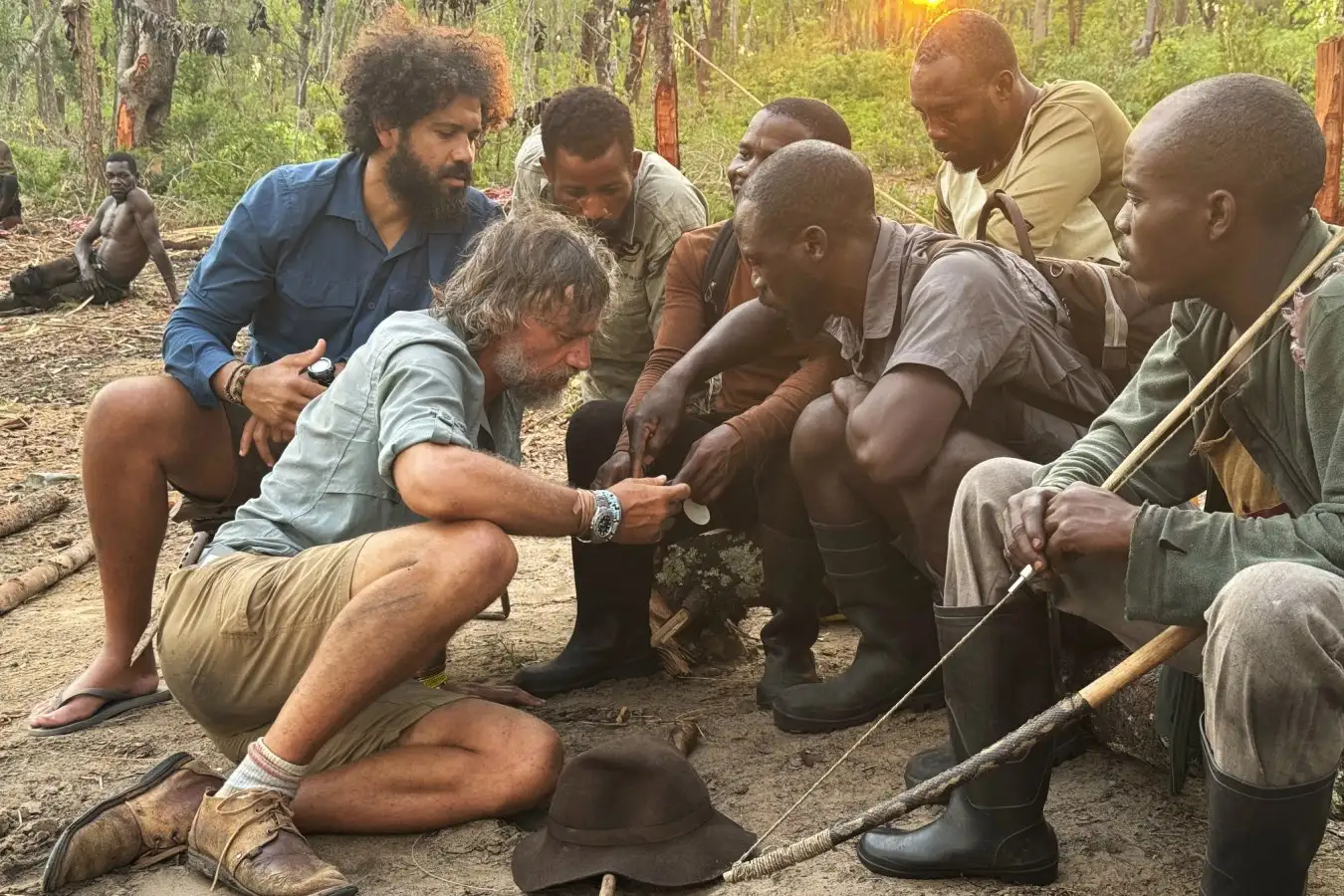
Environmental anthropologist Kerllen Costa (far left), conservationist Steve Boyes (second left) and Angolan hunter-guides search for ghost elephants, possibly shown below
Ariel Leon Isacovitch
Ghost Elephants
Werner Herzog, Disney+
Film director Werner Herzog has always been drawn to the limits of human knowledge – to the places where science meets myth, where discovery shades into obsession. In
Ghost Elephants, which premiered at last year’s Venice Film Festival, he follows conservationist Steve Boyes in Angola as he searches for a herd of elephants that may or may not exist. It is both a scientific expedition and a philosophical fable that asks what it means to chase a dream that could easily remain just that.
The premise is strikingly simple. Boyes believes that there has been a sighting of a group of unusually large elephants, possibly related to the legendary Fnykvi specimen preserved at the Smithsonian National Museum of Natural History in Washington DC. Named after the engineer and big-game hunter Josef Fnykvi who shot it, it is one of the largest land mammals ever displayed and stands nearly a metre taller than the average African elephant. The elephants may be roaming the remote Bi plateau, a sparsely inhabited, wooded region roughly the size of England.
For a decade, Boyes has nurtured this hypothesis, piecing together anecdotal evidence from San master trackers, whose ability to read traces in the land remains one of the most sophisticated of any surviving hunter-gatherer cultures. If they are found, these “ghost elephants” could improve biologists’ understanding of elephant genetics, gigantism and migration patterns in one of the least studied parts of Africa.
Herzog, however, is never content to tell a straightforward natural history story. His gravelly narration, in a style that is part-professor, part-sceptic and part-humourist, frames Boyes’s project in broader terms. What begins as a quest for DNA samples becomes a reflection on how science and imagination intertwine. He likens Boyes’s pursuit to Captain Ahab’s hunt for the White Whale, though here the obsession is not destructive but generative, sustained by the conviction that something vast and hidden still lies beyond the human gaze.
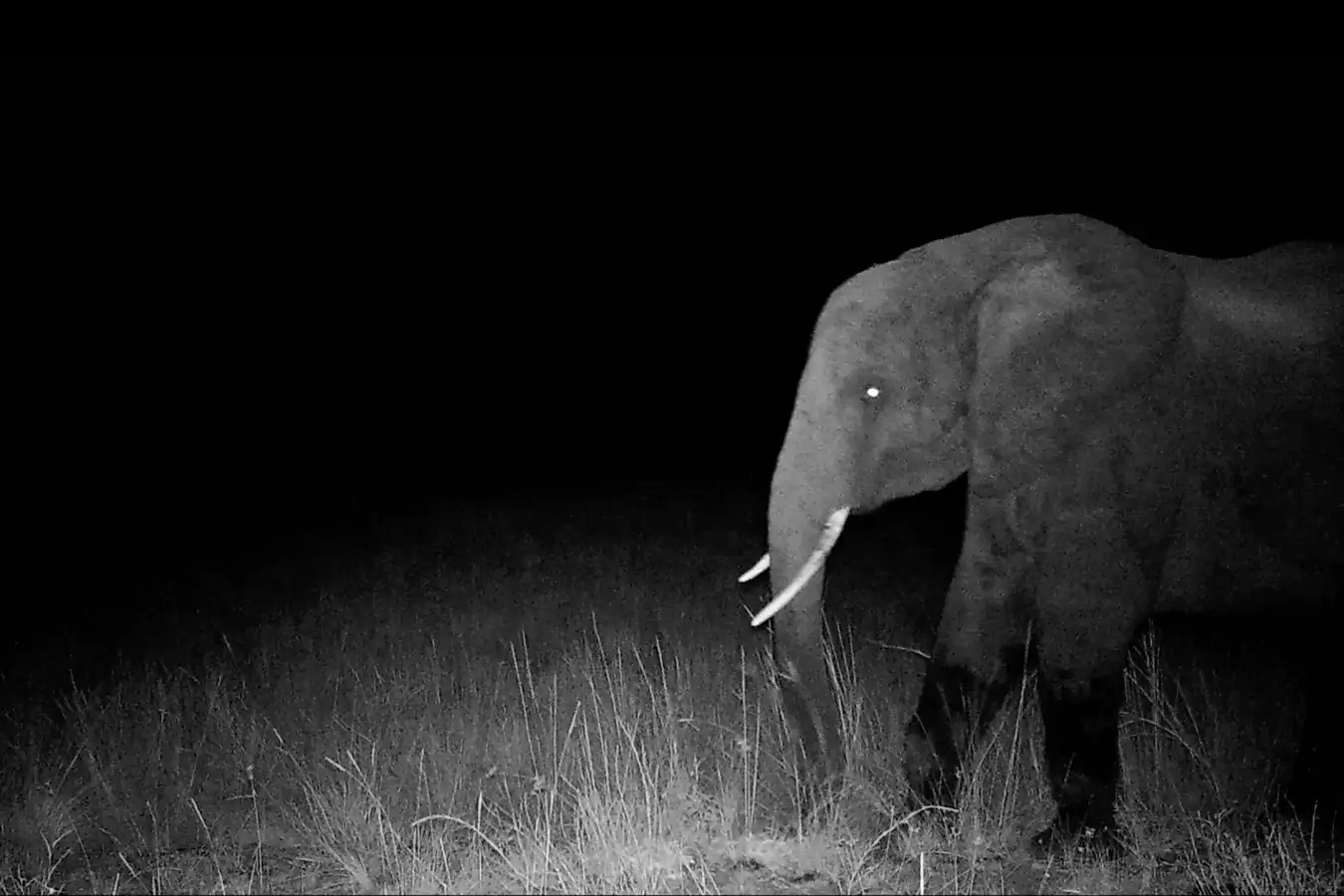
An elephant – possibly a ghost elephant – captured by a motion-controlled camera
The Wilderness Project Archive
The film’s scientific content is woven carefully into its narrative fabric. Viewers see Boyes and his team prepare their expedition equipment, negotiate access with local leaders and do fieldwork in terrain that challenges both them and their instruments.
The film stops short of offering hard data – this isn’t a peer-reviewed publication after all – but it does capture the methodology of field science in real time: hypothesis, observation, inference and the cautious drawing of conclusions. The ultimate discovery, provisional and incomplete, rests less on spectacle than on the slow accumulation of evidence, a rhythm the film embraces with its measured pacing.
Herzog also uses the camera to widen the frame of inquiry. The cinematography recalls the polished textures of National Geographic documentaries, yet always bears Herzog’s signature curiosity. Sweeping aerial shots of the plateau convey the immensity of the landscape, while close studies of trackers’ hands reading footprints on the ground reveal a parallel science rooted in embodied knowledge.
The San people, among the oldest continuous cultures on Earth, carry genetic lineages that diverged from other humans up to 200,000 years ago. Their expertise in tracking isn’t treated as folklore, but as a form of empirical knowledge honed over millennia – science before labs.
Inevitably, the search for elephants becomes a prism for larger themes. Climate change, colonialism and the aftershocks of industrial exploitation surface in Herzog’s commentary, which is never heavy-handed but is persistent. The Angolan flatlands, once scarred by war, are now a site where conservation, Indigenous sovereignty and ecological responsibility intersect. Boyes’s quest underscores the paradox of conservation science: to study is to intervene, and the very act of seeking to preserve can alter what is found.
“ The film is a scientific expedition and a fable, asking what it means to chase a dream that could remain just thate “
In Herzog’s hands, the ghost elephants remain both possibility and metaphor – fascinating creatures that embody a longing for mysteries that science has yet to tame. The message is clear: exploration is never only about what we find, but also about the humility of not knowing, and the persistence of asking questions at the edge of knowledge.
Davide Abbatescianni is a film critic based in Rome
Topics:
此内容由惯性聚合(RSS阅读器)自动聚合整理,仅供阅读参考。 原文来自 — 版权归原作者所有。