

惯性聚合 高效追踪和阅读你感兴趣的博客、新闻、科技资讯
阅读原文 在惯性聚合中打开

推荐订阅源

S
Schneier on Security
cs.AI updates on arXiv.org
P
Palo Alto Networks Blog
AWS News Blog
AWS News Blog
Latest news
Latest news
Microsoft Security Blog
钛媒体:引领未来商业与生活新知
钛媒体:引领未来商业与生活新知
V
Vulnerabilities – Threatpost
大猫的无限游戏
大猫的无限游戏
让小产品的独立变现更简单 - ezindie.com
月光博客
月光博客
C
CERT Recently Published Vulnerability Notes
T
Tenable Blog
雷峰网
雷峰网
K
Kaspersky official blog
人人都是产品经理
人人都是产品经理
C
Cybersecurity and Infrastructure Security Agency CISA
L
Lohrmann on Cybersecurity
T
The Exploit Database - CXSecurity.com
T
Tor Project blog
A
Arctic Wolf
Project Zero
Project Zero
F
Fortinet All Blogs
T
Threatpost
D
Darknet – Hacking Tools, Hacker News & Cyber Security
S
SegmentFault 最新的问题
P
Privacy & Cybersecurity Law Blog
D
DataBreaches.Net
量子位
Cisco Talos Blog
Cisco Talos Blog
博客园 - 【当耐特】
V
Visual Studio Blog
CTFtime.org: upcoming CTF events
博客园 - 叶小钗
I
Intezer
G
GRAHAM CLULEY
Google Online Security Blog
T
The Blog of Author Tim Ferriss
T
Troy Hunt's Blog
Y
Y Combinator Blog
Cyber Security Advisories - MS-ISAC
C
Cyber Attacks, Cyber Crime and Cyber Security
Hacker News: Ask HN
Hacker News: Ask HN
M
MIT News - Artificial intelligence
N
News | PayPal Newsroom
Cyberwarzone
Cyberwarzone
V
V2EX
腾讯CDC
Webroot Blog
Webroot Blog
MongoDB | Blog
MongoDB | Blog

New Scientist - Home

Smart underwear detects lactose intolerance by tracking your farts 2026 will be the hottest year on record, leading scientist predicts NHS England rushes to hide software over AI hacking fears The 4 biggest myths about hydration, according to an expert Oak trees use delaying tactics to thwart hungry caterpillars Will Colombia summit kick-start the end of the fossil fuel era? Why I explore our inevitable love for robots in my novel Luminous Read an extract from Luminous by Silvia Park The rings of Uranus are even stranger than we thought An unorthodox version of quantum theory could reveal what reality is 'Green' cryptocurrency uses 18 times more energy than makers claim Your oral microbiome could affect your weight, liver and diabetes risk Human heads have changed shape a lot in the past 100 years Doubts cast over 'wild' claim that magnetic control can turn on genes The best new science fiction books of May 2026 The rich but complicated legacy of genome pioneer Craig Venter We have figured out a new way to send messages into the past Our verdict on Red Mars: Mostly great, with a few quibbles New Scientist recommends New York's Bone Museum and Gecko Gallery Thought-provoking photographs capture what it feels like to have ADHD Is an AI version of Mark Zuckerberg – or any boss – a good plan? Ann Leckie continues to shine with new sci-fi novel Radiant Star Simple treatment tweak drastically reduces blood loss from severe cuts Weird 'transdimensional' state of matter is neither 2D nor 3D Why dinosaurs lived much more complex lives than we thought The chips in your phone are probably broken – and that's a good thing Scorpions reinforce their claws and stingers with metals Extreme weather in 2025 drove record wildfire emissions in Europe Cancer is increasing in young people and we still don't know why People are betting on measles outbreaks – and that might be useful Gamblers are betting millions of dollars on measles outbreaks Is consciousness more fundamental to reality than quantum physics? Humanoid robots may be about to break the 100-metre sprint record How I pay almost nothing to power my house and electric car We may finally have a cure for many different autoimmune conditions Coral reefs on a remote archipelago shrugged off a massive heatwave Why the keto diet could be a revolutionary way to treat mental illness Giant Arctic continent launched dinosaurs to world domination 10,000 new planets found hidden in NASA telescope data How your heart rate variability can offer an insight into your mind 100-year-old assumption about the universe may soon be overturned Gravity's strength measured more reliably than ever before Symptoms of early dementia reversed by bespoke treatment plans QBox theory may offer glimpse of reality deeper than quantum realm Is stem cell therapy about to transform medicine and reverse ageing? Largest-ever octopus was great white shark of invertebrate predators Do you need to worry about Mythos, Anthropic's computer-hacking AI? Catching a cold can delay cancer from spreading to the lungs Huge study reveals how Epstein-Barr virus may cause multiple sclerosis Striking photo essay examines deadly spread of dengue fever in Nepal 98 per cent of meat and dairy sustainability pledges are greenwashing New Scientist recommends Jeff Beal’s New York Études, Vol. II Can you slow ageing with your diet? A new book gives it a go Why your opinion of used electric vehicles is probably wrong This mesmerising Cornish time-travel film is not to be missed We need more radioactive drugs. Can we make them from nuclear waste? Table tennis-playing robot on track to becoming world champion Exercise advice for long covid may be doing more harm than good Fermat's Last Theorem: still a must-read about a 350-year maths secret If a bird flu pandemic starts, we may have an mRNA vaccine ready Titan’s strange plains may be explained by unusual weather How we discovered the speed limit of arithmetic – and broke it The monstrous number sequences that break the rules of mathematics Game theory explains why the US's goals in Iran keep changing Diamonds are surprisingly elastic when you make them tiny A whole new way to prevent death from sepsis shows promise Parrot uses his broken beak to become a dominant male Can we ‘vaccinate’ ourselves against stress? Why the right kind of stress is crucial for your health and happiness Can you determine your personalised stress score? We might finally know how to use quantum computers to boost AI Hospital-acquired pneumonia reduced by daily toothbrushing Brushing your teeth in hospital could prevent catching a bad infection Electric vehicle owners could earn thousands by supporting power grid Requests for blood from unvaccinated donors is harming patients Werner Herzog searches for ghost elephants in stunning new documentary The biggest threat to Chernobyl is no longer radiation Modern living may be causing big changes to our oestrogen levels Temperature gets a new definition using a quantum device Meta and YouTube fined $3 million for harming mental health How big is a 'shedload'? Let's ask the nuclear physicists What to read this week: the persuasive How Flowers Made Our World The brain's cleaning system can be boosted to rid Alzheimer's proteins Oldest known dog extends the genetic history of our canine companions Landmark experiment reveals a big unexpected problem with cloning Ancient bones reveal vivid details of a Neanderthal elephant hunt Want to live forever? There are major questions to confront, first Cancer-causing chemical found to be leaking from gas cookers Earth may have formed from two separate rings around the sun Cystitis or tooth decay could trigger dementia just a few years later Antimatter has been transported by road for the first time How AI shook the world's largest meeting of physicists Adrian Tchaikovsky: 'I try and do interesting aliens' Are humans degenerating genetically and getting dumber as a result? Genetic clues tell the story of Neanderthals' decline Warmer ocean is driving the Antarctic sea ice 'regime shift' Mysterious comet disintegration caught by telescope after lucky break 'Zombie' cells created by transplanting genomes into dead bacteria Security credentials inadvertently leaked on thousands of websites Inside the world’s first antimatter delivery service
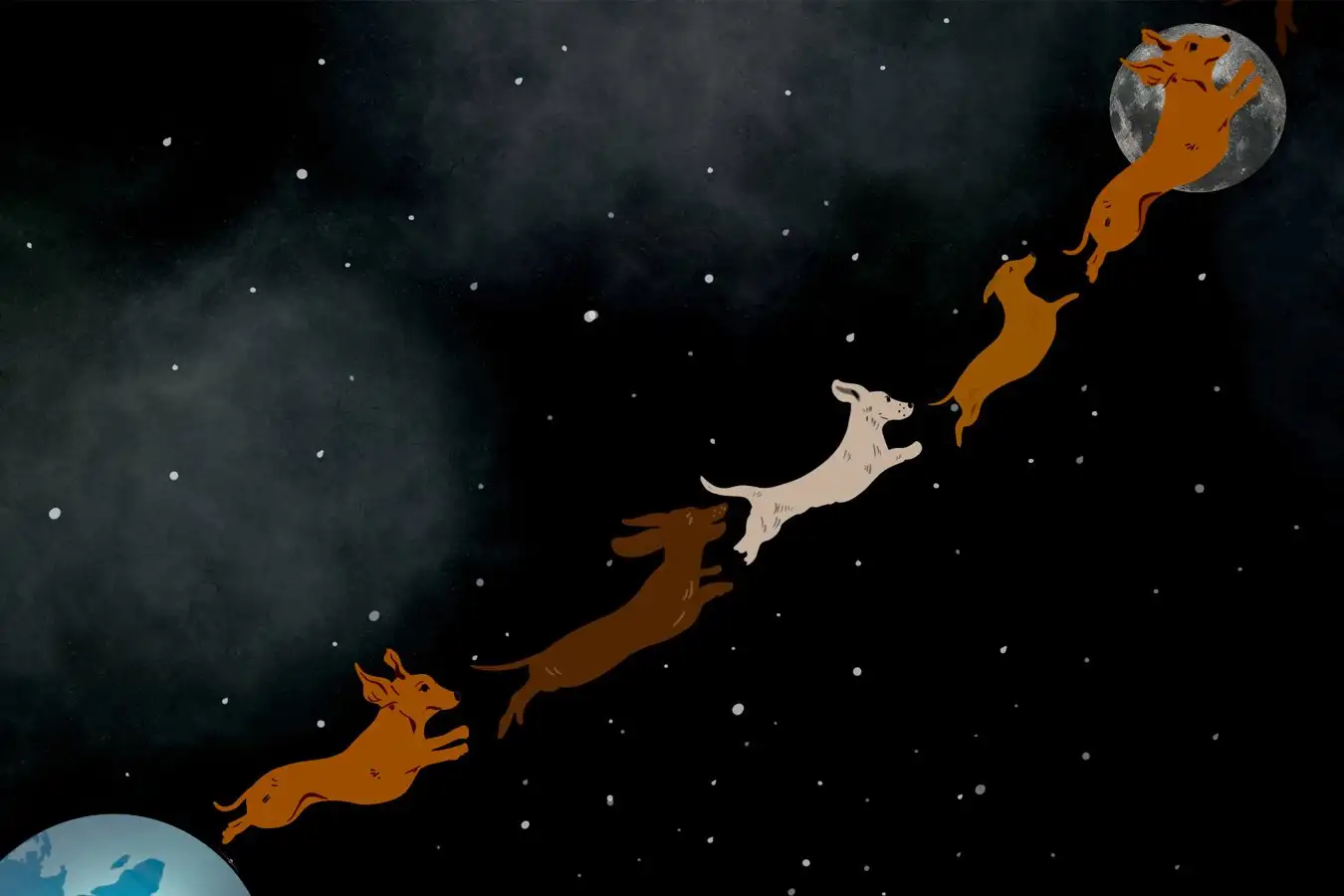
How many dachshunds would it take to get to the moon?
2026-04-23 · via New Scientist - Home

New Scientist. Science news and long reads from expert journalists, covering developments in science, technology, health and the environment on the website and the magazine.

Josie Ford

Feedback is New Scientist’s popular sideways look at the latest science and technology news. You can submit items you believe may amuse readers to Feedback by emailing feedback@newscientist.com

Moon wanderings

Readers may have heard that the Artemis II crew successfully travelled around the moon and back to Earth this month. A lot has been said about the mission, some of it delightful and some of it baffling.

A key aspect of Artemis II is that, at the most distant point of their journey, the astronauts were 406,771 kilometres from Earth, further than anyone has ever gone before. Reader Helen von den Steinen wrote in to tell us about an “absurd unit of measurement” used by The New York Times to convey the scale of that gap. This unit was, of course, wiener dogs.

“If you took 22-inch dachshunds and laid them nose to tail, you’d need a very cooperative pack of almost 728 million dogs to cover the distance,” we were informed. In case anyone hoped to check that, they also offered the important caveat that there are “only around 900 million dogs, of any breed, in existence”.

Not content with that, the paper switched to dog walks. “If you took one of the dachshunds on a brisk 3-mile-per-hour walk, you’d need to walk for more than 84,000 hours to get there”, they write, which “translates to nearly 10 years of continuous walking”. Finally, they imagined constructing “a chain of 2.37 billion Nathan’s Famous hot dogs to cover the distance”. A competitive eater who can devour 76 hot dogs every 10 minutes would need to eat nonstop for almost 594 years to consume the entire chain, they write, eating over 700 billion calories in the process.

Helen admired “the way they effortlessly transition between live dogs and hot dogs as if they are some comparable measurement”. Feedback shares this admiration, and wonders how much dachshunds vary in length and if this was accounted for. Further to this, perhaps it might be helpful, when trying to convey immense distance, to start with something long like San Francisco’s Golden Gate Bridge and do multiples of that, but let’s not get too sensible about this.

We also note, without comment, the inevitable online remarks about the trip being faked, for example from writer James Delingpole, who wrote on X that the crew had been “sequestered in some ritzy hotel” for the duration of the mission.

Moving swiftly on, we should like to finish by turning to the work of reader Richard Simmons. He was following up on a bit in these pages about the moon possibly being made of cheddar, in the sense of money, because of the allegedly growing lunar economy (11 April). Richard wondered exactly what kind of cheese the moon might be made of. After dismissing green cheese and other options, he settled on Selles Sur Cher. This is a French variety, described as “a close-textured disc coated in a dusting of charcoal ash”. Based on the photos from Artemis II, Richard says, “it has the correct colour and surface texture”.

Shedloads of marathons

During a previous discussion about the exact size of a “shedload”, reader F. Ian Lamb introduced the concept of an “endogenous relative scaling unit”, or ERS unit (28 March). This refers to a unit that isn’t absolute, but rather varies in size depending on context or even individual perception. Feedback wondered at the time if shedload was the only example of an ERS unit or if there might be more out there.

Reader Andrew Winkley suggests “marathon”. Clearly, in the context of long-distance running races, it has an unambiguous meaning, set in the 1920s: 42.195 kilometres, or 26.22 miles. But, as Andrew points out, it is also used to measure time, and here things get fuzzy. Consider a “24-hour dance marathon”, “a marathon study session down the library” and “a marathon booze-up”. As Andrew says, “what constitutes a marathon in this context would depend on the activity”. And, Feedback might add, the person’s tolerance for the activity in question.

Declassified

At this point, the limitations of AI are well-established, so savvy users are carefully choosing applications where its problems can be controlled or don’t matter.

Just kidding, someone wants to use it to classify government documents. Reporter Matthew Sparkes ran across a paper on arXiv called “Retrieval augmented classification for confidential documents”. The authors note that classifying documents is a lot of work: “requiring users to manually label each document’s confidentiality level is labor-intensive, disrupts work continuity, and often results in inconsistent or subjective labeling”. Hence their proposal to use a large language model instead.

They tested their model on transcripts of US diplomatic cables published by WikiLeaks some years ago. Their best model was able to classify them as “unclassified”, “confidential” and “secret” with 96 per cent accuracy.

Matt identifies the immediate issue: if the tool is 96 per cent accurate, then, presumably, “4 per cent of top-secret info will be leaked”. Feedback stared at this for a while and had some further thoughts. First, the researchers don’t compare the AI to expert humans, so we don’t know if it does a better or worse job.

Second, we found ourselves wondering: in which direction does the AI err? When you are classifying government documents, it may be best to err on the side of caution, to avoid, say, revealing the launch codes for all your country’s nuclear missiles. We couldn’t find any information about such asymmetric errors in the study.

Still, what could go wrong?

Got a story for Feedback?

You can send stories to Feedback by email at feedback@newscientist.com. Please include your home address. This week’s and past Feedbacks can be seen on our website.