


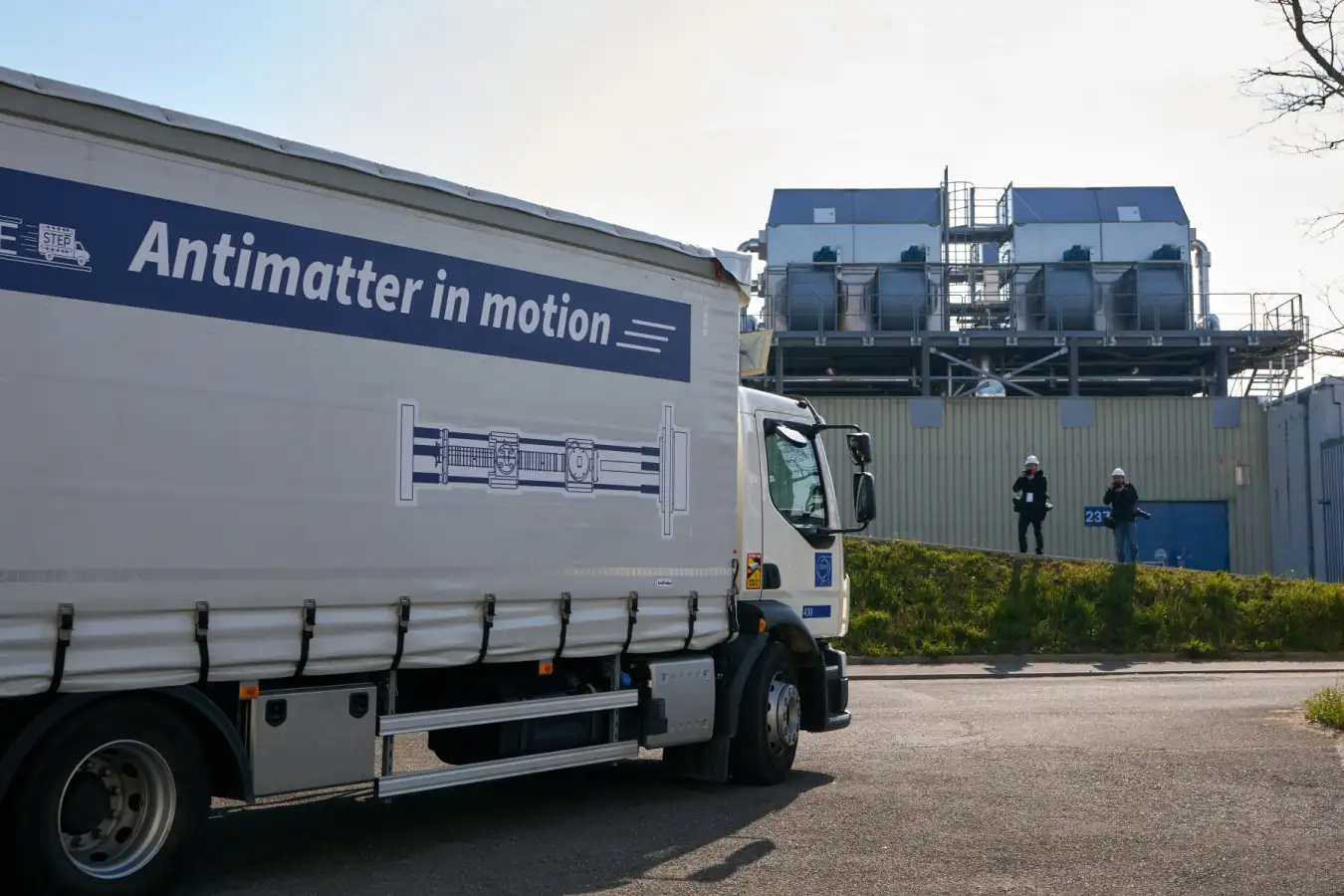
CERN’s antimatter-transporting truck
CERN
Antimatter has finally hit the road. Around 100 antiprotons took a 20-minute trip on the back of a lorry around the CERN particle physics laboratory’s campus near Geneva, Switzerland. This demonstration is the first test of a future antimatter delivery service, which scientists hope will one day see antiprotons transported on demand to laboratories around Europe to study their mysteries.
“I’m very happy that we are now at the stage where it’s possible to [transport antimatter],” says Christian Smorra at CERN. “It has been a long journey, and it’s a lot of sweat and tears that went into this to make it work.”
All matter has an antimatter counterpart, which is theoretically identical apart from an opposite charge. A positron, for example, is the antimatter version of an electron. When an antimatter particle meets its matter equivalent, they annihilate, creating new particles or a flash of energy, which makes storing and testing the properties of antimatter precarious.
Only in the past few decades have scientists at CERN’s Antimatter Decelerator hall, known as the antimatter factory, been able to produce and hoard enough antimatter, like antiprotons, to do experiments on it and better understand its properties. The hope is that further experiments will reveal why we live in a universe dominated by matter and not its counterpart.
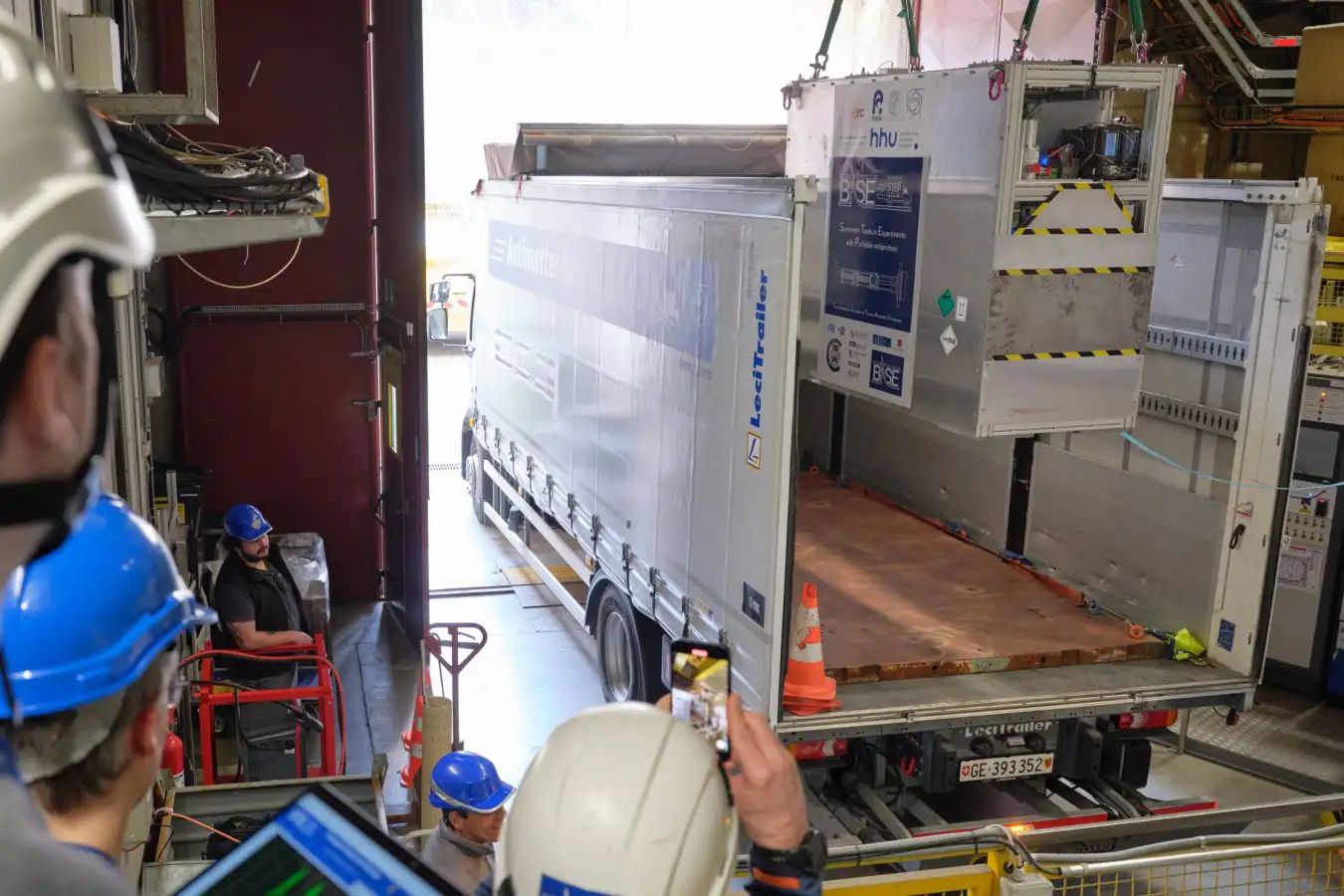
Delicate anticargo is loaded onto a truck
CERN
To slow down antiprotons from the near light speeds at which they are created, scientists use powerful magnetic fields, but this makes it hard to test the magnetic properties of antiprotons themselves. In 2018, Smorra and his team started the Symmetry Tests in Experiments with Portable antiprotons (STEP) project, a portable container using a tank of liquid helium and powerful magnetic fields that would eventually allow the antiprotons to be transported to a more magnetically quiet facility.
Now, the STEP project has successfully completed its test run on the back of a truck around a 4-kilometre loop of road on the CERN campus, transporting 92 antiprotons from the antimatter factory and back, with its cargo intact.
“This really opens up many more years of precision measurements, because this stops them from being hindered by the noise in the hall,” says Jeffrey Hangst at Aarhus University in Denmark, who runs the nearby ALPHA experiment that studies antihydrogen atoms.
Smorra and his team hope to eventually demonstrate that the STEP project can travel much further than just CERN, delivering antimatter to magnetically quiet laboratories across Europe. This could take several years, however, as much of CERN will close for upgrades to the Large Hadron Collider, which won’t finish until the end of 2028.
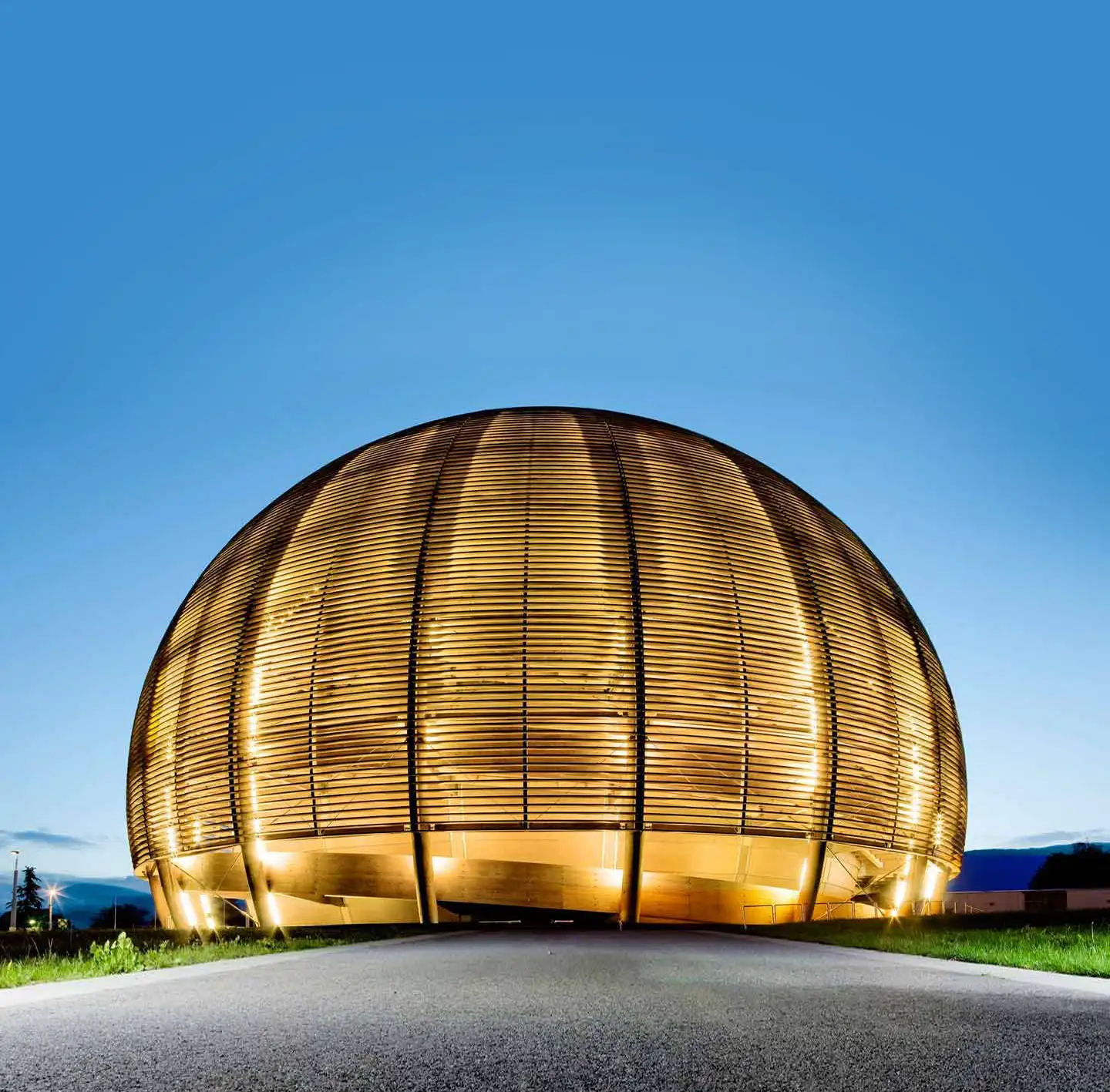
Prepare to have your mind blown by CERN, Europe’s particle physics centre, where researchers operate the famous Large Hadron Collider, nestled near the charming Swiss lakeside city of Geneva.
Topics:
此内容由惯性聚合(RSS阅读器)自动聚合整理,仅供阅读参考。 原文来自 — 版权归原作者所有。