







Speculative evolution is an “amazing treasure chest of possibilities” – Adrian Tchaikovsky
Tom Pepperdine
Adrian Tchaikovsky published his first book, the fantasy novel Empire in Black and Gold, in 2008. He turned to science fiction in 2015 with Children of Time, a far-future story of the accelerated evolution of Portia labiate spiders on a terraformed planet far from Earth. It was the first in a series which would go on to win Tchaikovsky prizes including the Arthur C Clarke Award and the British Science Fiction Association Award. Now he divides his writing time between science fiction and fantasy, with the fourth book in the Children of Time series, Children of Strife, out on 26 March. He joined head of books Alison Flood to talk about its protagonist – a human-sized mantis shrimp – and what could have inspired its terrifyingly awful villain.
Alison Flood: You studied zoology at university, right? The Children of Time series and its evolved animals feels like the perfect area for you to be writing in…
Adrian Tchaikovsky: In all honesty, the zoology degree I did, I didn’t get the content out of it. There was almost nothing on invertebrates at all. There was one lecture about insects, and it was ‘this is how we kill insects’. It wasn’t particularly what I was after. The animal behaviour elements were fairly depressing, because at that time the main paradigm was B. F. Skinner – that animals are robots and you’re not allowed to speculate about their interiority. What drove me to write about spiders, mantis shrimps and so forth was a pre-existing fascination with creatures like that, which the university course didn’t really assist with.
But your writing career didn’t immediately take off?
I started writing at about seventeen, and I was going for about fifteen or so years, writing and submitting books and getting nowhere with it before Empire in Black and Gold came out. The writing comes out of a different interest of mine, which is role-playing games. A lot of the creative elements of those games transfer very well into writing prose, building worlds and characters and so forth.
You started the Children of Time series over a decade ago. Four books in, did you always know this is where it would end – and is this indeed the end?
Children of Time was only ever going to be a standalone book in the first place – it was very much a punt. My stock in trade at the time was epic fantasy, with the Shadows of the Apt books, but I had this idea for a sci-fi. I don’t think anyone at my publishers had really expected it to do well, but I was doing well enough at fantasy they would indulge me in [this one book], and then it was going to be back to swords and dragons. Then, about a year after it came out, after going under the radar for quite a while, it suddenly exploded when it got onto the Arthur C Clarke Award shortlist. After that, it completely transformed my writing career and what people were expecting me to write.
As to whether this is the end of it, it’s an open-ended series, and really it comes down to, am I going to have a good enough idea for another one? I have half an idea for a fifth that might come together, but I need a bit more to kind of glom onto.
Fantasy was your first love. Do you enjoy writing sci-fi as much as fantasy these days?
I think with fantasy you get a bit more freedom in what you can write, because you’re not constrained by the real science, or by anything really, as long as you set out your axioms at the beginning. But with sci-fi, when you make something that fits nicely with how we understand the universe to work, that’s also its own pleasure.
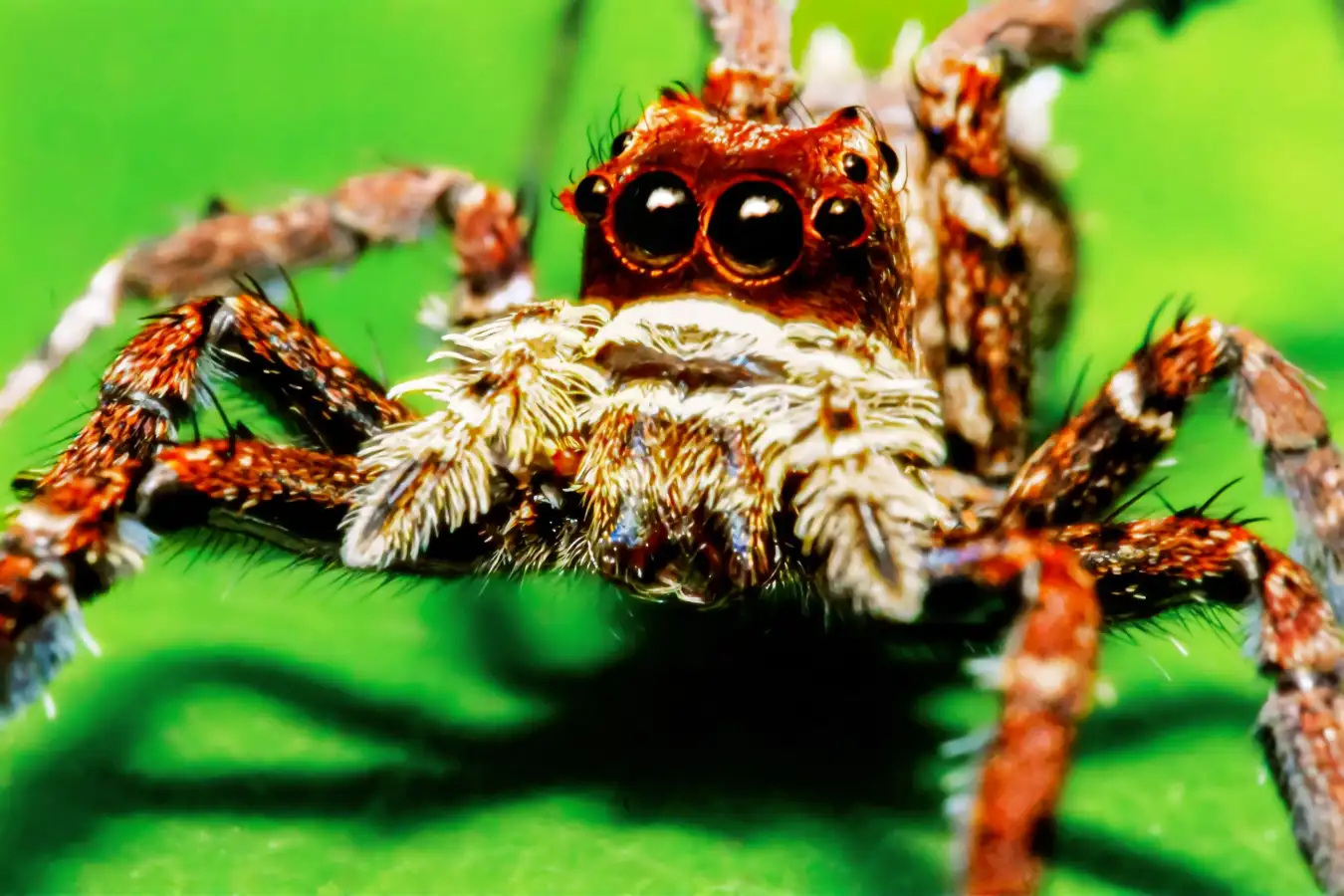
“What if they got a clear run of being a dominant, sapient species?” A Portia labiata spider
CHAO-FENG LIN/Alamy
You said you had an idea in the middle of writing your fantasy books for the Children of Time series. Was it just supercool spiders?
I read a research paper by Fiona Cross, a New Zealand scientist studying that particular species of spider, where she discovered the enormous complexity of their behaviours as they are now, with a minuscule clutch of neurons for a brain. And that just got me thinking that you could run a thought experiment – what if they got a clear run of being a dominant, sapient species, what would that look like? Children of Time was just an excuse to run that thought experiment, with all the human plot added on to give a reader an access point.
You started with uplifting spiders, then octopuses, now mantis shrimp. Why mantis shrimp?
Because they’re really cool, to be honest. The reason I pick a particular species is usually because I feel it’s got the potential to become something of the kind of order of intelligence that I’m generally writing about. Which means I’m looking at it and thinking about, what is it? What has it got going on at the moment? What are the evolutionary pressures on it that might lead it to become more intelligent? Because, of course, intelligence isn’t necessarily as useful as we think it is evolutionarily. A lot of things get on perfectly well without being particularly smart at all.
When you look at mantis shrimps, they’re not exactly social, but they live in very tight-packed colonies, they are extremely aggressive and very capable of killing members of their own species, and so they’ve had to evolve very sophisticated social intelligence. I mean sophisticated from the point of view of a small crustacean, where they have a whole culture, effectively, of duelling, display and deception. They know what fights to pick, and when to push and when to back down, which to me, seems like a very strong driver for becoming more and more intelligent.
What were the challenges of writing this species into what it becomes, and what kind of research did you do to put all that together?
Normally, when I’m doing my research for this sort of thing, I’m looking for an easy in. Either I find someone who knows about a topic and chat with them, and that’s a very efficient way of getting up to speed on it. Or, in the case of the octopuses, there’s an extremely good book on octopus cognition which just summarises everything in a very readable fashion, which is Other Minds by Peter Godfrey-Smith.
For the mantis shrimps, there is a world authority on mantis shrimps who I credit at the beginning of the book [Roy L. Caldwell], who retired recently, and who I could not get hold of for love nor money. I had to just get hold of his entire body of research, about 40 years of mantis studies, and read through it all and find the useful bits. I spent a couple of months going through his back catalogue.
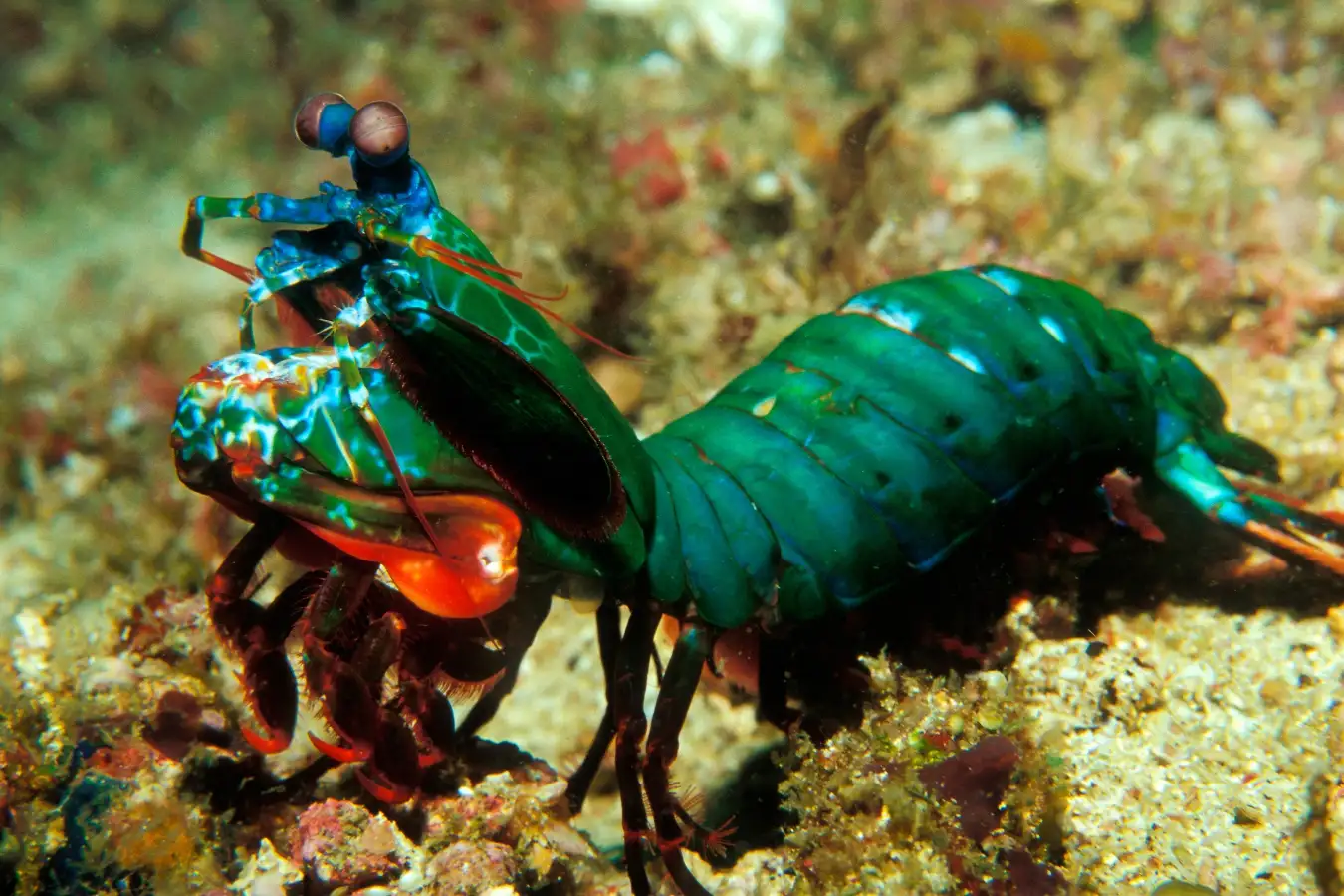
A mantis shrimp, the latest subject of Adrian Tchaikovsky’s novels
WaterFrame/Alamy
How do mantis shrimp compare to uplifting octopuses and spiders?
I think they’re probably easier than octopuses, because the way octopus neurology works is extremely complex, and translating that into a point of view for my narrative was very difficult.
With the mantis shrimps, I had to delve into physics a bit because of the way their eyes work. There is a particular type of polarized light that they can see and nothing else can see, which I felt I had to work into the book. But I didn’t know what it meant, so I had to start reading.
I loved how expressive Cato the mantis shrimp’s body was, how he’s curling up in shame.
All of that’s based on real, current mantis shrimp body language. [When you’re writing about an uplifted species], you use what you’ve got from the start, and then you say, well, this is what they do now, how would that become adapted into more complex communication measures.
Obviously here you’ve got a creature that’s living underwater. It doesn’t have any way of generating sophisticated sounds other than clicks and things. You get this complex language of full body gestures going on. And then, of course, because their eyes are so good, it does mean that you can have extremely fine distinctions of gesture and angle to communicate details. And they do have a lot of bits. I’ve drawn mantis shrimp a couple of times, and they are phenomenally complicated to draw, because they have so many antennae, legs and arms and things.
The Children of Time series is set around the idea that Earth is doomed and humanity has set out to terraform new planets to live on. But Children of Strife goes in quite a dark direction with this, with a power-mad terraformer playing god with evolution on a distant planet. What set you off on that route?
Looking around at the sort of people who are calling the shots in the world today, I can’t imagine where I’ve got characters like Gerey Hartmand from. It’s an utter mystery.
Evolution is obviously a topic that fascinates you and one you keep coming back to. I also loved your book, Alien Clay, where life has evolved in such a different way to how it has in these books.
Evolution, especially speculative evolution – whether we’re talking about how things might have gone differently on Earth, or whether we’re looking at how alien life might evolve – just seems like this amazing treasure chest of possibilities. The big eye-opener for me was a book called Wonderful Life by Stephen Jay Gould, where he talks about the life in the early Cambrian and the Burgess Shale fossils. Because if you look at that in isolation, there’s no obvious direction of where things are going to go. And one of the things I’m kicking against in Alien Clay, for example, is the idea people tend to have that evolution has a direction – that we are the end and evolution can knock off, that we’re perfect. And of course, that isn’t how it works.
In The Doors of Eden, I rerun Earth evolution about a dozen times, with different species coming out on top each time. And then in Alien Clay and in Shroud, I’m looking at the completely different ways evolution could go. It’s just this endlessly fascinating exercise.
Dougal Dixon is very much the grandfather of speculative evolution, with his book After Man. I remember encountering that when I was in secondary school, and it blowing my mind. It’s the idea that people are gone, and then whatever’s left radiates out to fill all the evolutionary niches.
None of your alien creations are “human with an alien head” sorts of creatures. They’re all their own thing.
Even when I’m doing space opera, like in the Final Architecture books, I still try and do interesting aliens. I appreciate that there are budgetary reasons why a lot of film and TV aliens historically have been people with things stuck to their foreheads or wearing Halloween masks. But if we find alien life that has evolved independently of Earth life, it is going to be more alien to us than the most alien thing we can think of on Earth. It will have a completely different genetic code.
The vastness of time is very much a part of the Children of Time books. Is it sometimes hard to get your head around it when you’re writing?
It was weird because Children of Time wasn’t originally intended to go on to become a series at all. I had to think it through: what are the implications? It did feel I was having to let go of what would normally be the mainstay of any kind of narrative plot – what is the timescale, what is the deadline?
One of the nice things about reading the Children of Time series is the empathy these very different species have for each other. Do you enjoy that as you write?
I do, but it’s also a very deliberate choice with the series. It’s there right at the beginning. Empathy is, and has increasingly become, in the years since the first book was published, an extremely valuable and endangered commodity in the world. Having empathy for things that are not like us is wonderful. That’s the good future, really, whether the things that are not like us are also human beings, or whether they are spiders or aliens or whatever.
There is another future which we seem to have taken some perilous steps towards in those intervening years, which is not having empathy for anyone. There is a cult of selfishness that is very evident today, so in my minuscule way in the books I’m trying to push back, I guess, and have my happy multi-species interstellar civilization, where everyone is just getting on.
Topics:
此内容由惯性聚合(RSS阅读器)自动聚合整理,仅供阅读参考。 原文来自 — 版权归原作者所有。