


Physics
Experiment with nanodiamonds reveals that they are less rigid than other diamonds, adding to our understanding of how they could be used in new technologies
20 April 2026
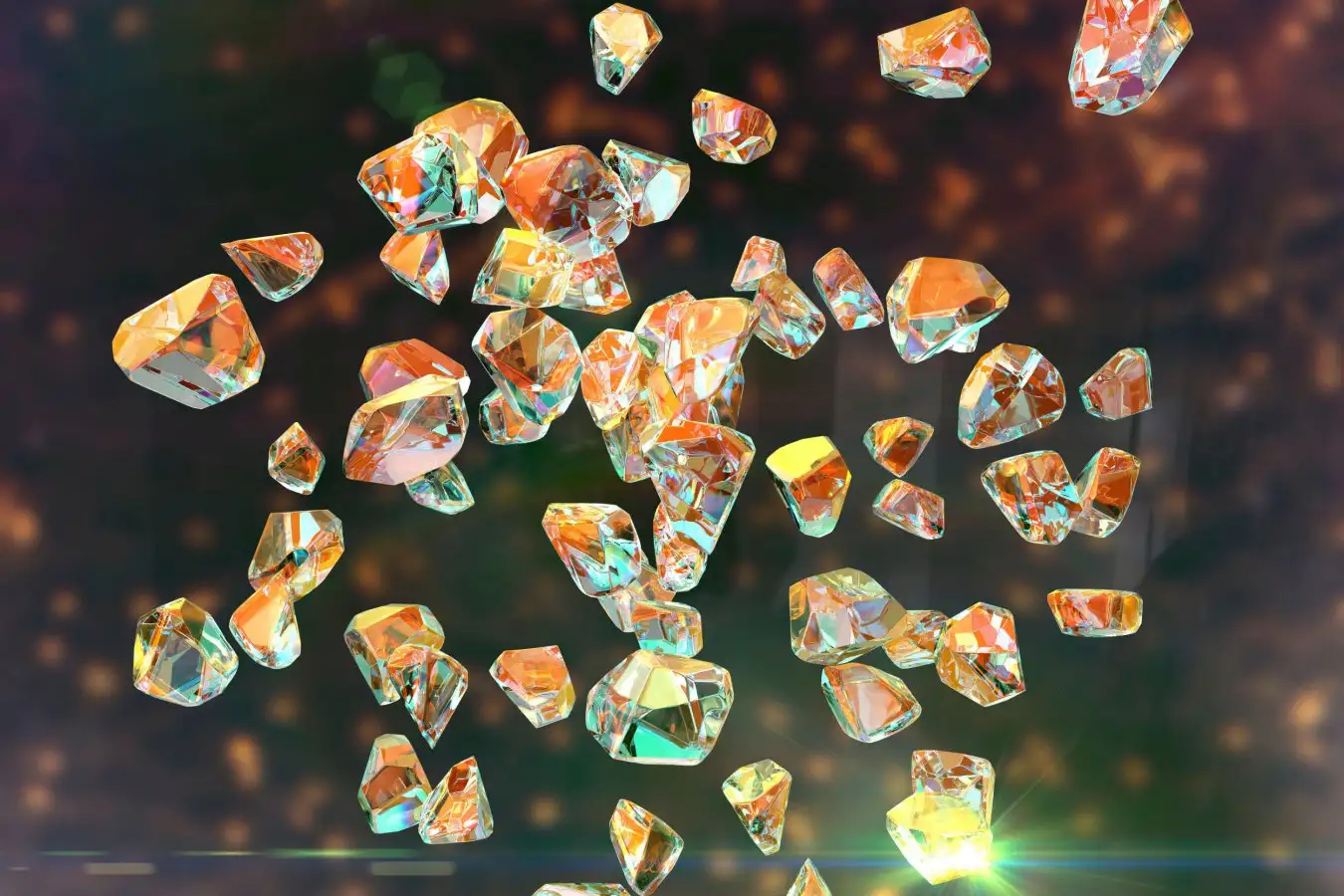
An artist’s impression of nanodiamonds
KATERYNA KON/SCIENCE PHOTO LIBRARY/Alamy
Diamonds are forever, but if you make them ultrasmall, they can get a little squishy. An experiment with some of the smallest diamonds ever studied has now revealed why they become surprisingly elastic when they are ultrasmall.
“Bulk diamonds are widely known for extreme stiffness and hardness. At the nanoscale, things can be different,” says Chongxin Shan at Zhengzhou University in China. He and his colleagues studied how diamonds as small as 4 nanometres across – hundreds of times smaller than some viruses – respond to pressure.
The researchers clamped each tiny diamond between two cylinders that were diamond-tipped and capable of compressing the nanodiamond. The cylinders were connected to a force sensor that measured how much the diamond resisted and a special microscope that imaged the compressed diamond.
Shan says that making reliable measurements at the nanoscale is challenging because all measured effects are very small and any tiny disturbance from the diamond’s environment can add noise to the data. To avoid this problem, the researchers repeated the experiment with about 100 different diamonds and took precautions like making measurements in high vacuum where no particles of air could disturb them. They found that as the diamonds’ diameter decreased from 12 to 4 nanometres, their stiffness decreased by about 30 per cent – meaning they became more elastic.
The researchers then used their measurements and computer simulations of the diamonds to work out why. Shan says that because the diamonds were so small, the ratio between the number of atoms on their surface layer and the number of atoms comprising their core was large, but the chemical bonds between the two regions were weak. This made the nanodiamonds more elastic than larger diamonds where the surface-to-core ratio is smaller and the stronger bonds within the core dominate the diamond’s behaviour, he says.
Yang Lu at the City University of Hong Kong says that the new experiment found unexpected changes in diamonds’ properties even compared with past studies of tiny diamonds. His team completed some of the first studies showing that diamonds at the nanoscale can be less hard and brittle, but the new work pushed the smallness level down tenfold. This is important because tiny diamonds are becoming an increasingly popular material for building novel electronics as well as quantum devices, says Lu. “And artificial diamonds are becoming extremely cheap nowadays so it’s a good time for putting diamonds in more and more [applications],” he says.
Topics: