






The last time a government official from Lebanon sat down to think carefully about national digital infrastructure, nobody expected another war with Israel. That’s how it has always gone.
“We were not ready for this,” says Kamal Shehadi, the Lebanese minister of technology and AI, and minister of the displaced. “I have to admit that we didn’t expect something of this magnitude to happen.”
On March 2, 2026, Israeli evacuation warnings began appearing on phones across southern Lebanon. Days later, similar alerts reached residents of Beirut’s densely populated southern suburbs, urging them to leave as strikes were imminent.
Within minutes, families were moving. Within days, nearly 1.3 million people—nearly 1 in 5 residents of the country—were forcibly displaced. Schools that have been turned into shelters were filled past capacity. People slept in cars along the coast road north of Beirut. And somewhere in a government office, a small team started updating a database.
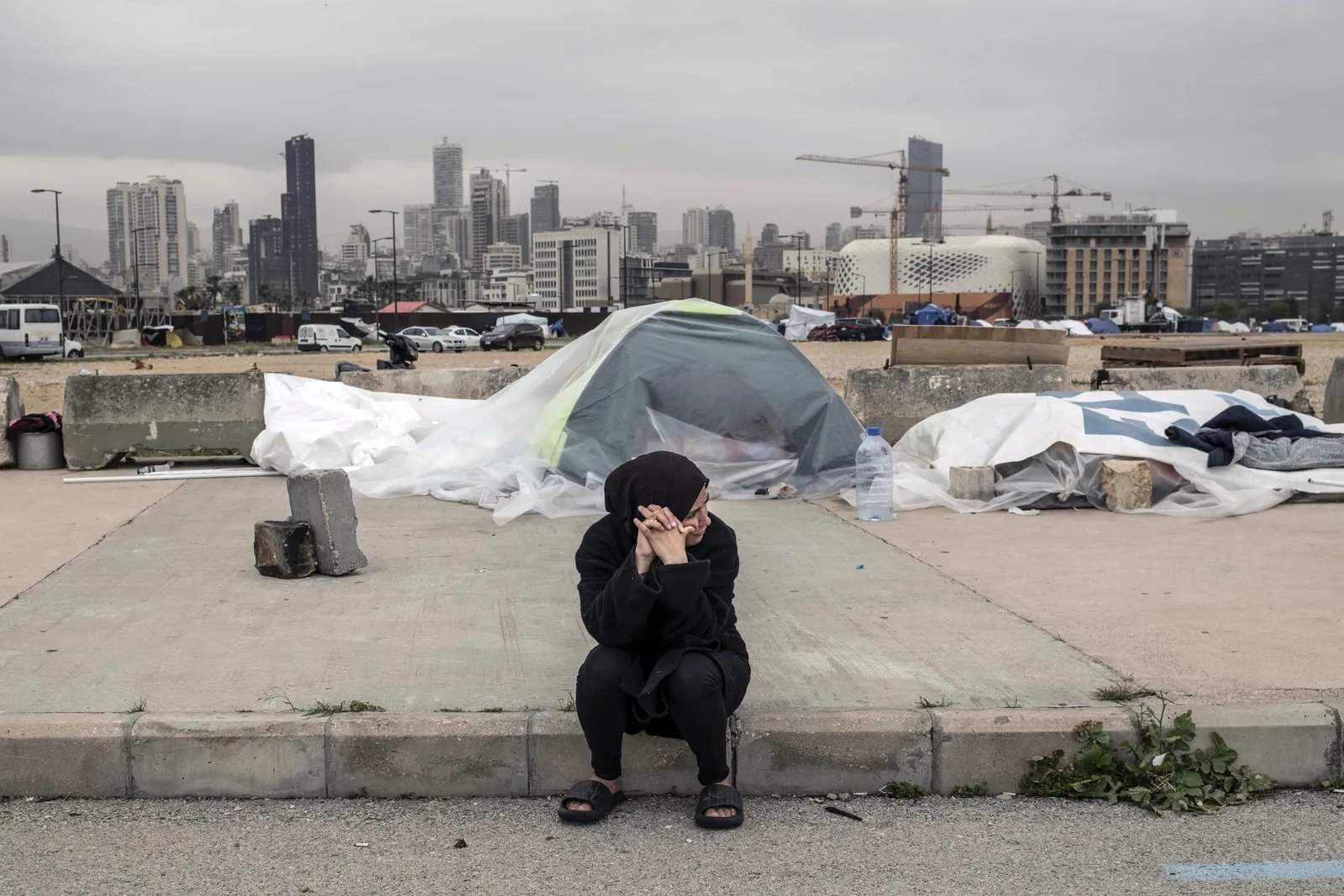
A woman sits by a tent as displaced families struggle for survival in the streets of Beirut, Lebanon.Murat Sengul; Getty Images
That platform is currently the closest thing Lebanon has to a real-time view of its own humanitarian crisis. It tracks food packages, fuel supplies, hygiene kits, and medicine. It tells government officials which shelter in which district is running low on blankets. It is, by global standards, modest technology. By Lebanon’s standards, it might be the most functional piece of government software in the country.
While the US, Israel, and Iran negotiate, Israel has excluded Lebanon from the ongoing two-week ceasefire. Local media have reported up to 100 Israeli air strikes on Lebanon within 10 minutes on April 8, in a clear sign that forced displacement, disruption, and chaos will continue in the nation.
“We’re able to monitor where these commodities are stocked but also what is actually provided to the shelters,” says Shehadi. “We can track today every single food package that is delivered, and so we have a clear idea of what’s needed.” Flour, sugar, fuel, butane, medicine. The system has a list.
The Ministry of Social Development runs the shelters. The Ministry of Economy watches the supply lines—“making sure that the country is well-stocked and that the imports of key commodities is ongoing,” Shehadi says. Technology stitches it together. The Disaster Relief Management unit, housed in the prime minister’s office and battle tested through the 2024 war and the 2020 Beirut port explosion, runs point.
What makes the current deployment different from previous crises is coverage and speed. More than 667,000 people registered on the government’s online displacement platform in a single week—an increase of 100,000 in one day alone. The government set up mobile registration, verification teams, and financial disbursement pipelines in days. “We’ve made it very easy for them to sign up,” he says. “There is a team of volunteers, but also a team of professionals who will check and make sure that this is truly an [internally displaced person].”
Shehadi says that roughly 200,000 people are in government-managed collective shelters. Another 800,000 or so are receiving direct financial assistance while sheltering with relatives or in rented apartments. Roughly 80 percent of all displaced persons are now on some form of government support. “We know which shelters need more hygiene kits, which shelters need more pillows, more mattresses,” Shehadi says. “We’re able to provide it in a more focused way but also provide more transparency.” Those shelters provide free internet to allow students to continue to study online and adults to work remotely.
The minister mentions one more piece of technology. An emergency alert system is coming—location-based, delivered through the mobile network, designed to ping phones when a security incident or hazard is detected nearby. “Soon, there’s going to be a national emergency alert system to notify people using your smartphone,” he says. “It’s going to be based on location—any hazard, any other danger in their area.”
When pressed on how it works, he cuts the conversation short: “I can’t get into that at this point.” Of course, the architecture of an alert system, especially during an active war, is a matter of national security. A system that sits at the intersection of mobile network infrastructure, real-time threat intelligence, and mass public communication is exactly the kind of system that adversaries study for weaknesses.
There is a deeper context and truth to this technology: This is a massive work-around for a system that should have already existed. The reason tracking food packages feels like an achievement is because Lebanon never built the underlying digital infrastructure that would make this trivially easy and taken for granted. There is no national digital identity system. There is no national digital payment infrastructure. There are no verified, interoperable records connecting a Lebanese citizen to a bank account, a verified address, a health record.
The World Bank has been documenting this for years, publishing detailed diagnostics of Lebanon’s fragmented identity infrastructure, recommending changes and supporting a 2020-2030 Digital Transformation Strategy designed to fix it. Lebanon’s existing national ID card system is partially digitized but carries outdated data, lacks connectivity with other government systems, and provides insufficient digital authentication.
In February 2026—weeks before the latest escalation—Lebanon secured $150 million in World Bank financing for the Lebanon Digital Acceleration Project, explicitly designed to build out digital ID and payments infrastructure.
Shehadi does not soften this. “Had these things already been put in place, they would have made it so much easier to distribute assistance and to check the identity of the recipient and to make sure that the right people are receiving the right medicine and the right financial assistance.”
He says it plainly: “We’re starting from a very basic tech base. Your options are limited.”
“Don’t delay having this technology in place. You should really be pushing for this to be in place,” he says. It is advice aimed, implicitly, at every government currently treating digital infrastructure as a future problem. Lebanon keeps learning this lesson. It keeps having to relearn it.
The digital ID is not a convenience; it is a precondition for delivering services, fighting corruption and reaching vulnerable populations in exactly the moments when it matters most. The moments, in other words, that always seem to arrive before anyone expected them.
To understand why this crisis is heavier than the last one, look at the Lebanese economy before March 2. The Lebanese lira had already lost over 98 percent of its value by 2023. Approximately 80 percent of the population was living in poverty before March 2, 2026.
The World Bank’s cumulative GDP contraction for Lebanon since 2019 had exceeded 38 percent by the end of 2024. It had previously ranked the Lebanese crisis one of the top three most severe economic crises globally since the mid-19th century—a designation usually reserved for wartime economies. The current conflict is projected to cut GDP a further 12 to 16 percent in 2026.
The UN and its partners had already appealed for $308 million just to fund a three-month emergency response. That figure is less than Lebanon’s estimated monthly relief need. International pledges have covered a fraction of it.
There’s a concept in disaster response called compounding vulnerability—the idea that each successive crisis finds populations with fewer resources and less capacity to absorb the hit. The UN Refugee Agency (UNHCR) has documented it directly in Lebanon: For many families, this displacement is not their first. It is their second or third.
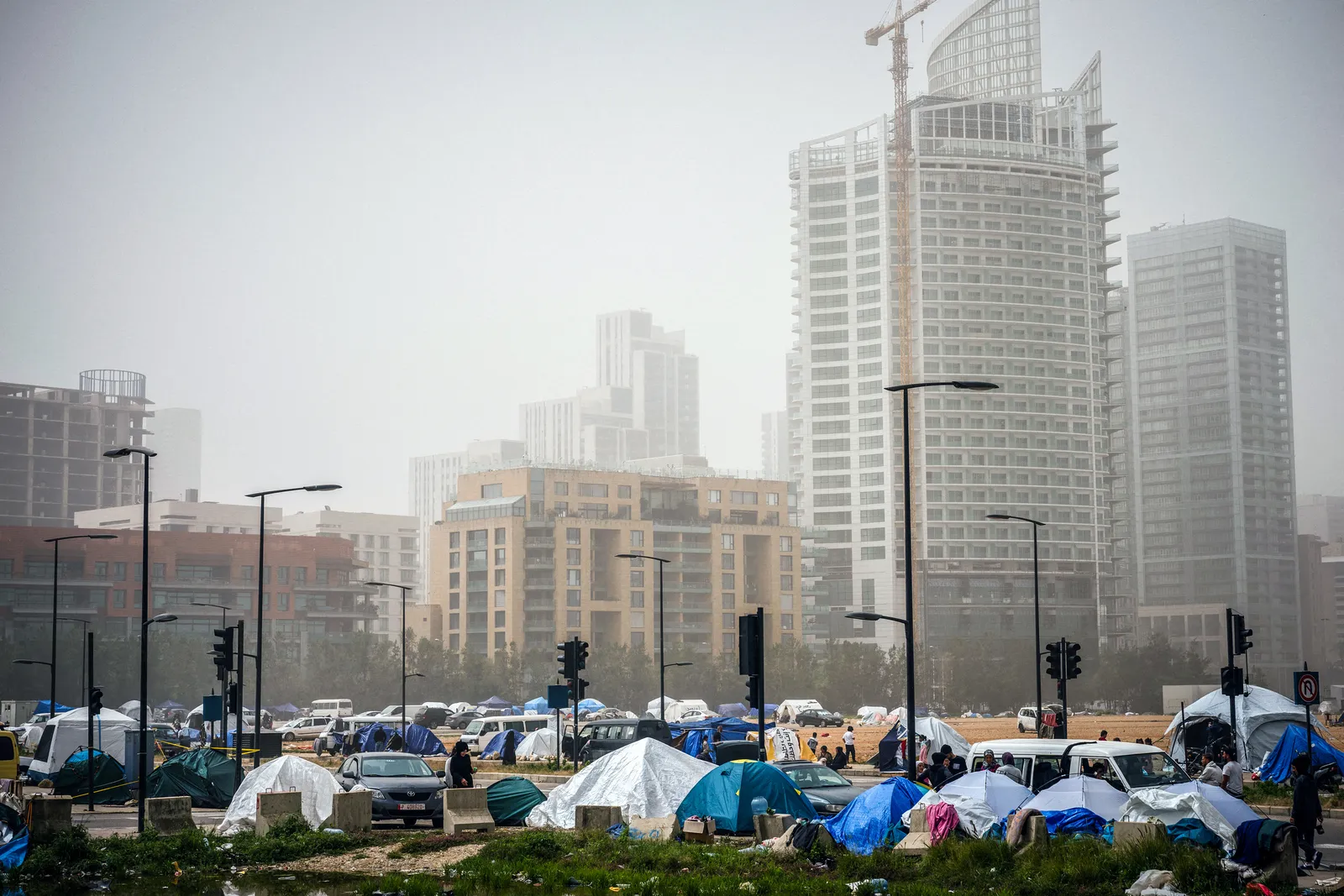
Displaced families stand next to their tents at an unofficial camp erected along Beirut’s seafront area during a sandstorm.Dimitar Dilkoff; Getty Images
Against that backdrop, the minister’s statement that “we didn’t expect something of this magnitude to happen” reads more like a precise description of a government that has been managing a permanent emergency since 2019.
Expecting Lebanon to have prebuilt a national digital ID and payments infrastructure while simultaneously navigating an economic collapse, a banking sector implosion, and a two-year political vacuum that only ended in January 2025 is, as a practical matter, a lot to ask. And yet the absence is still the absence. It is felt most acutely by the people with the fewest alternatives.
The harder problem—the one that Shehadi admits he doesn’t have an answer to—is what comes next. The immediate relief operation is difficult but tractable: count the food packages, match the supply to the shelters, and sign people up for financial assistance. The medium-term problem is economic and structural in a way that no tracking platform can solve.
“The million people who’ve been displaced have lost their jobs and their source of income,” the minister says. “There’s a whole set of cascading problems that emerge from that.” Early economic data from 2026 is brutal: 30 percent of small and medium-size businesses have already shut down permanently. Unemployment has surged to between 46 and 48 percent.
Meanwhile, Israel has signaled it intends to continue occupying southern Lebanon up to the Litani River, a zone covering roughly a 10th of the country. The last time Israel held that territory, the occupation lasted 18 years.
Chatham House analysts have warned that a prolonged presence would undermine what little remains of Lebanon’s ability to project state authority in the south, and reinvigorate Hezbollah, the group Israel claims it is trying to dismantle. Parliamentary elections, originally scheduled for May 2026, have been postponed for two years.
The minister’s ask, in this context, is modest and enormous at the same time: free internet in shelters, so kids can keep going to school online. Digital certification programs, so displaced workers can build skills while they wait. A national alert system to warn people before the next strike hits their neighborhood.
In the meantime, the nation’s digital infrastructure remains weak, but Shehadi understands the stakes. “It doesn’t help us today,” he says of Lebanon’s digital transformation program, “but hopefully in a few weeks, in a few months, this will bear fruit.”
What Shehadi is left with —what the Lebanese people are left with—is the aid platform. The list of shelters and their blanket counts. The log of food packages dispatched and received. The enrollment form. By the standards of what this crisis demands, it is not enough. By the standards of what Lebanon has managed to build, under the conditions Lebanon has been forced to operate in, it is something. Not a solution. A ledger. Proof, at minimum, that someone is counting and that the count is holding.
This article was originally published on WIRED Middle East.
此内容由惯性聚合(RSS阅读器)自动聚合整理,仅供阅读参考。 原文来自 — 版权归原作者所有。