







If your organization uses on-premises storage area network (SAN)-based storage, you might be familiar with its benefits, such as significant capacity, quick performance for transactional databases, and reliability. However, as the storage ages, maintaining performance or capacity for data growth could be difficult. To meet this need and support workloads that require low latency and high throughput, AWS offers an on-demand SAN in the Cloud solution comprised of a single data volume backed by two EBS io2 Block Express volumes and an EC2 r5b.24xlarge instance.
We ran benchmarking tests to compare transactional database performance of this Amazon SAN in the Cloud solution and an on-premises mid-level HPE 3PAR StoreServ 8450 SAN solution that we configured similarly to the AWS solution. We ran a synthetic I/O workload and an online transaction processing (OLTP) workload on the two solutions. Both the instance and the on-premises solution used Intel® Xeon® processors from the same generation (Cascade Lake), featured the same number of cores and threads, and offered the same amount of memory. To learn more about our configurations and why we chose them, see the full report.
We found that the AWS SAN in the Cloud solution featuring an EC2 R5b instance and EBS io2 Block Express storage:
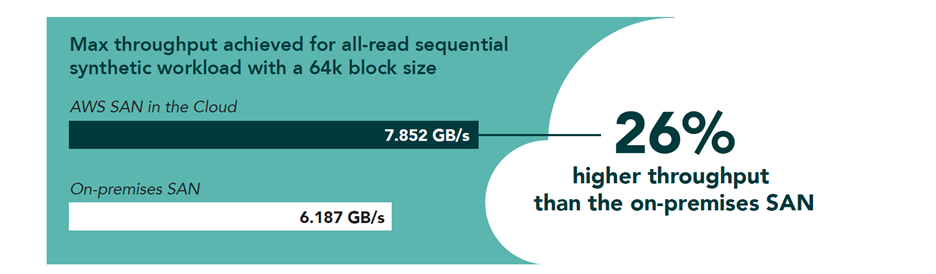
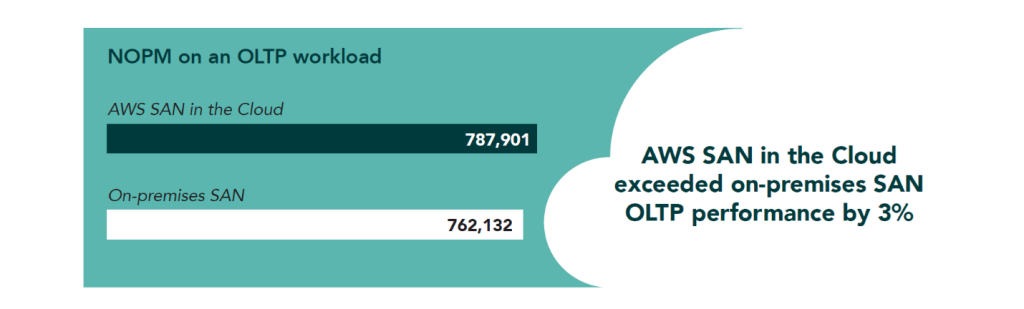
With the performance we saw from an AWS SAN in the Cloud solution of EBS io2 Block Express volumes and an EC2 r5b instance, your business could lift and shift business-critical OLTP workloads to free up on-premises SAN capacity for other workloads, meeting current usage levels and getting scalability for data growth.
To find out more about our testing and results, read the report at http://facts.pt/JIBjXqh.
This blog was commissioned by AWS.
此内容由惯性聚合(RSS阅读器)自动聚合整理,仅供阅读参考。 原文来自 — 版权归原作者所有。