




惯性聚合 高效追踪和阅读你感兴趣的博客、新闻、科技资讯
阅读原文 在惯性聚合中打开

推荐订阅源

L
LangChain Blog
博客园 - 司徒正美
美团技术团队
WordPress大学
WordPress大学
奇客Solidot–传递最新科技情报
奇客Solidot–传递最新科技情报
人人都是产品经理
人人都是产品经理
让小产品的独立变现更简单 - ezindie.com
T
Troy Hunt's Blog
S
Schneier on Security
T
The Exploit Database - CXSecurity.com
P
Proofpoint News Feed
云风的 BLOG
云风的 BLOG
Engineering at Meta
Engineering at Meta
Cisco Talos Blog
Cisco Talos Blog
T
Tor Project blog
B
Blog
NISL@THU
NISL@THU
月光博客
月光博客
博客园 - 【当耐特】
AWS News Blog
AWS News Blog
cs.CL updates on arXiv.org
腾讯CDC
L
Lohrmann on Cybersecurity
The Cloudflare Blog
L
LINUX DO - 最新话题
S
Security @ Cisco Blogs
S
Secure Thoughts
Spread Privacy
Spread Privacy
有赞技术团队
有赞技术团队
The Last Watchdog
The Last Watchdog
Project Zero
Project Zero
cs.AI updates on arXiv.org
Vercel News
Vercel News
H
Hacker News: Front Page
S
SegmentFault 最新的问题
Schneier on Security
aimingoo的专栏
aimingoo的专栏
P
Privacy & Cybersecurity Law Blog
博客园 - 三生石上(FineUI控件)
Forbes - Security
Forbes - Security
C
CXSECURITY Database RSS Feed - CXSecurity.com
I
InfoQ
T
Tailwind CSS Blog
Application and Cybersecurity Blog
G
GRAHAM CLULEY
W
WeLiveSecurity
小众软件
小众软件
Recorded Future
Recorded Future
Cyberwarzone
Cyberwarzone
cs.CV updates on arXiv.org

Coralogix

Stop Guessing Why Your Pods Are Crashing Coralogix Raises $200M to Scale the Observability Backbone for the Age of AI DataPrime at ingest (DPXL): See the impact of any routing decision New Explore: Faster answers, less friction, and a better way to investigate your data Explore for Spans: One View with Infinite Depth What Is Log Monitoring? Pipeline, Pitfalls, and Practices for 2026 What Is APM? A Guide to Application Performance Monitoring What Is an Incident Commander? Role, Skills, and Best Practices The cost of knowledge Introducing the Coralogix CLI: Headless Observability for Every Agent How the Coralogix CLI Adds Production Intelligence to Any Agent for Any Use Case Real-Time Database Monitoring: Solving Database Latency with Zero-Code eBPF Tracing Coralogix and Atlassian: Full-Stack Observability Inside the Incident Workflow Your Team is Using Claude Code. Do You Know What It’s Costing You? How Kotak811 Revolutionized Digital Banking Observability with Coralogix The Security Trifecta: Operationalizing API Protection with AWS, Wallarm, and Coralogix From Vibes to Signals: Observing Your AI Coding Workflow What “AI-Ready Data” actually means for observability teams Code Agents Need Observability DataPrime at Ingest: Fine-Grained TCO Routing with DPXL Agent-First Observability: Dynamic Data, High Cardinality, and the Business Impact Building Audit-Ready Observability for Digital Banking Debug frontend issues with AI: Real user monitoring meets the Coralogix MCP server The End of Manual Instrumentation: Scaling Observability with OTel OBI & Coralogix Evil Token: AI-Enabled Device Code Phishing Campaign Spending More, Seeing Less: How Indexing Limits Capital Markets Visibility Digital Trading: Why “Healthy Systems” Still Lose Trades From Trace to Root Cause: Mastering the new Trace Drilldown Coralogix Earns 196 Badges in G2 Spring 2026 Reports Across 15 Categories Bridging the gap between mobile experience and technical reality Monitor schema health with engine.schema_fields: Structure, Drift, and Volatility AWS GuardDuty Modules Explained: Features, Coverage, and How Customers Benefit with Coralogix The AWS logs you miss during an incident Slack, Teams & Google Chat in Your SIEM: Why Collaboration Audit Logs Matter
Managing OpenTelemetry at Scale: Why OTel Pipelines Need a Control Plane
Jonny Steiner · 2026-05-10 · via Coralogix

OpenTelemetry made telemetry possible everywhere – turning observability pipelines into distributed production infrastructure. Distributed infrastructure requires a control plane for inventory, governance, and safe change. 

At 500 collectors across hybrid environments, operational overhead becomes a production risk. The moment telemetry pipelines become a distributed infrastructure, they inherit the operational problems of one.

The Reality of Day-2 Operations 

When teams move past initial deployment into long-term maintenance, they encounter the consequences of unmanaged infrastructure:

  • Velocity bottlenecks: Updates require repeated PRs, Helm upgrades, staged restarts, and manual verification. This manual cycle is too slow for modern DevOps.
  • Coverage blindspots: Finding outdated or non-reporting environments takes manual investigation, leaving gaps in instrumentation.
  • Noisy neighbors: Misconfigured collectors quietly consume CPU and memory. Without fleet-wide visibility, these outliers are hard to detect and remediate consistently.

Left unaddressed, these operational pains become significant consequences for the business: 

  • Configuration drift leads to inconsistent telemetry and security postures across the cloud environment. 
  • Slow, manual rollouts create long compliance windows during active incidents.
    • Waiting hours for PRs and Helm upgrades to propagate a configuration fix extends MTTR and stalls troubleshooting when every minute counts.
  • Without a centralized inventory, teams simply cannot answer critical questions about which versions or configurations are running in specific environments. 

Ultimately, this reliance on manual changes results in a massive operational impact for every update.

Teams need the same rollout control and governance for observability pipelines that they already expect from Kubernetes and CI/CD.

In practice, that means a control plane that can:

  • Give you a live inventory of what’s running and whether it’s healthy
  • Enforce version consistency and highlight drift
  • Target changes safely (canary → phased rollout → full rollout)
  • Prove convergence and keep an audit trail (and rollback when needed)

Coralogix Fleet Management provides that control plane for OpenTelemetry at scale.

What Fleet Management Is (and Why OpAMP Matters)

Fleet Management acts as the control plane for OpenTelemetry, giving teams centralized visibility into collector health, versions, and resource usage across their fleet. 

Concretely, the control plane shows up in two places:

  1. Fleet-wide inventory and health view (so you can see what’s running and spot drift/outliers)
  2. Controlled rollout mechanism (so configuration changes become targeted, observable deployments – not manual work per cluster).

Inventory & health (Agent Catalog): Centralized operational visibility into agent health, versions, and resource footprint – so you can find outliers and gaps without manual investigation.

Controlled change (Supervisor-enabled remote configuration): A supervised mechanism to deliver approved configuration updates and restart collectors so configuration rollouts are repeatable, targeted, and auditable.

To ensure this control plane remains open and vendor-agnostic, the system utilizes OpAMP (Open Agent Management Protocol). This standardizes the communication between the management plane and your agents, ensuring consistent orchestration.

The Architecture: Remote configuration is made possible by the OpenTelemetry Supervisor, which manages each Collector instance. The interaction follows a secure, structured flow:

  • Standardized Communication: The Supervisor establishes an HTTP connection to the Fleet Management interface.
  • Update checks (OpAMP HTTP transport): Because we utilize the OpAMP HTTP transport, the Supervisor regularly checks in with the management plane to receive approved configuration updates.
  • Automated Configuration Delivery: Once a change is detected, the Supervisor retrieves the update, applies it, and automatically restarts the Collector to activate the new configuration.

Real-World Impact: The Security Redaction Scenario

To understand the value of a telemetry control plane, let’s consider a scenario: a security audit identifies exposed PII in your telemetry, requiring an immediate redaction configuration update across every OTel pipeline in your organization.

This is a major hurdle. Organizations often struggle to implement PII redaction across hundreds of collectors, leading to fragmented policies where some data is missed entirely. Without orchestration, these shifts are slow, inconsistent, and prone to error.

Before: The Manual Marathon

In a traditional, unmanaged setup, pushing a security update follows a grueling, manual path that mirrors the slow pace of legacy infrastructure management:

  • The PR Bottleneck: Create and merge Pull Requests for multiple Helm charts across dozens of namespaces and clusters.
  • The Waiting Game: Manually trigger upgrades and wait for pods or services to restart across every environment.
  • The Validation Gap: Log into multiple systems to verify that the new configuration is active, then manually validate that the resulting telemetry is actually being redacted.
  • The Compliance Window: Throughout this hours-long process, misconfigured collectors remain active, leaving a window where sensitive data continues to leak into your backend.

After: Orchestrated Fleet Rollouts

With Fleet Management, this operational loop is compressed into a single, auditable workflow.

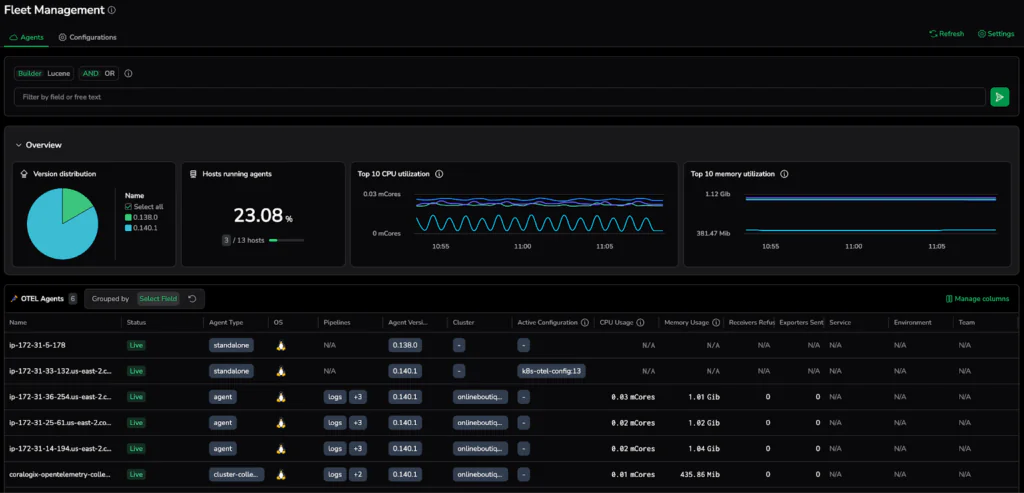
Step 1: Before making a change, use the Agent Catalog to verify your fleet’s current state. This centralized visibility shows which versions are active and identifies outliers that require specific attention.
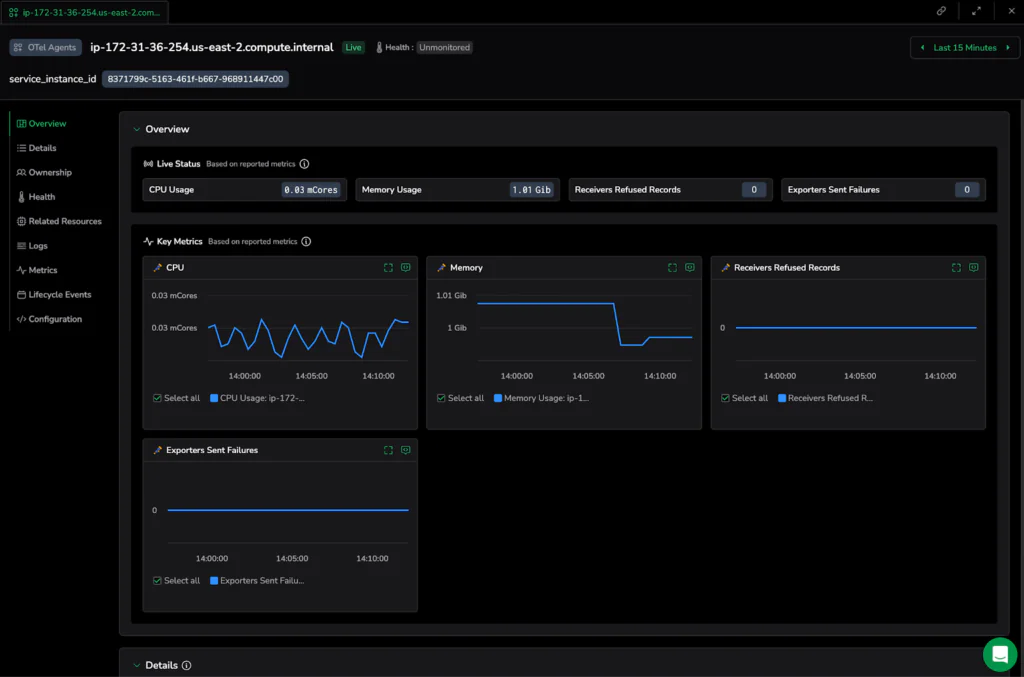
Step 2: Targeted Precision (Selectors) instead of “bulk update and pray” approaches isolate specific hosts or clusters, allowing for safe canary rollouts where you test redaction logic on a subset of agents before a global push.
Step 3: Preview and activate a coordinated config set (Configuration Family) to ensure Agent, Gateway, and Cluster Collector configs stay synchronized. The UI provides a built-in preview so you can see which agents match the selectors before activation.
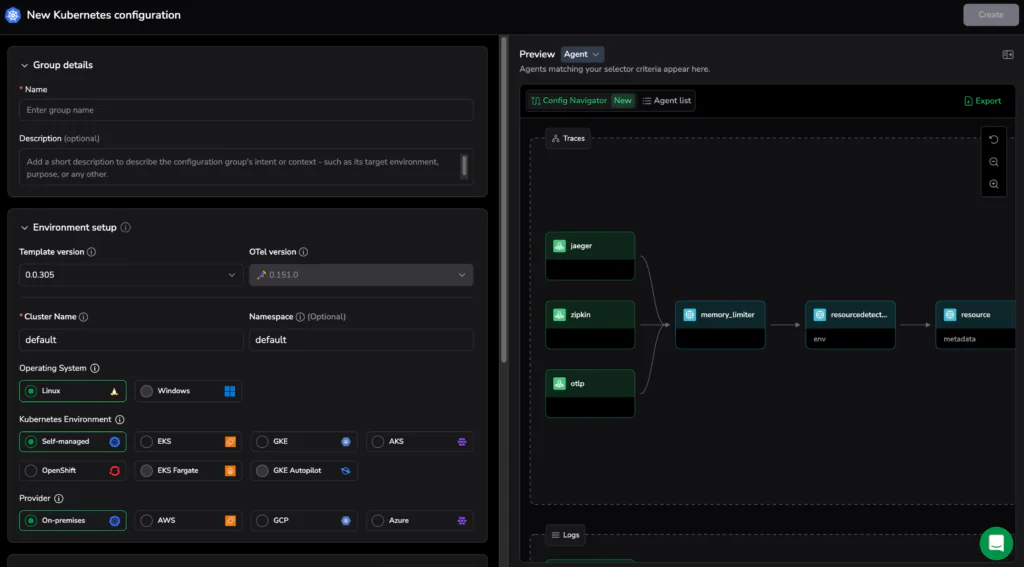
fleet management config

Step 4: Monitor Rollout Health as the Supervisor retrieves the new configuration during its next update check. You can monitor the rollout status as it converges across the fleet. If a collector fails to apply the configuration, you can drill down into its diagnostics to pinpoint the bottleneck and resolve it immediately.
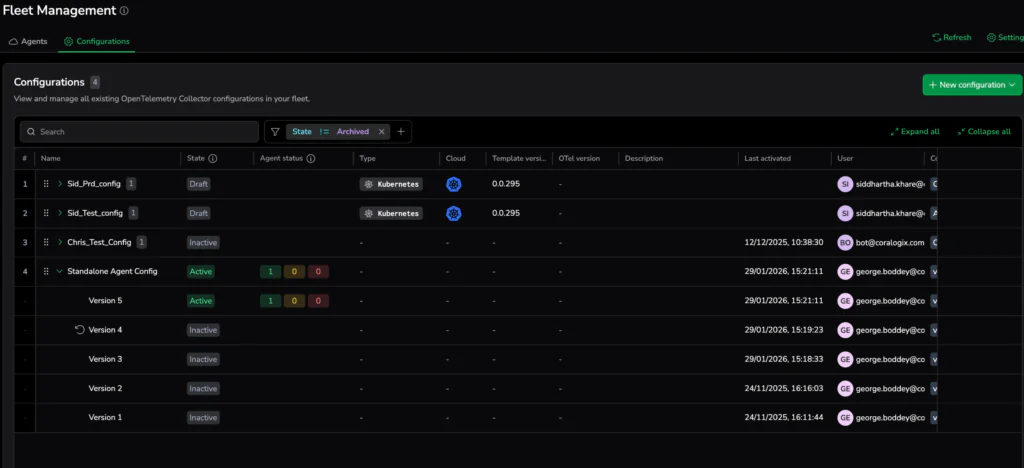
fleet management active

Orchestration is the New Standard

The emergence of OpenTelemetry solved telemetry generation. The next operational challenge to overcome is telemetry governance at scale. Observability pipelines are more distributed than ever, so infrastructure organizations need the same deployment safety, visibility, and lifecycle control they already expect from Kubernetes and CI/CD systems.

Coralogix Fleet Management turns telemetry changes from manual infrastructure work into controlled, observable deployments. It ensures that as your OpenTelemetry footprint grows, your operations remain consistent, audited, and scalable.

Take Control of Your Fleet

If you are ready to move from manual configuration to automated fleet orchestration:

  • Audit Your Inventory: In Coralogix, navigate to Integrations → Fleet Management to view your Agent Catalog and identify version gaps or health outliers.
  • Enable Remote Configuration: Deploy your collectors with the Supervisor enabled to unlock versioned rollouts and centralized configuration management in the Configurations tab.

Get Started with Coralogix Fleet Management