

惯性聚合 高效追踪和阅读你感兴趣的博客、新闻、科技资讯
阅读原文 在惯性聚合中打开

推荐订阅源

L
LangChain Blog
博客园 - 司徒正美
美团技术团队
WordPress大学
WordPress大学
奇客Solidot–传递最新科技情报
奇客Solidot–传递最新科技情报
人人都是产品经理
人人都是产品经理
让小产品的独立变现更简单 - ezindie.com
T
Troy Hunt's Blog
S
Schneier on Security
T
The Exploit Database - CXSecurity.com
P
Proofpoint News Feed
云风的 BLOG
云风的 BLOG
Engineering at Meta
Engineering at Meta
Cisco Talos Blog
Cisco Talos Blog
T
Tor Project blog
B
Blog
NISL@THU
NISL@THU
月光博客
月光博客
博客园 - 【当耐特】
AWS News Blog
AWS News Blog
cs.CL updates on arXiv.org
腾讯CDC
L
Lohrmann on Cybersecurity
The Cloudflare Blog
L
LINUX DO - 最新话题
S
Security @ Cisco Blogs
S
Secure Thoughts
Spread Privacy
Spread Privacy
有赞技术团队
有赞技术团队
The Last Watchdog
The Last Watchdog
Project Zero
Project Zero
cs.AI updates on arXiv.org
Vercel News
Vercel News
H
Hacker News: Front Page
S
SegmentFault 最新的问题
Schneier on Security
aimingoo的专栏
aimingoo的专栏
P
Privacy & Cybersecurity Law Blog
博客园 - 三生石上(FineUI控件)
Forbes - Security
Forbes - Security
C
CXSECURITY Database RSS Feed - CXSecurity.com
I
InfoQ
T
Tailwind CSS Blog
Application and Cybersecurity Blog
G
GRAHAM CLULEY
W
WeLiveSecurity
小众软件
小众软件
Recorded Future
Recorded Future
Cyberwarzone
Cyberwarzone
cs.CV updates on arXiv.org

Coralogix

Stop Guessing Why Your Pods Are Crashing Coralogix Raises $200M to Scale the Observability Backbone for the Age of AI DataPrime at ingest (DPXL): See the impact of any routing decision New Explore: Faster answers, less friction, and a better way to investigate your data What Is Log Monitoring? Pipeline, Pitfalls, and Practices for 2026 What Is APM? A Guide to Application Performance Monitoring What Is an Incident Commander? Role, Skills, and Best Practices Managing OpenTelemetry at Scale: Why OTel Pipelines Need a Control Plane The cost of knowledge Introducing the Coralogix CLI: Headless Observability for Every Agent How the Coralogix CLI Adds Production Intelligence to Any Agent for Any Use Case Real-Time Database Monitoring: Solving Database Latency with Zero-Code eBPF Tracing Coralogix and Atlassian: Full-Stack Observability Inside the Incident Workflow Your Team is Using Claude Code. Do You Know What It’s Costing You? How Kotak811 Revolutionized Digital Banking Observability with Coralogix The Security Trifecta: Operationalizing API Protection with AWS, Wallarm, and Coralogix From Vibes to Signals: Observing Your AI Coding Workflow What “AI-Ready Data” actually means for observability teams Code Agents Need Observability DataPrime at Ingest: Fine-Grained TCO Routing with DPXL Agent-First Observability: Dynamic Data, High Cardinality, and the Business Impact Building Audit-Ready Observability for Digital Banking Debug frontend issues with AI: Real user monitoring meets the Coralogix MCP server The End of Manual Instrumentation: Scaling Observability with OTel OBI & Coralogix Evil Token: AI-Enabled Device Code Phishing Campaign Spending More, Seeing Less: How Indexing Limits Capital Markets Visibility Digital Trading: Why “Healthy Systems” Still Lose Trades From Trace to Root Cause: Mastering the new Trace Drilldown Coralogix Earns 196 Badges in G2 Spring 2026 Reports Across 15 Categories Bridging the gap between mobile experience and technical reality Monitor schema health with engine.schema_fields: Structure, Drift, and Volatility AWS GuardDuty Modules Explained: Features, Coverage, and How Customers Benefit with Coralogix The AWS logs you miss during an incident Slack, Teams & Google Chat in Your SIEM: Why Collaboration Audit Logs Matter
Explore for Spans: One View with Infinite Depth
Jonny Steiner · 2026-05-26 · via Coralogix

A unified investigation surface designed to end context-switching and reduce MTTR.

I. The Crisis of Investigative Latency

It’s 20 minutes into a P0 incident, and you have already switched between four different tools, re-authenticated twice, and translated queries across three incompatible syntax languages. The root cause you are searching for. Well, that is still out there somewhere.

The reality of investigative latency is that most engineering teams face navigation problems, not data problems. During high-pressure incidents, teams lose cognitive momentum due to context switching between disconnected telemetry silos. This fragmentation forces a mental reset that pushes exhausted engineers toward whichever dataset is easiest to query (usually logs), even when distributed traces contain the fastest path to an answer. 

Explore for Spans establishes a single operational plane for distributed tracing. Engineers can filter, inspect, and pivot across spans, traces, flows, and logs within a single interface, eliminating rewritten queries and broken context. Removing this friction becomes an operational priority. To maintain velocity, the environment integrates native Error and Duration filters, instantly stripping away system noise to keep the investigation moving.

II. The Unified Operational Surface

Spans are no longer a specialist dataset. Modern observability requires a unified entry point where spans inherit the same workspace structure, query logic, and multi-tab workflows used for logs. Standardizing the interface eliminates the translation layer previously required to switch between telemetry types. If a team can query a log, they can query a span. This removes the context switch that typically stalls investigative momentum.
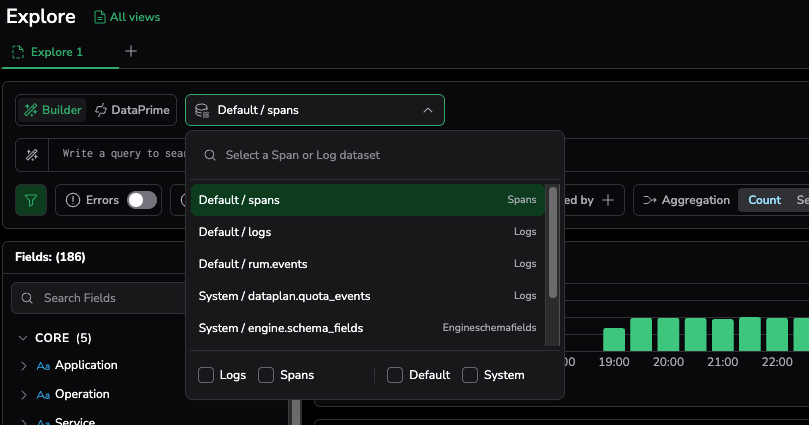
This consistent workspace ensures the learning curve for distributed tracing is a straight line. Engineers discover span metadata via the same search parameters and time pickers used across the platform, helping engineers orient themselves within seconds of an investigation. Instead of translating investigative intent into a foreign UI, teams maintain focus on the problem at hand.

Precision Filtering: Error, Duration, and Trace Relationships

Investigation success relies on narrowing the search space without rewriting queries or switching tools.

  • Error Isolation: Click the error toggle to instantly surface only traces containing a failing span, bypassing manual error-string queries to jump straight to the breach.
  • Latency Outliers: Filter by explicit millisecond thresholds to isolate performance regressions, outlier operations, and downstream bottlenecks.
  • Relational Filters: Filter spans by their exact placement and dependency within a trace rather than static field values. Instead of writing complex query logic, engineers instantly isolate root spans or identify entry-point traffic to pinpoint exactly which parent service triggered a downstream failure. 

III. The Persistence of Investigative Context

True observability requires fluid movement between system-wide patterns and granular request instances. Traditionally, zooming in or out of data forces an “investigative reset,” which means engineers must rebuild filters, reselect services, and re-interpret results in a disconnected layout. This fragmentation breaks the state of flow. Explore reduces these boundaries, helping keep query context, time ranges, and filters consistent as you navigate between telemetry layers.
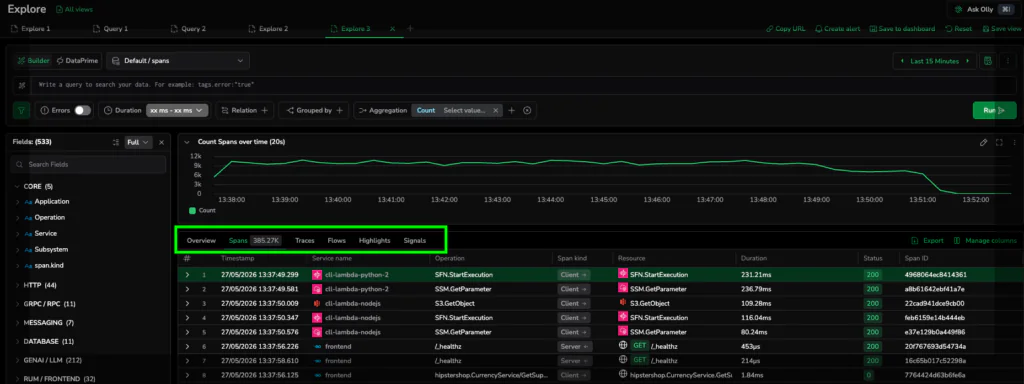
  • Overview Tab: Visualize query results using Group By and Aggregation to quickly spot architectural outliers and performance shifts.
  • Spans Tab: Inspect individual operations, mapping specific services, endpoints, and high-cardinality attributes.
  • Traces Tab: Group filtered spans into request-level summaries to provide an end-to-end trace-centric layout.
  • Flows Tab: Visualize service-to-service topology paths for the selected request or trace execution.
  • Highlights Tab: Automatically analyze anomalous field distributions to identify the structural drivers of performance regressions.
  • Signals Tab: Pivot into multi-dimensional performance tracking via nested Outliers and RED Metrics dashboards to monitor systemic health alongside raw data distributions.

Granularity as a Dial, Not a Doorway

Investigations typically begin with a pattern like a volume spike, failure increase, or latency regression. In Explore, granularity is a dial rather than a doorway, allowing for seamless transitions without a context switch:

  • Pattern Isolation: Start with a broad system scan, then tighten the query using native Request, Error, and Duration filters to isolate relevant operations.
  • Derived Trace Summaries: Switch from the individual Spans to Traces tab to see a request-level summary of the filtered data. Since query context is preserved, you can move from millions of spans to a manageable set of explainable requests instantly.
  • Connected Execution Paths: Switch to the Flows tab to follow a request’s journey across services, and maintain continuity on a single surface.

Keeping your filters and context intact as you switch views means you never have to rebuild your query or restart an investigation from scratch.

IV. Telemetry Convergence: Moving from Evidence to Resolution

Resolution occurs when logs and spans converge into a single investigative language. Traditionally, searching for evidence across different datasets is a tedious, manual process that inflates MTTR. Explore makes this connection native, transforming the drill-down from a data-gathering exercise into a definitive path to root cause. 
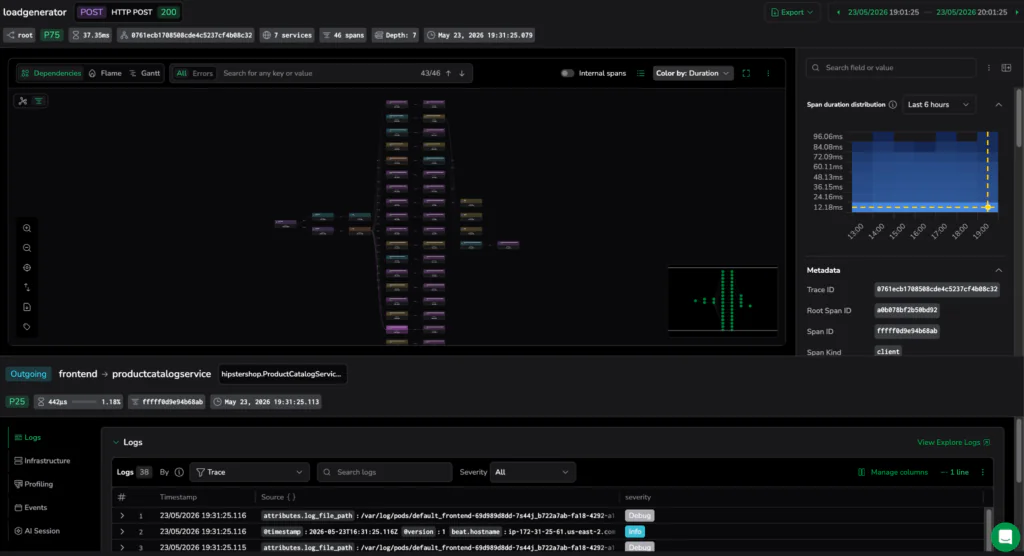
Two-Way Correlation: The End of copy/paste

Investigative friction often stems from the manual join that engineers must perform between traces and logs. Embedding logs directly beneath the trace map inside the drill-down drawer, enables a seamless, bidirectional workflow: 

  • Bidirectional Discovery: Jump from a suspicious span to its relevant log lines, or pivot from a log entry back into the exact location within the distributed trace.
  • In-Context Resolution: Confirm the root cause without leaving the investigative workspace, eliminating the copy-pasting of Trace IDs that typically stalls incident response.
  • Unified Precision: Whether utilizing the guided UI Query Builder or executing complex relational logic via DataPrime, the workflow remains identical. In this environment, “expert mode” is a deeper layer of the same infrastructure, not a different universe.

The Complete Context Plane

The investigative capacity of the drill-down drawer goes beyond basic logs. The workspace automatically aggregates and scopes related telemetry types to the exact context and time window of your selected span.

Without leaving the interface, teams instantly:

  • Isolate underlying host resource constraints or CPU/memory bottlenecks driving application latency.
  • Correlate specific execution exceptions with AI-assisted diagnostics to trace internal state changes instantly.

Instead of hunting across five separate tools, the evidence is localized automatically, removing the manual data gathering that prolongs high-pressure incidents.

V. Adaptive Visualization: Intent-Based Monitoring

Investigative momentum relies on a UI that adapts to the depth of the inquiry. During a live incident, building custom dashboards to interpret data is an operational failure. Explore automatically reconfigures its visualization layer based on your active query parameters, moving from static charts to dynamic analytics instantly.

To deliver on this, the Explore interface introduces three dedicated workspace tabs tailored to the velocity of your inquiry:

The Highlights Tab: Automatically surfaces critical anomalies, structural outliers, and high-signal trace variants the moment you execute a search, giving you an immediate starting point without manual hunting.

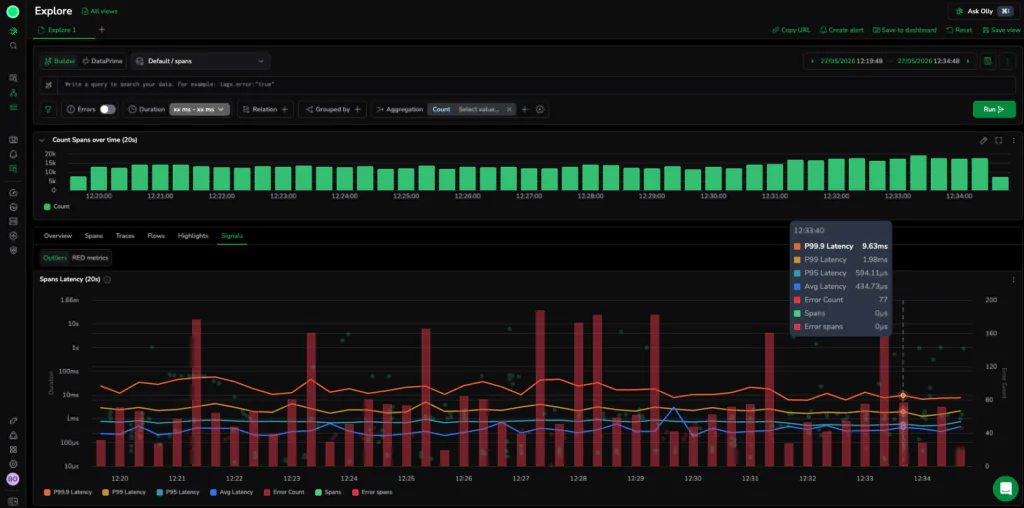
The Signals Tab: Consolidates advanced operational telemetry into an adaptive analytics pane, allowing teams to toggle instantly between two high-signal sub-views:

RED Metrics View: Standardizes on Request rate, Errors, and Duration (RED) to instantly identify systemic latency shifts and volume spikes across your services.

Outliers View: Plots critical latency percentiles ($P_{99.9}$, $P_{99}$, $P_{95}$, and Average) alongside real-time error count histogram distributions on a single coordinate system, ensuring teams never lose sight of macro-architectural trends while diving deep into micro span details.
The Strategic Shift: A Span-First Architecture

Moving to a unified investigation surface is an architectural foundation for the future of telemetry. Establishing a span-first workflow ensures that as system complexity grows, the investigation remains continuous. Utilizing derived modes like Traces and Flows enables execution paths through a request’s entire journey without the friction of a tool-based context switch.

The industry has moved beyond the era of collecting telemetry silos. The requirement now is an investigative plan that preserves the shape of the question from the first pattern to the final root cause.

Stop acting as human middleware between your logs and traces. 20 minutes into your next critical incident, you shouldn’t be fighting your tooling or copying trace IDs across disconnected surfaces. Standardize your debugging workflow on an infrastructure that keeps your context locked and your momentum intact.

Eliminate Investigative Latency — Sign Up for a Free Trial

For a deep dive into distributed trace investigation with Explore Spans, read our New Explore blog here.