Pete Wilson is our Vice President for Apptio Business and General Manager for the APAC region. With over twenty years of experience in information technology, financial services, engineering, software development, and the airline industry, he has built a solid reputation for successfully designing and executing large-scale, complex business and technology transformation programs within major global organizations.
Technology has become the figurative backbone of business, driving competitive advantage, innovation, and the agility needed to survive in an increasingly digital economy. Even companies outside traditionally tech-driven sectors now rely heavily on technology to gain a competitive advantage. Apps and infrastructure, both on-premises and in the cloud, now support virtually all business functions, such as finance, operations, marketing, and customer service, that are critical to driving customer value.
Despite rising costs due to inflation and high interest rates, our increasing dependence on technology means business leaders are still planning to increase spend over the coming years. Our recent survey report showed that 90% of organizations expect their technology budgets to increase in 2025 to support existing infrastructure, maintain operational essentials, and drive new business through innovation. In line with our findings, Forrester predicts that software spending will grow at a CAGR of 10.5% through 2027, while IDC forecasts even faster growth for cloud at 19.4% CAGR between 2024 and 2028. And as spend increases, so do the hurdles in managing this spend and showing how that spend delivers value back to the business.
As reliance on technology increases, the complexity of the IT estate does, too. Ineffective management of this complexity can lead to misspent funds, productivity decline, and other risks. In the early 2000s, technology had primarily on-premises concerns, including all local infrastructure and applications. As we’ve expanded from public cloud to multi-cloud and then hybrid cloud systems, we’ve amplified the cost considerations as we make the shift from primarily CapEx to variable OpEx spend—which makes planning more of a challenge. Also, a skilled workforce is essential to navigating the complexities of hybrid environments and supporting cross-functional initiatives related to areas like AI and sustainability—making talent management a crucial part of the equation. Further complicating matters, as companies continue to become more distributed in location and procurement processes, wrapping your hands around the entirety of technology spend, and managing the myriad investments becomes increasingly difficult. In fact, 75% of companies can’t prove a solid ROI for their cloud transformations.*
Technology executives face the challenging task of managing technology budgets and delivering accurate forecasts, tracking variance, and driving optimization efforts—all while trying to drive cost efficiency and demonstrate the value of technology to their business consumers. With so many variables, it’s hard to get beyond basic run-the-business imperatives to create an overarching growth strategy while partnering with other business units to improve outcomes and deliver value. The metrics of primary importance for tech decision-makers in 2025 are ROI (87%), cost-benefit analysis (52%), operational efficiency gains (41%), and net present value (40%).*
IT Financial Management (ITFM) and Technology Business Management (TBM) had similar origins, focusing on optimizing IT budgets. However, over the past decade, the emergence of public cloud, SaaS, and Kubernetes has shifted a significant portion of technology spend outside the IT budget. Engineering teams and business lines that leverage these technologies increasingly manage their own spend separately, leading to the emergence of practices like FinOps.
While ITFM and FinOps are distinct practices, each addresses specific aspects of technology spend within their domain. Additionally, as Agile practices have expanded, Enterprise Agile Planning (EAP) developed as a way to enhance the management of labor and project workstreams in technology initiatives.
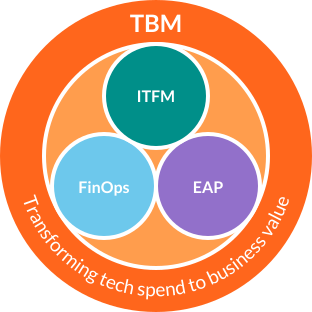
As complexity and interdependencies have multiplied, bridging the gaps between ITFM, FinOps, and EAP practice areas has become increasingly important. Only with an integrated perspective can companies ensure technology investments are doing more than just helping run the business, but rather driving value in the form of business outcomes like increased operational efficiency, accelerated digital transformation, improved innovation and agility, etc. This is where the discipline of Technology Business Management (TBM) really shines.
TBM spans all the practice areas mentioned above, providing a unified approach to managing technology investments across the enterprise—from on-prem, to cloud, to highly skilled tech labor. Taking a comprehensive approach to technology investment management makes it easier to stay aligned with corporate goals and translate investments into clear business value. Moreover, TBM elevates technology to the level of corporate strategy by translating tech spend into a language the rest of the business can understand via a taxonomy for identifying and allocating tech costs and investments. This includes providing critical data that IT leaders need to justify technology spend to senior leadership, such as technology performance and utilization data (48%), risk and compliance data (43%), and financial data (38%).*
Having a strategy for spanning technology management practice areas becomes increasingly essential as new innovations and initiatives have cross-departmental impacts. Three examples come to mind: hybrid cloud, AI, and sustainability.
Hybrid cloud is a computing model that integrates and orchestrates workloads between public cloud and private cloud, i.e. on-premises datacenters. A hybrid cloud model has numerous benefits, including increased flexibility and scalability, cost optimization, data sovereignty, and risk reduction. The acceleration of hybrid cloud has increased the need to orchestrate usage across public and private cloud, requiring greater coordination between ITFM and FinOps to manage the increased complexity of tracking total cost of ownership, allocation challenges, and cross-environment optimization.
AI is another area that benefits from the cross-practice scope of TBM. When companies kickstart AI initiatives, workloads can rapidly expand, increasing cloud costs and straining on-prem infrastructure. Funding these AI initiatives presents its own challenges, with organizations reporting they are using a mix of internal capital allocation (50%), cost savings from AI-driven efficiencies (39%), and dedicated AI funds (36%).* This makes a hybrid view essential when balancing cost optimization with performance and managing technical and human resources, particularly as companies look to scale successful projects.
Similarly, sustainability initiatives related to carbon emission and energy-consumption goals require a cross-practice approach. These initiatives are increasingly important as organizations respond to key drivers, including technological advancements (74%), brand reputation (73%), and consumer demand (71%).* As businesses aim to reduce their carbon footprints, TBM provides the transparency needed to monitor related metrics across cloud and on-prem infrastructure, helping align technology goals with corporate sustainability objectives.
While TBM represents an overarching strategy for driving greater business value from all technology investments, achieving this end goal greatly benefits from proper tooling. Financial and operational data tied to technology spend is often siloed across the enterprise—not to mention the cloud. ITFM practitioners do their best to track and optimize the financials of the IT budget, including understanding the total cost of ownership for everything from applications and services to infrastructure. Meanwhile, FinOps practitioners handle cloud cost optimization, often trying to balance performance and cost across multiple public cloud providers. Workstreams are managed by Agile teams, tracking progress towards milestones in various project management tools and trying to ensure labor aligns with strategic goals.
Together, our ITFM, FinOps, and EAP solutions provide visibility into all technology investments across practice areas, breaking down data silos by automatically ingesting and allocating spend across the enterprise. Working together seamlessly, they form the backbone of a TBM strategy.
As technology investments become increasingly complex, TBM is essential for maximizing business value and driving strategic outcomes. Our suite of TBM solutions is designed to help you better manage and optimize your entire technology estate and more quickly reach your goals. Visit our Innovation Hub to see how we’re continuously improving our TBM offerings to provide a holistic and nuanced view of all your technology investments. Whether you’re managing hybrid cloud, AI initiatives, or sustainability goals, our solutions provide the clarity and insight needed to drive success.
*Apptio, an IBM company. (2025) Guiding Technology Investments: Insights for Business Leaders – Global Survey Report
此内容由惯性聚合(RSS阅读器)自动聚合整理,仅供阅读参考。 原文来自 — 版权归原作者所有。