
惯性聚合 高效追踪和阅读你感兴趣的博客、新闻、科技资讯
阅读原文 在惯性聚合中打开

推荐订阅源

C
Cybersecurity and Infrastructure Security Agency CISA
D
Darknet – Hacking Tools, Hacker News & Cyber Security
cs.CL updates on arXiv.org
S
Schneier on Security
L
Lohrmann on Cybersecurity
S
Securelist
P
Palo Alto Networks Blog
SecWiki News
SecWiki News
T
Troy Hunt's Blog
H
Hacker News: Front Page
AWS News Blog
AWS News Blog
Latest news
Latest news
Hacker News - Newest:
Hacker News - Newest: "LLM"
NISL@THU
NISL@THU
The Hacker News
The Hacker News
F
Full Disclosure
让小产品的独立变现更简单 - ezindie.com
大猫的无限游戏
大猫的无限游戏
O
OpenAI News
P
Proofpoint News Feed
Know Your Adversary
Know Your Adversary
G
GRAHAM CLULEY
博客园_首页
Attack and Defense Labs
cs.CV updates on arXiv.org
Security Latest
Security Latest
云风的 BLOG
云风的 BLOG
K
Kaspersky official blog
WordPress大学
WordPress大学
www.infosecurity-magazine.com
宝玉的分享
宝玉的分享
L
LINUX DO - 热门话题
博客园 - 叶小钗
L
LINUX DO - 最新话题
Martin Fowler
Martin Fowler
N
News | PayPal Newsroom
Project Zero
Project Zero
OSCHINA 社区最新新闻
OSCHINA 社区最新新闻
PCI Perspectives
PCI Perspectives
月光博客
月光博客
IT之家
IT之家
Recent Announcements
T
The Exploit Database - CXSecurity.com
D
DataBreaches.Net
J
Java Code Geeks
酷 壳 – CoolShell
酷 壳 – CoolShell
Last Week in AI
Last Week in AI
Google Online Security Blog
C
CXSECURITY Database RSS Feed - CXSecurity.com
钛媒体:引领未来商业与生活新知
钛媒体:引领未来商业与生活新知

Pinecone

Pinecone Assistant: A Managed Knowledge Layer for Production AI Applications Multi-domain RAG in n8n: why one knowledge base is not enough Allspice Transforms the Culinary Experience with Semantic Search Powered by Pinecone | Pinecone Building RAG workflows in n8n: choosing the right Pinecone node Knowledge needs a meta-knowledge layer Garbage Day: How Pinecone Safely Deletes Billions of Objects at Scale When "Performance" Means Two Different Things Pinecone BYOC: Pinecone in your AWS, GCP, or Azure account, no vendor access True, Relevant, and Wrong: The Applicability Problem in RAG Use the Pinecone Plugin for Claude Code to develop AI Applications Faster Millions at Stake: How Melange's High-Recall Retrieval Prevents Litigation Collapse Powering High-stakes Patent Search at Scale: How Melange Built a Reliable AI System on Pinecone | Pinecone Pinecone Assistant Node in n8n: Turn Any Data Source Into Knowledge RAG with Access Control Pinecone Dedicated Read Nodes are now in Public Preview Inside Pinecone: Slab Architecture New Bulk Data Operations: Update, Delete, and Fetch by Metadata The Hidden Cost of Building: Lessons from Aquant Simplifying Vector Embeddings with Pinecone Integrated Inference Capabilities Pinecone joins Microsoft Marketplace as a Launch Partner GTM Engineering: Clay + Pinecone for AI-powered Sales Outbound Build an AI knowledge assistant with Google Docs and Pinecone Moving Pinecone forward with Ash Ashutosh as CEO and Edo spearheading our growing AI ambitions as Chief Scientist Pinecone Founder Edo Liberty to Spearhead Pinecone’s Growing AI Ambitions; Appoints Ash Ashutosh as CEO to Expand Vector Database Market Leadership Fast, Accurate Retrieval for Creators at Scale: Delphi’s Path Toward a Million Conversational Agents with Pinecone | Pinecone Announcing Pinecone Pioneers: A Program for Builders, Organizers, and Community Leaders What is Context Engineering? Chunking Strategies for LLM Applications Beyond the hype: Why RAG remains essential for modern AI Obviant Makes 30% More Accurate Defense Acquisition Recommendations Combining Sparse and Dense Retrieval with Pinecone | Pinecone Build more knowledgeable AI applications with new LLMs and greater control in Pinecone Assistant #NYTECHWEEK 2025 Retrieval-Augmented Generation (RAG) Accurate and Efficient Metadata Filtering in Pinecone’s Serverless Vector Database | Pinecone Terminal X AI Agents, Powered by Pinecone, Turn Complex Financial Data Into Production-grade Insights at Scale | Pinecone Aquant Delivers Scalable, Expert-level Service Intelligence with Pinecone | Pinecone Cascading retrieval with multi-vector representations: balancing efficiency and effectiveness Vector databases aren't just for large-scale enterprise AI Unveiling DIME: Reproducibility, Scalability, and Formal Analysis of Dimension Importance Estimation for Dense Retrieval | Pinecone Fast and Effective Early Termination for Simple Ranking Functions | Pinecone Domain-specific AI Agents at Scale: CustomGPT.ai Serves 10,000+ Customers with Pinecone | Pinecone Using Pinecone asynchronously with FastAPI A Flexible Resource for Top-Weighted Comparisons Between Sets and Rankings | Pinecone Build secure, scalable agentic AI workflows with Rubrik Annapurna and Pinecone Tool up: Pinecone’s first MCP servers are here Add context to your agent with Pinecone Assistant MCP remote server E2Rank: Efficient and Effective Layer-wise Reranking | Pinecone ColBERT-serve: Efficient Multi-Stage Memory-Mapped Scoring | Pinecone Efficient Constant-Space Multi-Vector Retrieval | Pinecone How Vanguard Worked with Pinecone to Boost Customer Support with Faster Calls and 12% More Accurate Responses | Pinecone Pinecone Named to Fast Company's Annual List of the World's Most Innovative Companies of 2025 Launch Week: Pinecone for agents, search, recommendations, and more Optimizing Pinecone for agents (and more) Retrieval Inference for scale and performance How 1up Turns Sales Reps Into Product Experts with Pinecone | Pinecone Don’t be dense: Launching sparse indexes in Pinecone Unlock High-Precision Keyword Search with pinecone-sparse-english-v0 Evolving Pinecone's architecture to meet the demands of Knowledgeable AI Pinpoint references faster with citation highlights in Pinecone Assistant Bringing the leading vector database to your cloud Getting started with llama-text-embed-v2 Natural Language Counterfactual Explanations for Graphs Using Large Language Models | Pinecone Easily build knowledgeable chat and agent-based applications in minutes with Pinecone Assistant, now generally available How to build an agentic, chat or RAG knowledge system using Pinecone Assistant Real-time RAG with Pinecone and Estuary Flow BigQuery to Pinecone in Real-Time with Estuary Flow Stravito Turns Market and Consumer Data Into Actionable Insights with Pinecone Inference | Pinecone Accelerate prototyping and development with Pinecone Local First-of-its-kind Pinecone Knowledge Platform to Power Best-in-class Retrieval for Customers Introducing integrated inference: Embed, rerank, and retrieve your data with a single API Strengthening security and increasing control with CMEK and API key roles Introducing Pinecone Rerank V0 Introducing cascading retrieval: Unifying dense and sparse with reranking From Idea to Action: How Pinecone Assistant Meaningfully Accelerates AI Business Building AI apps on Azure with Pinecone just got a lot easier Building a reliable, curated, and accurate RAG system with Cleanlab and Pinecone Four features of the Assistant API you aren't using - but should Deploying Pinecone with Infrastructure as Code (IaC) Streamlining CI/CD with Pinecone Local September 2024 Product Update Results of the Big ANN: NeurIPS'23 competition | Pinecone Introducing import from object storage for more efficient data transfer to Pinecone serverless Simplify, enhance, and evaluate RAG development with Pinecone Assistant, now in public preview Vectors and Graphs: Better Together August 2024 Product Update Pinecone Helps Deep Talk Deliver World-Class AI Assistants with Lower Engineering Overhead | Pinecone Assembled Delivers Better, Faster AI- Driven Support with Pinecone | Pinecone Llama 3.1 Agent using LangGraph and Ollama Build knowledgeable AI with Pinecone serverless, now generally available on Microsoft Azure Pinecone serverless is now generally available on Google Cloud, adding knowledge to AI assistants and other applications Accelerating Legal Discovery and Analysis with Pinecone and Voyage AI Bridging Dense and Sparse Maximum Inner Product Search | Pinecone Refine Retrieval Quality with Pinecone Rerank Introducing reranking to Pinecone Inference to simplify building accurate AI July 2024 Product Update Connect to Pinecone within your platform to enable a seamless AI development experience Introducing Pinecone API Versioning RAG Brag with Inkeep Co-Founder Nick Gomez LangGraph and Research Agents Introducing Pinecone Inference to streamline your AI workflow
Integrating cloud-based vector databases with CI/CD Pipelines
Roie Schwaber-Cohen, Bear Douglas, Zachary Proser · 2024-05-03 · via Pinecone

What is CI/CD?

Continuous Integration (CI) and Continuous Delivery (CD) are software development best practices. CI automates integrating code changes from multiple contributors into a single software project, providing rapid feedback via unit and integration tests and early detection of issues.
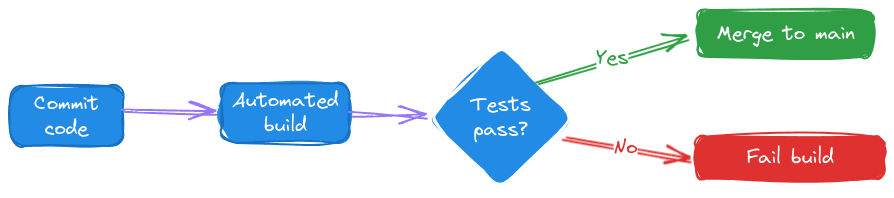
Continuous integration workflow

A continuous integration workflow

CD extends this automation, promoting code through all stages of the production pipeline to enable quick and reliable releases.
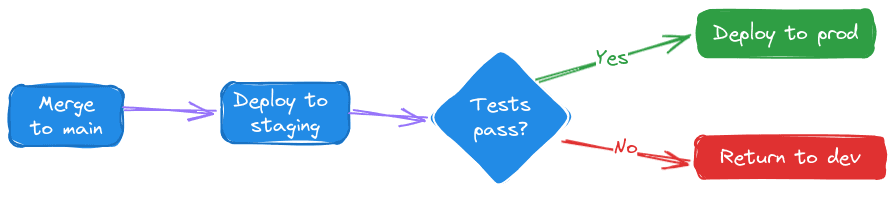
Continuous delivery workflow


These practices enhance developer productivity and satisfaction and decrease the number of defects in production.

This chapter offers practical recommendations for managing CI/CD pipelines with cloud-based vector databases like Pinecone.

Challenges testing cloud-based managed services in CI/CD pipelines

There are a number of challenges that arise when testing cloud-based services in CI/CD, including keeping test jobs originating from the same monorepo isolated, testing non-local services that can’t be containerized, and ensuring that tests running concurrently in a busy environment do not interfere with each other by reading from or writing to a common data source.

We’ll consider each of these challenges in turn, alongside its solution, using our open-source example repository that smoothly manages CI/CD with Pinecone’s cloud-native vector database. You can fork, clone, and use our starting point and GitHub actions to quickly set up a similar workflow for your organization.

This chapter and companion repository uses GitHub, but the same principles we’re examining here apply to other version control and CI/CD systems.

Managing monorepo complexity in CI/CD

Challenge: the monorepo pattern complicates development by multiple teams, leading to potential conflicts at runtime

A common scenario complicating CI/CD tasks is the monorepo owned by several development teams. In our example repository, imagine that team A is responsible for the recommendation service, while team B is responsible for the question_and_answer service.

The monorepo pattern has a number of advantages, but it complicates concurrent development by multiple teams, as overlapping CI/CD processes can interfere with each other.
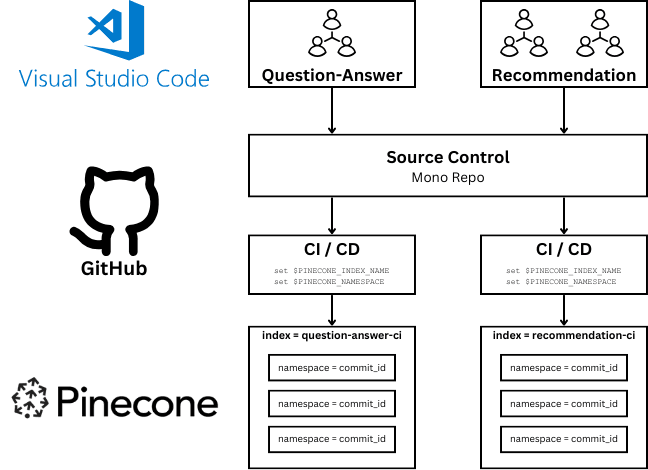
Working with a typical monorepo setup


Each team's updates can trigger CI/CD processes that need to be isolated yet efficient.

Solution: Create separate GitHub Actions workflows triggered by changes in specific file paths

We define CI/CD processes that trigger based on changes in specific directories. This ensures that only relevant tests and deployments are triggered, preventing unnecessary builds and conserving resources.

In our sample repository, the .github/workflows/github-actions-recommendation.yaml file specifies the recommendation subdirectory in its paths array, telling the GitHub Actions service to only run this workflow if the file at that specific path has changes:

name: CI/CD - Recommendation
run-name: Recommendation - ${{ github.actor }} - ${{ github.event_name }} - ${{ github.sha }}
on: 
  push:
    paths:
      - 'recommendation/**'


... remainder of workflow follows ...

We do the same thing for the question_and_answer CI/CD workflow in its respective file. We run the Question-Answer workflow whenever the question_answer directory changes.

name: CI/CD - Question-Answer
run-name: Question-Answer - ${{ github.actor }} - ${{ github.event_name }} - ${{ github.sha }}
on: 
  push:
    paths:
      - 'question_answer/**'

... remainder of workflow follows ...

Each development team now fires only its own jobs by working on their area of responsibility.

Effective testing of Cloud-based services

Challenge: Non-local cloud services prevent traditional mocking and containerization strategies

Managed cloud services offer many advantages, including ease of use, reliability, and ongoing security maintenance.

Everything in engineering is a trade off, and one of the difficulties of using managed cloud services is that you cannot easily replicate the service within a container or software mocks in your pipeline.

In a traditional CI/CD context, the fact that Team A’s job is running in a container is the boundary that provides strong isolation guarantees. How can we accomplish something similar when every team needs to hit the same cloud API?

Solution: Dynamically provision resources for testing, and scope jobs to specific resources

In a typical CI/CD environment, it’s common to see multiple concurrent test runs, especially when the repository triggers tests for every pull request, every new commit on a branch and every merge to main and release.

We can create the cloud resources necessary for testing at the beginning of our test runs. In our companion repo, https://github.com/pinecone-field/cicd-demo/blob/main/setup.py demonstrates how to provision four Pinecone indexes that will serve as our testing resources:

  • question-answer-ci
  • recommendation-ci
  • question-answer-production
  • recommendation-answer-production

You could either run this script manually when setting up your project or programmatically as part of your setup workflow. We’ll use these four indexes in future tests and allow separate teams to read and write from them as needed, providing high-level isolation between tests.

Note that both the workflows above set their own value for the Pinecone index they’re using: PINECONE_INDEX_RECOMMENDATION and PINECONE_INDEX_QUESTION_ANSWER.

To further scope down CI/CD jobs to ensure they’re not interfering with our partner teams’ jobs, we can use environment variables to ensure jobs only interact with their designated resources.

The CI/CD jobs set two environment variables to ensure that all unit tests run in a dedicated CI index with a unique namespace in Pinecone. This ensures each job’s runtime and test data are isolated.

In addition, each workflow creates a brand new Pinecone namespace, within their respective index, mapped to the commit ID of the current run, ensuring isolation from past and future runs:

PINECONE_NAMESPACE: ${{ github.sha }}

Here’s what this flow looks like at runtime, when a developer pushes a new commit:
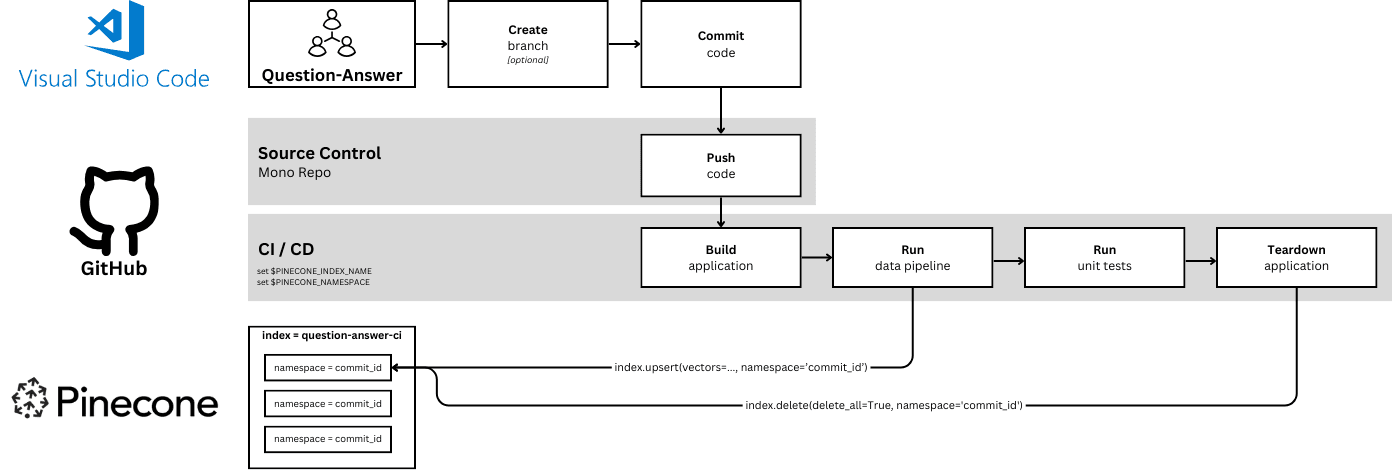
Separating workflows with discrete file path targets

When code is committed to the “question_answer” sub-folder the “CI/CD - Question-Answer” job executes in its private index and within a new namespace unique to that run.

When code is committed to the “recommendation” sub-folder the “CI/CD - Recommendation” job executes in the same way.

When the namespace is allocated, the job takes care of upserting a sample set of vectors to test against.

Optimizing resource management and cost control

Challenge: Failing to clean up cloud resources leads to higher cloud bills at the end of the month

When it’s time to tear down, the namespace is cleaned up and deleted:

jobs:
  Build-RunDataPipeline-RunTests-Teardown:
    runs-on: ubuntu-latest
    steps:
      - name: Checkout code
        uses: actions/checkout@v2
      - name: Install dependencies
        run: pip install -r requirements.txt
      - name: Run data pipeline - upsert
        run: python question_answer/data_pipeline.py upsert
      - name: Run question_answer tests
        run: python -m unittest question_answer.test
      - name: Run data pipeline - delete
        if: always()
        run: python question_answer/data_pipeline.py delete


Note that each workflow’s last job is set to run `always` - meaning that it will execute the teardown operation at the end of each test run by calling the delete method within the data_pipeline.py file, which uses the same environment variables from earlier steps to clean up the test namespace.

This teardown process addresses our cost requirement as well. By ensuring that test resources are cleaned up at the end of every test run, we decrease the chances of a surprise on our cloud bill.

Was this article helpful?