

惯性聚合 高效追踪和阅读你感兴趣的博客、新闻、科技资讯
阅读原文 在惯性聚合中打开

推荐订阅源

N
News and Events Feed by Topic
S
Security @ Cisco Blogs
S
Secure Thoughts
Attack and Defense Labs
cs.AI updates on arXiv.org
Hacker News - Newest:
Hacker News - Newest: "LLM"
Recent Commits to openclaw:main
H
Hacker News: Front Page
博客园 - 叶小钗
H
Heimdal Security Blog
Microsoft Security Blog
Forbes - Security
Forbes - Security
AI
AI
cs.CV updates on arXiv.org
T
Troy Hunt's Blog
罗磊的独立博客
Application and Cybersecurity Blog
爱范儿
爱范儿
GbyAI
GbyAI
The Last Watchdog
The Last Watchdog
TaoSecurity Blog
TaoSecurity Blog
C
CXSECURITY Database RSS Feed - CXSecurity.com
D
DataBreaches.Net
Recent Announcements
Schneier on Security
C
Cisco Blogs
美团技术团队
D
Docker
让小产品的独立变现更简单 - ezindie.com
WordPress大学
WordPress大学
月光博客
月光博客
雷峰网
雷峰网
Threat Intelligence Blog | Flashpoint
H
Hackread – Cybersecurity News, Data Breaches, AI and More
A
Arctic Wolf
B
Blog RSS Feed
Cisco Talos Blog
Cisco Talos Blog
C
Cybersecurity and Infrastructure Security Agency CISA
V
Vulnerabilities – Threatpost
V2EX - 技术
V2EX - 技术
Y
Y Combinator Blog
N
News and Events Feed by Topic
www.infosecurity-magazine.com
W
WeLiveSecurity
Security Archives - TechRepublic
G
GRAHAM CLULEY
Jina AI
Jina AI
Hugging Face - Blog
Hugging Face - Blog
酷 壳 – CoolShell
酷 壳 – CoolShell
The Hacker News
The Hacker News

Pinecone

Pinecone Assistant: A Managed Knowledge Layer for Production AI Applications Multi-domain RAG in n8n: why one knowledge base is not enough Allspice Transforms the Culinary Experience with Semantic Search Powered by Pinecone | Pinecone Building RAG workflows in n8n: choosing the right Pinecone node Knowledge needs a meta-knowledge layer Garbage Day: How Pinecone Safely Deletes Billions of Objects at Scale When "Performance" Means Two Different Things Pinecone BYOC: Pinecone in your AWS, GCP, or Azure account, no vendor access True, Relevant, and Wrong: The Applicability Problem in RAG Use the Pinecone Plugin for Claude Code to develop AI Applications Faster Millions at Stake: How Melange's High-Recall Retrieval Prevents Litigation Collapse Powering High-stakes Patent Search at Scale: How Melange Built a Reliable AI System on Pinecone | Pinecone Pinecone Assistant Node in n8n: Turn Any Data Source Into Knowledge RAG with Access Control Pinecone Dedicated Read Nodes are now in Public Preview Inside Pinecone: Slab Architecture New Bulk Data Operations: Update, Delete, and Fetch by Metadata The Hidden Cost of Building: Lessons from Aquant Simplifying Vector Embeddings with Pinecone Integrated Inference Capabilities Pinecone joins Microsoft Marketplace as a Launch Partner GTM Engineering: Clay + Pinecone for AI-powered Sales Outbound Build an AI knowledge assistant with Google Docs and Pinecone Moving Pinecone forward with Ash Ashutosh as CEO and Edo spearheading our growing AI ambitions as Chief Scientist Pinecone Founder Edo Liberty to Spearhead Pinecone’s Growing AI Ambitions; Appoints Ash Ashutosh as CEO to Expand Vector Database Market Leadership Fast, Accurate Retrieval for Creators at Scale: Delphi’s Path Toward a Million Conversational Agents with Pinecone | Pinecone Announcing Pinecone Pioneers: A Program for Builders, Organizers, and Community Leaders What is Context Engineering? Chunking Strategies for LLM Applications Beyond the hype: Why RAG remains essential for modern AI Obviant Makes 30% More Accurate Defense Acquisition Recommendations Combining Sparse and Dense Retrieval with Pinecone | Pinecone Build more knowledgeable AI applications with new LLMs and greater control in Pinecone Assistant #NYTECHWEEK 2025 Retrieval-Augmented Generation (RAG) Accurate and Efficient Metadata Filtering in Pinecone’s Serverless Vector Database | Pinecone Terminal X AI Agents, Powered by Pinecone, Turn Complex Financial Data Into Production-grade Insights at Scale | Pinecone Aquant Delivers Scalable, Expert-level Service Intelligence with Pinecone | Pinecone Cascading retrieval with multi-vector representations: balancing efficiency and effectiveness Vector databases aren't just for large-scale enterprise AI Unveiling DIME: Reproducibility, Scalability, and Formal Analysis of Dimension Importance Estimation for Dense Retrieval | Pinecone Fast and Effective Early Termination for Simple Ranking Functions | Pinecone Domain-specific AI Agents at Scale: CustomGPT.ai Serves 10,000+ Customers with Pinecone | Pinecone Using Pinecone asynchronously with FastAPI A Flexible Resource for Top-Weighted Comparisons Between Sets and Rankings | Pinecone Build secure, scalable agentic AI workflows with Rubrik Annapurna and Pinecone Tool up: Pinecone’s first MCP servers are here Add context to your agent with Pinecone Assistant MCP remote server E2Rank: Efficient and Effective Layer-wise Reranking | Pinecone ColBERT-serve: Efficient Multi-Stage Memory-Mapped Scoring | Pinecone Efficient Constant-Space Multi-Vector Retrieval | Pinecone How Vanguard Worked with Pinecone to Boost Customer Support with Faster Calls and 12% More Accurate Responses | Pinecone Pinecone Named to Fast Company's Annual List of the World's Most Innovative Companies of 2025 Launch Week: Pinecone for agents, search, recommendations, and more Optimizing Pinecone for agents (and more) Retrieval Inference for scale and performance How 1up Turns Sales Reps Into Product Experts with Pinecone | Pinecone Don’t be dense: Launching sparse indexes in Pinecone Unlock High-Precision Keyword Search with pinecone-sparse-english-v0 Evolving Pinecone's architecture to meet the demands of Knowledgeable AI Pinpoint references faster with citation highlights in Pinecone Assistant Bringing the leading vector database to your cloud Getting started with llama-text-embed-v2 Natural Language Counterfactual Explanations for Graphs Using Large Language Models | Pinecone Easily build knowledgeable chat and agent-based applications in minutes with Pinecone Assistant, now generally available How to build an agentic, chat or RAG knowledge system using Pinecone Assistant Real-time RAG with Pinecone and Estuary Flow BigQuery to Pinecone in Real-Time with Estuary Flow Stravito Turns Market and Consumer Data Into Actionable Insights with Pinecone Inference | Pinecone Accelerate prototyping and development with Pinecone Local First-of-its-kind Pinecone Knowledge Platform to Power Best-in-class Retrieval for Customers Introducing integrated inference: Embed, rerank, and retrieve your data with a single API Strengthening security and increasing control with CMEK and API key roles Introducing Pinecone Rerank V0 Introducing cascading retrieval: Unifying dense and sparse with reranking From Idea to Action: How Pinecone Assistant Meaningfully Accelerates AI Business Building AI apps on Azure with Pinecone just got a lot easier Building a reliable, curated, and accurate RAG system with Cleanlab and Pinecone Four features of the Assistant API you aren't using - but should Deploying Pinecone with Infrastructure as Code (IaC) Streamlining CI/CD with Pinecone Local September 2024 Product Update Results of the Big ANN: NeurIPS'23 competition | Pinecone Introducing import from object storage for more efficient data transfer to Pinecone serverless Simplify, enhance, and evaluate RAG development with Pinecone Assistant, now in public preview Vectors and Graphs: Better Together August 2024 Product Update Pinecone Helps Deep Talk Deliver World-Class AI Assistants with Lower Engineering Overhead | Pinecone Assembled Delivers Better, Faster AI- Driven Support with Pinecone | Pinecone Llama 3.1 Agent using LangGraph and Ollama Build knowledgeable AI with Pinecone serverless, now generally available on Microsoft Azure Pinecone serverless is now generally available on Google Cloud, adding knowledge to AI assistants and other applications Accelerating Legal Discovery and Analysis with Pinecone and Voyage AI Bridging Dense and Sparse Maximum Inner Product Search | Pinecone Refine Retrieval Quality with Pinecone Rerank Introducing reranking to Pinecone Inference to simplify building accurate AI July 2024 Product Update Connect to Pinecone within your platform to enable a seamless AI development experience Introducing Pinecone API Versioning RAG Brag with Inkeep Co-Founder Nick Gomez LangGraph and Research Agents Introducing Pinecone Inference to streamline your AI workflow
Introducing Pinecone Marketplace:  Getting to Production in Minutes
Roie Schwaber-Cohen · 2026-05-06 · via Pinecone

A surprising amount of what your team knows is already written down. It's in the manual somebody put together last year, in the onboarding doc that gets passed around every time a new hire starts, in the thread where the tricky edge case finally got resolved, in the contract language your legal team has explained a hundred times. The knowledge exists. It's catalogued, stored, and searchable in theory.

But it doesn't help the person who needs it at the moment they need it.

So you answer the question. Again. And again. You find yourself reaching for the same Google Doc, pasting the same three paragraphs into Slack, saying some version of "we covered this in the handbook, let me find the section." The handbook has the answer. You have the answer. The person asking still can't get to it.

The part that's been broken

The tools that were supposed to solve this haven't. Enterprise search finds the document but leaves you to read the whole thing. Generic AI chatbots confidently make things up, or blend two policies together into an answer that sounds right but is wrong in a way you won't catch until it matters. Stuffing everything into a long context window works until the knowledge doesn't fit, or until the model can't tell which policy applies to which case, or until you realize you're spending too much burning tokens.

The other path is to build the pipeline yourself — hire the engineers, stand up retrieval, add evals, manage the refresh cycles, keep it running. Most in-house "ask our docs" projects stall out somewhere between the proof of concept and the version anyone actually uses, because the gap between retrieves relevant text and answers the question correctly turns out to be much larger than anyone expected. Plus, it keeps you from working on your core competency.

What's been missing is something in the middle: a way to put real knowledge behind an application without needing engineers to build and maintain the pipeline, and without it going off the rails the first time someone asks a question that requires more than copying a paragraph back.

Knowledge, as we use the term, is the curated, situated content your team actually operates on — policies, contracts, runbooks, tickets, the resolution to last month's weird edge case — together with the context that makes it usable: what's current, what supersedes what, which version applies in which situation. The difference between a system of record (what your data warehouse stores) and a system of knowledge (what your team actually knows). Not the model's training data. Not a pile of retrieved chunks the application has to stitch back together.

What Marketplace actually does

It starts with a template. Pick one for the kind of application you want — customer support, legal search, sales enablement, onboarding, or something else — and point it at the knowledge it should use. A folder in Google Drive, a stack of PDFs, a wiki, a set of tickets. Marketplace ingests everything, and a few minutes later you have something your team can start asking questions of.

Answers come with receipts. The system responds in full sentences, with citations that point back to the specific documents the answer came from. You can see what it knows — and what it doesn't, which turns out to be almost as important. When a question falls outside its scope, it says so instead of inventing an answer to be helpful. When answering a question requires pulling from more than one document — a contract clause that interacts with a policy, a support issue that touches two different product areas — it reasons through the connection instead of stitching together unrelated fragments. That stitching is the failure mode that makes most AI answers untrustworthy. (More on how that works here.)

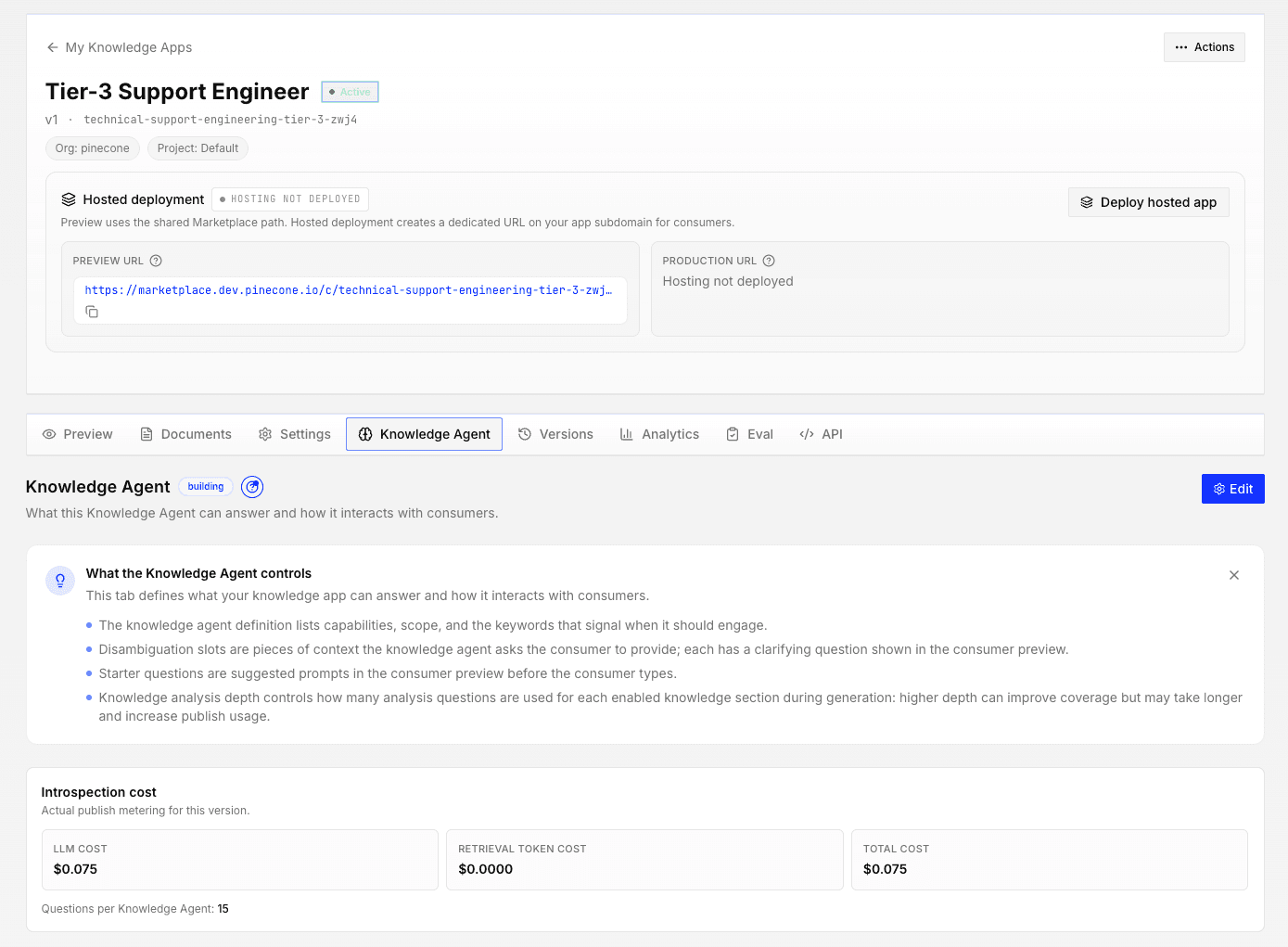
Publishing is one click. Once the application is live, your team accesses it as a web app at a URL. Gate access with single sign-on, open it to a whole department, or share it with partner outside your organization. The same knowledge layer can also serve the AI agents your company is starting to deploy — so agents answer from the same vetted sources your team does, and every improvement to the knowledge base benefits both. The work you put into Marketplace compounds over time.

Why it's different

Three things matter for the knowledge worker deciding whether to trust this with real work.

Every answer traces back to a source. Not a vague gesture at "the knowledge base," but a specific citation to a specific document. If the application tells a new hire how your refund policy works, they can click through and read the actual policy. This is what makes the answers trustworthy, and it's what makes the system useful for anything that has real consequences.

It's honest about its edges. The system knows what it knows, and it's built to say so when a question falls outside that scope. The worst failure mode in an AI tool isn't being wrong; it's being confidently wrong about something the reader can't verify. Marketplace is designed to fail loudly and truthfully, not quietly and confidently.

You don't need an engineering team to run it. This is the part that has blocked most knowledge workers from solving this problem themselves. Marketplace handles the infrastructure — the ingestion, the updating, the versioning, the scaling — so the work you do is the work you already know how to do: decide what knowledge should be in there, write the occasional clarifying note, review the questions people are asking. You stay focused on the work you do best. The system does the parts that were never your job in the first place.

Where you take it

Start small. Pick one corner of your team's knowledge that people keep asking about, stand up an application for it, see if it changes the shape of your week. If it does, the same foundation scales — to more of your team's knowledge, to more teams in your organization, to applications you share with customers and partners, and eventually to the AI agents that will be asking questions on behalf of people who haven't even joined yet.

The line between "knowledge for people" and "knowledge for agents" is thinner than it looks, and the thing you build here works on both sides of it.

Getting started

Free on Starter — 1M input tokens/month through June 30 (2x the usual) so you can test it on real workloads.

Setup is three steps and takes about as long as writing the email that announces it.

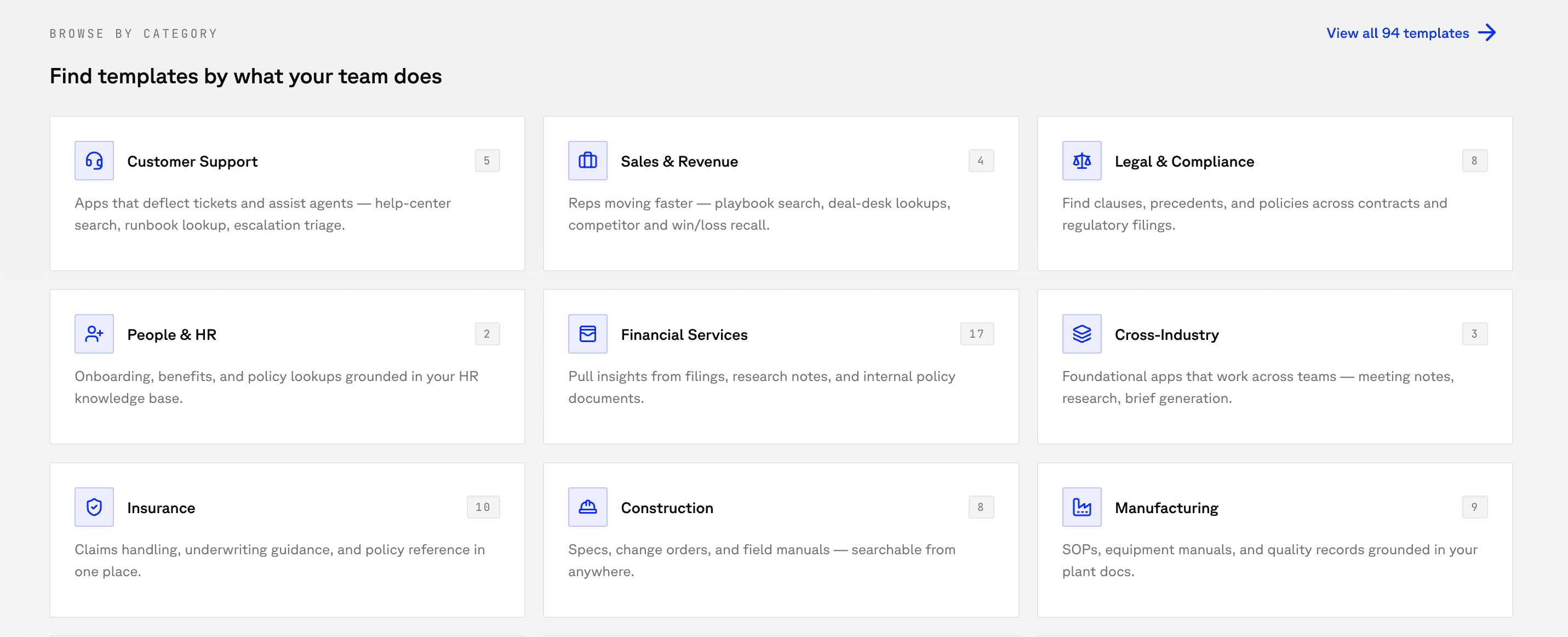
1. Pick a template. Customer support, legal search, sales enablement, onboarding, internal IT, or a blank starting point. Each template ships with a tuned prompt, a recommended schema, and defaults that match the shape of the problem.
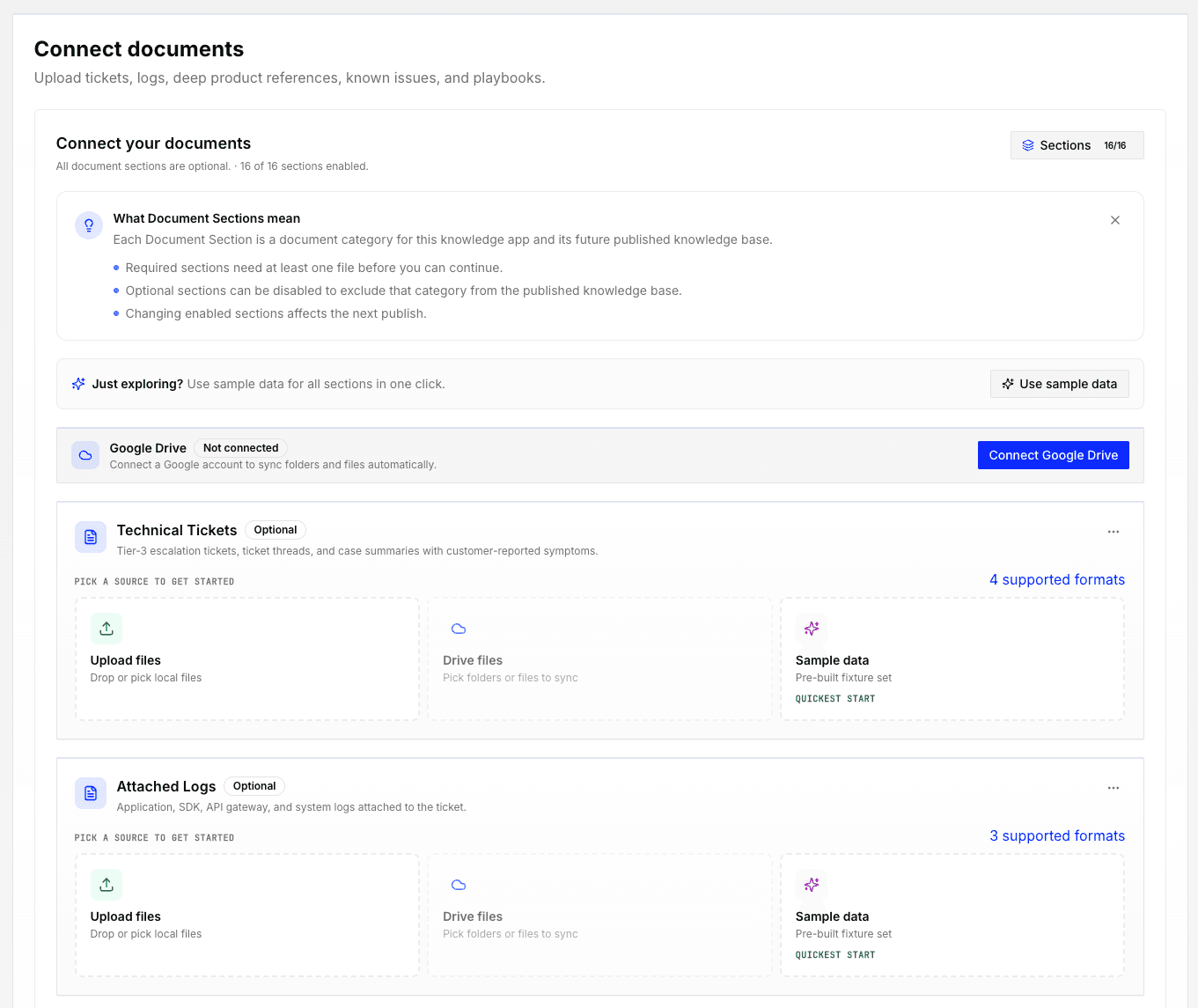
2. Connect your sources. Google Drive folders, PDF uploads, wiki exports, ticket exports. Marketplace handles chunking, embedding, and indexing. Re-indexing on source changes is automatic.
3. Publish. One click, a branded interface, SSO-gated, shareable internally or externally. Connect to agents through the same endpoint when you're ready.
Marketplace is available now as a web application. Start at marketplace.pinecone.io.