
惯性聚合 高效追踪和阅读你感兴趣的博客、新闻、科技资讯
阅读原文 在惯性聚合中打开

推荐订阅源

GbyAI
GbyAI
博客园 - 三生石上(FineUI控件)
S
Securelist
U
Unit 42
The Cloudflare Blog
奇客Solidot–传递最新科技情报
奇客Solidot–传递最新科技情报
Simon Willison's Weblog
让小产品的独立变现更简单 - ezindie.com
cs.CV updates on arXiv.org
Threat Intelligence Blog | Flashpoint
B
Blog
T
Tenable Blog
The Hacker News
The Hacker News
The Register - Security
IT之家
IT之家
博客园 - 【当耐特】
Spread Privacy
Spread Privacy
P
Privacy & Cybersecurity Law Blog
博客园_首页
T
Tailwind CSS Blog
人人都是产品经理
人人都是产品经理
C
Cybersecurity and Infrastructure Security Agency CISA
Know Your Adversary
Know Your Adversary
NISL@THU
NISL@THU
OSCHINA 社区最新新闻
OSCHINA 社区最新新闻
阮一峰的网络日志
阮一峰的网络日志
T
Tor Project blog
C
CERT Recently Published Vulnerability Notes
Apple Machine Learning Research
Stack Overflow Blog
Stack Overflow Blog
T
Threat Research - Cisco Blogs
T
The Exploit Database - CXSecurity.com
V
Vulnerabilities – Threatpost
A
Arctic Wolf
cs.CL updates on arXiv.org
V
V2EX
aimingoo的专栏
aimingoo的专栏
大猫的无限游戏
大猫的无限游戏
Scott Helme
Scott Helme
L
LINUX DO - 热门话题
Cyberwarzone
Cyberwarzone
V
Visual Studio Blog
月光博客
月光博客
爱范儿
爱范儿
钛媒体:引领未来商业与生活新知
钛媒体:引领未来商业与生活新知
美团技术团队
G
GRAHAM CLULEY
cs.AI updates on arXiv.org
H
Heimdal Security Blog
K
KPMG report finds enterprise disconnect between AI and its ROI | CIO

Pinecone

Pinecone Assistant: A Managed Knowledge Layer for Production AI Applications Multi-domain RAG in n8n: why one knowledge base is not enough Allspice Transforms the Culinary Experience with Semantic Search Powered by Pinecone | Pinecone Building RAG workflows in n8n: choosing the right Pinecone node Knowledge needs a meta-knowledge layer Garbage Day: How Pinecone Safely Deletes Billions of Objects at Scale When "Performance" Means Two Different Things Pinecone BYOC: Pinecone in your AWS, GCP, or Azure account, no vendor access True, Relevant, and Wrong: The Applicability Problem in RAG Use the Pinecone Plugin for Claude Code to develop AI Applications Faster Millions at Stake: How Melange's High-Recall Retrieval Prevents Litigation Collapse Powering High-stakes Patent Search at Scale: How Melange Built a Reliable AI System on Pinecone | Pinecone Pinecone Assistant Node in n8n: Turn Any Data Source Into Knowledge RAG with Access Control Pinecone Dedicated Read Nodes are now in Public Preview Inside Pinecone: Slab Architecture New Bulk Data Operations: Update, Delete, and Fetch by Metadata The Hidden Cost of Building: Lessons from Aquant Simplifying Vector Embeddings with Pinecone Integrated Inference Capabilities Pinecone joins Microsoft Marketplace as a Launch Partner GTM Engineering: Clay + Pinecone for AI-powered Sales Outbound Build an AI knowledge assistant with Google Docs and Pinecone Moving Pinecone forward with Ash Ashutosh as CEO and Edo spearheading our growing AI ambitions as Chief Scientist Pinecone Founder Edo Liberty to Spearhead Pinecone’s Growing AI Ambitions; Appoints Ash Ashutosh as CEO to Expand Vector Database Market Leadership Fast, Accurate Retrieval for Creators at Scale: Delphi’s Path Toward a Million Conversational Agents with Pinecone | Pinecone Announcing Pinecone Pioneers: A Program for Builders, Organizers, and Community Leaders What is Context Engineering? Chunking Strategies for LLM Applications Beyond the hype: Why RAG remains essential for modern AI Obviant Makes 30% More Accurate Defense Acquisition Recommendations Combining Sparse and Dense Retrieval with Pinecone | Pinecone Build more knowledgeable AI applications with new LLMs and greater control in Pinecone Assistant #NYTECHWEEK 2025 Retrieval-Augmented Generation (RAG) Accurate and Efficient Metadata Filtering in Pinecone’s Serverless Vector Database | Pinecone Terminal X AI Agents, Powered by Pinecone, Turn Complex Financial Data Into Production-grade Insights at Scale | Pinecone Aquant Delivers Scalable, Expert-level Service Intelligence with Pinecone | Pinecone Cascading retrieval with multi-vector representations: balancing efficiency and effectiveness Vector databases aren't just for large-scale enterprise AI Unveiling DIME: Reproducibility, Scalability, and Formal Analysis of Dimension Importance Estimation for Dense Retrieval | Pinecone Fast and Effective Early Termination for Simple Ranking Functions | Pinecone Domain-specific AI Agents at Scale: CustomGPT.ai Serves 10,000+ Customers with Pinecone | Pinecone Using Pinecone asynchronously with FastAPI A Flexible Resource for Top-Weighted Comparisons Between Sets and Rankings | Pinecone Build secure, scalable agentic AI workflows with Rubrik Annapurna and Pinecone Tool up: Pinecone’s first MCP servers are here Add context to your agent with Pinecone Assistant MCP remote server E2Rank: Efficient and Effective Layer-wise Reranking | Pinecone ColBERT-serve: Efficient Multi-Stage Memory-Mapped Scoring | Pinecone Efficient Constant-Space Multi-Vector Retrieval | Pinecone How Vanguard Worked with Pinecone to Boost Customer Support with Faster Calls and 12% More Accurate Responses | Pinecone Pinecone Named to Fast Company's Annual List of the World's Most Innovative Companies of 2025 Launch Week: Pinecone for agents, search, recommendations, and more Optimizing Pinecone for agents (and more) Retrieval Inference for scale and performance How 1up Turns Sales Reps Into Product Experts with Pinecone | Pinecone Don’t be dense: Launching sparse indexes in Pinecone Unlock High-Precision Keyword Search with pinecone-sparse-english-v0 Evolving Pinecone's architecture to meet the demands of Knowledgeable AI Pinpoint references faster with citation highlights in Pinecone Assistant Bringing the leading vector database to your cloud Getting started with llama-text-embed-v2 Natural Language Counterfactual Explanations for Graphs Using Large Language Models | Pinecone Easily build knowledgeable chat and agent-based applications in minutes with Pinecone Assistant, now generally available How to build an agentic, chat or RAG knowledge system using Pinecone Assistant Real-time RAG with Pinecone and Estuary Flow BigQuery to Pinecone in Real-Time with Estuary Flow Stravito Turns Market and Consumer Data Into Actionable Insights with Pinecone Inference | Pinecone Accelerate prototyping and development with Pinecone Local First-of-its-kind Pinecone Knowledge Platform to Power Best-in-class Retrieval for Customers Introducing integrated inference: Embed, rerank, and retrieve your data with a single API Strengthening security and increasing control with CMEK and API key roles Introducing Pinecone Rerank V0 Introducing cascading retrieval: Unifying dense and sparse with reranking From Idea to Action: How Pinecone Assistant Meaningfully Accelerates AI Business Building AI apps on Azure with Pinecone just got a lot easier Building a reliable, curated, and accurate RAG system with Cleanlab and Pinecone Four features of the Assistant API you aren't using - but should Deploying Pinecone with Infrastructure as Code (IaC) Streamlining CI/CD with Pinecone Local September 2024 Product Update Results of the Big ANN: NeurIPS'23 competition | Pinecone Introducing import from object storage for more efficient data transfer to Pinecone serverless Simplify, enhance, and evaluate RAG development with Pinecone Assistant, now in public preview Vectors and Graphs: Better Together August 2024 Product Update Pinecone Helps Deep Talk Deliver World-Class AI Assistants with Lower Engineering Overhead | Pinecone Assembled Delivers Better, Faster AI- Driven Support with Pinecone | Pinecone Llama 3.1 Agent using LangGraph and Ollama Build knowledgeable AI with Pinecone serverless, now generally available on Microsoft Azure Pinecone serverless is now generally available on Google Cloud, adding knowledge to AI assistants and other applications Accelerating Legal Discovery and Analysis with Pinecone and Voyage AI Bridging Dense and Sparse Maximum Inner Product Search | Pinecone Refine Retrieval Quality with Pinecone Rerank Introducing reranking to Pinecone Inference to simplify building accurate AI July 2024 Product Update Connect to Pinecone within your platform to enable a seamless AI development experience Introducing Pinecone API Versioning LangGraph and Research Agents Introducing Pinecone Inference to streamline your AI workflow Build Privacy-aware AI software using Pinecone
RAG Brag with Inkeep Co-Founder Nick Gomez
Valeria Gomez · 2024-07-17 · via Pinecone

In a recent RAG Brag episode, Nick Gomez, Co-founder and CEO of Inkeep, shared insights about his journey and the inspiration behind starting a company focused on helping companies with technical products, improve self-help experiences with AI, and machine learning. He shared his background and the innovative ways Inkeep is addressing challenges in the technical and developer support space.

Nick Gomez's journey began at Microsoft, where he spent three years working on developer experiences in the identity space. He noticed that while authentication and identity are crucial, they often create hurdles for developers who prefer to focus on their core business logic rather than getting bogged down in technical details. These experiences led him to partner with Robert Tran to create Inkeep — an AI search and support copilots for technical products. This conversation explores how it all began and the lessons they learned while building AI software.

What was the inspiration behind founding Inkeep?

When we decided to start a company, we wanted to focus on developer products, a market that often gets overlooked. During our research, we noticed a gap: while most B2B SaaS products use chatbots like Intercom or Zendesk, only about 20% of developer companies do. Developers often see these chatbots as marketing tools, not helpful resources. Our original motivation was to create a product designed for developers that provides immediate, helpful answers without the marketing and sales stigma of traditional chatbots. We’ve since found that that approach actually resonated with many companies with technical products and savvy (or picky) end-users; in particular, if they have high support volumes and tons of content.

What sets Inkeep apart from other support solutions?

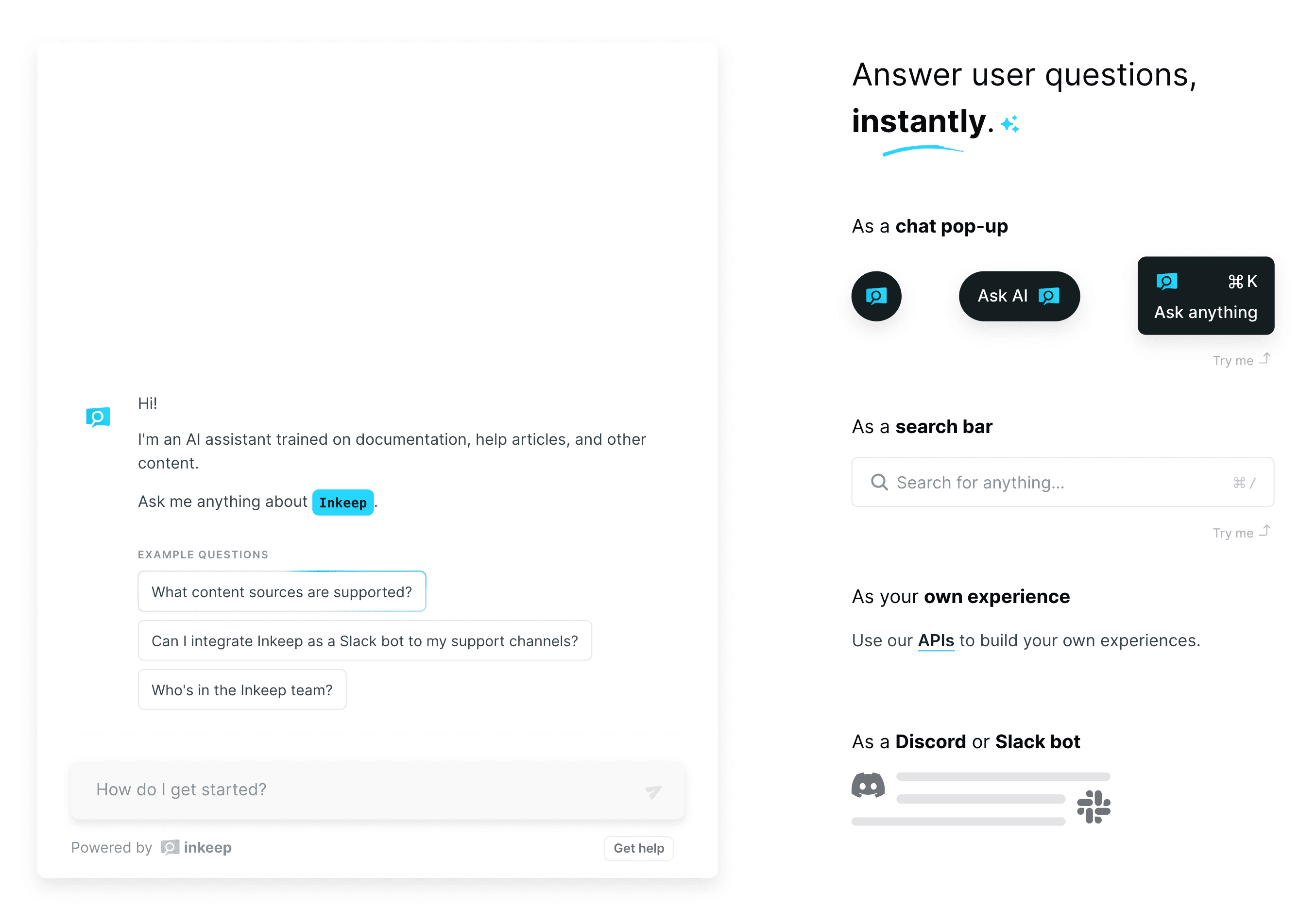
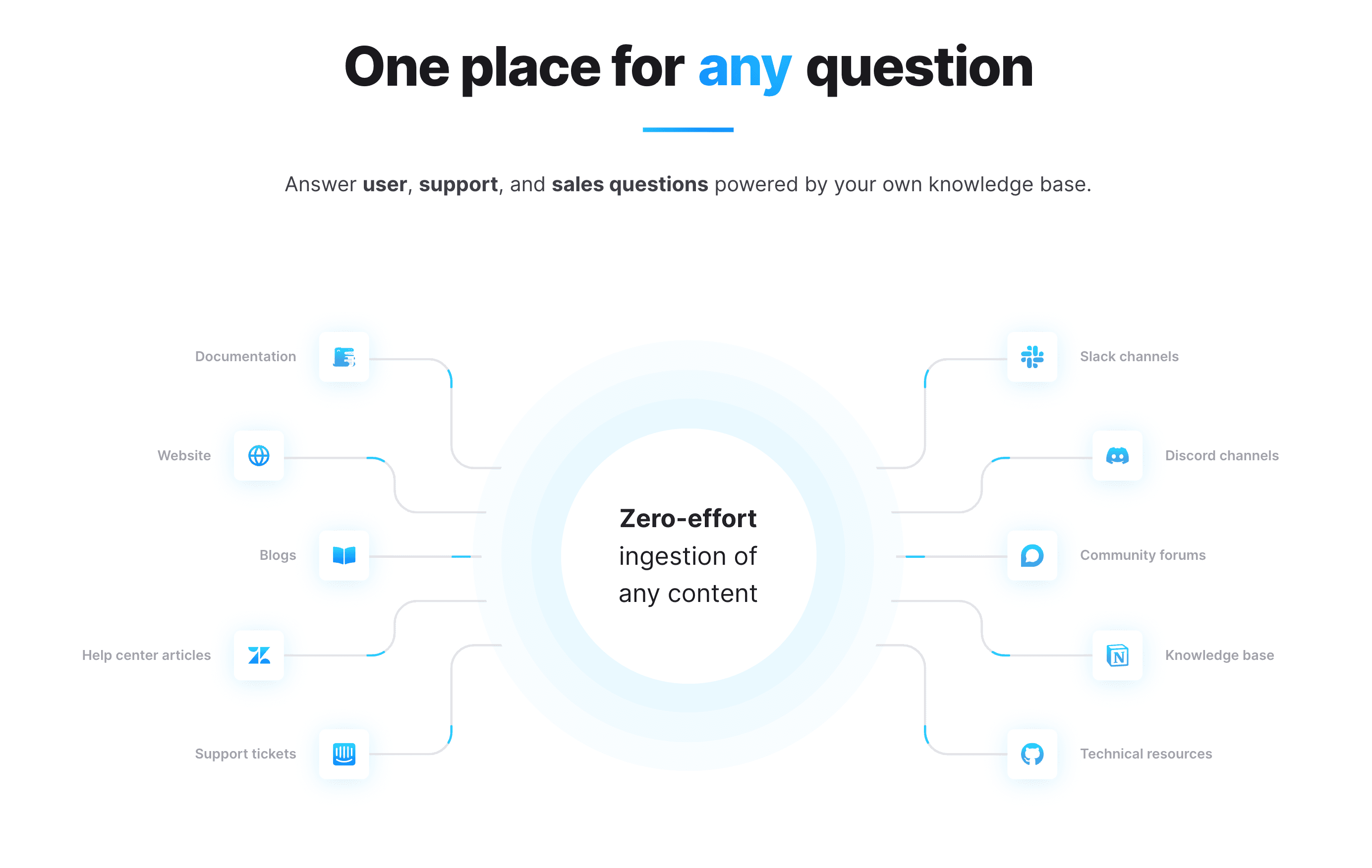
Inkeep differentiates itself by offering a completely hands-free solution that maintains a very high bar for quality of answers. Our platform can automatically ingest content from any source—whether it’s documentation, support tickets, or forums—without requiring engineering teams to invest time and resources. We offer simple, embeddable UI components like search bars and chatbots for Slack or Discord, allowing companies to seamlessly integrate Inkeep wherever they interact with their users.

Another key aspect is that we handle the complexities like content ingestion, chunking, and keeping data current. Teams don’t need to worry about setup or maintenance; they just embed Inkeep and focus on their core tasks. Our system also detects when the chatbot can’t find information and turns these gaps into actionable items for documentation or content teams. This helps improve technical content which ultimately enhances the user experience and support deflection rates. We aim to help teams support their users better, turning every interaction into valuable insights for continuous improvement.
Could you explain the different AI/ ML techniques that power Inkeep’s capabilities?

Our approach has been iterative and focused on practical implementation rather than over-engineering upfront. Initially, we started with basic solutions and iterated based on real-world feedback. As we onboarded more customers and encountered diverse use cases, we identified areas where our solutions fell short, such as retrieval issues or model hallucinations. To address these challenges, we continuously experiment with new techniques. Each time we implement a new approach, we leverage a backlog of test cases derived from our early challenges to validate its effectiveness. This approach allows us to refine our methods over time and ensure robust performance across different scenarios.

Early on, we realized we needed to treat various content types differently. For example, documentation, which is structured and authoritative, is treated differently from Slack conversations, which are more dynamic, less structured, and of mixed quality. This approach allows us to manage various content types effectively, delivering accurate and contextually relevant responses, unlike more general methods.

Our chunking strategy is integral to how we process and manage content. By breaking down documents into smaller, contextually coherent chunks, we ensure that our AI solution can handle and analyze the information more effectively. We use hierarchy to break down large documents and treat for example Slack conversations differently from documents. This approach not only improves the accuracy of our responses but also enhances the retrieval process, allowing our system to provide developers with the most relevant information quickly. This chunking strategy also improves indexing and search, making sure even detailed queries get precise answers.

How does Inkeep leverage Pinecone to optimize performance and scalability?

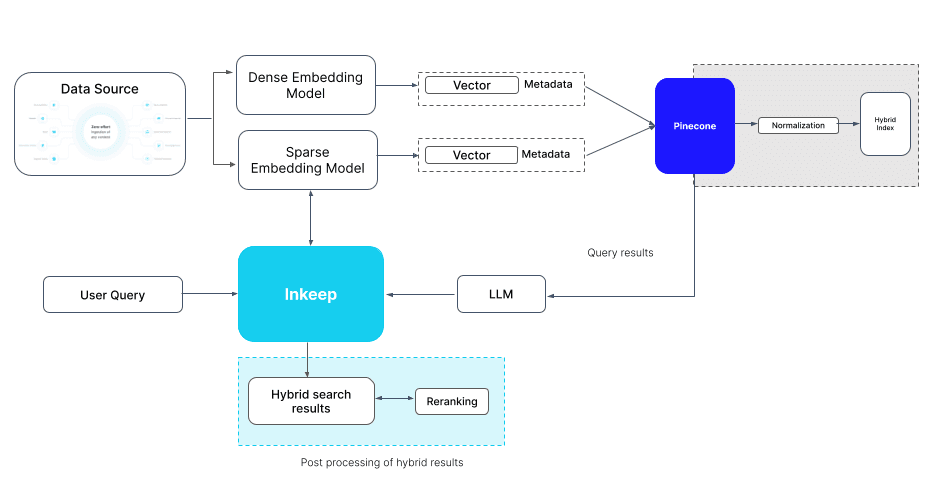
We use Pinecone for vector storage and retrieval which has proved crucial for providing flexibility across different customer needs. For example, we create dedicated instances for enterprise customers using Pinecone's pod architecture to ensure low latency for our search service. However, for chat applications where latency is less critical, we use Pinecone's serverless option, which is more cost-efficient. Pinecone also supports hybrid search, combining sparse and dense embeddings, to deliver a more robust and accurate search experience. This flexibility allows us to optimize costs and performance, whether dealing with enterprises with extensive documentation or smaller companies with fewer pages.
How does Inkeep minimize hallucinations and ensure reliable answers?

Reducing hallucinations in our AI solution heavily depends on our RAG method. Models hallucinate less when they have the right content to work with. If the content has the answer, hallucination rates drop. The tricky part is when content seems relevant but isn't accurate or lacks context, leading to misleading answers. For instance, if a model only knows "Pinecone is a vector database" without understanding its full range of features, it might over-interpret narrow content. By providing a diverse set of context to our RAG pipeline, we cut down on misinterpretation. We also experiment with prompts to encourage conservative responses and build comprehensive context about our customers to boost accuracy.

What were some of the major challenges Inkeep faced in ingesting content from various sources? How did you overcome them?

One of our biggest challenges was dealing with the diverse formats and structures of content across different platforms. Each company has its unique way of organizing documents or setting up custom documentation sites. Creating a solution that could effectively ingest this varied content at a high fidelity and quality level was incredibly challenging. Unlike traditional search engines that require developers to preprocess and structure content before indexing, our goal was to offer a solution where companies wouldn't have to worry about these technical details. To address this, we developed algorithms that autonomously navigate and extract hierarchical content from arbitrary websites, ensuring comprehensive content ingestion even in complex scenarios.

Another critical aspect we faced was content scraping. For example, many platforms use JavaScript to load tabs, where content only appears when you interact with it. This made scraping tricky, as we had to simulate browser behavior to accurately access hidden content.
Looking ahead, I see three key phases to generative AI applications: advanced search and retrieval, action-based workflows with human oversight, and autonomous AI agents managing complex tasks. At Inkeep, we're focusing on improving our action-based workflows to help documentation and support teams boost productivity and improve the quality of their content and products. Search and retrieval is relatively mature now, with chatbots helping users find content across various structured and unstructured sources. Action-based workflows, which suggest actions with human oversight, are becoming more common and enhancing productivity. In the future, autonomous AI agents will perform multiple steps with greater autonomy, although this is still in its early stages but holds a lot of promise.

What advice would you give to aspiring entrepreneurs looking to start their own tech companies?

I've had an entrepreneurial itch since I was a kid — like even back in 2nd grade sold candy at school for a bit of profit, though I did get in trouble a few times! What I've learned in my recent startup journey is that you don't need to know everything upfront. Even though I come from a product and engineering background, I had no experience in sales or marketing. But once you start a startup, it naturally pushes you to learn these new skills. You learn by doing and adapting — that's what I call "drive to survive." The key is to focus on solving a real problem that needs to be solved. Listen to your potential or current customers and let their needs guide your solution. Find people who believe in your idea enough to support you. Trust the process and let the market guide you on how to bring your solution to the world.

More RAG Brag

For further insights into Nick and Inkeep, be sure to watch the entire recording or visit their website. Stay tuned as we continue the RAG Brag series, featuring compelling discussions with AI industry leaders. More episodes are on the way!