

惯性聚合 高效追踪和阅读你感兴趣的博客、新闻、科技资讯
阅读原文 在惯性聚合中打开

推荐订阅源

WordPress大学
WordPress大学
D
Darknet – Hacking Tools, Hacker News & Cyber Security
Hacker News: Ask HN
Hacker News: Ask HN
N
News and Events Feed by Topic
Forbes - Security
Forbes - Security
The Last Watchdog
The Last Watchdog
TaoSecurity Blog
TaoSecurity Blog
Schneier on Security
SecWiki News
SecWiki News
V
Vulnerabilities – Threatpost
Project Zero
Project Zero
O
OpenAI News
W
WeLiveSecurity
Security Archives - TechRepublic
Exploit-DB.com RSS Feed
H
Hacker News: Front Page
Cisco Talos Blog
Cisco Talos Blog
Spread Privacy
Spread Privacy
Help Net Security
Help Net Security
P
Privacy & Cybersecurity Law Blog
K
Kaspersky official blog
S
Security @ Cisco Blogs
Latest news
Latest news
AWS News Blog
AWS News Blog
U
Unit 42
Martin Fowler
Martin Fowler
阮一峰的网络日志
阮一峰的网络日志
S
Secure Thoughts
CTFtime.org: upcoming CTF events
Application and Cybersecurity Blog
Know Your Adversary
Know Your Adversary
Scott Helme
Scott Helme
博客园 - 司徒正美
B
Blog RSS Feed
C
Check Point Blog
Hacker News - Newest:
Hacker News - Newest: "LLM"
D
Docker
Google Online Security Blog
Jina AI
Jina AI
aimingoo的专栏
aimingoo的专栏
Recent Commits to openclaw:main
Last Week in AI
Last Week in AI
月光博客
月光博客
C
CXSECURITY Database RSS Feed - CXSecurity.com
S
SegmentFault 最新的问题
NISL@THU
NISL@THU
T
The Blog of Author Tim Ferriss
C
Cisco Blogs
Attack and Defense Labs
小众软件
小众软件

Pinecone

Pinecone Assistant: A Managed Knowledge Layer for Production AI Applications Multi-domain RAG in n8n: why one knowledge base is not enough Allspice Transforms the Culinary Experience with Semantic Search Powered by Pinecone | Pinecone Building RAG workflows in n8n: choosing the right Pinecone node Knowledge needs a meta-knowledge layer Garbage Day: How Pinecone Safely Deletes Billions of Objects at Scale When "Performance" Means Two Different Things Pinecone BYOC: Pinecone in your AWS, GCP, or Azure account, no vendor access True, Relevant, and Wrong: The Applicability Problem in RAG Use the Pinecone Plugin for Claude Code to develop AI Applications Faster Millions at Stake: How Melange's High-Recall Retrieval Prevents Litigation Collapse Powering High-stakes Patent Search at Scale: How Melange Built a Reliable AI System on Pinecone | Pinecone Pinecone Assistant Node in n8n: Turn Any Data Source Into Knowledge RAG with Access Control Pinecone Dedicated Read Nodes are now in Public Preview Inside Pinecone: Slab Architecture New Bulk Data Operations: Update, Delete, and Fetch by Metadata The Hidden Cost of Building: Lessons from Aquant Simplifying Vector Embeddings with Pinecone Integrated Inference Capabilities Pinecone joins Microsoft Marketplace as a Launch Partner GTM Engineering: Clay + Pinecone for AI-powered Sales Outbound Build an AI knowledge assistant with Google Docs and Pinecone Moving Pinecone forward with Ash Ashutosh as CEO and Edo spearheading our growing AI ambitions as Chief Scientist Pinecone Founder Edo Liberty to Spearhead Pinecone’s Growing AI Ambitions; Appoints Ash Ashutosh as CEO to Expand Vector Database Market Leadership Fast, Accurate Retrieval for Creators at Scale: Delphi’s Path Toward a Million Conversational Agents with Pinecone | Pinecone Announcing Pinecone Pioneers: A Program for Builders, Organizers, and Community Leaders What is Context Engineering? Chunking Strategies for LLM Applications Beyond the hype: Why RAG remains essential for modern AI Obviant Makes 30% More Accurate Defense Acquisition Recommendations Combining Sparse and Dense Retrieval with Pinecone | Pinecone Build more knowledgeable AI applications with new LLMs and greater control in Pinecone Assistant #NYTECHWEEK 2025 Retrieval-Augmented Generation (RAG) Accurate and Efficient Metadata Filtering in Pinecone’s Serverless Vector Database | Pinecone Terminal X AI Agents, Powered by Pinecone, Turn Complex Financial Data Into Production-grade Insights at Scale | Pinecone Aquant Delivers Scalable, Expert-level Service Intelligence with Pinecone | Pinecone Cascading retrieval with multi-vector representations: balancing efficiency and effectiveness Vector databases aren't just for large-scale enterprise AI Unveiling DIME: Reproducibility, Scalability, and Formal Analysis of Dimension Importance Estimation for Dense Retrieval | Pinecone Fast and Effective Early Termination for Simple Ranking Functions | Pinecone Domain-specific AI Agents at Scale: CustomGPT.ai Serves 10,000+ Customers with Pinecone | Pinecone Using Pinecone asynchronously with FastAPI A Flexible Resource for Top-Weighted Comparisons Between Sets and Rankings | Pinecone Build secure, scalable agentic AI workflows with Rubrik Annapurna and Pinecone Tool up: Pinecone’s first MCP servers are here Add context to your agent with Pinecone Assistant MCP remote server E2Rank: Efficient and Effective Layer-wise Reranking | Pinecone ColBERT-serve: Efficient Multi-Stage Memory-Mapped Scoring | Pinecone Efficient Constant-Space Multi-Vector Retrieval | Pinecone How Vanguard Worked with Pinecone to Boost Customer Support with Faster Calls and 12% More Accurate Responses | Pinecone Pinecone Named to Fast Company's Annual List of the World's Most Innovative Companies of 2025 Launch Week: Pinecone for agents, search, recommendations, and more Optimizing Pinecone for agents (and more) Retrieval Inference for scale and performance How 1up Turns Sales Reps Into Product Experts with Pinecone | Pinecone Don’t be dense: Launching sparse indexes in Pinecone Unlock High-Precision Keyword Search with pinecone-sparse-english-v0 Evolving Pinecone's architecture to meet the demands of Knowledgeable AI Pinpoint references faster with citation highlights in Pinecone Assistant Bringing the leading vector database to your cloud Getting started with llama-text-embed-v2 Natural Language Counterfactual Explanations for Graphs Using Large Language Models | Pinecone Easily build knowledgeable chat and agent-based applications in minutes with Pinecone Assistant, now generally available How to build an agentic, chat or RAG knowledge system using Pinecone Assistant Real-time RAG with Pinecone and Estuary Flow BigQuery to Pinecone in Real-Time with Estuary Flow Stravito Turns Market and Consumer Data Into Actionable Insights with Pinecone Inference | Pinecone Accelerate prototyping and development with Pinecone Local First-of-its-kind Pinecone Knowledge Platform to Power Best-in-class Retrieval for Customers Introducing integrated inference: Embed, rerank, and retrieve your data with a single API Strengthening security and increasing control with CMEK and API key roles Introducing Pinecone Rerank V0 Introducing cascading retrieval: Unifying dense and sparse with reranking From Idea to Action: How Pinecone Assistant Meaningfully Accelerates AI Business Building AI apps on Azure with Pinecone just got a lot easier Building a reliable, curated, and accurate RAG system with Cleanlab and Pinecone Four features of the Assistant API you aren't using - but should Deploying Pinecone with Infrastructure as Code (IaC) Streamlining CI/CD with Pinecone Local September 2024 Product Update Results of the Big ANN: NeurIPS'23 competition | Pinecone Introducing import from object storage for more efficient data transfer to Pinecone serverless Simplify, enhance, and evaluate RAG development with Pinecone Assistant, now in public preview Vectors and Graphs: Better Together August 2024 Product Update Pinecone Helps Deep Talk Deliver World-Class AI Assistants with Lower Engineering Overhead | Pinecone Assembled Delivers Better, Faster AI- Driven Support with Pinecone | Pinecone Llama 3.1 Agent using LangGraph and Ollama Build knowledgeable AI with Pinecone serverless, now generally available on Microsoft Azure Pinecone serverless is now generally available on Google Cloud, adding knowledge to AI assistants and other applications Accelerating Legal Discovery and Analysis with Pinecone and Voyage AI Bridging Dense and Sparse Maximum Inner Product Search | Pinecone Refine Retrieval Quality with Pinecone Rerank Introducing reranking to Pinecone Inference to simplify building accurate AI July 2024 Product Update Connect to Pinecone within your platform to enable a seamless AI development experience Introducing Pinecone API Versioning RAG Brag with Inkeep Co-Founder Nick Gomez LangGraph and Research Agents Introducing Pinecone Inference to streamline your AI workflow
Rewriting a high performance vector database in Rust
Jack Pertschuk · 2022-09-14 · via Pinecone

I recently spoke at the Rust NYC meetup group about the Pinecone engineering team’s experience rewriting our vector database from Python and C++ to Rust. The event was very well attended (178+ registrations), which just goes to show the growing interest in Rust and its applications for real-world products. Below is a recap of what I discussed, but make sure to check out the full recording if interested in learning more.

Introduction to Pinecone - why are we here?

Data lakes, ML Ops, feature stores - these are all common buzzwords trying to solve similar sorts of problems. For example, let’s say you have a lot of unstructured data, and in order to gain insights you store it in blob storage. Historically, you would use an ML Ops platform, like a hosted Spark pipeline, for this. However, in many ways, we’re seeing the industry start to transition to the concept of vector databases and specifically approximate nearest neighbor (ANN) search to support similar use cases.
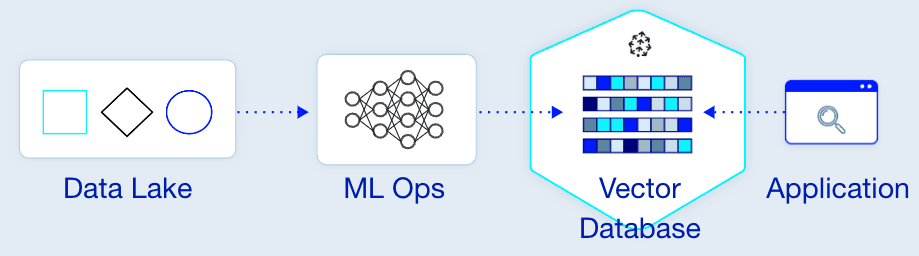
Pinecone is a fully managed, SaaS solution for this piece of the puzzle - the vector database. While the concept of the vector database has been used by many large tech companies for years, these sorts of companies have built their own proprietary, deep learning ANN indexing algorithms to serve news feeds, advertisements, and recommendations. These infrastructures and algorithms require intensive resources and overhead that most companies can’t support. With its strict memory management, efficient multi-threading, and fast, reliable performance, this is where the Pinecone solution comes in.

Ramping up with Rust

Pinecone was originally written in C++ with a connectivity wrapper written in Python. While this worked well for a while, we began to run into issues.

First of all, Python is a garbage collected language, which means it can be extremely slow for writing anything high performance at scale. In addition, it’s challenging to find developers with experience in both Python and C++. And so the idea of iterating on the database was born - we wanted to find some way to unify our code base while achieving the performance predictability we needed.

We looked at and compared several languages - Go, Java, C++, and Rust. We knew that C++ was harder to scale and maintain high quality as you build a dev team; that Java doesn’t provide the flexibility and systems programming language we needed; and that Go is also a garbage collected language. This left us with Rust. With Rust, the pros around performance, memory management, and ease of use outweighed the cons of it not yet being a very established language.

Identifying bottlenecks

Continuous benchmarking

As we began ramping up with Rust, we ran into a few bottlenecks. Before shipping the newly rewritten database, we wanted to ensure it continued to scale easily and have predictable performance. How did we test this? With continuous benchmarking.

Continuous benchmarking allowed us to see every commit broken down by the performance of a specific benchmark test. Through HTML reports, we are able to see the exact commit that caused the regression of the debt anytime a code change is merged.
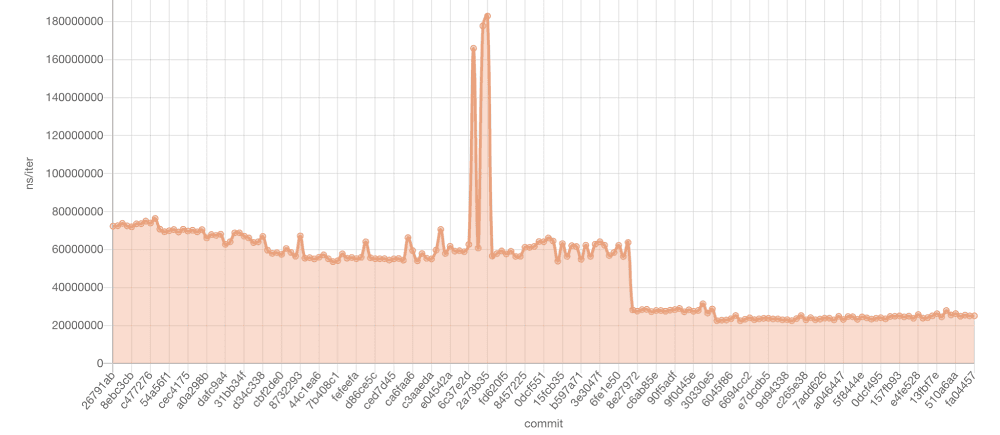
As you can see in the above graph, a commit was merged that caused a huge spike. However, with Criterion, an open source benchmarking tool, we were easily able to identify it, mitigate it, and push a fix. And over time, we lowered our latency and shipped improvements.

Building an observability layer

At this point, we’ve confirmed that the new database is performant, and have benchmarks to run it against. But what happens when you go to production, and things are slower than they should be? This is when you need an observability solution.

Adding an observability layer with Rust can be complicated without the support of a more mature developer community. As a result, we wanted a solution with minimal instrumentation, that’s easy to integrate, and is cloud agnostic. Our end goal was to provide a layer compatible with Datadog, Prometheus or any other metrics provider.

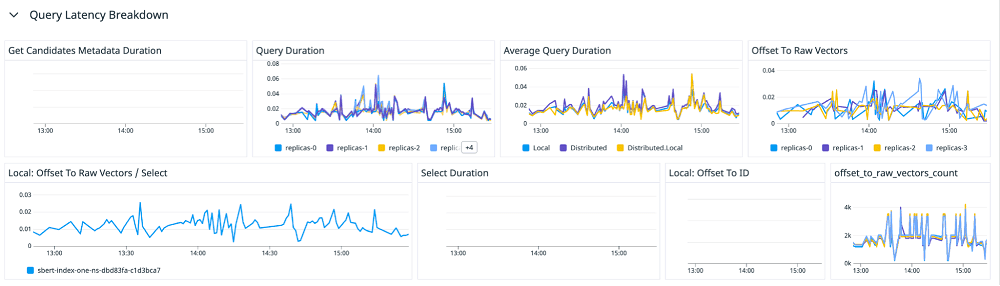
There are two main components to our observability layer - traces and aggregated metrics. With each of these signals, you can see how each part of the code is performing over time.

How did we achieve this? For metrics, we used some macros for histogram and counter metrics. We also used a custom Rust macro that hooks into OpenMetrics, and from there we can push metrics to Prometheus or Datadog. For tracing, we took a similar approach. We implemented an OpenTelemetry protocol that allows us to send traces to any observability solution. This way we’re able to see all of our metrics and trace requests as graphs in a single dashboard (see the below example).
Optimizing performance with Rust

After identifying and addressing the above bottlenecks, we were able to focus on optimizing performance. With Rust, there are several aspects around achieving high performance that we liked - low level optimized instruction sets, memory layout, and running async tasks.

Optimized instruction sets

One of the things we considered when choosing Rust was its access to low level optimized instruction sets, which are critical for optimizing the kind of vector based workloads that Pinecone utilizes. So for example, AVX-512 allows us to utilize parallel dot-product to compute high throughput dot-product queries on anything. And Rust gives us direct access to these compiler optimizations.

Memory layout

If you’re using a higher level language, you’re not going to have access to how the memory is laid out. A simple change, like removing indirection in our list, was an order of magnitude improvement in our latencies since there’s memory prefetching in the compiler and the CPU can anticipate which vectors are going to be loaded next in order to improve the memory footprint.

Running async tasks

Rust is async, and Tokio is the one of the most popular async providers. It’s performant, ergonomic, and has options for running on a single event loop. However, it’s not great for running CPU intensive workloads, like with Pinecone.

When it comes to running these tasks, there are many options. For example, because Tokio has different runtime modes, you can run it by itself in this async mode with multiple threads. And in that context, you can block on an individual thread in place, which is called ‘block_in_place’. You can also use ‘spawn_blocking’.

There are also “smart” work, parallel processing libraries, like Rayon, that maintain a thread pool and implement things like work stealing. And finally there’s the option of your own solution. If you want more control, you can use MPSC channels. While you have to write some custom code, they give you the fine grained ability to schedule work and ensure data locality.

What’s next for Pinecone?

We are continuing to optimize our codebase to ensure we’re maintaining a highly performant, stable, and fast database. This recap highlights the key points discussed during the meetup, but make sure to watch the full recording for more detail.

If you are interested in learning more about Pinecone and vector databases, check out the resources on our learn page or try it out (it’s free). Also, if you’re currently using or interested in working with Rust, we are hiring.