



惯性聚合 高效追踪和阅读你感兴趣的博客、新闻、科技资讯
阅读原文 在惯性聚合中打开

推荐订阅源

Google Online Security Blog
S
Security @ Cisco Blogs
Recent Commits to openclaw:main
人人都是产品经理
人人都是产品经理
The Hacker News
The Hacker News
W
WeLiveSecurity
freeCodeCamp Programming Tutorials: Python, JavaScript, Git & More
OSCHINA 社区最新新闻
OSCHINA 社区最新新闻
The Cloudflare Blog
博客园 - 司徒正美
雷峰网
雷峰网
L
LINUX DO - 最新话题
博客园 - 叶小钗
云风的 BLOG
云风的 BLOG
The Last Watchdog
The Last Watchdog
V2EX - 技术
V2EX - 技术
S
Security Affairs
有赞技术团队
有赞技术团队
月光博客
月光博客
T
Threatpost
T
Tor Project blog
O
OpenAI News
cs.AI updates on arXiv.org
cs.CL updates on arXiv.org
V
V2EX
Know Your Adversary
Know Your Adversary
Project Zero
Project Zero
博客园 - 三生石上(FineUI控件)
D
Docker
AWS News Blog
AWS News Blog
AI
AI
P
Proofpoint News Feed
K
Kaspersky official blog
H
Hackread – Cybersecurity News, Data Breaches, AI and More
D
Darknet – Hacking Tools, Hacker News & Cyber Security
www.infosecurity-magazine.com
S
Securelist
F
Fortinet All Blogs
F
Full Disclosure
cs.CV updates on arXiv.org
量子位
Hacker News - Newest:
Hacker News - Newest: "LLM"
CTFtime.org: upcoming CTF events
P
Palo Alto Networks Blog
Cyberwarzone
Cyberwarzone
Cisco Talos Blog
Cisco Talos Blog
美团技术团队
N
News | PayPal Newsroom
T
The Blog of Author Tim Ferriss
MyScale Blog
MyScale Blog

Pinecone

Pinecone Assistant: A Managed Knowledge Layer for Production AI Applications Multi-domain RAG in n8n: why one knowledge base is not enough Allspice Transforms the Culinary Experience with Semantic Search Powered by Pinecone | Pinecone Building RAG workflows in n8n: choosing the right Pinecone node Knowledge needs a meta-knowledge layer Garbage Day: How Pinecone Safely Deletes Billions of Objects at Scale When "Performance" Means Two Different Things Pinecone BYOC: Pinecone in your AWS, GCP, or Azure account, no vendor access True, Relevant, and Wrong: The Applicability Problem in RAG Use the Pinecone Plugin for Claude Code to develop AI Applications Faster Millions at Stake: How Melange's High-Recall Retrieval Prevents Litigation Collapse Powering High-stakes Patent Search at Scale: How Melange Built a Reliable AI System on Pinecone | Pinecone Pinecone Assistant Node in n8n: Turn Any Data Source Into Knowledge RAG with Access Control Pinecone Dedicated Read Nodes are now in Public Preview Inside Pinecone: Slab Architecture New Bulk Data Operations: Update, Delete, and Fetch by Metadata The Hidden Cost of Building: Lessons from Aquant Simplifying Vector Embeddings with Pinecone Integrated Inference Capabilities Pinecone joins Microsoft Marketplace as a Launch Partner GTM Engineering: Clay + Pinecone for AI-powered Sales Outbound Build an AI knowledge assistant with Google Docs and Pinecone Moving Pinecone forward with Ash Ashutosh as CEO and Edo spearheading our growing AI ambitions as Chief Scientist Pinecone Founder Edo Liberty to Spearhead Pinecone’s Growing AI Ambitions; Appoints Ash Ashutosh as CEO to Expand Vector Database Market Leadership Fast, Accurate Retrieval for Creators at Scale: Delphi’s Path Toward a Million Conversational Agents with Pinecone | Pinecone Announcing Pinecone Pioneers: A Program for Builders, Organizers, and Community Leaders What is Context Engineering? Chunking Strategies for LLM Applications Beyond the hype: Why RAG remains essential for modern AI Obviant Makes 30% More Accurate Defense Acquisition Recommendations Combining Sparse and Dense Retrieval with Pinecone | Pinecone Build more knowledgeable AI applications with new LLMs and greater control in Pinecone Assistant #NYTECHWEEK 2025 Retrieval-Augmented Generation (RAG) Accurate and Efficient Metadata Filtering in Pinecone’s Serverless Vector Database | Pinecone Terminal X AI Agents, Powered by Pinecone, Turn Complex Financial Data Into Production-grade Insights at Scale | Pinecone Aquant Delivers Scalable, Expert-level Service Intelligence with Pinecone | Pinecone Cascading retrieval with multi-vector representations: balancing efficiency and effectiveness Vector databases aren't just for large-scale enterprise AI Unveiling DIME: Reproducibility, Scalability, and Formal Analysis of Dimension Importance Estimation for Dense Retrieval | Pinecone Fast and Effective Early Termination for Simple Ranking Functions | Pinecone Domain-specific AI Agents at Scale: CustomGPT.ai Serves 10,000+ Customers with Pinecone | Pinecone Using Pinecone asynchronously with FastAPI A Flexible Resource for Top-Weighted Comparisons Between Sets and Rankings | Pinecone Build secure, scalable agentic AI workflows with Rubrik Annapurna and Pinecone Tool up: Pinecone’s first MCP servers are here Add context to your agent with Pinecone Assistant MCP remote server E2Rank: Efficient and Effective Layer-wise Reranking | Pinecone ColBERT-serve: Efficient Multi-Stage Memory-Mapped Scoring | Pinecone Efficient Constant-Space Multi-Vector Retrieval | Pinecone How Vanguard Worked with Pinecone to Boost Customer Support with Faster Calls and 12% More Accurate Responses | Pinecone Pinecone Named to Fast Company's Annual List of the World's Most Innovative Companies of 2025 Launch Week: Pinecone for agents, search, recommendations, and more Optimizing Pinecone for agents (and more) Retrieval Inference for scale and performance How 1up Turns Sales Reps Into Product Experts with Pinecone | Pinecone Don’t be dense: Launching sparse indexes in Pinecone Unlock High-Precision Keyword Search with pinecone-sparse-english-v0 Evolving Pinecone's architecture to meet the demands of Knowledgeable AI Pinpoint references faster with citation highlights in Pinecone Assistant Bringing the leading vector database to your cloud Getting started with llama-text-embed-v2 Natural Language Counterfactual Explanations for Graphs Using Large Language Models | Pinecone Easily build knowledgeable chat and agent-based applications in minutes with Pinecone Assistant, now generally available How to build an agentic, chat or RAG knowledge system using Pinecone Assistant Real-time RAG with Pinecone and Estuary Flow BigQuery to Pinecone in Real-Time with Estuary Flow Stravito Turns Market and Consumer Data Into Actionable Insights with Pinecone Inference | Pinecone Accelerate prototyping and development with Pinecone Local First-of-its-kind Pinecone Knowledge Platform to Power Best-in-class Retrieval for Customers Introducing integrated inference: Embed, rerank, and retrieve your data with a single API Strengthening security and increasing control with CMEK and API key roles Introducing Pinecone Rerank V0 Introducing cascading retrieval: Unifying dense and sparse with reranking From Idea to Action: How Pinecone Assistant Meaningfully Accelerates AI Business Building AI apps on Azure with Pinecone just got a lot easier Building a reliable, curated, and accurate RAG system with Cleanlab and Pinecone Four features of the Assistant API you aren't using - but should Deploying Pinecone with Infrastructure as Code (IaC) Streamlining CI/CD with Pinecone Local September 2024 Product Update Results of the Big ANN: NeurIPS'23 competition | Pinecone Introducing import from object storage for more efficient data transfer to Pinecone serverless Simplify, enhance, and evaluate RAG development with Pinecone Assistant, now in public preview Vectors and Graphs: Better Together August 2024 Product Update Pinecone Helps Deep Talk Deliver World-Class AI Assistants with Lower Engineering Overhead | Pinecone Assembled Delivers Better, Faster AI- Driven Support with Pinecone | Pinecone Llama 3.1 Agent using LangGraph and Ollama Build knowledgeable AI with Pinecone serverless, now generally available on Microsoft Azure Pinecone serverless is now generally available on Google Cloud, adding knowledge to AI assistants and other applications Accelerating Legal Discovery and Analysis with Pinecone and Voyage AI Bridging Dense and Sparse Maximum Inner Product Search | Pinecone Refine Retrieval Quality with Pinecone Rerank Introducing reranking to Pinecone Inference to simplify building accurate AI July 2024 Product Update Connect to Pinecone within your platform to enable a seamless AI development experience Introducing Pinecone API Versioning RAG Brag with Inkeep Co-Founder Nick Gomez LangGraph and Research Agents Introducing Pinecone Inference to streamline your AI workflow
Hybrid Search and Learning-to-Rank with Metarank
Vsevolod Goloviznin · 2023-06-30 · via Pinecone

As more advanced Large Language Models (LLMs) are released, the dream of an accurate semantic search comes closer to reality. But a classical term search is still hard to beat, even with the largest LLMs. So what if you don’t need to choose between two approaches and combine them within a single hybrid multi-retriever system?

In this article, we’re going to discuss a case when Elasticsearch, Opensearch, Solr, and Pinecone are used together to get the best from both words, with the final combined ranking produced with Metarank.

A Multiple Retrievers Problem

A typical scenario for the multi-retriever setup is to have a traditional Lucene-based term search and a vector search engine installed side-by-side for the same collection of documents and query both in parallel. A classical term search will return BM25-scored documents, and a vector search engine will try to produce a more semantically correct set of results.
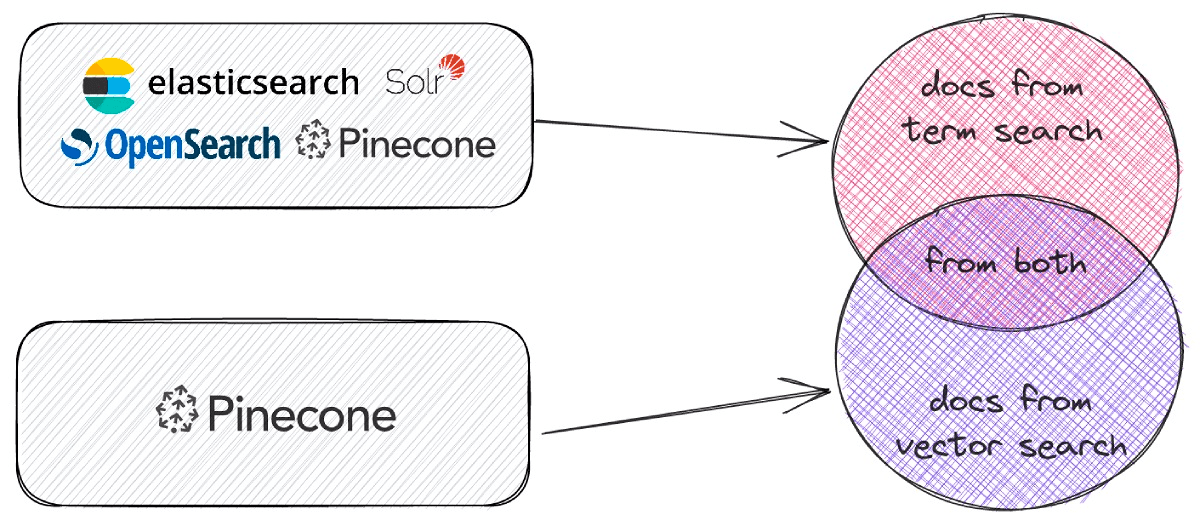
Multi-retriever setup

However, when you have multiple sources of documents to merge into a single search page, it may not be obvious how to combine them:

  • Different retrievers use non-comparable score types, like BM25 and cosine similarity.
  • Documents may come from single or multiple sources at the same time. There should be a way to deal with duplicates in the final ranking.

In a beautiful world where BM25 and cosine similarity have the same scale and statistical distribution, a final ranking can be done by just adding both scores together.

BM25 Score Distribution

Lucene-based classical search engines like Elastic, SOLR, and OpenSearch use BM25 as a scoring function to rank multiple found documents for a single search result listing. The BM25 formula depends on the lengths of query, document, and term frequencies, and its values are usually distributed within the low double-digits range.

A practical example of BM25 values distribution is the MSRD dataset: 28320 unique movie search queries over a database of 10k TMDB movie descriptions. In the diagram below, you can see how BM25 scores are distributed across different positions within search results:
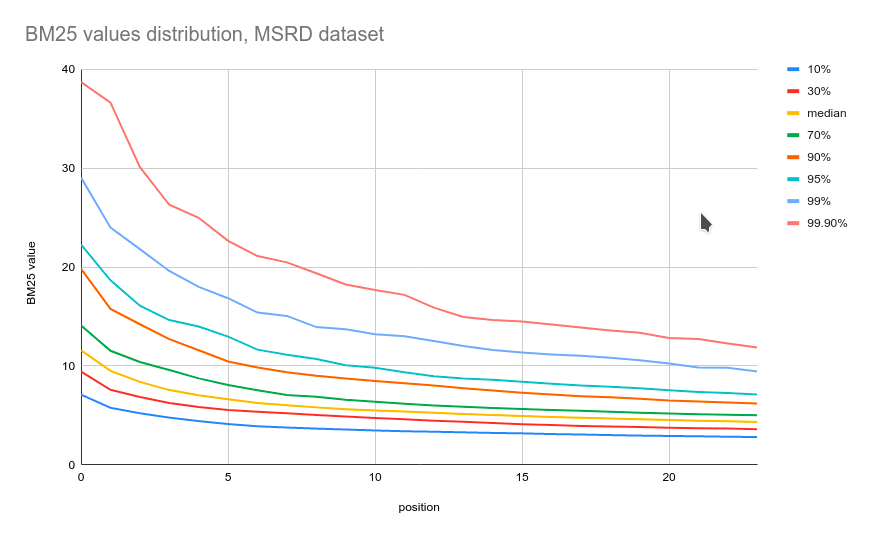
BM25 values distribution, MSRD dataset

From another perspective, BM25 scores of items in the first position have a non-even distribution, as you can see from the graph below:
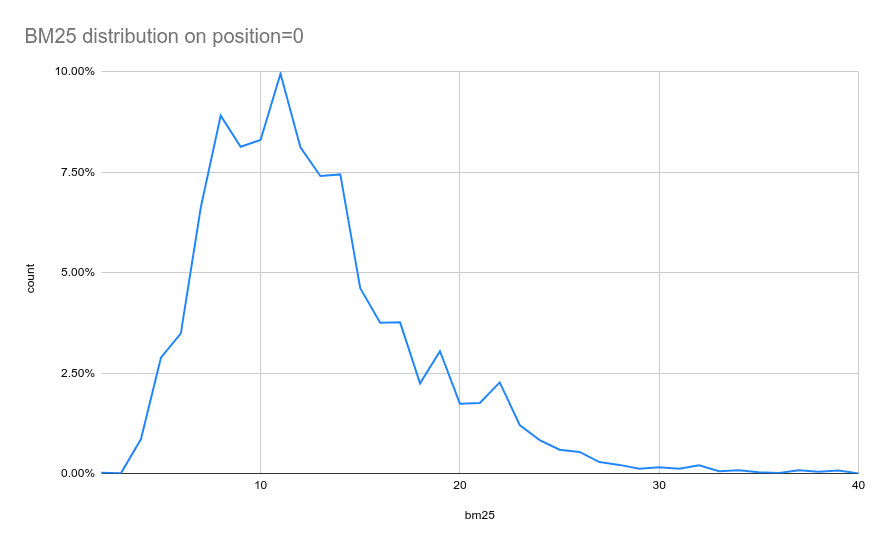
BM25 values distribution on position=0

So in a real-world situation, the BM25 scores you may get from an Elasticsearch are unbound and non-evenly distributed, which is perfectly fine until you try to merge it with another non-even distribution.

Cosine Similarity Value Distribution

Does text embedding similarity from a vector search also have a non-even distribution? Let’s take the same MSRD dataset of queries and movies, and push it through an all-MiniLM-L6-v2 LLM with SBERT to compute text embeddings. These embeddings can be later used inside a vector search engine like Pinecone. Still, to simplify things, we’re only going to perform an in-memory k-NN search between queries and movie documents and compute the same cosine similarity distribution for top-N documents.
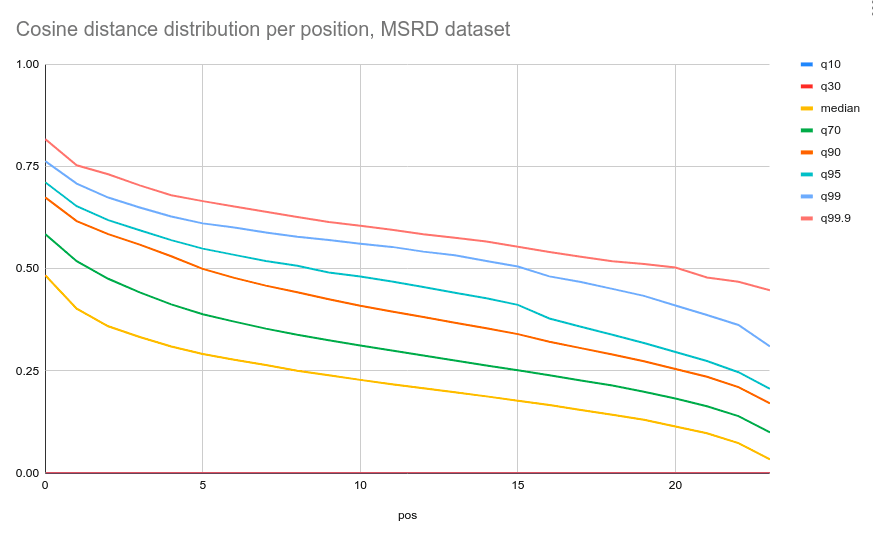
Cosine distance distribution per position, MSRD dataset

As you can see from the graphs above, the cosine similarity distribution between query-item embeddings is also not that even and differs quite a lot from the BM25 one:

  • Thick-tailed,
  • Has finite upper and lower bounds,
  • Much smaller peak on position-0.

So, what should we do if there’s no simple way to combine multiple rankings in a statistically correct way?

Learning-to-Rank for Multiple Retrievers

From another perspective, BM25 scores and cosine similarity can be treated as input ranking features for a ranking-focused ML model like LambdaMART and implicit customer feedback as labels.

If a visitor clicks on a document, it’s a positive signal; if ignored, it is negative. So we can ask this ML model to figure out the best way to merge both document sets into a single ranking to maximize a standard search relevance metric like NDCG.
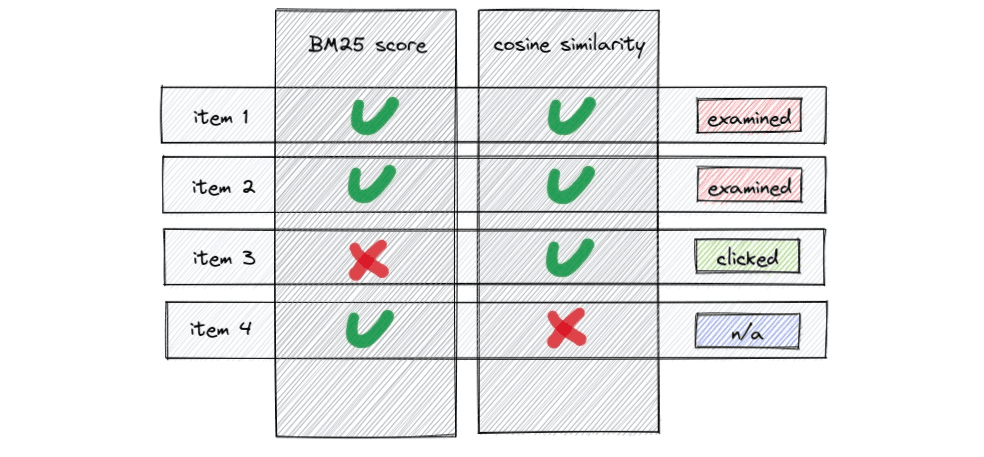
BM25 score / cosine similarity

But how does the underlying ML model handle holes in the data when a document comes only from a single source and, for example, has only a BM25 score but not the cosine similarity? There are multiple approaches to solving this problem:

  • Replace all null values with an average or median value across the dataset/ranking.
  • Use a ranking algorithm that can handle missing values natively, like decision trees - which is a core building block of the LambdaMART Learn-to-Rank algorithm.

All major LambdaMART algorithms implementations like XGBoost, LightGBM, and CatBoost all handle missing values in a very similar fashion. A null is a separate, distinct feature value, which can also be part of a split while building yet another decision tree. In other words, each feature split has a default go-to route for a case when the value is missing.

This approach results in much more stable results for cases when the feature value is sparse, so the majority of its values are missing.

Metarank as a Secondary Re-ranker

Implementing an in-house solution for a LambdaMART-style multi-retriever problem will require you to build a couple of data pipelines:

  • Collecting visitor feedback to log all clicks happening in search results.
  • Query logging: we should also collect both search queries and all the documents from all retrievers.
  • Feature logging: we should persist BM25 and cosine similarity scores for all query-document combinations to use it later during ML model training.

It takes time to build such a system in-house, and such an adventure is not always possible without a team with proper expertise in ranking optimization. But instead of doing everything from scratch, we suggest using existing open-source tools as it may save us quite some time in the whole journey.

Metarank is an open-source project focused on solving common ranking problems. It is flexible enough to be used as a secondary re-ranker for the multi-retriever use case we’re discussing.
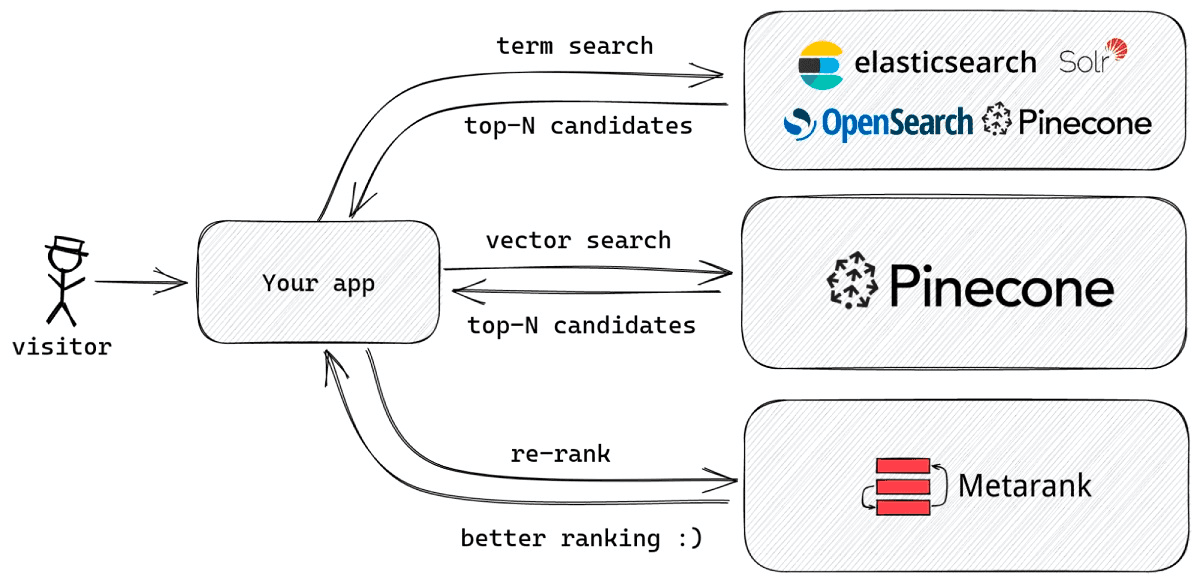
Re-ranking

A recent release of Pinecone also supports traditional term search natively, so in some cases you don’t need to configure two separate search engines and just use two different retrieval methods from only a single Pinecone instance.

A typical Metarank integration flow consists of three main processes:
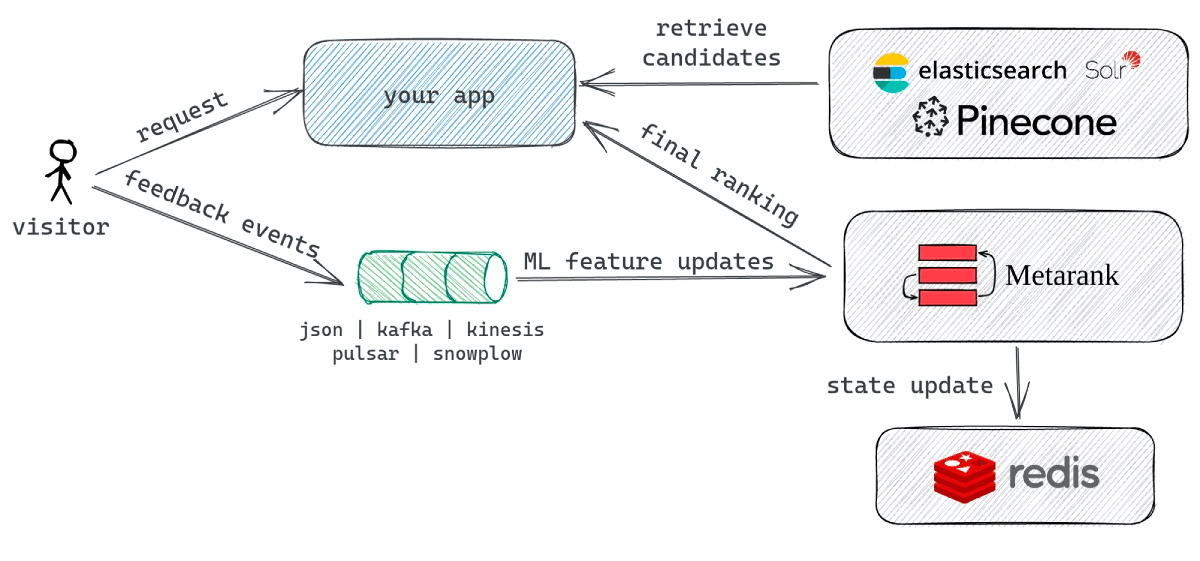
  • Metarank receives feedback events with visitor behavior, like clicks and search impressions. Historical feedback events are used for ML model training and real-time events for online model inference and re-ranking.
  • A backend application receives a search request from a visitor and forwards it to Elasticsearch and Pinecone. Both search result sets are concatenated together without specific ordering and then sent to Metarank for a final ranking.
  • Metarank runs the LambdaMART model over the candidate document set and produces the final ranking, which is later presented to the visitor.

Metarank integration flow

Historical Click-through Events

Metarank has a serious limitation (which is not a limitation per se, but more like a functional requirement) that you need to have a history of behavioral data of your visitors to start working on ranking optimization. But like with a chicken-and-egg problem, you need to implement some basic initial unified ranking over multiple retrievers to collect visitor clicks and impressions.

A common approach to this task is interleaving: both result sets are sorted by relevance score and then merged into a single ranking one by one, like a zip line.
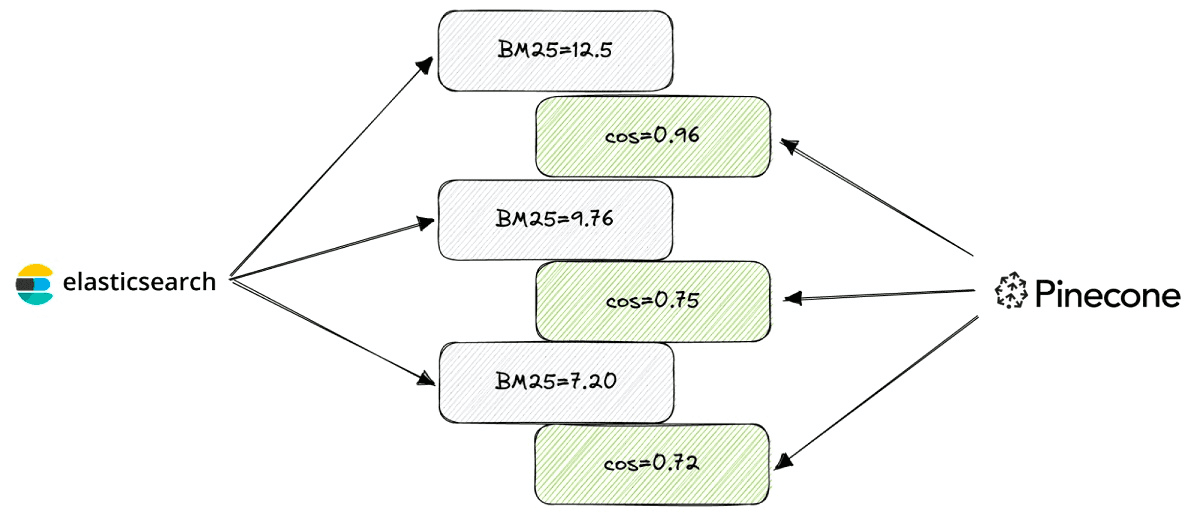
Interleaving

The interleaving process is a great baseline approach: simple enough to implement and hard enough to beat. It can also be extended to support multiple sampling probabilities so that a document may be taken from one of the result sets more frequently than from another.

With a baseline merging strategy, we can start collecting visitor click-through data. Metarank expects to receive three types of events:

  1. Metadata events about users and items. As we’re not using any user/item-specific information in the ranking process, we can skip emitting these.
  2. Ranking events: what was presented to a visitor.
  3. Interaction events: how the visitor reacted to the ranking.

An example ranking event is a JSON object with query information and per-document scores taken from primary search requests. All per-item fields are optional, so in a case when a document was retrieved only by Pinecone and has no BM25 score, skip the field:
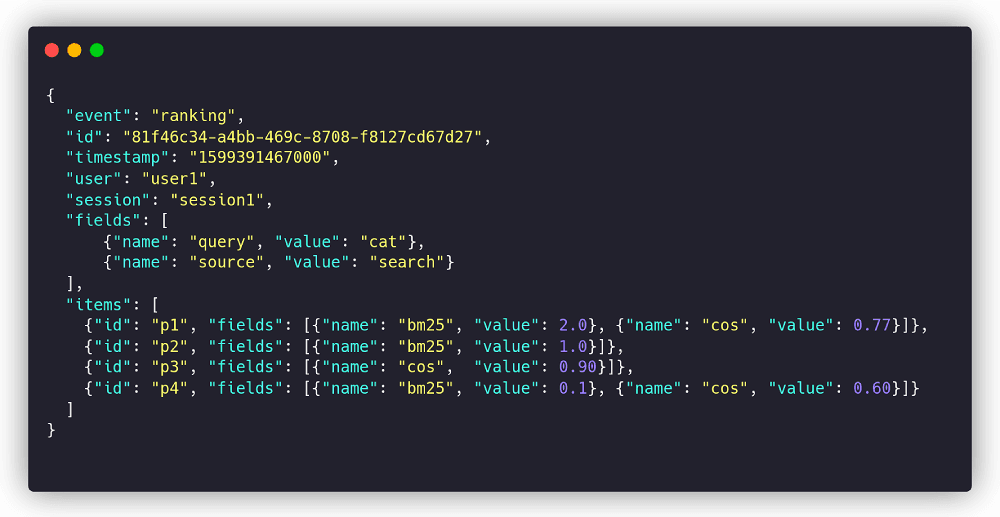
Ranking event

When a visitor makes a click on a document after seeing the ranking, we have to emit an “interaction” event. It describes what was clicked and within which context:
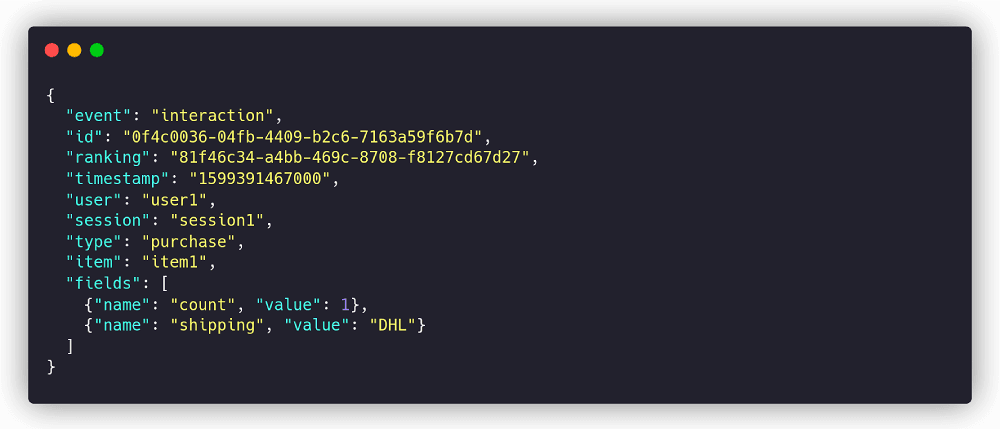
Interaction event

Metarank can pull historical ranking and interaction events from multiple sources (S3 files, Apache Kafka, Apache Pulsar, AWS Kinesis, and GCP Pubsub are supported), so you’re free to choose the best method to collect and store them. There is also an option to use Snowplow Analytics telemetry collector instead of setting up your analytical collection pipeline.

Re-ranking Setup

With click-through event collection in place, we can create a Metarank configuration. The config file consists of four main parts: state, click-through, feature, and model sub-sections.

State configuration. The place where all ranking state about users and items should be stored. Ironically, in our case, all the ranking features are present directly in the re-ranking request. There is no user/item state apart from the ML model itself.

In this guide, we’re going to use an in-memory store, but it’s only useful for demonstrational and development purposes. In a production environment, you should prefer Redis.

Click-through store configuration. Metarank persists a complete click-chain when a visitor clicks on a document. It includes a list of items presented to the visitor, performed interactions, and ranking features used to build the original ranking event. Such events are quite large, and instead of saving all of them in Redis, there are other more cost-effective alternatives.

The click-through store section is optional and by default, uses the main state store to persist click-throughs, so for the sake of simplicity, we’ll omit this.

Feature extractor configuration. How to map semi-structured incoming metadata/ranking/interaction events to the actual ML ranking features.

In our use case, we have only two ranking features, using BM25 and cosine scores supplied by the backend app directly in the ranking request:
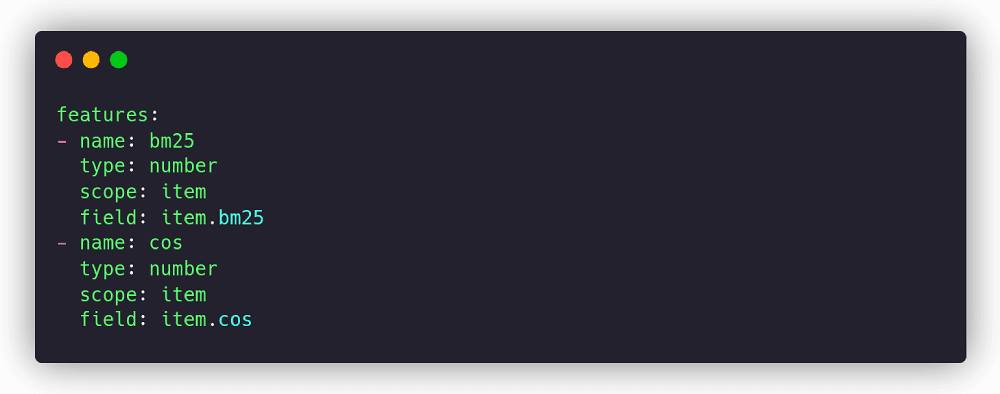
Ranking features

Model configuration. ML model options and used features. Metarank can serve multiple models at once, but in this guide we’ll define only a single “xgboost” model:
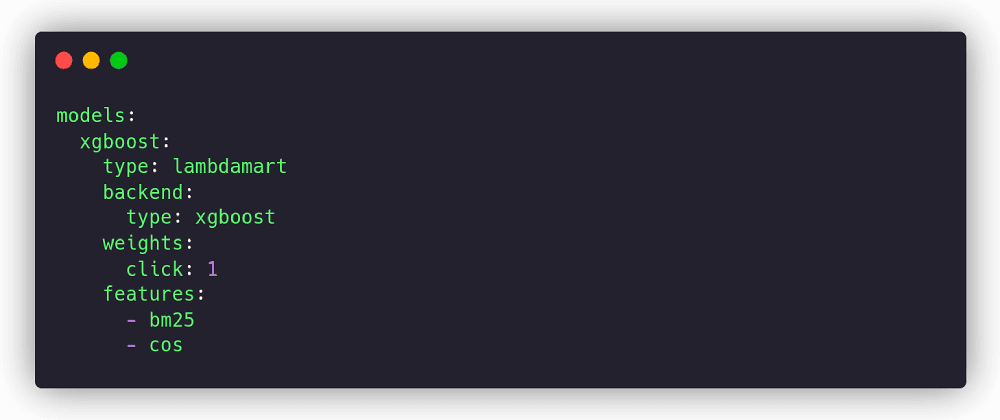
xgboost model

Import and Model Training

With a configuration file in place, we can finally invoke Metarank to process the historical data and build the ML ranking model. Metarank can be run as a JVM application with the java -jar command line or as a docker container. We will use the latter in this guide, as it’s more common (but a bit more complicated due to a volume setup).

Metarank has a set of separate sub-commands for data import, model training, and serving (todo: links), but there is a shortcut to run all of them sequentially together, the standalone mode. It’s also not very well suited for production but is extremely useful in simple demos and prototype projects.

docker run -i -t -p 8080:8080 -v <YOUR DIR WITH CONFIG>:/opt/metarank metarank/metarank:latest standalone --config /opt/metarank/config.yml --data /opt/metarank/events.jsonl.gz

Metarank in the standalone mode will import the historical data, train the ranking ML model and switch to the inference mode to serve real-time re-ranking requests.

Sending Requests

When the visitor-facing backend app receives a search request, the request needs to be passed through to the underlying retrievers. So, for example, we can translate a “terminator” query to the following Elasticsearch request:
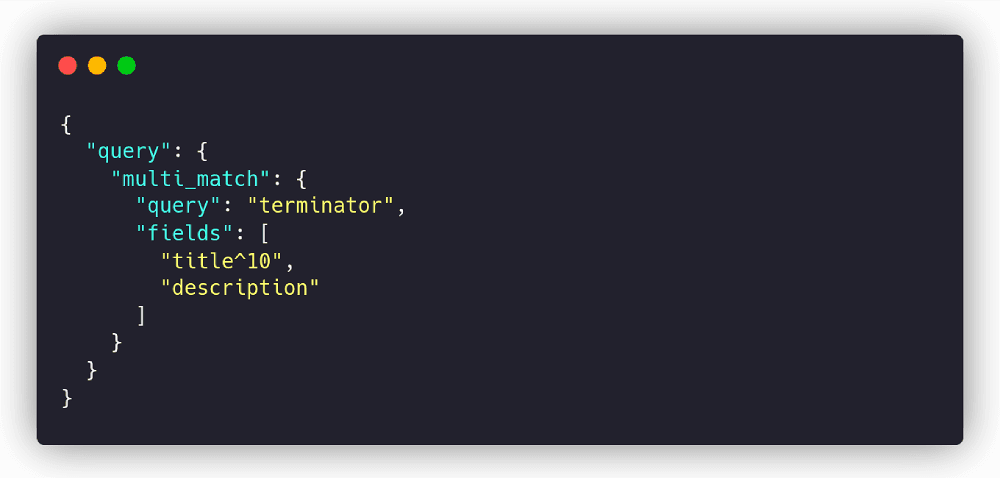
Elasticseach request

The request must first be converted into a vector representation for a semantic search using your favorite text embedding method. For example, the term “terminator” embedding for a MiniLM model looks like this 384-dimensional vector:
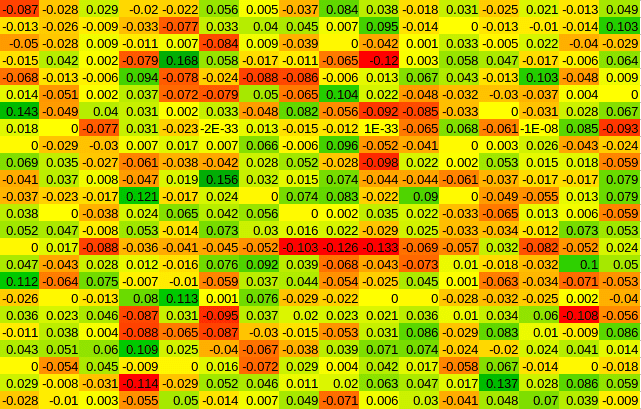
Vector representation

With this vector, we can then query a Pinecone vector search engine for semantically close documents:
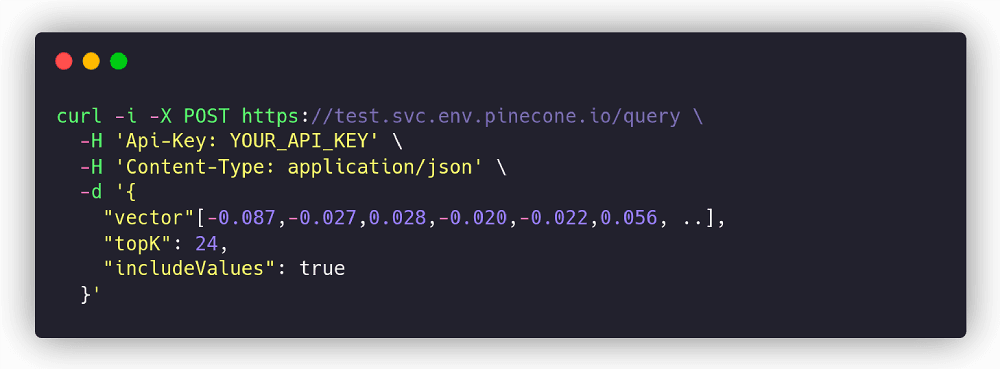
Pinecone vector search query

Elasticsearch and Pinecone search responses share some of the found documents. We concatenate these responses and send them to Metarank for a final ranking:

Ranking event

And finally Metarank will respond with the final ranking:
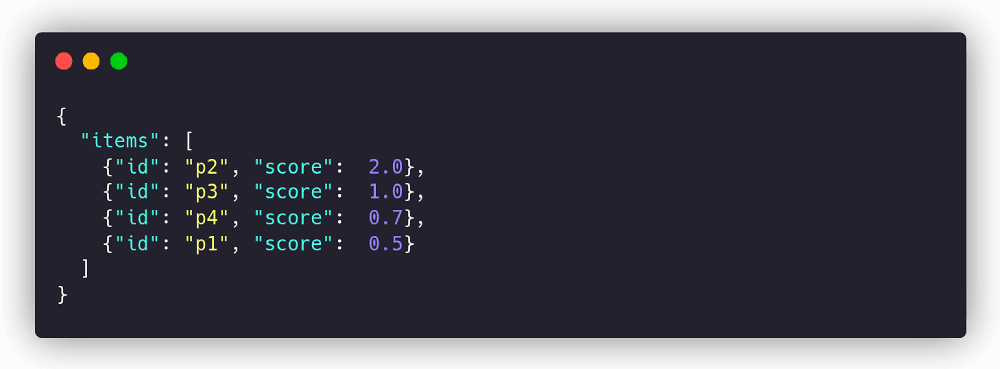
Final ranking

Big success!

Next steps

In this article, we attempted to highlight a typical re-ranking setup with Metarank, adapted for a hybrid search with multiple diverse retrievers.

But in the multi-retriever example here, we only used two specific ranking features: BM25 and cosine similarity scores supplied by search engines. Metarank can also do much more, as it can also compute complex behavioral features like:

  • Rates: CTR, conversion rate.
  • User: User-Agent, GeoIP and Referer
  • Profile: interaction history
  • Item: price and category.

These ranking features can improve the relevance of the final ranking but require a bit more complicated infrastructure setup: the re-ranking process may become stateful (e.g., the next response depends on the previous one).