



Growing expectations around search (that our applications should automatically understand our intent) have led to important advancements — like semantic search — that go beyond keyword search capabilities. However, both keyword and semantic search have important tradeoffs to consider:
In fact, for text-search use cases, a hybrid approach — combining keyword and semantic search — provides more relevant results than either one alone. But running two separate search solutions plus a third system for combining the results is an engineering nightmare.
That’s why we’re excited to announce the hybrid vector index, a first-of-its-kind solution that lets engineers easily build keyword-aware semantic search into their applications. Continue reading to learn more.
Companies are turning to hybrid search techniques to help users get more relevant search results. The ability to search based on both what users say and what they mean leads to better results and happier users.
Our research shows the impact of hybrid search on relevance compared to standalone keyword and semantic search: Whether searching in-domain or out-of-domain from the original training data, the hybrid results are better across the board.
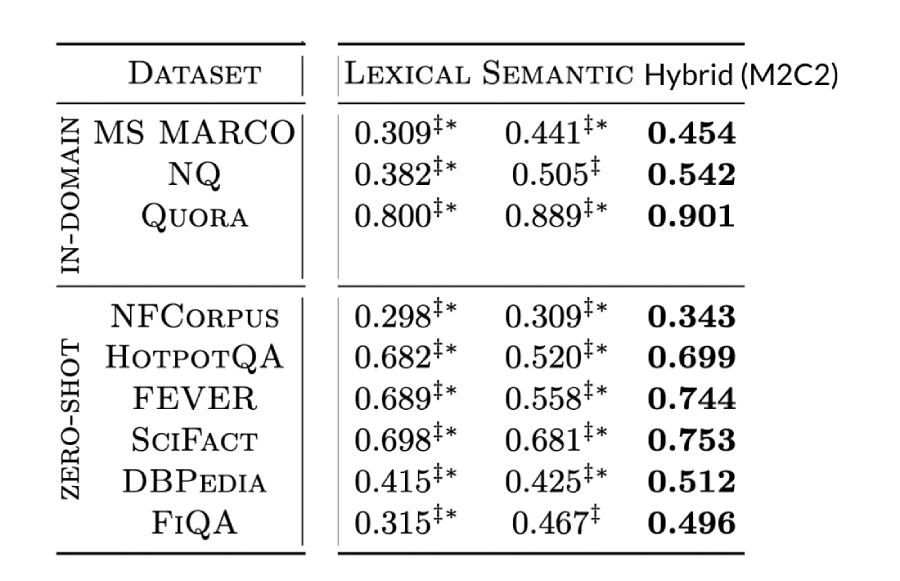
Figure: Evaluating lexical, semantic, and hybrid retrieval, NDCG@1000
We also know there’s a growing area of research around using hybrid vectors for use cases outside of text (e.g. creating sparse vectors from a learned sparse model (like SPLADE) instead of BM25). However, existing solutions make doing this no easy feat. Not only do you need to run multiple solutions — keyword and vector search systems alongside a reranking system — but you also have to know which levers to pull in order to transform your vectors to work with these existing solutions.
With the new hybrid vector index, you don’t need to be an ML expert to build hybrid search for these use cases. We’ve designed it to be:
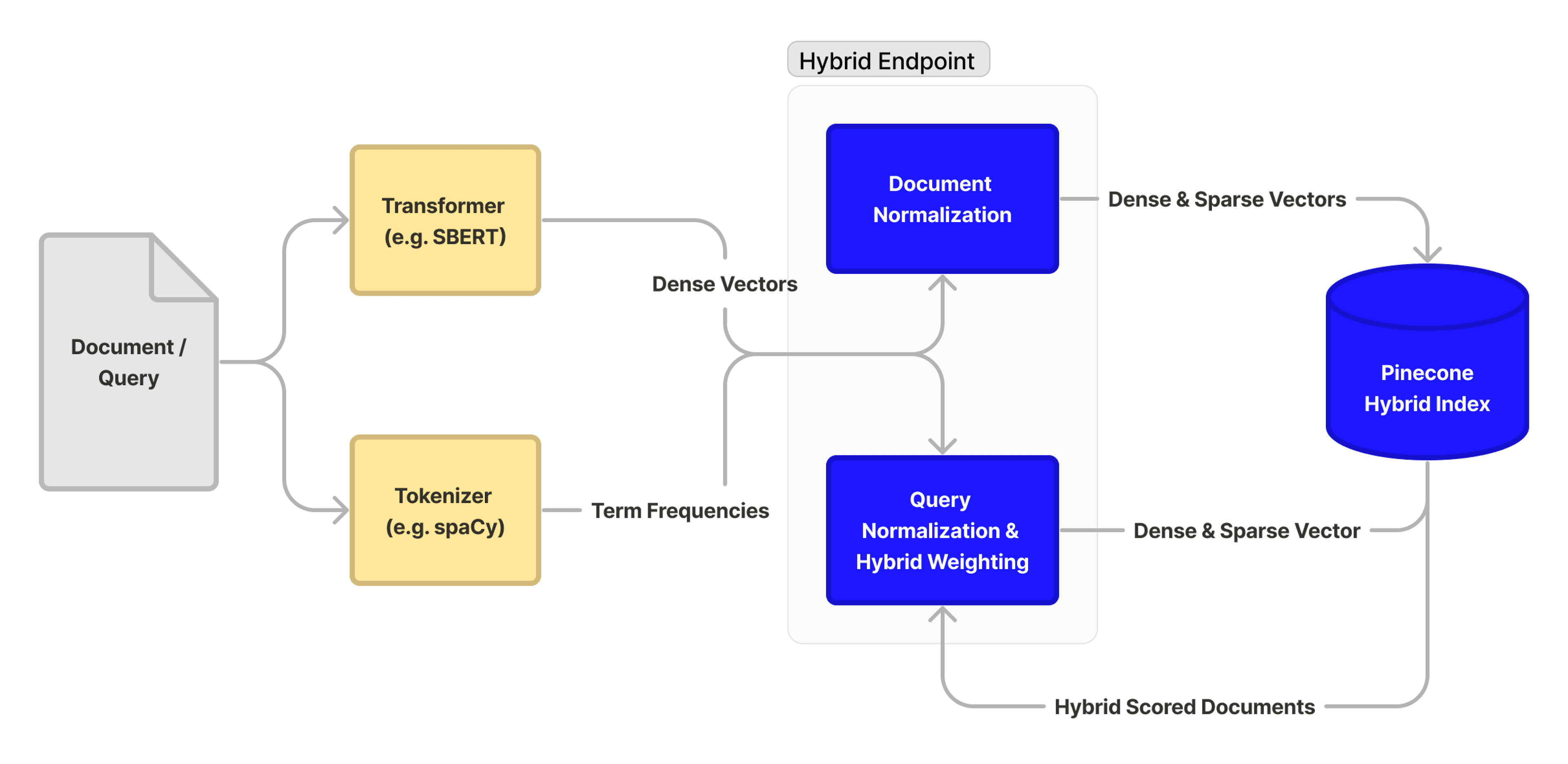
And since text is the predominant use case for hybrid search, we’re adding a hybrid endpoint to the Pinecone API. This endpoint accepts vector embeddings (dense vectors) and term frequencies (sparse vectors) for uploading or querying the hybrid index. This new, hybrid API endpoint provides:
Hybrid search is a powerful capability that we believe should be accessible to all. As Nils Reimers, the creator of Sentence Transformers, put it:
Semantic search can largely improve search performance, but there are still some shortcomings, especially when it comes to keyword-specific queries. Combining semantic search capabilities with traditional BM25 solves many of these issues, but so far the available solutions are not practical to deploy as you need to use two different systems. This is why I am so excited that Pinecone is adding keyword semantic search functionality to their managed vector database. It will give even better search results for many use-cases.
Before diving into how our hybrid search solution works, let’s define some key terms:
We designed our hybrid search to be easy to use and scale, which we’ll demonstrate with the following example.
Imagine you need to build a feature to let users browse and analyze employee survey responses. You want to support searches for both general concepts (e.g. company offsite in Greece) and company-specific terms (e.g. Pinecone).
Here’s how to do it with Pinecone’s hybrid index:
s1h).headers = {"Api-Key": APIKEY}
config = {
"name": "my-index",
"dimension": 328,
"metric": "dotproduct",
"pods": 1,
"pod_type": "s1h",
}
requests.post('https://controller.<env>.pinecone.io/databases', headers=headers, json=config)
from sentence_transformers import SentenceTransformer
from transformers import AutoTokenizer
from collections import Counter
import requests

tokenizer = AutoTokenizer.from_pretrained('transfo-xl-wt103')
model = SentenceTransformer('sentence-transformers/all-MiniLM-L6-v2')

doc = "Visiting the parthenon during the Pinecone offsite was an awesome experience."
vector = model.encode([doc]).tolist()  # [0.1, -0.1, 0.2, ...]
tokens = dict(Counter(tokenizer.encode(doc)))  # {5:1, 10500:1, 7:1, ... }
upsert = {
    "vectors": [{
        "id": "example-id-1",
        "values": vector,  # Dense Vector
        "sparse_values": tokens,  # Sparse Vector
        "metadata": {'text': doc}
    }],
}
requests.post('https://<index-name>-<project-id>.svc.<env>.pinecone.io/hybrid/vectors/upsert', json=payload, headers=headers)
Alpha=1 will provide a purely semantic-based search result and alpha=0 will provide a purely keyword-based result equivalent to BM25. The default value is 0.5.question = "pinecone athens offsite"
query = {
"topK": 2,
"vector": model.encode([question]).tolist(),
"sparseVector": dict(Counter(tokenizer.encode(question))),
"alpha": 0.5 # Weight
}
resp = requests.post('https://<index-name>-<project-id>.svc.<env>.pinecone.io/hybrid/query', json=query, headers=headers)
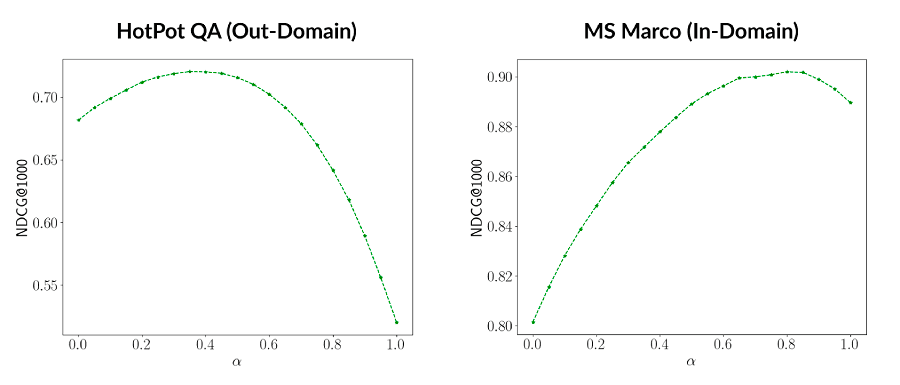
Note: The above diagrams show the effects of alpha values on sample datasets. When using a model that is not trained for the corpus (out-of-domain), you should downweight the semantic score with lower values of alpha (e.g. 0.3-0.6). When using a model that is fine-tuned (in-domain), use values closer to 1.
# Matches
resp.json()['matches']
[{'id': '3706692',
  'score': 0.763926864,
  'values': [],
  'sparseValues': {},
  'metadata': {'text': 'Visiting the parthenon during the Pinecone offsite was an awesome experience.'}},
{'id': '3393693',
  'score': 0.582026243,
  'values': [],
  'sparseValues': {},
  'metadata': {'context': “Last time i visited greece was on my own.”}}]
Just like that, you can build keyword-aware semantic search into your applications, and provide great results without tuning models or indexes, or managing multiple systems.
The below diagram displays both the upsert and query paths.
Pinecone is built for high-performance vector search at massive scale, and this new hybrid index is no exception. You can expect the same capacity (around 5 million 768-dimension vectors per pod), throughput, and latency as our storage-optimized s1 pods. As always, actual capacity and performance may vary based on use case and datasets, so we encourage you to experiment and contact us for help if needed. All index types in Pinecone come with metadata filtering, vertical and horizontal scaling, snapshots, expert support, and more.
Read the docs, and stay tuned for more updates and technical deep dives (including how to get started with hybrid search).
此内容由惯性聚合(RSS阅读器)自动聚合整理,仅供阅读参考。 原文来自 — 版权归原作者所有。