

惯性聚合 高效追踪和阅读你感兴趣的博客、新闻、科技资讯
阅读原文 在惯性聚合中打开

推荐订阅源

Cyberwarzone
Cyberwarzone
C
CXSECURITY Database RSS Feed - CXSecurity.com
C
CERT Recently Published Vulnerability Notes
The Hacker News
The Hacker News
Recent Commits to openclaw:main
Security Archives - TechRepublic
Google Online Security Blog
D
Docker
H
Hacker News: Front Page
Recent Announcements
GbyAI
GbyAI
OSCHINA 社区最新新闻
OSCHINA 社区最新新闻
P
Proofpoint News Feed
Security Latest
Security Latest
AI
AI
I
InfoQ
Google DeepMind News
阮一峰的网络日志
阮一峰的网络日志
S
Secure Thoughts
Attack and Defense Labs
P
Proofpoint News Feed
让小产品的独立变现更简单 - ezindie.com
K
KPMG report finds enterprise disconnect between AI and its ROI | CIO
Scott Helme
Scott Helme
N
News | PayPal Newsroom
Y
Y Combinator Blog
V
Visual Studio Blog
Latest news
Latest news
大猫的无限游戏
大猫的无限游戏
Microsoft Security Blog
cs.CL updates on arXiv.org
WordPress大学
WordPress大学
V
Vulnerabilities – Threatpost
C
Cyber Attacks, Cyber Crime and Cyber Security
TaoSecurity Blog
TaoSecurity Blog
S
Security @ Cisco Blogs
D
DataBreaches.Net
Cyber Security Advisories - MS-ISAC
N
Netflix TechBlog - Medium
T
Troy Hunt's Blog
CTFtime.org: upcoming CTF events
H
Heimdal Security Blog
美团技术团队
S
Securelist
Threat Intelligence Blog | Flashpoint
S
Security Affairs
T
Threat Research - Cisco Blogs
Webroot Blog
Webroot Blog
G
Google Developers Blog
aimingoo的专栏
aimingoo的专栏

Pinecone

Pinecone Assistant: A Managed Knowledge Layer for Production AI Applications Multi-domain RAG in n8n: why one knowledge base is not enough Allspice Transforms the Culinary Experience with Semantic Search Powered by Pinecone | Pinecone Building RAG workflows in n8n: choosing the right Pinecone node Knowledge needs a meta-knowledge layer Garbage Day: How Pinecone Safely Deletes Billions of Objects at Scale When "Performance" Means Two Different Things Pinecone BYOC: Pinecone in your AWS, GCP, or Azure account, no vendor access True, Relevant, and Wrong: The Applicability Problem in RAG Use the Pinecone Plugin for Claude Code to develop AI Applications Faster Millions at Stake: How Melange's High-Recall Retrieval Prevents Litigation Collapse Powering High-stakes Patent Search at Scale: How Melange Built a Reliable AI System on Pinecone | Pinecone Pinecone Assistant Node in n8n: Turn Any Data Source Into Knowledge RAG with Access Control Pinecone Dedicated Read Nodes are now in Public Preview Inside Pinecone: Slab Architecture New Bulk Data Operations: Update, Delete, and Fetch by Metadata The Hidden Cost of Building: Lessons from Aquant Simplifying Vector Embeddings with Pinecone Integrated Inference Capabilities Pinecone joins Microsoft Marketplace as a Launch Partner GTM Engineering: Clay + Pinecone for AI-powered Sales Outbound Build an AI knowledge assistant with Google Docs and Pinecone Moving Pinecone forward with Ash Ashutosh as CEO and Edo spearheading our growing AI ambitions as Chief Scientist Pinecone Founder Edo Liberty to Spearhead Pinecone’s Growing AI Ambitions; Appoints Ash Ashutosh as CEO to Expand Vector Database Market Leadership Fast, Accurate Retrieval for Creators at Scale: Delphi’s Path Toward a Million Conversational Agents with Pinecone | Pinecone Announcing Pinecone Pioneers: A Program for Builders, Organizers, and Community Leaders What is Context Engineering? Chunking Strategies for LLM Applications Beyond the hype: Why RAG remains essential for modern AI Obviant Makes 30% More Accurate Defense Acquisition Recommendations Combining Sparse and Dense Retrieval with Pinecone | Pinecone Build more knowledgeable AI applications with new LLMs and greater control in Pinecone Assistant #NYTECHWEEK 2025 Retrieval-Augmented Generation (RAG) Accurate and Efficient Metadata Filtering in Pinecone’s Serverless Vector Database | Pinecone Terminal X AI Agents, Powered by Pinecone, Turn Complex Financial Data Into Production-grade Insights at Scale | Pinecone Aquant Delivers Scalable, Expert-level Service Intelligence with Pinecone | Pinecone Cascading retrieval with multi-vector representations: balancing efficiency and effectiveness Vector databases aren't just for large-scale enterprise AI Unveiling DIME: Reproducibility, Scalability, and Formal Analysis of Dimension Importance Estimation for Dense Retrieval | Pinecone Fast and Effective Early Termination for Simple Ranking Functions | Pinecone Domain-specific AI Agents at Scale: CustomGPT.ai Serves 10,000+ Customers with Pinecone | Pinecone Using Pinecone asynchronously with FastAPI A Flexible Resource for Top-Weighted Comparisons Between Sets and Rankings | Pinecone Build secure, scalable agentic AI workflows with Rubrik Annapurna and Pinecone Tool up: Pinecone’s first MCP servers are here Add context to your agent with Pinecone Assistant MCP remote server E2Rank: Efficient and Effective Layer-wise Reranking | Pinecone ColBERT-serve: Efficient Multi-Stage Memory-Mapped Scoring | Pinecone Efficient Constant-Space Multi-Vector Retrieval | Pinecone How Vanguard Worked with Pinecone to Boost Customer Support with Faster Calls and 12% More Accurate Responses | Pinecone Pinecone Named to Fast Company's Annual List of the World's Most Innovative Companies of 2025 Launch Week: Pinecone for agents, search, recommendations, and more Optimizing Pinecone for agents (and more) Retrieval Inference for scale and performance How 1up Turns Sales Reps Into Product Experts with Pinecone | Pinecone Don’t be dense: Launching sparse indexes in Pinecone Unlock High-Precision Keyword Search with pinecone-sparse-english-v0 Evolving Pinecone's architecture to meet the demands of Knowledgeable AI Pinpoint references faster with citation highlights in Pinecone Assistant Bringing the leading vector database to your cloud Getting started with llama-text-embed-v2 Natural Language Counterfactual Explanations for Graphs Using Large Language Models | Pinecone Easily build knowledgeable chat and agent-based applications in minutes with Pinecone Assistant, now generally available How to build an agentic, chat or RAG knowledge system using Pinecone Assistant Real-time RAG with Pinecone and Estuary Flow BigQuery to Pinecone in Real-Time with Estuary Flow Stravito Turns Market and Consumer Data Into Actionable Insights with Pinecone Inference | Pinecone Accelerate prototyping and development with Pinecone Local First-of-its-kind Pinecone Knowledge Platform to Power Best-in-class Retrieval for Customers Introducing integrated inference: Embed, rerank, and retrieve your data with a single API Introducing Pinecone Rerank V0 Introducing cascading retrieval: Unifying dense and sparse with reranking From Idea to Action: How Pinecone Assistant Meaningfully Accelerates AI Business Building AI apps on Azure with Pinecone just got a lot easier Building a reliable, curated, and accurate RAG system with Cleanlab and Pinecone Four features of the Assistant API you aren't using - but should Deploying Pinecone with Infrastructure as Code (IaC) Streamlining CI/CD with Pinecone Local September 2024 Product Update Results of the Big ANN: NeurIPS'23 competition | Pinecone Introducing import from object storage for more efficient data transfer to Pinecone serverless Simplify, enhance, and evaluate RAG development with Pinecone Assistant, now in public preview Vectors and Graphs: Better Together August 2024 Product Update Pinecone Helps Deep Talk Deliver World-Class AI Assistants with Lower Engineering Overhead | Pinecone Assembled Delivers Better, Faster AI- Driven Support with Pinecone | Pinecone Llama 3.1 Agent using LangGraph and Ollama Build knowledgeable AI with Pinecone serverless, now generally available on Microsoft Azure Pinecone serverless is now generally available on Google Cloud, adding knowledge to AI assistants and other applications Accelerating Legal Discovery and Analysis with Pinecone and Voyage AI Bridging Dense and Sparse Maximum Inner Product Search | Pinecone Refine Retrieval Quality with Pinecone Rerank Introducing reranking to Pinecone Inference to simplify building accurate AI July 2024 Product Update Connect to Pinecone within your platform to enable a seamless AI development experience Introducing Pinecone API Versioning RAG Brag with Inkeep Co-Founder Nick Gomez LangGraph and Research Agents Introducing Pinecone Inference to streamline your AI workflow Build Privacy-aware AI software using Pinecone
Strengthening security and increasing control with CMEK and API key roles
Anshum Garg, Adhvik Kanagala · 2024-12-02 · via Pinecone

Security, control, and performance are non-negotiable requirements for Pinecone and for our customers, and we’re pleased to unveil two new features that support these goals:

  • Customer-managed encryption keys (CMEK)
  • Role-Based Access Control (RBAC) with API key roles

Below, we’ll explain each feature in detail and show you how to leverage them within your Pinecone projects.

Enhancing data security and tenant isolation with CMEK

By default, Pinecone serverless features strong protections for customer data, including:

  • Applying AES256 encryption for data at rest
  • Isolating tenants using strong logical boundaries and provenance checks within the multi-tenant environment

The introduction of CMEK brings with it a range of benefits, including:

  • Greater control: With CMEK, you manage the keys used for encryption and decryption, keeping full control over access to your data and preventing third parties from accessing the keys without your consent. You can also revoke keys independently and immediately, providing even more control over data access.
  • Enhanced tenant isolation: Because your data is encrypted with different keys from all the other data, CMEK enhances tenant isolation within a multi-tenant environment like Pinecone serverless — even beyond existing measures such as provenance checks and logical isolation of resources.
  • An additional security layer: By managing your own keys, you reduce reliance on Pinecone’s internal key management systems, creating an added security layer (via trust boundaries) that can provide additional guarantees that may be required for sensitive data.

Importantly, the additional security and control also:

  • Supports compliance requirements: Some regulations (e.g., GDPR, HIPAA, and many financial standards) mandate direct control over encryption keys, which CMEK can help address.
  • Improves visibility and auditability: With CMEK, you can more closely monitor and log key usage and access attempts, providing better transparency and further supporting compliance activities.

Note: While CMEK provides many important benefits, it also requires careful key management and protection measures on the part of the customer, as lost or mismanaged keys can render data inaccessible.

Pinecone’s CMEK and hierarchical encryption

Understanding how Pinecone encrypts your data, along with the associated design considerations, can help you evaluate how and when to use CMEK. To build your knowledge, we’ll briefly cover two closely related topics:

  1. CMEK within a Pinecone serverless environment
  2. Hierarchical encryption with CMEK

CMEK within a Pinecone serverless environment

CMEK is enabled at the Pinecone project level, which forces all indexes in the project to be encrypted. Note that the CMEK toggle cannot be subsequently changed, so this is a permanent decision for the project's life.

After the initial setup, the experience using a CMEK-encrypted index is identical to using a serverless Pinecone index.
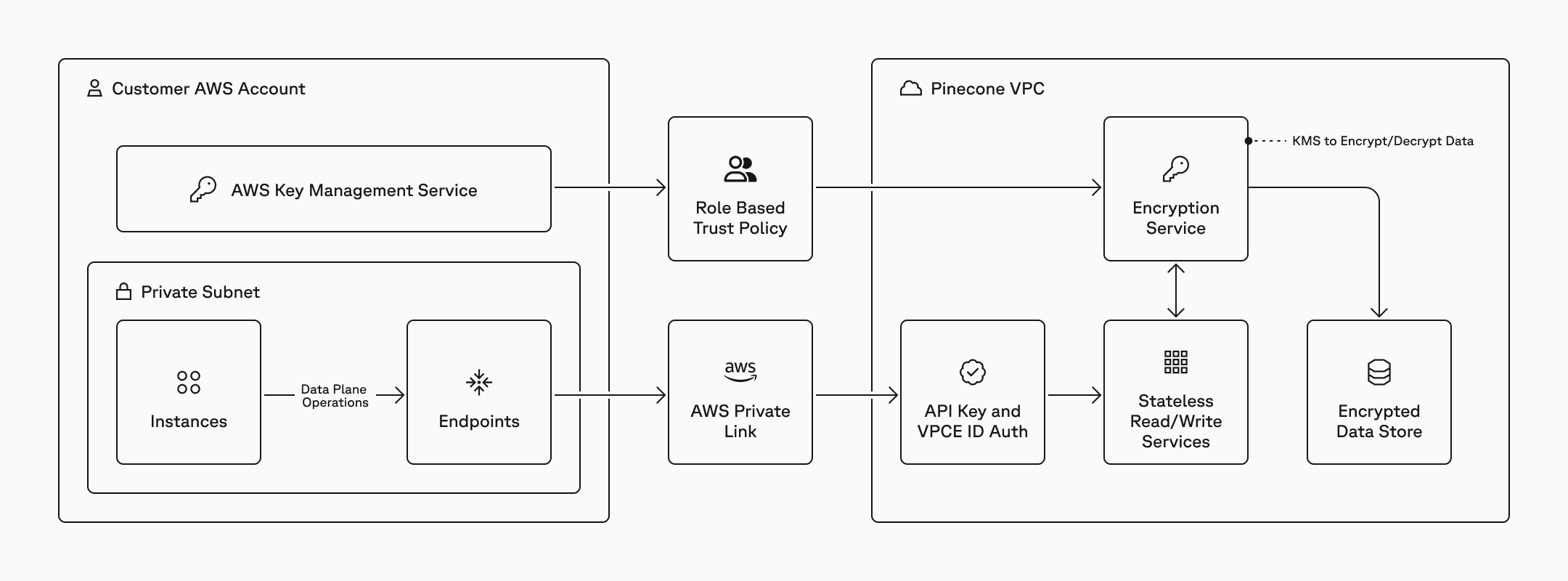
Securing Pinecone serverless with CMEK and AWS PrivateLink

Encryption service

In the background, all access to stored data that represents the CMEK-encrypted index is abstracted behind an encryption service.

This encryption service manages data encryption and decryption when customers perform data plane operations by accessing and caching encryption material and brokering access to a customer’s Key Management Service (KMS). It also delineates system boundaries, allowing us to ensure that no stateful services ever handle unencrypted data and that stateful services only store encrypted data.

Moreover, only stateless services handle unencrypted data, which they serve upon customer requests. Any cached data in stateless services (e.g., to serve fresh data that is not indexed yet) becomes inaccessible and is evicted upon the encryption service detecting loss of access to encryption keys.

Accessing the customer’s key

Customers using CMEK manage and control encryption keys that are used to encrypt/decrypt data in Pinecone by creating the key in their own AWS account. While we only support AWS KMS today, we are also looking to expand access to other environments.

Pinecone can access this key by assuming a role in your account that has access to the key. The AssumeRole operation is enabled by a trust policy in your account. This approach is a fairly standard way of setting up cross-account access in AWS environments, and can be configured with an optional external id that acts as a shared password between accounts for added security.

Key revocation experience

You can disable Pinecone’s access to your data by revoking Pinecone’s access to the key. This is by design and ensures that your data is inaccessible within minutes.

Following revocation, the longest your data will remain accessible is 15 minutes, which corresponds to the longest-lived in-memory cache. After this, Pinecone needs to re-decrypt data using your key. If you revoke Pinecone’s access to your key or disable it, then all Pinecone services will refuse to operate on the inaccessible index. Consequently, any queries/upserts you run on the index will result in a user error.

Hierarchical encryption with CMEK

To maintain high performance and strong security — and to enforce tenant isolation at multiple levels — Pinecone implements a system of hierarchical encryption that encrypts data without directly using the customer’s AWS key for every file.

Key Encryption Keys (KEKs)

In this system, each entity in Pinecone’s logical hierarchy — projects, indexes, and namespaces — is assigned a unique Key Encryption Key (KEK). In the hierarchy, each KEK:

  • is encrypted by its parent, and
  • is used to encrypt all of its child KEKs

Each of these KEKs is stored inside Pinecone’s KMS, which lives alongside the data plane in each data center. The root key encrypts project keys, and AWS manages this key to ensure that Pinecone never reveals it.

Crucially, no KEK is accessible outside of the KMS, and all KEKs are encrypted at rest. These measures ensure that:

  • KEKs never leave the KMS, and
  • Even in the event of a breach, they would not be accessible in decrypted form to any outside parties

Data Encryption Keys (DEKs)

The final key type is the blob key, which is a Data Encryption Key (DEK). DEKs are uniquely generated for each blob file generated by Pinecone for an index and are encrypted by the namespace key.

It’s worth highlighting that they are the only encryption keys that leave the KMS.

After encrypting a file, the DEK is wrapped by the namespace key and then stored alongside the original blob file for future decryption. When reading a blob file inside Pinecone, the DEK is sent to the encryption service for decryption by the namespace key. However, the namespace key is stored encrypted, so this also requires decryption of the index key (and thus the project key). Decrypting the index key requires that Pinecone have access to the customer-managed key, which ensures that the blob file cannot be decrypted without the customer’s permission.

This approach is far more complex than the simple alternative of requiring that each blob file be encrypted directly by the customer’s key — but the benefits are worth the effort:

  • We ensure that we only send encrypted keys to the Customer’s KMS instead of the blob files for encryption. This dramatically improves latencies and network IO costs.
  • The decrypted key material never leaves the KMS and is a fixed size — which ensures that the KEK wrap/unwrap process is consistent for any blob and all of the data encryption/decryption can happen inside the cluster

This allows us to support CMEK per index in the future and expand our offering.
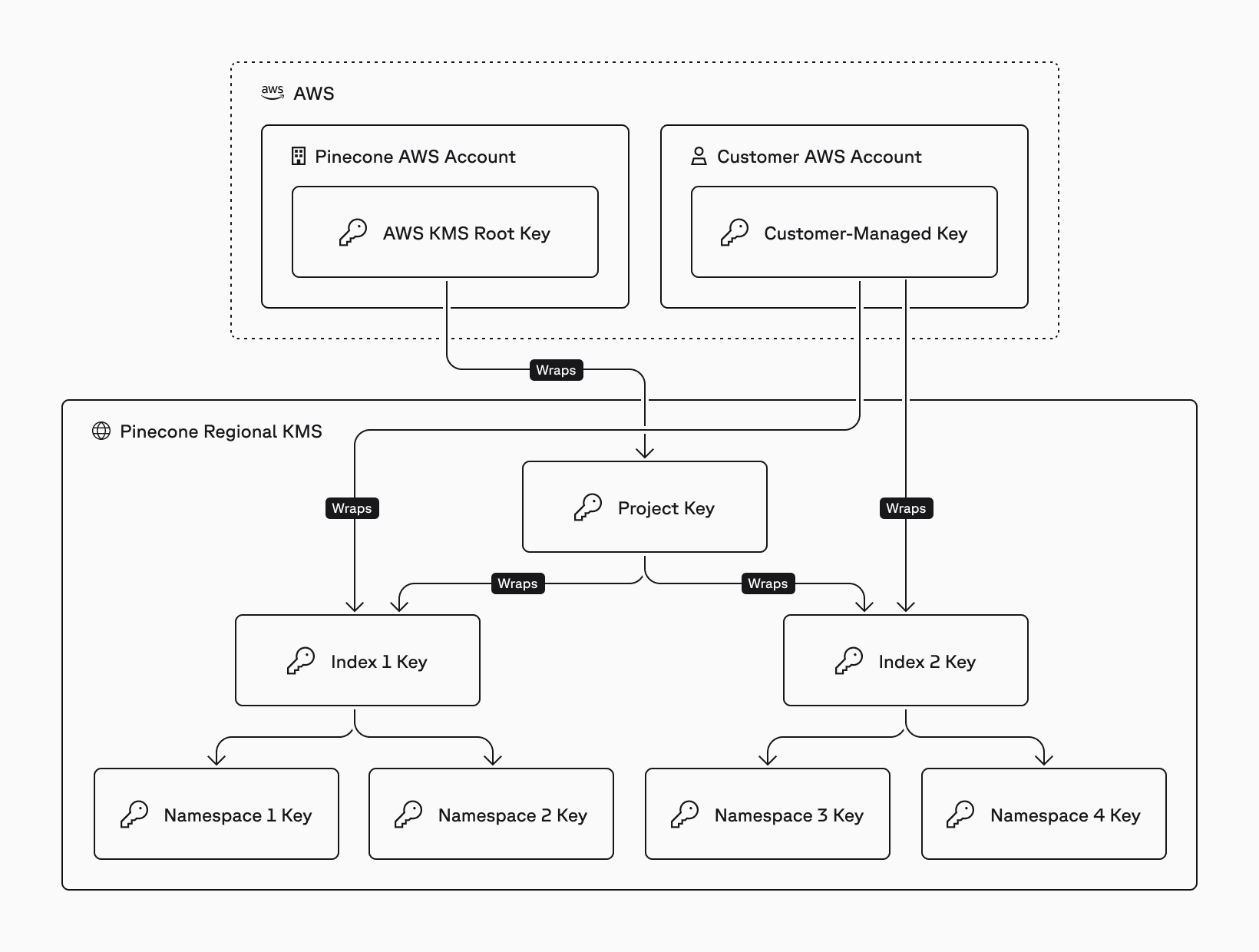
Hierarchical encryption provides strong security while maintaining high-performance

Enabling more granular RBAC with API key roles

We’re pleased to announce expanded, more granular RBAC with the addition of API key roles. Together with our User Roles for Projects and Organizations, API key roles equip you with a more robust and flexible RBAC system to help you scale.

Understanding Pinecone API key roles

Assigning a role to an API key determines what permissions the associated user (or other entity) has in your Pinecone account, creating a comprehensive access control system that helps mitigate security risks, streamline operations, and manage resources more efficiently.

This new API key functionality includes six roles — three across our control plane (which handles requests to manage resources like indexes and API keys), and three across the data plane (which handles requests to write and read records in indexes).
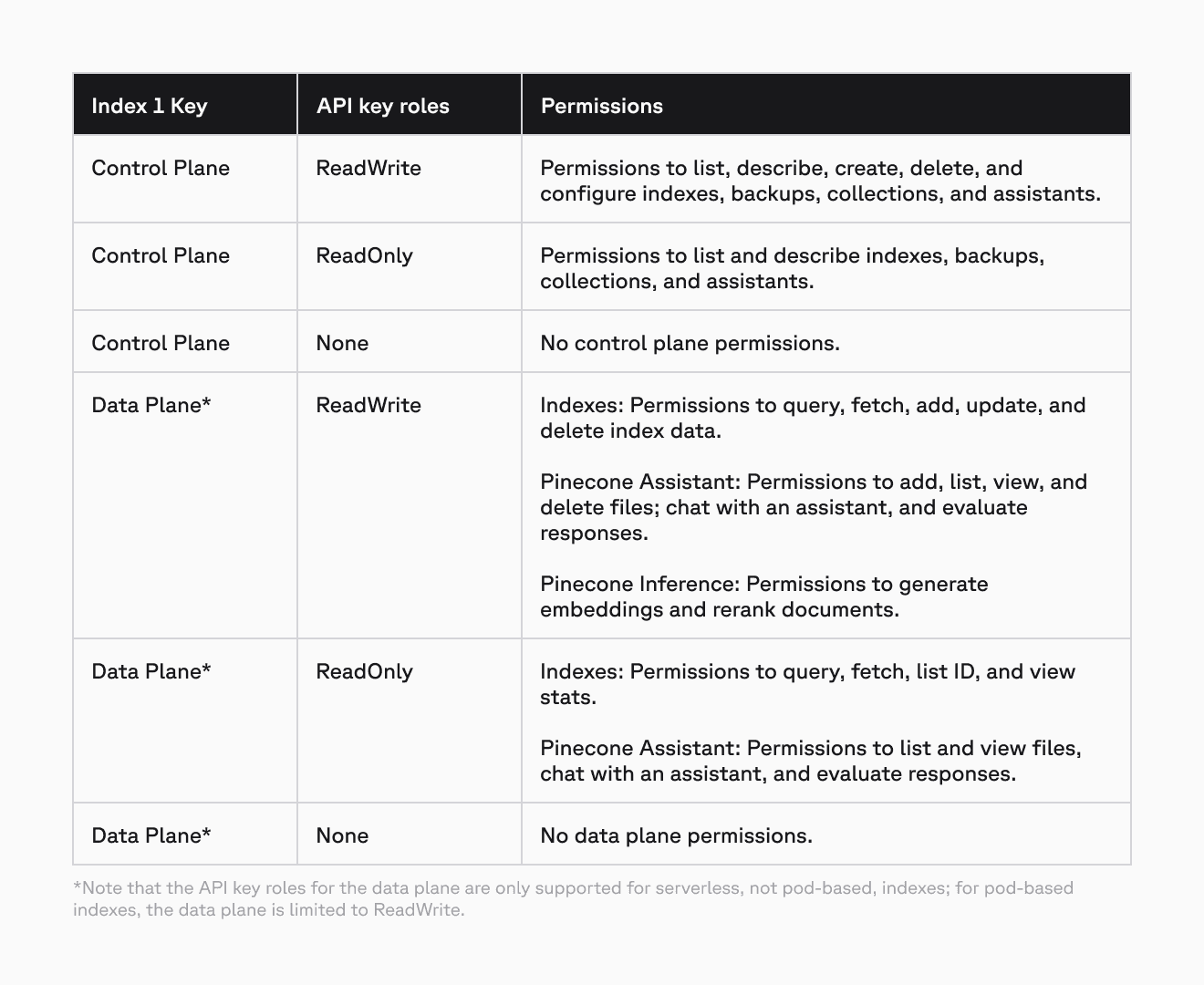
Start building today

API Key Roles and CMEK are now available in public preview. CMEK is currently limited to AWS with support for Azure and GCP coming soon. AWS users can add an additional layer of security with Private Endpoints for AWS PrivateLink, which is now generally available (GA). Review our documentation to configure CMEK or manage API keys, and start building today!